




~1 min
Average Reply Time
~1 hour
To Be Matched With A Tutor
30 Min Trial
75% Find Their Tutor On The 1st Trial
$20-35+/hr
Premium Yet Affordable Learning
Logic gates stump more students than any other topic in Digital Circuit — and most don’t find out until two weeks before finals.
Digital Circuit Tutor Online
Digital circuits are electronic systems that process binary signals using logic gates, flip-flops, multiplexers, and related components. Studied in electrical and computer engineering programmes, the subject equips students to design, analyse, and troubleshoot combinational and sequential logic systems.
MEB offers 1:1 online Electrical Engineering tutoring across Digital Circuit and related subjects — live, expert-matched, and built around your exact course. If you’ve searched for a Digital Circuit tutor near me, online tutoring gives you the same focused session with a verified specialist, regardless of time zone. Your tutor works through your specific gaps — not a generic syllabus — and each session ends with a clear next step.
- 1:1 online sessions tailored to your university course or exam board syllabus
- Expert verified tutors with hands-on Digital Circuit and electronics engineering backgrounds
- Flexible time zones — US, UK, Canada, Australia, Gulf covered
- Structured learning plan built after a diagnostic session
- Ethical homework and assignment guidance — you understand the work before you submit it
52,000+ students across the US, UK, Canada, Australia, and the Gulf have used MEB since 2008 — including students in Electrical Engineering subjects like Digital Circuit, Analog Circuits, and Digital Electronics.
Source: My Engineering Buddy, 2008–2025.
How Much Does a Digital Circuit Tutor Cost?
Rates run $20–$40/hr for most undergraduate and diploma-level Digital Circuit courses. Advanced topics — VLSI, FPGA design, high-speed logic — can go higher. The $1 trial gets you 30 minutes of live tutoring or a full explanation of one homework question before you commit to anything further.
| Level / Need | Typical Rate | What’s Included |
|---|---|---|
| Standard (most undergrad levels) | $20–$35/hr | 1:1 sessions, homework guidance, circuit problem walkthroughs |
| Advanced / Specialist (FPGA, VLSI, HDL) | $35–$70/hr | Expert tutor, niche depth, simulation tool support |
| $1 Trial | $1 flat | 30 min live session or one homework question explained in full |
Tutor availability tightens significantly in the 3–4 weeks before end-of-semester finals. Book early if your exam is coming up.
WhatsApp MEB for a quick quote — average response time under 1 minute.
Who This Digital Circuit Tutoring Is For
Digital Circuit catches students off guard. The first half of the course feels manageable — basic gates, truth tables, Boolean algebra. Then sequential logic hits, and everything accelerates. This tutoring is for students at that exact inflection point, and for those who never quite got stable ground under the earlier material either.
- First and second year electrical or computer engineering undergraduates hitting a wall on Karnaugh maps, flip-flops, or state machines
- Students retaking a Digital Circuit module after a failed first attempt — the tutor diagnoses exactly where the first run went wrong
- Students with a university conditional offer depending on this result
- Graduate students revisiting digital logic before an advanced VLSI or embedded systems course
- Students at MIT, Georgia Tech, Purdue, Imperial College, University of Toronto, TU Delft, or UNSW working through departmental lab assignments and simulation coursework
- Parents supporting a first-year engineering student whose confidence has dropped with their grades
Online Digital Circuit tutoring from MEB works across all of these situations — and the $1 trial means there’s no risk in finding out if it’s the right fit.
1:1 Tutoring vs Self-Study vs AI vs YouTube vs Online Courses
Self-study works if you’re disciplined, but Digital Circuit problems require immediate feedback — a wrong assumption about a state transition will compound through an entire assignment. AI tools explain concepts quickly but can’t watch you draw a K-map and catch the grouping error you keep making. YouTube covers gate-level basics well and stops there. Online courses move at a fixed pace regardless of where you’re stuck. 1:1 tutoring with MEB is live, calibrated to your exact course module and textbook, and corrects errors in the moment — the ones that cost marks on Digital Circuit exams every semester.
Outcomes: What You’ll Be Able To Do in Digital Circuit
After working with an MEB Digital Circuit tutor, students consistently report being able to solve multi-variable Boolean expressions using both algebraic simplification and Karnaugh map minimisation without second-guessing their groupings. They can analyse and design combinational circuits — adders, multiplexers, decoders — from a specification, not just from a textbook example. Students apply sequential logic principles to design working finite state machines, draw complete state diagrams, and translate those diagrams into D flip-flop implementations. They explain timing diagrams and propagation delays in a way that holds up in oral assessments and lab vivas. Most importantly, they stop avoiding the simulation tool — whether that’s Logisim, Multisim, or a departmental platform — and start using it to verify their designs before submission.
Based on feedback from 40,000+ sessions collected by MEB from 2022 to 2025, 58% of students improved by one full grade after approximately 20 hours of 1:1 tutoring in subjects like Digital Circuit. A further 23% achieved at least a half-grade improvement.
Source: MEB session feedback data, 2022–2025.
Supporting a student through Digital Circuit? MEB works directly with parents to set up sessions, track progress, and keep coursework on schedule. WhatsApp MEB — average response time is under a minute, 24/7.
What We Cover in Digital Circuit (Syllabus / Topics)

Track 1: Combinational Logic
- Boolean algebra — laws, theorems, De Morgan’s theorem
- Logic gates: AND, OR, NOT, NAND, NOR, XOR, XNOR
- Truth tables, canonical forms (SOP and POS)
- Karnaugh map minimisation — 2, 3, 4, and 5-variable maps
- Combinational building blocks: half adder, full adder, subtractor
- Multiplexers, demultiplexers, encoders, decoders, priority encoders
- Hazards and glitches in combinational circuits
Core texts: Morris Mano & Michael Ciletti, Digital Design; Roth & Kinney, Fundamentals of Logic Design.
Track 2: Sequential Logic and State Machines
- Latches: SR, D, JK latch behaviour and timing
- Flip-flops: D, JK, T, SR — edge-triggered operation
- Registers, shift registers, and counter design (ripple and synchronous)
- Finite state machines: Mealy vs Moore models
- State diagrams, state tables, and next-state logic derivation
- Timing analysis: setup time, hold time, propagation delay
- Synchronous and asynchronous sequential circuit design
Core texts: Wakerly, Digital Design: Principles and Practices; Floyd, Digital Fundamentals.
Track 3: Hardware Description and Programmable Logic
- Introduction to VHDL and Verilog for logic description
- Simulation and synthesis workflow
- FPGA design basics — LUT architecture, routing, timing constraints
- Programmable Logic Devices: PLAs, PALs, CPLDs
- Test benches and functional verification
- Implementing FSMs in HDL — one-hot and binary encoding
Core texts: Chu, FPGA Prototyping by VHDL Examples; Brown & Vranesic, Fundamentals of Digital Logic with VHDL Design.
At MEB, we’ve found that students who struggle with sequential logic almost always have a shaky grip on one earlier concept — usually the difference between a latch and an edge-triggered flip-flop. The tutor finds that in the first session and closes it before moving forward.
What a Typical Digital Circuit Session Looks Like
The tutor opens by checking the previous topic — usually something from the last assignment, like a K-map simplification that didn’t fully click or a state machine whose next-state equations came out wrong. That takes five minutes and immediately tells the tutor where the session needs to go. From there, the student and tutor work through problems on screen together — drawing logic diagrams, stepping through state transitions, or tracing a timing diagram for a JK flip-flop sequence. The tutor uses a digital pen-pad to annotate in real time; the student replicates the steps or explains their own reasoning while the tutor listens. Errors get caught mid-step, not at the end. The session closes with one concrete practice problem — usually a design task or a past-exam question on the topic covered — and the next topic is noted so the student knows exactly what to prepare before the following session.
How MEB Tutors Help You with Digital Circuit (The Learning Loop)
Diagnose: In the first session, the tutor asks the student to work through a short combinational or sequential problem live. That single exercise reveals whether the gap is in Boolean algebra, K-map grouping rules, flip-flop timing, or FSM construction — and sets the session order for the weeks ahead.
Explain: The tutor works through problems using a digital pen-pad on Google Meet — not slides, not a pre-recorded video. Every example is chosen to match the student’s current course module, textbook notation, and lab format. The explanation stops the moment the student’s face or answers signal confusion.
Practice: The student attempts the next problem while the tutor watches. This is where most online tutoring falls short — students need to actually do the problem under light pressure, not just watch someone else do it.
Feedback: The tutor goes step-by-step through any errors — not just marking them wrong, but showing exactly where the reasoning diverged and why that step costs marks on an exam. Partial credit errors get the same treatment as full misses.
Plan: At the end of each session, the tutor notes the next topic, assigns a specific practice problem, and flags any lab submission or exam date on the horizon. Nothing is left vague.
Students consistently tell us that the first session is where the most happens. A good tutor doesn’t just teach — they find the one misconception that’s been causing five different wrong answers, and fix that first.
Sessions run over Google Meet with a digital pen-pad or iPad and Apple Pencil. Before your first session, share your course syllabus or module guide, a recent homework or lab question you struggled with, and your exam or assignment date. The tutor uses that to plan the first diagnostic and every session that follows. Start with the $1 trial — 30 minutes of live tutoring that also serves as your first diagnostic.
Tutor Match Criteria (How We Pick Your Tutor)
Not every electrical engineer is the right tutor for Digital Circuit. MEB matches on four things specifically.
Subject depth: The tutor has verifiable background in digital logic — coursework, research, or professional experience with HDL, FPGA, or IC design. We check this before they take a session.
Tools: Every Digital Circuit tutor at MEB uses Google Meet with a digital pen-pad or iPad and Apple Pencil. Circuit diagrams and timing waveforms are drawn live — not described.
Time zone: Matched to your region — US, UK, Canada, Australia, or Gulf — so sessions don’t require a 5am start.
Goals: Whether you need to pass a resit, close gaps before finals, or work through logic gates and combinational design from scratch, the match accounts for that from the start.
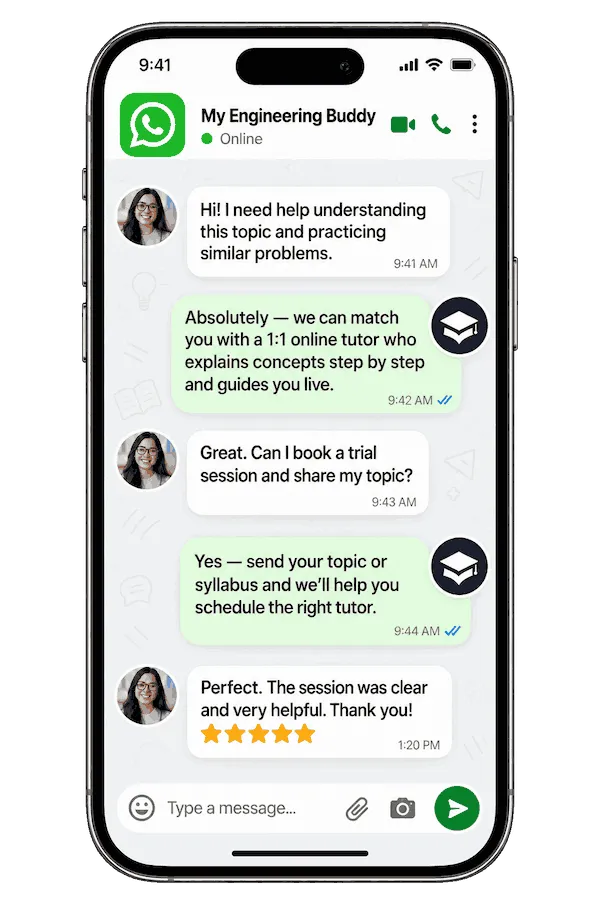
Unlike platforms where you fill out a form and wait, MEB responds in under a minute, 24/7. Tutor match takes under an hour. The $1 trial means you test before you commit. Everything runs over WhatsApp — no logins, no intake forms.
Study Plans (Pick One That Matches Your Goal)
A catch-up plan runs 1–3 weeks for students with a specific gap — say, sequential logic or HDL basics — before an upcoming lab submission or exam. An exam prep plan runs 4–8 weeks, covering the full Digital Circuit syllabus in a structured order with past-paper practice built in from week three. Weekly support follows your semester timetable, syncing to lectures and assignment deadlines as they come. The tutor builds the specific sequence after the first diagnostic — that session determines which plan fits and where it starts.
Pricing Guide
Digital Circuit tutoring starts at $20/hr for standard undergraduate-level content. Topics involving HDL coding, FPGA synthesis, or VLSI design typically run $35–$70/hr depending on the tutor’s background. Graduate-level or research-adjacent support can reach $100/hr.
Rate factors: course level, topic complexity (combinational vs sequential vs programmable logic), your timeline, and tutor availability. The tighter the deadline, the narrower the tutor pool.
For students targeting research roles, IC design positions, or graduate programmes at institutions where digital systems design is a core qualifier, tutors with professional FPGA or ASIC backgrounds are available at higher rates — share your specific goal and MEB will match the tier to your ambition.
Start with the $1 trial — 30 minutes, no registration, no commitment. WhatsApp MEB for a quick quote.
MEB has covered Electrical Engineering subjects — from circuit analysis tutoring to embedded systems help — for students across 30+ countries since 2008. Digital Circuit is one of the most requested modules in the engineering category.
Source: My Engineering Buddy, 2008–2025.
FAQ
Is Digital Circuit hard?
It starts accessible — gates and truth tables are manageable. Sequential logic is where most students hit a wall. State machines, flip-flop timing, and HDL synthesis require a different kind of thinking, and the jump happens fast within a single semester.
How many sessions are needed?
Students closing one specific gap — say, Karnaugh map minimisation or FSM design — typically need 3–6 sessions. A full-semester catch-up or exam prep plan usually runs 10–20 hours spread across 4–8 weeks. The tutor gives a clearer estimate after the first diagnostic session.
Can you help with homework and assignments?
MEB tutoring is guided learning — you understand the work, then submit it yourself. The tutor walks through the method, explains the logic, and lets you apply it. See our Academic Integrity policy and Why MEB page for full details on what we help with and what we don’t.
Will the tutor match my exact syllabus or exam board?
Yes. Before the first session, share your course outline, module guide, or textbook. MEB matches tutors to your specific university’s Digital Circuit content — not a generic version of the subject. This matters because notation, tool requirements, and assessment style vary significantly between institutions.
What happens in the first session?
The tutor gives you a short diagnostic problem — usually a combinational or sequential design task. That takes 10–15 minutes and reveals exactly where your gaps are. The rest of the session starts addressing the most urgent one. You leave with a clear plan for what comes next.
Is online tutoring as effective as in-person?
For Digital Circuit, yes — and in some ways better. The digital pen-pad and screen sharing mean circuit diagrams, timing waveforms, and state tables are drawn live and visible to both student and tutor simultaneously. There’s no board-squinting or poor lighting. Sessions are also recorded on request for review.
What’s the difference between combinational and sequential logic, and why do students always get confused?
Combinational circuits produce outputs based only on current inputs — no memory. Sequential circuits depend on current inputs and past states, stored in flip-flops. Students confuse them because both use gates, but sequential design requires tracking state over time, which is a fundamentally different design process.
Can MEB help with Logisim, Multisim, or other Digital Circuit simulation tools?
Yes. MEB tutors support Logisim, Multisim, and similar simulation platforms used in Digital Circuit lab work. The tutor can walk through circuit entry, simulation setup, and interpreting waveform outputs — not just the theory behind the design.
Do you cover VHDL and Verilog as part of Digital Circuit tutoring?
Yes, when the course requires it. Many Digital Circuit modules at the undergraduate level include an HDL component. MEB tutors cover both VHDL and Verilog — syntax, entity/architecture structure, test bench writing, and synthesis-ready code for common combinational and sequential circuits.
Can I get Digital Circuit help at midnight or on weekends?
Yes. MEB operates 24/7 across time zones. WhatsApp MEB at any hour and you’ll typically get a response in under a minute. Sessions can be booked same-day in most cases, including weekends and the nights before deadlines.
What if I don’t connect with my assigned tutor?
Tell MEB over WhatsApp. There’s no form to fill out and no waiting period. MEB will reassign you to another Digital Circuit tutor — usually within the same day. The $1 trial is specifically designed so you test the fit before committing to a full session block.
How do I get started?
Three steps: WhatsApp MEB, get matched to a verified Digital Circuit tutor — usually within an hour — then start your $1 trial. That’s 30 minutes of live 1:1 tutoring, or one homework question explained in full. No registration, no commitment beyond the first dollar.
Trust & Quality at My Engineering Buddy
Every MEB tutor goes through a subject-specific vetting process: academic credentials checked, a live demo session evaluated, and ongoing session feedback reviewed. Tutors covering Digital Circuit hold degrees in electrical engineering, electronics, or computer engineering — and many have professional experience in IC design, FPGA development, or embedded systems. MEB is rated 4.8/5 across 40,000+ verified reviews on Google. That rating reflects 18 years of subject-specific matching, not a general marketplace.
MEB tutoring is guided learning — you understand the work, then submit it yourself. For full details on what we help with and what we don’t, read our Academic Integrity policy and Why MEB.
MEB has served 52,000+ students across the US, UK, Canada, Australia, the Gulf, and Europe in 2,800+ subjects since 2008. Within Electrical Engineering, Digital Circuit sits alongside subjects like digital signal processing help and microprocessors tutoring as one of the most consistently requested modules. Tutors are matched to subject, level, and region — not assigned from a general pool. Learn more about how we work at MEB’s tutoring methodology.
A common pattern our tutors observe is that Digital Circuit students who come in convinced they’re “bad at logic” almost always have one foundational gap — Boolean simplification or flip-flop operation — that’s been dragging everything else down. Fix that one thing, and the subject opens up.
Explore Related Subjects
Students studying Digital Circuit often also need support in:
- Analog Electronics
- Basic Electronics
- Semiconductor Devices
- Microcontrollers
- Integrated Circuits (IC)
- Signals and Systems
- Computer Hardware
Digital Circuit is one of the most assignment-intensive modules in any electrical engineering degree — and one of the most resat. MEB has matched thousands of students to specialist tutors across this subject and its prerequisites since 2008.
Source: My Engineering Buddy, 2008–2025.
Next Steps
Getting started takes under two minutes.
- Share your exam board or university, the module you’re struggling with, and your current timeline
- Share your availability and time zone
- MEB matches you with a verified Digital Circuit tutor — usually within 24 hours, often within the hour
- Your first session starts with a diagnostic, so every minute from the first one is used well
Before your first session, have ready:
- Your course syllabus or module guide (or just the textbook title and chapter)
- A recent homework or lab question you struggled with
- Your exam date or assignment submission deadline
The tutor handles everything else.
Visit www.myengineeringbuddy.com for more on how MEB works.
WhatsApp to get started or email [email protected].
Reviewed by Subject Expert
This page has been carefully reviewed and validated by our subject expert to ensure accuracy and relevance.




