




~1 min
Average Reply Time
~1 hour
To Be Matched With A Tutor
30 Min Trial
75% Find Their Tutor On The 1st Trial
$20-35+/hr
Premium Yet Affordable Learning
Hire The Best Power Plant Engineering Tutor







Struggling with Rankine cycles, turbine efficiency problems, or plant system design? Most students hit a wall around heat balance calculations — here’s how to break through it.
Power Plant Engineering Tutor Online
Power Plant Engineering is an advanced engineering discipline covering the design, operation, and thermodynamic analysis of electricity-generating facilities — including steam, gas, nuclear, and renewable plants — equipping students to model energy conversion systems and optimise plant performance.
MEB offers 1:1 online engineering tutoring across 2,800+ advanced subjects, including a dedicated Power Plant Engineering tutor online service built for undergraduate and graduate students. Whether you’re searching for a Power Plant Engineering tutor near me or need someone who knows your exact university syllabus, MEB matches you within hours. Sessions are live, focused, and built around where you’re stuck right now.
- 1:1 online sessions tailored to your course syllabus and exam board
- Expert-verified tutors with subject-specific power systems knowledge
- Flexible time zones — US, UK, Canada, Australia, Gulf
- Structured learning plan built after a first diagnostic session
- Ethical homework and assignment guidance — you understand before you submit
52,000+ students across the US, UK, Canada, Australia, and the Gulf have used MEB since 2008 — including students in Engineering subjects like Power Plant Engineering, Mechanical Engineering, and Nuclear Engineering.
Source: My Engineering Buddy, 2008–2025.
How Much Does a Power Plant Engineering Tutor Cost?
Most Power Plant Engineering tutoring sessions run at $20–$40/hr for undergraduate-level work. Graduate and research-level topics — combined-cycle plant modelling, advanced exergy analysis — reach up to $100/hr. Start with the $1 trial: 30 minutes of live tutoring or one full homework question explained in detail, no registration needed.
| Level / Need | Typical Rate | What’s Included |
|---|---|---|
| Undergraduate (most levels) | $20–$40/hr | 1:1 sessions, homework guidance |
| Graduate / Specialist | $40–$100/hr | Expert tutor, advanced plant systems depth |
| $1 Trial | $1 flat | 30 min live session or 1 homework question |
Tutor availability tightens during final exam periods and end-of-semester project deadlines. Book early to secure your preferred time slot.
WhatsApp MEB for a quick quote — average response time under 1 minute.
Who This Power Plant Engineering Tutoring Is For
Power Plant Engineering sits at the intersection of thermodynamics, fluid mechanics, and electrical systems. Most students cope with individual topics but lose marks where those disciplines combine — heat balance diagrams, combined-cycle efficiency, or plant load calculations under variable demand.
- Third- and fourth-year undergraduates struggling with Rankine and Brayton cycle analysis
- Graduate students working through exergy destruction, cogeneration, or IGCC systems
- Students with a university conditional offer depending on passing this module
- Students retaking after a failed first attempt at plant thermodynamics or power systems
- Students 4–6 weeks from exams with heat transfer or turbine performance gaps still open
- Parents watching a child’s confidence drop alongside their engineering grades
- Students needing structured homework guidance on steam tables, T-s diagrams, or load dispatch problems
MEB tutors have worked with students at institutions including Georgia Tech, University of Michigan, Imperial College London, University of Toronto, UNSW Sydney, and TU Delft — in programmes where Power Plant Engineering is a compulsory module with no easy retake.
1:1 Tutoring vs Self-Study vs AI vs YouTube vs Online Courses
Self-study works if you’re disciplined, but steam table interpolation and combined-cycle efficiency problems need feedback to get right. AI tools can outline the Rankine cycle steps — they can’t spot where your specific enthalpy calculation went wrong. YouTube covers boiler fundamentals well; it stops when you’re stuck mid-problem on turbine staging. Online courses follow a fixed pace that rarely matches a university exam schedule. 1:1 tutoring with MEB is live, calibrated to your exact module, and corrects errors in real time — before they become exam-day habits in Power Plant Engineering.
Outcomes: What You’ll Be Able To Do in Power Plant Engineering
After focused sessions with an MEB Power Plant Engineering tutor, you’ll be able to solve complete Rankine and Brayton cycle problems from first principles, including reheat and regeneration configurations. You’ll analyze heat balance diagrams for real plant layouts, apply the second law to quantify exergy destruction in individual components, and model combined heat and power (CHP) systems for different load scenarios. Students also develop the confidence to explain plant efficiency trade-offs in written reports and viva-style assessments — a skill that’s tested harder than most expect.
Based on feedback from 40,000+ sessions collected by MEB from 2022 to 2025, 58% of students improved by one full grade after approximately 20 hours of 1:1 tutoring in subjects like Power Plant Engineering. A further 23% achieved at least a half-grade improvement.
Source: MEB session feedback data, 2022–2025.
Try your first session for $1 — 30 minutes of live 1:1 tutoring or one homework question explained in full. No registration. No commitment. WhatsApp MEB now and get matched within the hour.
What We Cover in Power Plant Engineering (Syllabus / Topics)

Thermodynamics and Power Cycles
- Rankine cycle: basic, reheat, and regenerative configurations
- Brayton cycle and gas turbine plant analysis
- T-s and h-s diagrams: construction and interpretation
- Steam tables and interpolation techniques
- Cycle efficiency, back-work ratio, and net work output
- Combined cycle gas turbine (CCGT) plant thermodynamics
- Second law analysis and exergy/availability calculations
Core texts include Engineering Thermodynamics by Rogers & Mayhew, Fundamentals of Engineering Thermodynamics by Moran & Shapiro, and Power Plant Engineering by Black & Veatch.
Plant Components and Systems
- Boilers: fire-tube, water-tube, supercritical and ultra-supercritical designs
- Steam turbines: impulse vs reaction staging, blade design principles
- Condensers, feedwater heaters, and deaerators
- Pumps, compressors, and heat exchangers in plant circuits
- Cooling water systems: once-through and cooling tower configurations
- Fuel systems: coal, natural gas, and biomass handling
Useful references include Steam Plant Operation by Woodruff, Lammers & Lammers and Power Plant Engineering by P.K. Nag for component-level detail.
Renewable and Nuclear Integration
- Cogeneration (CHP) and combined heat and power plant design
- Integrated gasification combined cycle (IGCC) systems
- Nuclear power plant thermodynamic cycles and reactor types
- Grid integration: load dispatch, base load vs peak load operation
- Emissions control: flue gas desulphurisation, NOx reduction systems
- Nuclear engineering tutoring for students covering reactor thermodynamics in depth
Recommended reading: Nuclear Power Plant Design by Lamarsh and the Federal Aviation Administration — for students whose programmes include turbine certification adjacent to aviation propulsion contexts, the FAA website provides useful regulatory framing on turbine standards.
At MEB, we’ve found that students who work through at least one complete heat balance diagram by hand — before moving to software — close marks gaps in plant efficiency questions roughly twice as fast as those who start directly in simulation tools.
What a Typical Power Plant Engineering Session Looks Like
The tutor opens by checking where you landed on the previous topic — usually Rankine cycle enthalpy calculations or turbine isentropic efficiency. You share your working on screen; the tutor reads it before saying a word. Then you move into the core problem: a combined-cycle plant with given inlet conditions, and you need the net efficiency. The tutor uses a digital pen-pad to annotate the T-s diagram in real time while you follow and reconstruct it yourself. When you get the condenser pressure term wrong, the tutor catches it immediately, walks back to why, and you redo that step. The session closes with a specific practice problem set — three heat balance questions at increasing complexity — and the next topic flagged: feedwater heater analysis. Need help with mechanical engineering tutoring alongside your power plant module? MEB covers that too.
How MEB Tutors Help You with Power Plant Engineering (The Learning Loop)
Diagnose: In the first session, the tutor asks you to work through a short thermodynamic problem — typically a basic Rankine cycle — while they watch. Within 15 minutes they’ve identified whether your gaps are in steam table use, cycle setup, or second-law application.
Explain: The tutor then works live examples on a digital pen-pad, talking through each step. No pre-recorded slides. The explanation is built around the specific error pattern found in your diagnostic, not a generic lecture on boiler cycles.
Practice: You attempt the next problem with the tutor present. They don’t intervene immediately — they let you work, then ask you to explain your reasoning before correcting anything.
Feedback: Step-by-step error correction follows. The tutor identifies exactly where marks would be lost in an exam answer — whether it’s a missing unit conversion, a wrongly applied isentropic assumption, or an incomplete second-law statement.
Plan: Each session ends with a written note of what was covered, what needs more work, and what comes next. For students three weeks from exams, that plan is tight and specific.
Sessions run over Google Meet. The tutor uses a digital pen-pad or iPad with Apple Pencil for all diagrams and worked solutions. Before your first session, share your course outline, any recent past paper you’ve attempted, and your exam or submission date. The first session serves as your diagnostic and your first real lesson simultaneously. Start with the $1 trial — 30 minutes of live tutoring that doubles as that first diagnostic.
Students consistently tell us that the moment the T-s diagram makes visual sense — not just as a shape but as a map of energy loss — everything else in Power Plant Engineering starts clicking into place. That’s the turning point most tutors aim for in session two or three.
Tutor Match Criteria (How We Pick Your Tutor)
Match quality matters more than speed. Here’s what MEB checks before assigning your tutor.
Subject depth: Tutors are vetted specifically on power systems thermodynamics, plant components, and the level of your course — undergraduate core module vs graduate-level exergy analysis are not the same thing.
Tools: Every tutor uses Google Meet with a digital pen-pad or iPad and Apple Pencil. No static PDFs, no screen-sharing of pre-made notes.
Time zone: Matched to your region — US, UK, Gulf, Canada, or Australia. Sessions happen at your study hours, not someone else’s working day.
Goals: Whether you need to pass a compulsory module, hit a distinction, or complete a research-level assignment on combined-cycle optimisation, the tutor is matched to that specific aim.
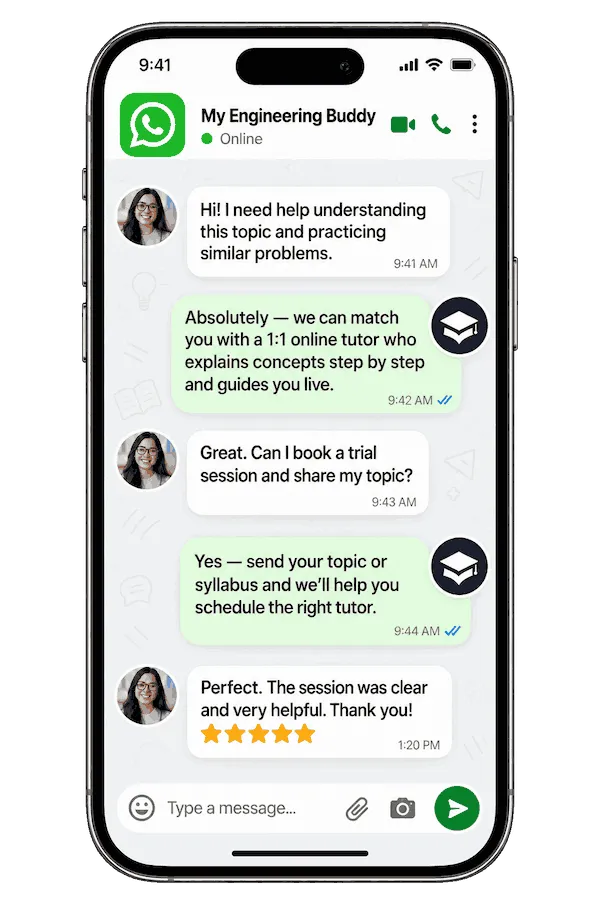
Unlike platforms where you fill out a form and wait, MEB responds in under a minute, 24/7. Tutor match takes under an hour. The $1 trial means you test before you commit. Everything runs over WhatsApp — no logins, no intake forms.
Study Plans (Pick One That Matches Your Goal)
Catch-up (1–3 weeks): For students behind on thermodynamic cycles or plant systems with an exam approaching fast. Sessions focus on the highest-yield topics first. Exam prep (4–8 weeks): Structured revision covering all major tracks — cycles, components, renewables — with past paper practice woven in from week two. Weekly support: Ongoing sessions aligned to your semester schedule, covering new material as it’s taught and reinforcing it before assessments. The tutor maps the exact sequence after your first diagnostic — no two plans look the same. Need electrical engineering tutoring alongside your power plant module? Both can run in parallel.
Pricing Guide
Power Plant Engineering tutoring starts at $20/hr for standard undergraduate content. Graduate and specialist topics — exergy analysis, IGCC system design, nuclear thermodynamics — run up to $100/hr. Rate depends on course level, topic complexity, how quickly you need sessions, and tutor availability.
Availability shrinks fast in the four weeks before final exams and during semester-end project submission windows. Early booking is not a marketing line — it’s a practical limitation.
For students targeting positions at major utilities, EPC contractors, or graduate research programmes in energy systems, tutors with professional power industry or research backgrounds are available at higher rates. Share your specific goal and MEB will match the right tier.
Start with the $1 trial — 30 minutes, no registration, no commitment. WhatsApp MEB for a quick quote.
MEB has supported engineering students across 2,800+ subjects since 2008 — from first-year thermodynamics through to graduate-level power systems research, across the US, UK, Canada, Australia, and the Gulf.
Source: My Engineering Buddy, 2008–2025.
A common pattern our tutors observe is that Power Plant Engineering students who struggle most are those who memorised the Rankine cycle without ever drawing a full T-s diagram from scratch. Twenty minutes fixing that usually unlocks the rest of the module.
FAQ
Is Power Plant Engineering hard?
It’s demanding. The subject requires solid thermodynamics and fluid mechanics as foundations, then applies them to complex real-plant systems. Students who struggle usually have gaps in one of those prerequisites — identifying which one early makes the rest manageable.
How many sessions are needed?
Most students working through a specific gap — Rankine cycle analysis, heat balance diagrams — need 6–10 sessions. Students using MEB for full-semester support average 15–20 sessions. The tutor gives a clearer estimate after the first diagnostic.
Can you help with homework and assignments?
MEB tutoring is guided learning — you understand the work, then submit it yourself. The tutor explains the method, works through a similar example, and checks your reasoning. See our Academic Integrity policy and Why MEB page for full details on what we help with and what we don’t.
Will the tutor match my exact syllabus or exam board?
Yes. Before matching, MEB asks for your university, course code, and syllabus outline. Tutors are assigned based on that specific content — not just a general knowledge of thermodynamics. Share your course materials when you first message.
What happens in the first session?
The tutor starts with a short diagnostic problem — usually a basic power cycle — to see exactly where your understanding breaks down. The rest of the session covers the most urgent gap. You leave with a clear plan for what comes next.
Is online tutoring as effective as in-person?
For engineering problem-solving, yes. The digital pen-pad replicates whiteboard working. Screen sharing lets the tutor read your own working in real time. Students in the Gulf, Canada, and Australia report no meaningful difference from face-to-face sessions for technical subjects.
Can I get Power Plant Engineering help at short notice — including late at night?
MEB operates 24/7 via WhatsApp. Most students get a tutor response within minutes. Late-night sessions before a morning exam or submission are common. Message first and MEB will confirm availability for your time zone immediately.
What’s the difference between steam plant and combined-cycle plant tutoring?
Steam plant sessions focus on Rankine cycle variants, boiler design, and turbine staging. Combined-cycle work adds Brayton cycle integration, gas turbine exhaust recovery, and overall plant efficiency optimisation. Most Power Plant Engineering courses cover both — tell MEB which your module emphasises.
Do you cover renewable energy integration in Power Plant Engineering?
Yes — including CHP systems, IGCC, and grid-level load dispatch topics that appear in advanced power plant modules. Students also sometimes need support crossing into chemical engineering tutoring for gasification and emissions control content.
How do I get started?
Message MEB on WhatsApp. Three steps: message → get matched with a verified Power Plant Engineering tutor → start your $1 trial (30 minutes live or one question explained in full). No forms, no waiting. Usually sorted within the hour.
Can a Power Plant Engineering tutor help with my final year project or dissertation?
Yes. MEB tutors can guide you through literature on plant efficiency optimisation, help structure your methodology for a heat balance model, or review your thermodynamic analysis section. Guidance only — all written work is yours. Get systems engineering help for project-level integration work too.
How does Power Plant Engineering relate to other engineering modules I’m taking?
Power Plant Engineering draws directly on thermodynamics, heat transfer, fluid mechanics, and electrical machines. Students often find that shoring up one of those foundations unlocks progress in the power plant module itself. MEB can run parallel sessions in related modules if needed. See also petroleum engineering tutoring for students in energy-focused programmes.
Trust & Quality at My Engineering Buddy
Every MEB tutor goes through subject-specific screening before taking a single session. That includes a live demo evaluation — not just a CV check — followed by ongoing review of session feedback scores. Tutors hold degrees in mechanical, electrical, chemical, or energy engineering, and many have professional experience in power generation or utilities. Rated 4.8/5 across 40,000+ verified reviews on Google. For industrial engineering tutoring and adjacent subjects, the same vetting standard applies.
MEB tutoring is guided learning — you understand the work, then submit it yourself. For full details on what we help with and what we don’t, read our Academic Integrity policy and Why MEB.
MEB has been running since 2008, serving 52,000+ students across the US, UK, Canada, Australia, the Gulf, and Europe in 2,800+ subjects. Engineering is one of MEB’s largest subject areas — from first-year civil engineering tutoring through to graduate-level power systems and energy research. The platform was built for students in demanding technical programmes where getting stuck for a week costs exam marks. Read more about how sessions work at MEB’s tutoring methodology.
Explore Related Subjects
Students studying Power Plant Engineering often also need support in:
- Aerospace Engineering
- Automotive Engineering
- Materials Science and Engineering
- Mechatronics
- Mining Engineering
- Metallurgical Engineering
- Marine Engineering
Next Steps
When you message MEB, share your exam board or university module code, the specific topic giving you the most trouble right now, and how many weeks you have before your exam or submission. Include your time zone and availability — morning, evening, or weekend.
MEB matches you with a verified Power Plant Engineering tutor — usually within a few hours. The first session starts with a diagnostic so every minute is used on what actually matters.
Before your first session, have ready:
- Your course outline or syllabus (module handbook is ideal)
- A recent past paper attempt or homework problem you got stuck on
- Your exam date or submission deadline
The tutor handles the rest. Visit www.myengineeringbuddy.com for more on how MEB works.
WhatsApp to get started or email [email protected].
Reviewed by Subject Expert
This page has been carefully reviewed and validated by our subject expert to ensure accuracy and relevance.




