~1 min
Average Reply Time
~1 hour
To Be Matched With A Tutor
30 Min Trial
75% Find Their Tutor On The 1st Trial
$20-35+/hr
Premium Yet Affordable Learning
Most students don’t fail Chinese because the language is too hard. They fail because nobody caught the tonal error in week two — and it compounded into week twelve.
Chinese Tutor Online
Chinese (Mandarin) is a tonal language using characters (Hanzi) and Pinyin romanisation, studied at GCSE, A Level, IB, AP, and university level, equipping learners with spoken fluency, reading comprehension, and written communication skills.
MEB’s language tutoring covers Chinese from beginner to advanced university level. If you’ve searched for a Chinese tutor near me and found generic platforms, MEB is different — every session is matched to your exact syllabus, exam board, or university module. You work with one tutor, not a rotating roster, and results show within a few sessions.
- 1:1 online sessions tailored to your course or exam board (GCSE, A Level, IB, AP, HSK, university)
- Expert-verified tutors with subject-specific knowledge of Chinese tones, characters, and grammar
- Flexible time zones — US, UK, Canada, Australia, Gulf
- Structured learning plan built after a diagnostic session
- Ethical homework and assignment guidance — you understand the work before you submit
52,000+ students across the US, UK, Canada, Australia, and the Gulf have used MEB since 2008 — including students in Language subjects like Chinese, Japanese tutoring, and Korean tutoring.
Source: My Engineering Buddy, 2008–2025.
How Much Does a Chinese Tutor Cost?
Most Chinese tutoring sessions at MEB run $20–$40/hr depending on level and exam board. The $1 trial gets you 30 minutes of live 1:1 tutoring or one full homework question explained — no registration, no commitment.
| Level / Need | Typical Rate | What’s Included |
|---|---|---|
| GCSE / A Level / IB / AP | $20–$35/hr | 1:1 sessions, homework guidance, exam prep |
| University / HSK Advanced | $35–$70/hr | Expert tutor, classical Chinese, linguistics depth |
| $1 Trial | $1 flat | 30 min live session or 1 homework question explained |
Tutor availability tightens significantly around GCSE and A Level exam windows in May–June and around university semester deadlines. Book early if you’re working to a fixed date.
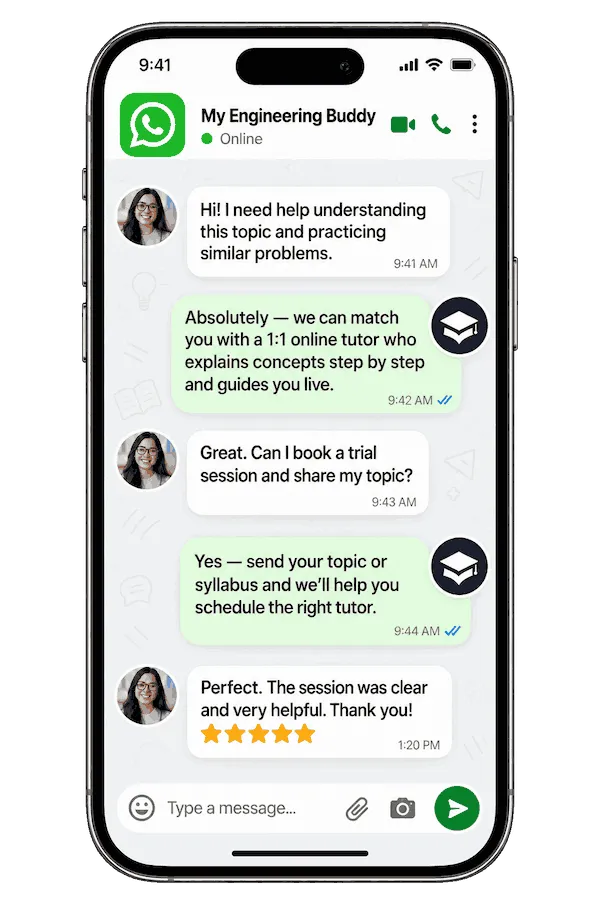
WhatsApp MEB for a quick quote — average response time under 1 minute.
Who This Chinese Tutoring Is For
Chinese attracts learners at very different stages with very different problems. The tutor match process accounts for that.
- GCSE and A Level students struggling with tonal accuracy and character writing under timed exam conditions
- IB and AP Chinese Language and Culture students working on written tasks and oral assessments
- University students in Mandarin, Sinology, or East Asian Studies with translation or linguistics modules
- Students retaking after a failed first attempt — particularly those who lost marks on listening and reading components
- Students with a university conditional offer that depends on their Chinese A Level grade
- Heritage speakers who can hold a conversation but need formal written Chinese for academic assessment
- Professionals and postgraduate students targeting HSK 5 or HSK 6 certification
Students at Oxford, Cambridge, SOAS, UC Berkeley, Georgetown, and the University of Toronto all use online 1:1 support to keep pace with the volume of new characters and grammar patterns introduced each semester. The $1 trial is the lowest-risk way to see if MEB’s approach fits your situation.
At MEB, we’ve found that the students who improve fastest in Chinese aren’t necessarily the most naturally gifted — they’re the ones who get corrective feedback on tones and characters within days of making an error, not weeks later in a marked exam paper. One hour of focused correction beats five hours of unguided review every time.
1:1 Tutoring vs Self-Study vs AI vs YouTube vs Online Courses
Self-study works if you’re disciplined, but nobody corrects your tones in real time. AI tools explain grammar rules quickly but cannot hear your pronunciation or diagnose the specific character stroke you’re getting wrong. YouTube is excellent for listening exposure and cultural context — it stops short when you’re stuck on a specific HSK grammar pattern. Online courses give structure but move at a fixed pace regardless of whether you’ve actually internalised the measure words. 1:1 tutoring with MEB is calibrated to your exact exam board or HSK level, corrects errors in the session, and moves only when you’re ready. For a language where a single tonal error changes the meaning entirely, that live correction loop is not optional — it’s the whole point.
Outcomes: What You’ll Be Able To Do in Chinese
After consistent 1:1 Chinese tutoring, students can accurately produce the four Mandarin tones across connected speech, not just in isolation. You’ll write and recognise the character sets required at your level — HSK 3 through HSK 6 or the equivalent A Level vocabulary range. Students can analyse and respond to unseen reading passages in timed conditions, apply grammar structures like 把 (bǎ) sentences and resultative complements correctly, and present a structured oral response on a cultural or contemporary topic without relying on memorised scripts. These aren’t vague promises. They’re the specific skills your examiner is scoring.
Supporting a student through Chinese? MEB works directly with parents to set up sessions, track progress, and keep coursework on schedule. WhatsApp MEB — average response time is under a minute, 24/7.
Based on feedback from 40,000+ sessions collected by MEB from 2022 to 2025, 58% of students improved by one full grade after approximately 20 hours of 1:1 tutoring in subjects like Chinese. A further 23% achieved at least a half-grade improvement.
Source: MEB session feedback data, 2022–2025.
What We Cover in Chinese (Syllabus / Topics)

Track 1: GCSE, A Level & IB Chinese
- Tones (first through fourth plus neutral) — production and recognition in connected speech
- Pinyin reading and accurate romanisation for exam listening components
- Character recognition and writing — vocabulary lists aligned to AQA, Edexcel, OCR, IB syllabus
- Grammar: aspect markers (了, 过, 着), topic-comment structures, complements of result and direction
- Reading comprehension strategies for unseen texts — inference, gist, and detail questions
- Written coursework: structuring an essay in Chinese with appropriate register and linking phrases
- Oral exam preparation — scripted and spontaneous response practice with cultural topic vocabulary
Core texts: HSK Standard Course series (Jiang Liping), Chinese Breakthrough (McGill University series), past papers from AQA, Edexcel, and IB exam banks.
Track 2: AP Chinese Language and Culture
- Presentational writing — formal email, story narration from visual prompt
- Interpersonal writing — responding to simulated emails with appropriate cultural register
- Presentational speaking — cultural presentation on a set topic with 4-minute delivery
- Interpersonal speaking — conversation simulation with six exchanges
- Reading and listening integration — authentic Chinese-language sources with inference tasks
- Cultural product, practice, and perspective content — exam-board framing for AP free-response
Core texts: AP Chinese Language and Culture (Cheng & Tsui), College Board released free-response questions, Integrated Chinese Level 2 (Cheng & Tsui).
Track 3: University-Level Mandarin & HSK Certification
- HSK 4, 5, and 6 vocabulary acquisition — active use, not passive recognition
- Classical Chinese (文言文) — grammar patterns, particle usage, translation methodology
- Academic Chinese reading — journal abstracts, political texts, contemporary media
- Translation theory and practice — Chinese to English and English to Chinese at university level
- Linguistics modules: tonal phonology, morphology of Chinese characters, Sinitic language families
- Research essay writing in Chinese — argumentation, citation conventions in Chinese academic style
Core texts: Contemporary Chinese (Sinolingua), A New Chinese Grammar (Po-Ching Yip & Don Rimmington), The Oxford Handbook of Chinese Linguistics.
Students consistently tell us that the jump from conversational Mandarin to academic or exam-level Chinese feels like learning a second version of the language. The grammar patterns, the written register, and the character load at HSK 5–6 or A Level are genuinely different from what you pick up in a conversation class. That gap needs direct instruction — not more listening practice.
What a Typical Chinese Session Looks Like
The tutor opens by reviewing the previous session’s focus — for example, 把 (bǎ) sentence construction or the distinction between 就 and 才 in time expressions. You share your screen or your written attempt at a past paper question. The tutor uses a digital pen-pad to annotate your work directly, marking tonal errors in Pinyin, flagging incorrect stroke order, and correcting grammar patterns in real time. You then attempt a new question with the tutor present — not after. Errors get addressed within seconds, not at the end of the session. The session closes with a specific character list or grammar pattern to practise before the next meeting, and the tutor notes the next topic so there’s no confusion about where to begin.
How MEB Tutors Help You with Chinese (The Learning Loop)
Diagnose: In the first session, the tutor identifies exactly where your Chinese is breaking down — tonal confusion, character recognition gaps, grammar patterns you’re avoiding because you’re unsure, or exam technique issues like spending too long on a reading comprehension and running out of time.
Explain: The tutor works through a live example on the digital pen-pad — building a 把 sentence step by step, or showing the structural logic of a Chinese essay opening. You see the reasoning, not just the answer.
Practice: You attempt a parallel question or produce a sentence of your own while the tutor watches. The practice happens inside the session, with support available immediately.
Feedback: The tutor explains each error — not just what was wrong, but why the examiner would deduct marks and what the correct pattern looks like in context. For tonal errors, you hear the correct version and repeat it.
Plan: At the end of each session, the tutor sets the next character list, grammar focus, or past paper task. Session progression follows your exam date or course calendar, not a generic curriculum.
All sessions run over Google Meet with a digital pen-pad or iPad + Apple Pencil for annotation. Before your first session, share your exam board or course syllabus, the most recent past paper or assignment you found difficult, and your exam or submission date. The first session is diagnostic — the tutor builds the plan from there. Start with the $1 trial — 30 minutes of live tutoring that also serves as your first diagnostic session.
For students who find online Japanese tutoring or Arabic tutoring manageable but hit a wall with Chinese characters, the issue is almost always the absence of a structured character acquisition system — not lack of effort.
Source: My Engineering Buddy, tutor observation data, 2008–2025.
Tutor Match Criteria (How We Pick Your Tutor)
Not every Chinese tutor is right for every student. MEB matches on four criteria.
Subject depth: The tutor must have demonstrated competency at your specific level — GCSE, A Level, AP, IB, or university Mandarin. HSK 6 tutors are available for advanced certification and postgraduate linguistic work.
Tools: Every tutor uses Google Meet with a digital pen-pad or iPad + Apple Pencil. Chinese character annotation in real time requires this — not a whiteboard, not typing.
Time zone: Matched to your region — US Eastern and Pacific, UK and Europe, Gulf time zones, Canada, and Australia. No scheduling gymnastics.
Goals: Whether you need exam-board-specific preparation, weekly coursework support, or deep grammar work for a linguistics module, the tutor is matched to that specific goal — not assigned generically.
Unlike platforms where you fill out a form and wait, MEB responds in under a minute, 24/7. Tutor match takes under an hour. The $1 trial means you test before you commit. Everything runs over WhatsApp — no logins, no intake forms.
Study Plans (Pick One That Matches Your Goal)
After the diagnostic, the tutor builds a session sequence to your timeline. A catch-up plan (1–3 weeks) targets the highest-yield exam components — typically listening and reading — when time is short. An exam prep plan (4–8 weeks) covers the full syllabus systematically, with past paper practice built in from week two. A weekly support plan runs alongside your semester or coursework calendar, addressing new grammar and characters as they appear in your course. French tutoring students on the same platform follow the same structured approach — the framework works across languages because the diagnostic drives it, not a generic template.
Pricing Guide
Chinese tutoring starts at $20/hr for GCSE and early undergraduate level. A Level, IB, and AP run $25–$40/hr depending on tutor seniority. University linguistics, classical Chinese, and HSK 6 preparation go up to $100/hr for tutors with postgraduate or professional research backgrounds.
Rate factors: your level, the complexity of the topic (classical Chinese costs more than GCSE vocabulary review), your timeline, and tutor availability at your preferred session time.
For students targeting places at SOAS, Oxford’s Oriental Studies programme, or leading East Asian Studies departments in the US and Canada, tutors with academic research or professional translation backgrounds are available at higher rates — share your specific goal and MEB will match the tier to your ambition.
Availability tightens in April–June around A Level and AP exam windows. Book ahead if that’s your window. Start with the $1 trial — 30 minutes, no registration, no commitment. WhatsApp MEB for a quick quote.
FAQ
Is Chinese hard to learn?
Mandarin Chinese is genuinely demanding for English speakers — four tones, no alphabet, and thousands of characters to learn. But difficulty is specific: most students find tonal accuracy and character retention the hardest parts, not grammar. With a good Chinese tutor online, those two areas improve measurably and quickly.
How many sessions will I need?
Students closing a specific exam gap typically need 8–15 sessions. Those building from near-zero to exam level need 20–40 sessions depending on frequency. The diagnostic session at the start identifies your actual gap — the tutor gives you a realistic session estimate after that, not before.
Can you help with Chinese homework and assignments?
Yes. MEB tutoring is guided learning — you understand the work, then submit it yourself. The tutor explains the grammar, walks through the character list, or unpacks the translation question with you. See our Academic Integrity policy and Why MEB page for full details on what we help with and what we don’t.
Will the tutor match my exact syllabus or exam board?
Yes. MEB tutors are matched to your specific board — AQA, Edexcel, OCR, IB, AP, or your university’s course outline. The tutor works from your actual past papers and assessment criteria, not a generic Chinese course. Heritage speakers and HSK candidates are matched separately.
What happens in the first session?
The tutor runs a diagnostic — a short spoken exchange to assess tone production, a reading or writing task to gauge character recognition, and a conversation about your exam date and specific weak areas. From that, they build the session plan. No time is wasted on material you already know.
Is online Chinese tutoring as effective as in-person?
For everything except in-person pronunciation drills, yes. Tone correction works well over audio. Character annotation works better online than on paper, because the tutor’s pen-pad annotations are immediately visible alongside your attempt on screen. Students at major universities in the UK and US consistently report equivalent outcomes.
Can I get Chinese help at midnight or on weekends?
Yes. MEB operates across time zones 24/7. Tutors in multiple regions mean there is almost always someone available outside standard business hours. WhatsApp MEB at any time — the response arrives in under a minute and the tutor match can follow the same day.
What if I don’t like my assigned tutor?
Request a change. It takes one WhatsApp message and MEB will match you with a different tutor, usually within the same day. The $1 trial exists precisely so you can assess fit before committing to a longer series of sessions. No argument, no process.
Do I need to know Pinyin before starting?
No. Tutors work with complete beginners, including those who have never seen Pinyin. If you are coming from a heritage background — you speak Cantonese or another Chinese variety at home but need Mandarin — tell MEB when you start. The tutor adjusts the approach significantly for heritage speakers versus complete beginners.
What is the difference between HSK levels and A Level Chinese — and which should I focus on?
HSK is a standardised Chinese government proficiency certification with six levels — it measures general Mandarin ability and is widely recognised by universities and employers. A Level Chinese is a UK school-leaving qualification that tests language skills in a specific academic format. If you need both, they overlap considerably at HSK 4–5 — a tutor can help you prepare for both simultaneously with a shared vocabulary and grammar programme.
How do I find a Chinese tutor in my city — and does location matter?
Location does not matter for MEB. All tutoring is online, so whether you’re in London, Dubai, Sydney, Toronto, or a smaller city without local Chinese tutors, the session quality is identical. Character annotation and tone correction work over Google Meet. The tutor is matched to your syllabus and time zone, not your postcode.
How do I get started?
Three steps: WhatsApp MEB with your level, exam board, and the topic giving you the most trouble. MEB matches you with a verified Chinese tutor — usually within an hour. Your first session starts with a diagnostic for $1 — 30 minutes live or one question explained in full.
Trust & Quality at My Engineering Buddy
Every MEB Chinese tutor goes through a subject-specific vetting process — this includes a live demo session evaluated for explanation clarity, tone correction accuracy, and ability to annotate Chinese characters in real time using a digital pen-pad. Tutors hold degrees in Chinese, Mandarin linguistics, East Asian Studies, or equivalent professional qualifications. Ongoing session feedback is reviewed by MEB, not filed away. Rated 4.8/5 across 40,000+ verified reviews on Google.
MEB tutoring is guided learning — you understand the work, then submit it yourself. For full details on what we help with and what we don’t, read our Academic Integrity policy and Why MEB.
MEB has been serving students in Language subjects — including Chinese, German tutoring, Spanish tutoring, and Russian tutoring — since 2008. Over 52,000 students across the US, UK, Canada, Australia, Gulf, and Europe have used the platform across 2,800+ subjects. Read about our tutoring methodology if you want to understand how MEB structures learning across sessions.
A common pattern our tutors observe is that students coming to Chinese tutoring for the first time often know more than they think — but their knowledge is disorganised. Tones are approximate. Character memory is passive, not active. The first few sessions are mostly about restructuring what’s already there, not starting from zero. That’s faster progress than most students expect.
Explore Related Subjects
Students studying Chinese often also need support in:
Next Steps
Before your first session, have ready: your exam board and syllabus (or course outline), a recent past paper attempt or homework you struggled with, and your exam or deadline date. The tutor handles the rest.
- Share your exam board, hardest component, and current timeline
- Share your availability and time zone
- MEB matches you with a verified Chinese tutor — usually within 24 hours
- The first session starts with a diagnostic so every minute is used well
Visit www.myengineeringbuddy.com for more on how MEB works.
WhatsApp to get started or email [email protected].
Reviewed by Subject Expert
This page has been carefully reviewed and validated by our subject expert to ensure accuracy and relevance.