~1 min
Average Reply Time
~1 hour
To Be Matched With A Tutor
30 Min Trial
75% Find Their Tutor On The 1st Trial
$20-35+/hr
Premium Yet Affordable Learning
Struggling with Swahili noun classes, tonal patterns, or exam essays? Most students hit the same three walls — and a single session fixes all of them.
Swahili Tutor Online
Swahili (Kiswahili) is a Bantu language spoken across East and Central Africa, widely taught at university level in the US, UK, Canada, and Australia. It equips learners with oral, written, and analytical proficiency in one of Africa’s most widely spoken lingua francas.
MEB connects you with a verified Swahili tutor online who knows your exact syllabus — whether that’s a university language module, an AP/IB course, or a research-level reading requirement. If you’ve typed “Swahili tutor near me” and found nothing useful, 1:1 online sessions are the practical answer. Our language tutoring covers 2,800+ subjects, and Swahili sits inside a full roster of modern and classical language support. You get live sessions, structured feedback, and a tutor matched to your level — no generic lesson plans.
- 1:1 online sessions tailored to your course syllabus and exam board
- Expert-verified tutors with subject-specific Swahili knowledge
- Flexible time zones — US, UK, Canada, Australia, Gulf
- Structured learning plan built after a diagnostic session
- Ethical academic guidance — you understand before you submit
52,000+ students across the US, UK, Canada, Australia, and the Gulf have used MEB since 2008 — including students in Language subjects like Swahili, Arabic tutoring, and Japanese tutoring.
Source: My Engineering Buddy, 2008–2025.
How Much Does a Swahili Tutor Cost?
Most Swahili tutoring sessions run $20–$40/hr depending on level and syllabus depth. Graduate-level or specialist literary analysis can reach $70–$100/hr. The $1 trial gets you 30 minutes of live tutoring or a full explanation of one homework question — no registration required.
| Level / Need | Typical Rate | What’s Included |
|---|---|---|
| Beginner / Intermediate | $20–$35/hr | 1:1 sessions, grammar & vocab, homework guidance |
| Advanced / University Level | $35–$70/hr | Literary analysis, research reading, specialist depth |
| Graduate / Research | $70–$100/hr | PhD-level text, translation, fieldwork prep |
| $1 Trial | $1 flat | 30 min live session or 1 homework question explained |
Availability tightens during semester submission windows and end-of-year exam periods. Book early if you’re within six weeks of a deadline.
WhatsApp MEB for a quick quote — average response time under 1 minute.
Who This Swahili Tutoring Is For
Most students who come to MEB for Swahili fall into a clear pattern: they’re doing fine on vocabulary quizzes but losing marks on noun class agreements, essay structure, or oral components. A few are starting from scratch with an imminent placement test.
- Undergraduate students in African Studies, Linguistics, or International Relations taking Swahili as a language requirement
- Graduate and PhD researchers who need reading proficiency for fieldwork or archival sources
- Students with a conditional offer from universities like Georgetown, Yale, SOAS London, or the University of Toronto where Swahili is a language prerequisite
- Students retaking after a failed first attempt on a university language module — a genuinely common situation that one well-structured revision block can reverse
- Students 4–6 weeks from a final oral or written exam with significant grammar gaps still to close
- Parents supporting a student whose confidence has dropped alongside their Swahili grades
If you need foreign language academic guidance alongside your Swahili work, MEB covers that too.
1:1 Tutoring vs Self-Study vs AI vs YouTube vs Online Courses
Self-study works if you’re disciplined, but Swahili noun classes don’t correct themselves. AI tools explain grammar rules quickly — they can’t hear your pronunciation or catch the specific agreement error you keep repeating. YouTube is useful for listening exposure; it stops when you need someone to explain why your sentence is wrong. Online courses move at a fixed pace regardless of where your gaps are. 1:1 tutoring with MEB is live, calibrated to your exact Swahili module, and corrects errors the moment they appear — including the oral component most self-study resources ignore entirely.
Outcomes: What You’ll Be Able To Do in Swahili
After a structured set of 1:1 sessions, students typically move from passive recognition to active production. You’ll be able to apply Swahili noun class agreements correctly across all eight major classes without prompting. You’ll analyze written Swahili texts for register, structure, and meaning — a core skill in university literary and cultural modules. You’ll write coherent essays and short compositions with accurate verb conjugations in past, present, and subjunctive forms. You’ll present spoken responses confidently in oral assessments, handling question-and-answer exchanges without stalling on morphology. Progress depends on your starting level and how much practice you put in between sessions — but the direction is consistently forward.
Supporting a student through Swahili? MEB works directly with parents to set up sessions, track progress, and keep coursework on schedule. WhatsApp MEB — average response time is under a minute, 24/7.
“Based on feedback from 40,000+ sessions collected by MEB from 2022 to 2025, 58% of students improved by one full grade after approximately 20 hours of 1:1 tutoring in subjects like Swahili. A further 23% achieved at least a half-grade improvement.”
Source: MEB session feedback data, 2022–2025.
At MEB, we’ve found that Swahili learners who struggle with noun classes almost always have the same underlying gap: they memorised the prefixes without ever practising agreement in full sentences. One session on that single point tends to unlock three other topics they thought were separate problems.
What We Cover in Swahili (Syllabus / Topics)

Track 1: Grammar, Structure & Morphology
- Noun classes and agreement systems (all eight major classes)
- Verb conjugation: tense markers, negation, and aspect
- Subject and object concords in complex sentences
- Relative clauses and subordinate constructions
- Locative and copulative structures
- Common error patterns for English-speaking learners
Core texts include Swahili: A Foundation for Speaking, Reading, and Writing by Hinnebusch & Mirza and Colloquial Swahili by Donovan McGrath.
Track 2: Reading, Writing & Academic Swahili
- Reading comprehension: newspapers, literary prose, official documents
- Essay structure and argumentation in formal Swahili
- Register differences between spoken and written Kiswahili
- Vocabulary expansion: academic, political, and cultural domains
- Translation tasks: Swahili to English and English to Swahili
- Editing and proofreading written work for grammatical accuracy
Supplementary reading often draws on Kiswahili: Lugha ya Taifa texts and university course readers used at SOAS and major US African Studies programmes.
Track 3: Oral Proficiency & Listening
- Pronunciation: phoneme distinctions, stress patterns, and tone
- Conversational fluency: greetings, transactions, academic discussion
- Oral assessment preparation: structured response practice
- Listening comprehension using authentic audio materials
- Cultural and pragmatic competence in spoken contexts
Tutors draw on audio materials aligned with the ACTFL Swahili proficiency guidelines and course-specific oral exam rubrics from the student’s institution.
The Modern Language Association consistently lists Swahili among the fastest-growing less-commonly-taught languages in US higher education — enrolment has risen steadily over the past decade.
Source: Modern Language Association.
What a Typical Swahili Session Looks Like
The tutor opens by checking what you covered last time — usually a specific verb tense or noun class set — and asks you to produce two or three example sentences from memory. That takes three minutes and tells the tutor exactly where you actually are, not where you think you are. From there, the session moves into the target topic: maybe object concords in relative clauses, or structuring a formal essay opening. The tutor works through the problem on a digital pen-pad so you can see the reasoning built step by step. You attempt the same structure yourself. The tutor corrects in real time — not at the end. The session closes with a short practice task: five sentences or a paragraph to draft before next time, with the next topic already logged.
Students consistently tell us that the first session feels different from classroom Swahili because the tutor is responding to what you say, not following a script. The pace adjusts mid-sentence if needed. That’s not something a recorded lesson or a textbook can do.
How MEB Tutors Help You with Swahili (The Learning Loop)
Diagnose: In the first session, the tutor identifies which noun classes are solid and which are producing systematic errors. Grammar gaps are separated from vocabulary gaps — these need different fixes.
Explain: The tutor works through live examples on a digital pen-pad via Google Meet. You see the agreement pattern built from its root, not memorised as a list. Worked examples cover the exact structures your exam or coursework tests.
Practice: You attempt sentences, short paragraphs, or translation tasks with the tutor present. Errors are caught immediately — not after you’ve reinforced the wrong pattern for a week.
Feedback: The tutor explains why an answer was wrong and which specific rule was violated. This is different from being told “incorrect” and moving on. Marks are often lost in Swahili essays on agreement, not on content — the feedback targets exactly that.
Plan: At the end of each session, the tutor sets the next topic and a specific practice task. You’re not guessing what to study next. The plan adjusts after each session based on what you got right.
Sessions run over Google Meet with a digital pen-pad or iPad and Apple Pencil. Before your first session, share your course syllabus, a recent essay or homework attempt, and your exam or submission date. The first session is diagnostic — the tutor uses it to map your exact position and build the right sequence from there. Start with the $1 trial — 30 minutes of live tutoring that also serves as your first diagnostic.
Research on second language acquisition consistently shows that immediate corrective feedback accelerates grammatical accuracy — particularly for morphologically complex languages like Swahili where agreement errors compound quickly.
Source: SLA corrective feedback research literature.
Try your first session for $1 — 30 minutes of live 1:1 tutoring or one homework question explained in full. No registration. No commitment.
WhatsApp MEB now
and get matched within the hour.
Tutor Match Criteria (How We Pick Your Tutor)
Not every Swahili speaker is the right tutor for your course. Here’s what MEB checks before making a match.
Subject depth: Tutors hold degrees or demonstrable expertise in Swahili linguistics, African Studies, or related fields. They know the syllabus — whether that’s a first-year university module, an advanced literary analysis course, or a graduate-level reading programme.
Tools: Every tutor works on Google Meet with a digital pen-pad or iPad and Apple Pencil. Written Swahili work and grammar explanations are shown live, not described verbally.
Time zone: Matched to your region — US, UK, Canada, Australia, or Gulf. No 3am sessions to get a tutor who knows your course.
Goals: Whether you need exam score improvement, essay accuracy, oral fluency, or research-level reading support, the tutor is selected for that specific objective.
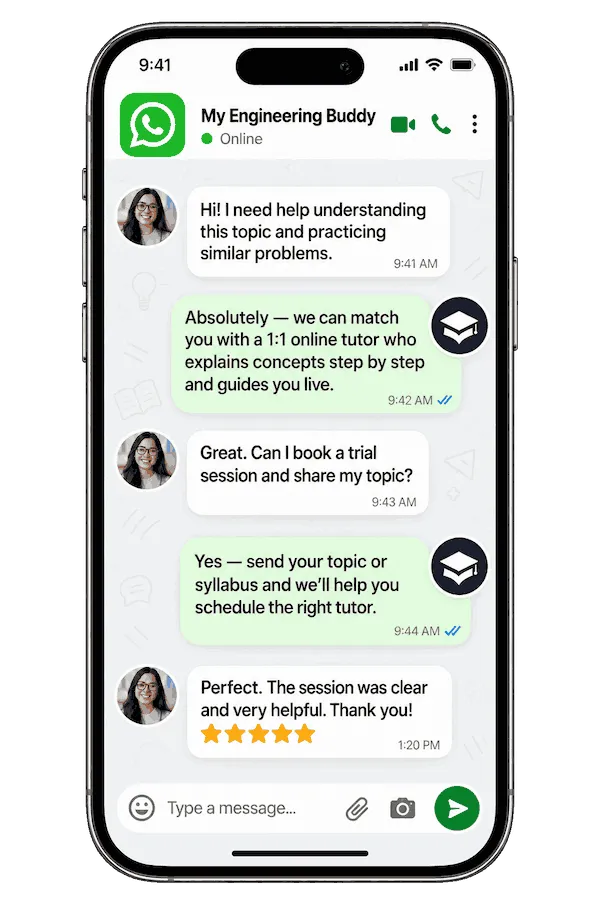
Unlike platforms where you fill out a form and wait, MEB responds in under a minute, 24/7. Tutor match takes under an hour. The $1 trial means you test before you commit. Everything runs over WhatsApp — no logins, no intake forms.
Study Plans (Pick One That Matches Your Goal)
After the first diagnostic session, your tutor builds the sequence. Three common structures: a catch-up plan (1–3 weeks, closing specific grammar or essay gaps before a submission deadline), an exam prep plan (4–8 weeks, structured revision across grammar, reading, writing, and oral components ahead of finals), or weekly ongoing support aligned to your semester schedule and coursework deadlines. The tutor adjusts the plan after each session — it’s not fixed from week one.
Pricing Guide
Swahili tutoring starts at $20/hr for beginner and intermediate levels. Advanced university and graduate-level sessions typically run $35–$70/hr. Specialist tutors with research or professional backgrounds in East African linguistics or literature are available at higher rates — share your specific goal and MEB will match the tier to your ambition.
Rate factors: your level, topic complexity, how close you are to a deadline, and tutor availability. Availability shrinks during semester exam periods — the closer to finals, the harder the booking.
Start with the $1 trial — 30 minutes, no registration, no commitment. WhatsApp MEB for a quick quote.
A common pattern our tutors observe is that students underestimate how much of their Swahili grade rests on grammatical agreement rather than vocabulary. A student who knows 800 words but uses noun class prefixes inconsistently will score lower than a student who knows 400 words and applies agreement correctly every time.
FAQ
Is Swahili hard to learn?
Swahili phonology is more straightforward than many languages — pronunciation follows consistent rules. The challenge is the noun class system and its agreement patterns across verbs, adjectives, and pronouns. Students with no prior exposure to Bantu languages typically find this the steepest part of the learning curve.
How many sessions will I need?
Most students working on a specific grammar weakness or exam component see clear improvement within 8–12 sessions. Students building proficiency from scratch for a full university module typically work over a semester. The first diagnostic session gives a more precise estimate for your situation.
Can you help with Swahili practice exercises?
Yes. MEB tutoring is guided learning — you understand the work, then submit it yourself. See our Academic Integrity policy and Why MEB page for full details on what we help with and what we don’t. Tutors explain grammar rules, essay structure, and translation tasks so the work you produce is genuinely yours.
Will the tutor match my exact syllabus or exam board?
Yes. Before matching, MEB asks for your institution, course code, and any exam board specifications. Tutors are selected based on familiarity with your specific module — not assigned generically. If your university uses a particular textbook, tell MEB when you WhatsApp.
What happens in the first session?
The tutor runs a short diagnostic — reviewing a recent homework attempt or asking you to produce a few sentences from the current topic. This maps your exact gaps and tells the tutor where to start. By the end of the first session you’ll have a topic sequence and a specific task for before next time.
Is online Swahili tutoring as effective as in-person?
For grammar-focused and essay-focused work, yes. The digital pen-pad replicates whiteboard explanation. Oral components work well over Google Meet with a stable connection. The main difference is that you need a quiet space with a decent microphone — particularly important for pronunciation practice.
Can I get help with Swahili at midnight or on weekends?
Yes. MEB operates 24/7 across time zones. Students in the Gulf, Australia, and the US West Coast regularly book late-evening or weekend sessions. WhatsApp MEB at any hour — average response time is under a minute regardless of when you message.
What if I don’t like my assigned tutor?
Tell MEB via WhatsApp and a replacement is arranged — usually within the same day. The $1 trial exists precisely for this: you test the fit before committing to a paid block. No awkward conversations, no fees for switching.
Do you offer group Swahili sessions?
MEB specialises in 1:1 sessions. Group arrangements aren’t standard, but if two students from the same course want shared sessions at a split rate, message MEB to discuss — it’s handled case by case.
What is the difference between Standard Swahili and spoken regional varieties?
Standard Swahili (Kiswahili Sanifu) is the written and formal register taught in most university programmes and used in official East African contexts. Regional varieties differ in vocabulary and some phonological features. University modules and formal exams assess Standard Swahili — tutors focus on this unless you specify otherwise.
How do I find a Swahili tutor without paying for a full term upfront?
Start with the $1 trial — 30 minutes of live tutoring or one question answered in full. No term commitment, no registration. WhatsApp MEB, describe what you’re working on, and you’re matched with a verified tutor within the hour. Pay per session or by block — your choice.
How do I get started?
Three steps: WhatsApp MEB with your course details and deadline, get matched with a verified Swahili tutor (usually within an hour), and start your $1 trial session — 30 minutes live or one homework question explained in full. No forms, no wait time.
Trust & Quality at My Engineering Buddy
Every MEB tutor goes through subject-specific vetting — not a generic onboarding process. For Swahili, that means demonstrating proficiency, explaining grammar rules live, and passing a reviewed demo session before being assigned to any student. Tutors hold relevant degrees or equivalent professional experience in Swahili linguistics, African Studies, or translation. Ongoing session feedback drives continuous review — underperforming tutors are removed, not just flagged. Rated 4.8/5 across 40,000+ verified reviews on Google.
MEB tutoring is guided learning — you understand the work, then submit it yourself. For full details on what we help with and what we don’t, read our Academic Integrity policy and Why MEB.
MEB has served 52,000+ students across the US, UK, Canada, Australia, the Gulf, and Europe since 2008 — across 2,800+ subjects. Language subjects are one of MEB’s strongest categories, with active tutor rosters in Swahili, French tutoring, Spanish tutoring, and Chinese tutoring. If you need support in a closely related area, see our tutoring methodology for how MEB structures learning across language subjects.
Explore Related Subjects
Students studying Swahili often also need support in:
Next Steps
Before your first session, have ready: your exam board and syllabus (or course outline), a recent essay or homework attempt you struggled with, and your exam or submission deadline. The tutor handles the rest.
- Share your course module, hardest component (grammar, writing, oral), and current timeline
- Share your availability and time zone
- MEB matches you with a verified Swahili tutor — usually within 24 hours
The first session starts with a diagnostic so every minute is used well. Visit www.myengineeringbuddy.com for more on how MEB works.
WhatsApp to get started or email [email protected].
Reviewed by Subject Expert
This page has been carefully reviewed and validated by our subject expert to ensure accuracy and relevance.