




~1 min
Average Reply Time
~1 hour
To Be Matched With A Tutor
30 Min Trial
75% Find Their Tutor On The 1st Trial
$20-35+/hr
Premium Yet Affordable Learning
Still losing marks on German cases and verb conjugations six weeks before your exam? That’s the exact gap a 1:1 German tutor closes — fast.
German Tutor Online
German is a West Germanic language spoken by over 100 million native speakers across Germany, Austria, and Switzerland. Studied at GCSE, A Level, IB, AP, and university level, it equips learners with professional communication and literary analysis skills.
MEB provides 1:1 online tutoring and homework help across 2,800+ advanced subjects — including German at every level from GCSE through university. Whether you’re searching for a German tutor near me or need flexible online sessions that fit a US, UK, or Gulf time zone, MEB matches you with a verified subject specialist, usually within the hour. Our language tutoring programme covers the full range of modern and classical languages, and German sits at its core. One diagnostic session shows the tutor exactly where your marks are going — and why.
- 1:1 online sessions tailored to your exact course and exam board
- Expert-verified tutors with demonstrated subject-specific knowledge in German
- Flexible time zones — US, UK, Canada, Australia, and the Gulf all covered
- Structured learning plan built after a first diagnostic session
- Ethical homework and assignment guidance — you understand the work before you submit it
52,000+ students across the US, UK, Canada, Australia, and the Gulf have used MEB since 2008 — including students in Language subjects like German, French, and Spanish, as well as students tackling Italian and Dutch.
Source: My Engineering Buddy, 2008–2025.
How Much Does a German Tutor Cost?
Most German tutoring sessions run at $20–$40/hr, depending on level and exam board. Advanced undergraduate or university-level German literature may reach $60–$70/hr. Not sure yet? Start with the $1 trial — 30 minutes of live 1:1 tutoring or a full explanation of one homework question.
| Level / Need | Typical Rate | What’s Included |
|---|---|---|
| Standard (GCSE, A Level, IB, AP) | $20–$35/hr | 1:1 sessions, homework guidance, syllabus alignment |
| Advanced / University-Level | $35–$70/hr | Expert tutor, literature, linguistics, translation depth |
| $1 Trial | $1 flat | 30 min live session or one full homework question explained |
Tutor availability tightens significantly in the four weeks before A Level, IB, and AP exam windows. Book early if you’re working to a fixed deadline.
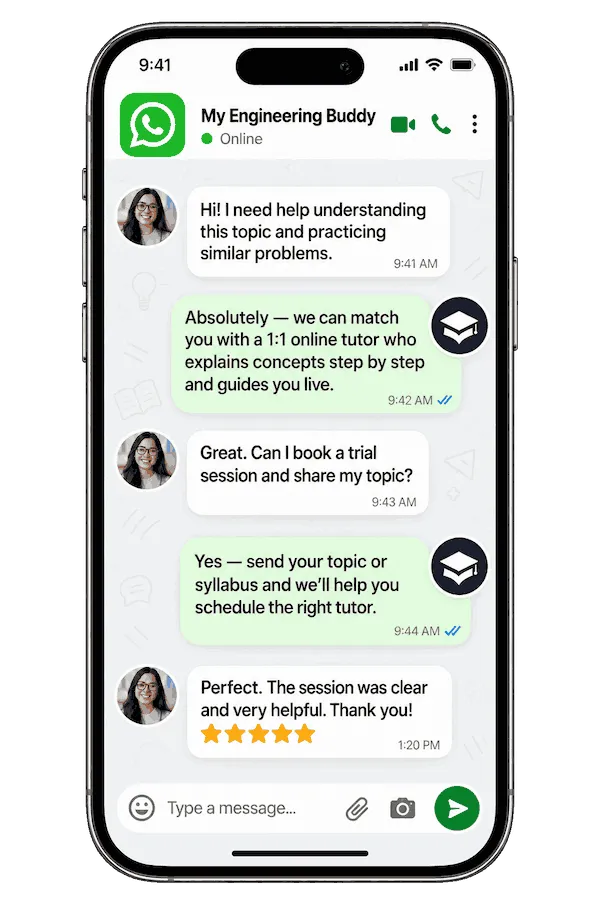
WhatsApp MEB for a quick quote — average response time under 1 minute.
Who This German Tutoring Is For
German attracts learners at very different stages — and with very different pressures. Some need to close a grammar gap before a final paper. Others are starting from scratch with no background in the language at all.
- GCSE and A Level students working through Edexcel, AQA, or OCR German syllabuses
- IB and AP German Language and Culture students preparing for oral and written components
- Undergraduate students enrolled in German language, literature, or linguistics modules at universities such as Edinburgh, Toronto, Melbourne, NYU, or the University of Amsterdam
- Students retaking after a failed first attempt and needing targeted support on specific weak areas
- Students with a university conditional offer depending on this German grade — every mark matters
- Parents watching a child’s confidence drop alongside their written German scores
If you’re preparing for the Goethe-Institut exams (A1 through C2), the TestDaF, or the DSH (Deutsche Sprachprüfung für den Hochschulzugang), MEB tutors can work to those specific frameworks too. Need support with a German translation essay or an oral exam roleplay? Those count as well. Start with the $1 trial to test the fit before committing to a regular schedule.
1:1 Tutoring vs Self-Study vs AI vs YouTube vs Online Courses
Self-study works if you’re disciplined — but German grammar (the four-case system, adjective endings, separable verbs) produces errors that go uncaught without a reader who knows the rules. AI tools explain quickly but can’t hear your German oral or tell you why your Akkusativ usage is inconsistent. YouTube covers the basics well; it stops short when you’re stuck on a Konjunktiv II construction at 11 pm. Online courses move at a fixed pace that rarely matches your exam timetable. 1:1 tutoring with MEB is live, calibrated to your specific board and component, and corrects errors the moment they appear — not three weeks later when you’ve already embedded the wrong pattern.
Outcomes: What You’ll Be Able To Do in German
After consistent 1:1 German tutoring sessions, students can write coherent, accurately structured essays on literary and cultural topics with the right register and case agreement throughout. They can analyze a German prose or poetry extract and produce the kind of response that earns marks in the written exam — not just general commentary. Students apply the full case system (Nominativ, Akkusativ, Dativ, Genitiv) without reverting to guesswork under exam pressure. They present and respond in the oral component with enough fluency to hold a structured conversation on familiar and unfamiliar themes. And they read authentic German texts — news articles, short stories, letters — with enough comprehension to answer inference questions accurately.
Supporting a student through German? MEB works directly with parents to set up sessions, track progress, and keep coursework on schedule. WhatsApp MEB — average response time is under a minute, 24/7.
Based on feedback from 40,000+ sessions collected by MEB from 2022 to 2025, 58% of students improved by one full grade after approximately 20 hours of 1:1 tutoring in subjects like German. A further 23% achieved at least a half-grade improvement.
Source: MEB session feedback data, 2022–2025.
What We Cover in German (Syllabus / Topics)
Grammar and Language Structure
- The four-case system: Nominativ, Akkusativ, Dativ, Genitiv — with der/die/das agreement
- Verb conjugation: regular, irregular, separable, reflexive, and modal verbs
- Tense formation: Präsens, Perfekt, Präteritum, Futur I and II
- Konjunktiv I and II — reported speech and hypothetical constructions
- Passive voice, relative clauses, and subordinate clause word order
- Adjective endings across all case/gender combinations
- Common prepositions governing Akkusativ, Dativ, or both
Core references: Hammer’s German Grammar and Usage (Durrell), German: An Essential Grammar (Paulsell), Schaum’s Outline of German Grammar.
Reading Comprehension and Written Production
- Reading authentic German texts — newspaper extracts, literary passages, formal letters
- Comprehension strategies: inference, gist, and detail questions
- Structured essay writing in German with formal register and accurate grammar
- Translation into and out of German at GCSE, A Level, and undergraduate level
- Summary and note-taking from German source texts
- Text types: discursive essays, letters, reports, and creative responses
Core references: The Oxford-Duden German Dictionary, Vorsprung (Lovik et al.), Deutsch: Na klar! (DiDonato et al.).
Literature, Culture, and Oral Preparation
- Set texts: prose, drama, and poetry — varies by board (AQA, Edexcel, IB, AP)
- Themes and context in 20th-century German literature (e.g. Kafka, Brecht, Grass)
- Historical and cultural context: Weimar Republic, post-war Germany, reunification
- Oral exam preparation: structured conversation, roleplay, and stimulus-card responses
- Listening comprehension: audio texts, radio extracts, and interview formats
- AP German Language and Culture: interpersonal writing, presentational speaking, cultural comparison
Core references: Begegnungen B1+ (Buscha/Szita), Menschen series (Hueber), AP German Language and Culture (Stiefenhöfer).

At MEB, we’ve found that German learners who struggle with the case system aren’t making random errors — they’re applying a consistent wrong rule. Identifying that rule in the first session, and replacing it cleanly, is faster than drilling exercises for weeks without knowing what’s actually broken.
What a Typical German Session Looks Like
The tutor opens by checking the previous session’s practice task — usually a short paragraph written in German using the Konjunktiv II or a set of translation sentences. The student shares their screen or a photo of their work. The tutor reads through it on screen, annotates using a digital pen-pad, and identifies the exact errors: case endings, verb placement, or register. Then the two of them work through a fresh set of problems together — maybe a reading passage from a past AQA or IB paper, or a structured essay plan for a literary text. The student attempts each section first; the tutor steps in when the reasoning breaks down. By the end, the student has a concrete task: rewrite two paragraphs, prepare three oral responses on a given theme, or translate a passage without looking at the model answer. Next topic is agreed before the session closes.
How MEB Tutors Help You with German (The Learning Loop)
Diagnose: In the first session, the tutor asks the student to produce a short piece of written German or works through a past paper question together. The aim is to find the actual gap — not the one the student thinks they have, but the one showing up in their marks.
Explain: The tutor works through the problem live on Google Meet using a digital pen-pad. For German grammar, this often means annotating a sentence to show case function in real time — not just stating a rule, but showing why a specific word takes a specific ending in this sentence.
Practice: The student attempts the next question or construction while the tutor watches. This is where the real learning happens. Doing it correctly once under supervision is worth more than twenty passive revision exercises. You can get French tutoring or Spanish tutoring through MEB using the same live-practice structure.
Feedback: The tutor goes through each error and explains precisely why marks would be lost — whether it’s Dativ/Akkusativ confusion, wrong subordinate clause order, or a register mismatch in a written task. The student doesn’t just see the correction; they understand the rule it applies.
Plan: The tutor sets a specific task for before the next session and notes the next topic in the sequence. Progress is tracked. If an exam date is approaching, the session plan shifts accordingly — oral practice and past papers take priority over new grammar.
Sessions run on Google Meet. The tutor uses a digital pen-pad or iPad and Apple Pencil to annotate text on screen. Before your first session, share your exam board, current grade or level, a recent piece of written German work, and your exam date if one is set. The first session covers a diagnostic and the first topic. Start with the $1 trial — 30 minutes of live tutoring that also serves as your first diagnostic.
Students consistently tell us that the moment things click in German isn’t when they memorise a table — it’s when they understand why the language works the way it does. The case system stops being random once a tutor shows you the logic underneath it.
Tutor Match Criteria (How We Pick Your Tutor)
Match quality matters more than speed. Here’s what MEB checks before pairing you with a German tutor.
Subject depth: The tutor must have demonstrated competence in German at your specific level — GCSE, A Level, IB, AP, or university. Exam board matters: a tutor who knows AQA German may not know the Edexcel oral format.
Tools: Every tutor uses Google Meet and a digital pen-pad or iPad with Apple Pencil. No exceptions — written annotation is essential for language correction work.
Time zone: MEB matches to your region — US Eastern, UK/Europe, Gulf Standard, or Australian Eastern. Late-night sessions available.
Goals: Whether you need exam score improvement, essay writing help, oral confidence, or homework guidance on a specific assignment, the match reflects that specific goal.
Unlike platforms where you fill out a form and wait, MEB responds in under a minute, 24/7. Tutor match takes under an hour. The $1 trial means you test before you commit. Everything runs over WhatsApp — no logins, no intake forms.
Study Plans (Pick One That Matches Your Goal)
MEB builds the session sequence after the diagnostic, but most German students fall into one of three patterns: catch-up (1–3 weeks, specific grammar gaps or missed coursework to close before an exam), exam prep (4–8 weeks of structured revision covering all four skills — reading, writing, listening, oral — aligned to a specific exam date), or weekly support (ongoing sessions through the semester, timed around essay deadlines and oral mock dates). The tutor maps the exact sequence after the first session.
Pricing Guide
German tutoring starts at $20/hr for standard school-level work and runs to $40/hr for most undergraduate and language-intensive sessions. Niche support — such as translation studies, academic German for research, or TestDaF/DSH preparation — may reach $60–$100/hr depending on tutor background.
Rate factors: your level, the specific component (writing vs oral vs reading), timeline pressure, and tutor availability. Availability tightens sharply in the four weeks before major exam windows — A Level, IB, and AP sessions in particular.
For students targeting offers from competitive universities where a German grade at A or 7 is a condition — or for those aiming at B2/C1 proficiency certifications — tutors with professional backgrounds in linguistics, translation, or German literature are available at higher rates. Share your specific goal and MEB will match the tier to your target.
Start with the $1 trial — 30 minutes, no registration, no commitment. WhatsApp MEB for a quick quote.
MEB tutors have supported students across Language subjects — German, French, Spanish, Italian — from school level through university finals. The same structured diagnostic and feedback loop applies regardless of the language or the level.
Source: My Engineering Buddy, 2008–2025.
FAQ
Is German hard to learn?
German grammar is genuinely complex — four noun cases, grammatical gender on every noun, and verb-second word order in main clauses. Most learners find the case system the steepest part. With a tutor working through the logic live, the rules become predictable rather than arbitrary.
How many sessions do I need?
Students with a specific exam in 4–6 weeks typically need 8–12 focused sessions. Students building general proficiency work at their own pace. The tutor sets a realistic timeline after the first diagnostic, based on your current level and your goal.
Can you help with homework and assignments?
Yes. MEB tutoring is guided learning — you understand the work, then submit it yourself. That applies to translation tasks, essay drafts, grammar exercises, and oral preparation. See our Academic Integrity policy and Why MEB page for full details on what we help with and what we don’t.
Will the tutor match my exact syllabus or exam board?
Yes. When you contact MEB, share your board (AQA, Edexcel, OCR, IB, AP, Goethe-Institut, TestDaF, or your university’s course outline). The tutor is matched to that specific framework — not a generic German curriculum.
What happens in the first session?
The tutor runs a short diagnostic — usually a piece of written German or a past paper question. This identifies your real gaps, not just the ones you’re aware of. The session plan for subsequent weeks is built from what the diagnostic shows.
Is online tutoring as effective as in-person for German?
For German specifically, yes. The tutor annotates text, corrects written work, and conducts oral practice over Google Meet with a digital pen-pad. The feedback loop is immediate. Students preparing for listening and speaking components find the online format works well once the session structure is established.
What is the difference between A Level German and IB German?
A Level German (typically AQA or Edexcel) is a two-year qualification assessed through reading, writing, listening, and speaking components, with a literature or film study element. IB German (ab initio or Language B) is part of the broader IB Diploma and includes individual oral assessment and a written assignment. The texts, themes, and assessment criteria differ substantially between boards, and MEB tutors work to the specific one you’re sitting.
Can you help with the AP German Language and Culture exam?
Yes. AP German Language and Culture covers interpersonal communication, presentational writing and speaking, and cultural comparison tasks. MEB tutors work through past exam prompts, the email reply task, the argumentative essay, and the cultural comparison presentation — all components that reward structured practice rather than passive study.
Can you help me prepare for the Goethe-Institut or TestDaF exams?
Yes. These are proficiency-based exams rather than school qualifications, and MEB tutors familiar with the B2–C2 level frameworks can work through the specific task types — written production, reading comprehension, oral interaction, and listening — that appear in the Goethe-Institut and TestDaF formats. Share the level and exam date when you contact MEB.
Do you offer group German sessions?
No. MEB offers 1:1 sessions only. Group sessions reduce personalisation to the point where the tutor can no longer focus on your specific errors in real time. Every session is built around one student’s exact gaps and goals.
How do I find a German tutor available in my time zone?
When you contact MEB via WhatsApp, share your time zone and preferred session times. MEB covers US Eastern, Pacific, UK, Gulf, and Australian Eastern time zones. Tutors working late-night slots are available for students in the Gulf and Asia-Pacific regions.
How do I get started?
Start with the $1 trial — 30 minutes of live 1:1 tutoring or one homework question explained in full. Three steps: WhatsApp MEB, get matched within the hour, and start your trial session. No registration, no commitment required.
Trust & Quality at My Engineering Buddy
Every MEB German tutor goes through subject-specific screening before their first session: a live demonstration of their teaching ability, a review of their German-language qualifications or professional background, and ongoing evaluation through student feedback after each session. Tutors working at A Level or IB level are checked against the relevant syllabus. Those covering university-level literature or linguistics hold postgraduate qualifications in those areas. Rated 4.8/5 across 40,000+ verified reviews on Google. That rating reflects 18 years and 52,000+ students — not a recent spike.
MEB tutoring is guided learning — you understand the work, then submit it yourself. For full details on what we help with and what we don’t, read our Academic Integrity policy and Why MEB.
MEB has been serving students in Language subjects — including German, Italian tutoring, and Arabic tutoring — since 2008, across the US, UK, Canada, Australia, the Gulf, and Europe. The platform now covers 2,800+ subjects. You can also find support for Russian tutoring and Japanese tutoring within the same network. Tutor quality is consistent across all language subjects — the same screening, the same session structure, the same feedback loop. Read more about the approach on our tutoring methodology page.
Try your first session for $1 — 30 minutes of live 1:1 tutoring or one homework question explained in full. No registration. No commitment. WhatsApp MEB now and get matched within the hour.
Explore Related Subjects
Students studying German often also need support in:
From GCSE to university finals, MEB German tutors work to your exact exam board, your exact component, and your exact deadline. No generic curriculum. No wasted sessions.
Source: My Engineering Buddy, 2008–2025.
Next Steps
Ready to start? Here’s what to do:
- Share your exam board (AQA, Edexcel, IB, AP, Goethe-Institut, TestDaF, or your university module) and your hardest component
- Share your availability and time zone — MEB covers all major regions
- MEB matches you with a verified German tutor, usually within 24 hours
- Your first session starts with a diagnostic so every minute is used well
Before your first session, have ready:
- Your exam board and syllabus (or university course outline)
- A recent piece of written German, past paper attempt, or homework question you struggled with
- Your exam or assignment deadline date — the tutor maps the plan from there
Visit www.myengineeringbuddy.com for more on how MEB works.
WhatsApp to get started or email [email protected].
Reviewed by Subject Expert
This page has been carefully reviewed and validated by our subject expert to ensure accuracy and relevance.




