
Transform Learning with STEM Tutoring: Boost Grades and Build 21st Century Skills

STEM tutoring provides personalized, flexible support that significantly improves academic performance, confidence, and problem-solving skills in science, technology, engineering, and mathematics subjects.
The Growing Demand for STEM Tutoring in Today’s Educational Landscape
The world’s appetite for STEM professionals continues to soar, yet students across the globe struggle to master these challenging subjects. STEM jobs are projected to grow 10.4% between 2023 and 2033, almost three times faster than non-STEM occupations. This dramatic growth means that today’s students face an unprecedented opportunity—but only if they can successfully navigate complex mathematical equations, scientific theories, and engineering principles.
The reality is stark: despite this massive demand, educational systems worldwide face significant challenges. In the United States alone, over 3.5 million STEM jobs are projected to remain unfilled by 2025 due to a critical skills gap. Meanwhile, only 20% of high school graduates are prepared for college-level STEM coursework.
The financial incentives for mastering these subjects are undeniable. Let’s look at the data comparing STEM and non-STEM career trajectories.
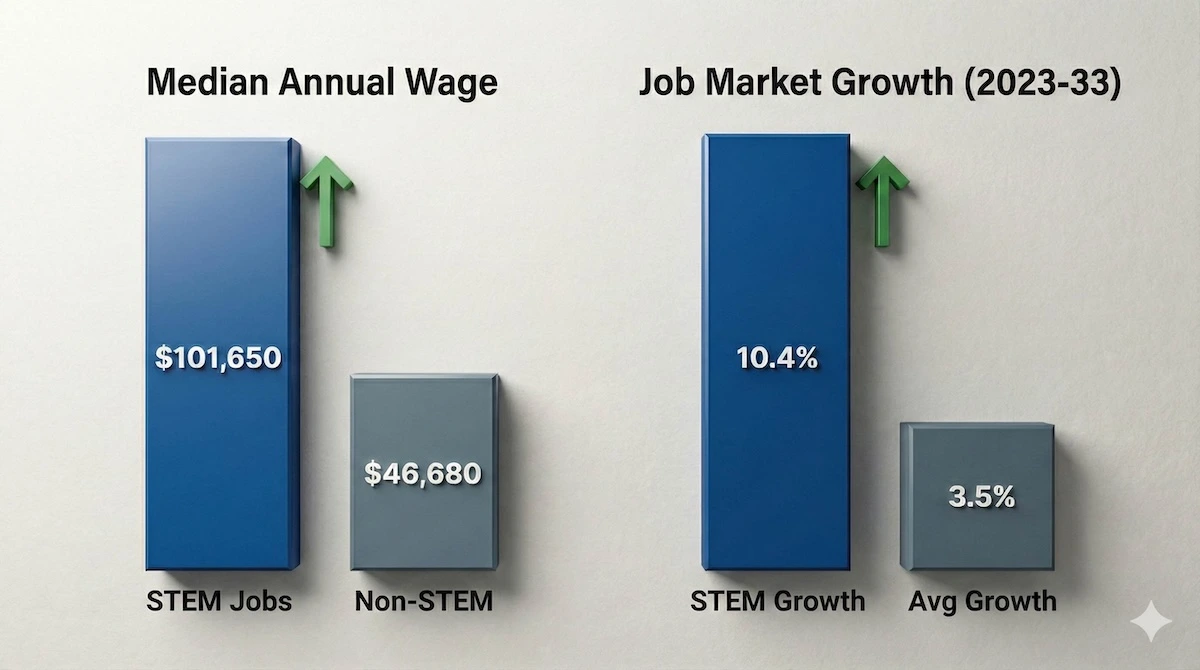
Data confirms that STEM careers offer double the salary and triple the growth potential of non-STEM fields.
As the data shows, the investment in STEM skills yields significantly higher returns in both salary and job security.
This gap creates a powerful opportunity for students who receive proper support. STEM tutoring has emerged as one of the most effective solutions, with research showing that 76% of students reported grade improvements within 3 months of starting online tutoring.
Understanding the STEM Education Challenge
STEM subjects present unique challenges that traditional classroom settings often struggle to address effectively. These disciplines require not just memorization, but deep conceptual understanding, analytical thinking, and the ability to apply abstract concepts to real-world problems.
Consider Sarah, a high school junior struggling with organic chemistry. In her packed classroom of 30 students, she felt lost when the teacher explained molecular structures. The fast-paced curriculum left little time for individual questions. However, after working with a STEM tutor online, Sarah could pause, ask questions, and work through problems at her own pace. Within two months, her chemistry grade improved from a D+ to a B.
Change doesn’t happen overnight, but with structured support, it happens faster than you might think. Here is what a typical improvement timeline looks like.
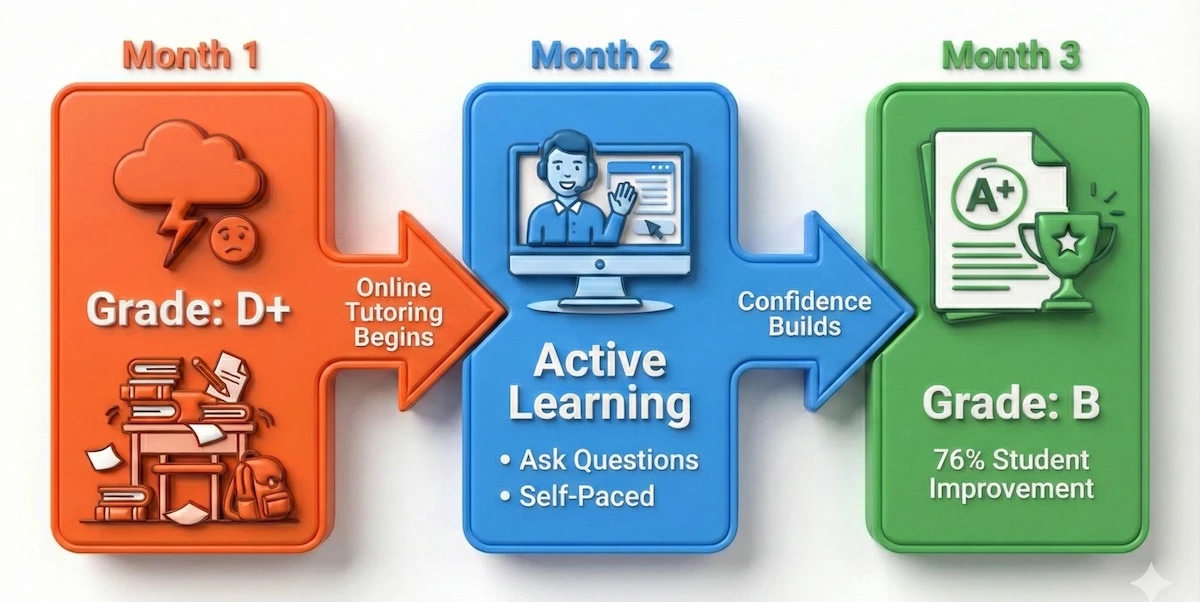
Consistent online tutoring can transform a struggling student into a confident achiever in just three months.
Reaching that ‘B’ grade or higher is a predictable result of consistent, active engagement with a tutor.
The Scale of STEM Teacher Shortages
The challenge extends beyond student difficulties to include severe teacher shortages. STEM teacher production has decreased substantially from nearly 32,000 teachers in 2011 to under 20,000 in 2022—a 37% drop over the last decade. In many regions, more than 80% of secondary schools face shortages of adequate mathematics and science teachers.
This shortage particularly affects underserved communities and rural areas, where students have even fewer opportunities to access quality STEM instruction. STEM tutoring online bridges this gap by connecting students with expert educators regardless of geographic location.
The Science Behind Effective STEM Tutoring
Research consistently demonstrates that personalized tutoring produces remarkable results in STEM subjects. The median annual wage for STEM occupations is $101,650 compared with $46,680 for non-STEM jobs, making the investment in quality STEM education particularly valuable.
A comprehensive study of online math tutoring programs found that students experienced gains equivalent to six additional months of learning. The key factors contributing to this success include individualized attention, adaptive pacing, and immediate feedback—all hallmarks of effective STEM homework help.
Personalized Learning Approaches
Effective STEM tutoring recognizes that each student learns differently. Some students are visual learners who benefit from diagrams and interactive simulations, while others prefer step-by-step verbal explanations. A skilled STEM teacher can quickly identify these learning preferences and adapt their approach accordingly.
Modern online platforms enhance this personalization through technology. Interactive whiteboards, virtual labs, and simulation software allow tutors to demonstrate complex concepts in engaging ways. Students can manipulate variables in physics experiments or visualize molecular interactions in chemistry, making abstract concepts tangible.
Benefits of Online STEM Tutoring
The transition to digital education has revolutionized how students access STEM support. The global online tutoring market is projected to reach $23.73 billion by 2030, growing at a CAGR of 14.5%, with STEM subjects accounting for the largest share of this growth.
Flexibility and Accessibility
Unlike traditional tutoring, STEM tutoring online eliminates geographic barriers and scheduling constraints. Students in rural areas can access the same high-quality instruction as their urban counterparts. Working professionals returning to school can schedule sessions around their work commitments.
Consider Marcus, a college student working part-time while studying engineering. Traditional tutoring centers closed before he finished his shift, but online sessions allowed him to receive STEM assignment help at 10 PM after work. This flexibility was crucial to his academic success.
Cost-Effective Solutions
Online platforms often provide more affordable options than in-person tutoring. The average cost of private tutoring ranges from $25 to $80 per hour, with specialized STEM subjects typically commanding higher rates. However, online delivery models can reduce these costs while maintaining quality through efficient resource allocation.
How does online tutoring really stack up against traditional face-to-face sessions? This comparison highlights the key differences.
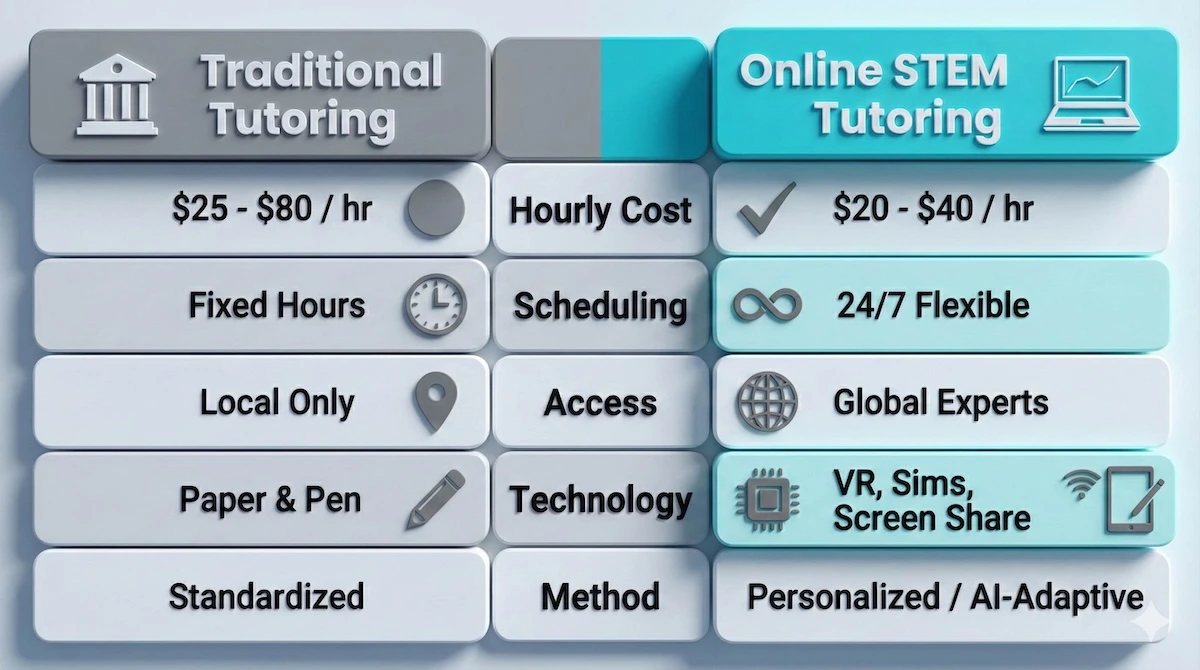
Online tutoring offers superior flexibility, lower costs, and advanced learning tools compared to traditional methods.
The flexibility and digital tools available online provide a distinct advantage for today’s busy students.
Many platforms offer various pricing tiers, from on-demand STEM hw help to comprehensive monthly packages that include unlimited question-and-answer support, practice problems, and progress tracking.
Enhanced Engagement Through Technology
Digital tools transform how students interact with STEM content. Virtual reality can transport students inside a human cell for biology lessons, while coding platforms allow real-time collaboration on programming projects. These interactive elements make learning more engaging and memorable than traditional textbook approaches.
Success Stories: Real Students, Real Results
The impact of quality STEM tutoring extends far beyond improved grades. Research shows that students who receive consistent tutoring support develop increased confidence, better study habits, and stronger problem-solving skills that benefit them throughout their academic and professional careers.
Take the case of Maria, a first-generation college student struggling with calculus. Her family couldn’t afford expensive private tutoring, but she found an affordable online STEM tutor through a scholarship program. Not only did her calculus grade improve from failing to an A-, but she also developed the confidence to pursue a computer science major.
Studies of online STEM education programs show particularly promising results. Students’ self-efficacy improved significantly after participating in online STEM camps, with gains in computational thinking and task value that persisted beyond the program duration.
Building Essential 21st Century Skills
Beyond subject mastery, STEM tutoring develops critical skills increasingly valued by employers. Students learn to approach complex problems systematically, communicate technical concepts clearly, and persist through challenging tasks.
These skills prove invaluable across disciplines. A student who learns rigorous problem-solving through physics tutoring applies the same systematic approach to business analysis. Mathematical modeling skills transfer to economics coursework and financial planning.
How to Choose the Right STEM Tutor
With the growing market for STEM tutoring online, students and parents face an overwhelming array of options. The key is identifying tutors who combine subject expertise with effective teaching skills and technological proficiency.
Essential Qualifications to Look For
When you hire a STEM tutor, prioritize candidates with both strong academic credentials and proven teaching experience. Look for tutors with advanced degrees in relevant fields, professional experience in STEM careers, and specific training in online education methods.
Many successful online tutors are practicing engineers, scientists, or researchers who bring real-world perspective to their instruction. This practical experience helps students understand how classroom concepts apply to actual career situations.
Technology and Platform Considerations
Effective online tutoring requires robust technology platforms that support interactive learning. Look for services that offer screen sharing, virtual whiteboards, file sharing, and session recording capabilities. The ability to record sessions allows students to review challenging concepts later, reinforcing learning.
Some platforms integrate directly with learning management systems used by schools, allowing seamless coordination between classroom instruction and tutoring support.
Communication and Teaching Style
The best STEM teacher adapts their communication style to match student needs. During initial consultations, assess whether the tutor can explain complex concepts in accessible language, demonstrates patience with student questions, and provides constructive feedback.
Look for tutors who encourage questions and create safe learning environments where students feel comfortable making mistakes. This psychological safety is particularly important in STEM subjects, where students often develop math anxiety or science phobia that impedes learning.
Finding the perfect tutor doesn’t have to be a guessing game. Use this simple checklist to vet potential candidates.
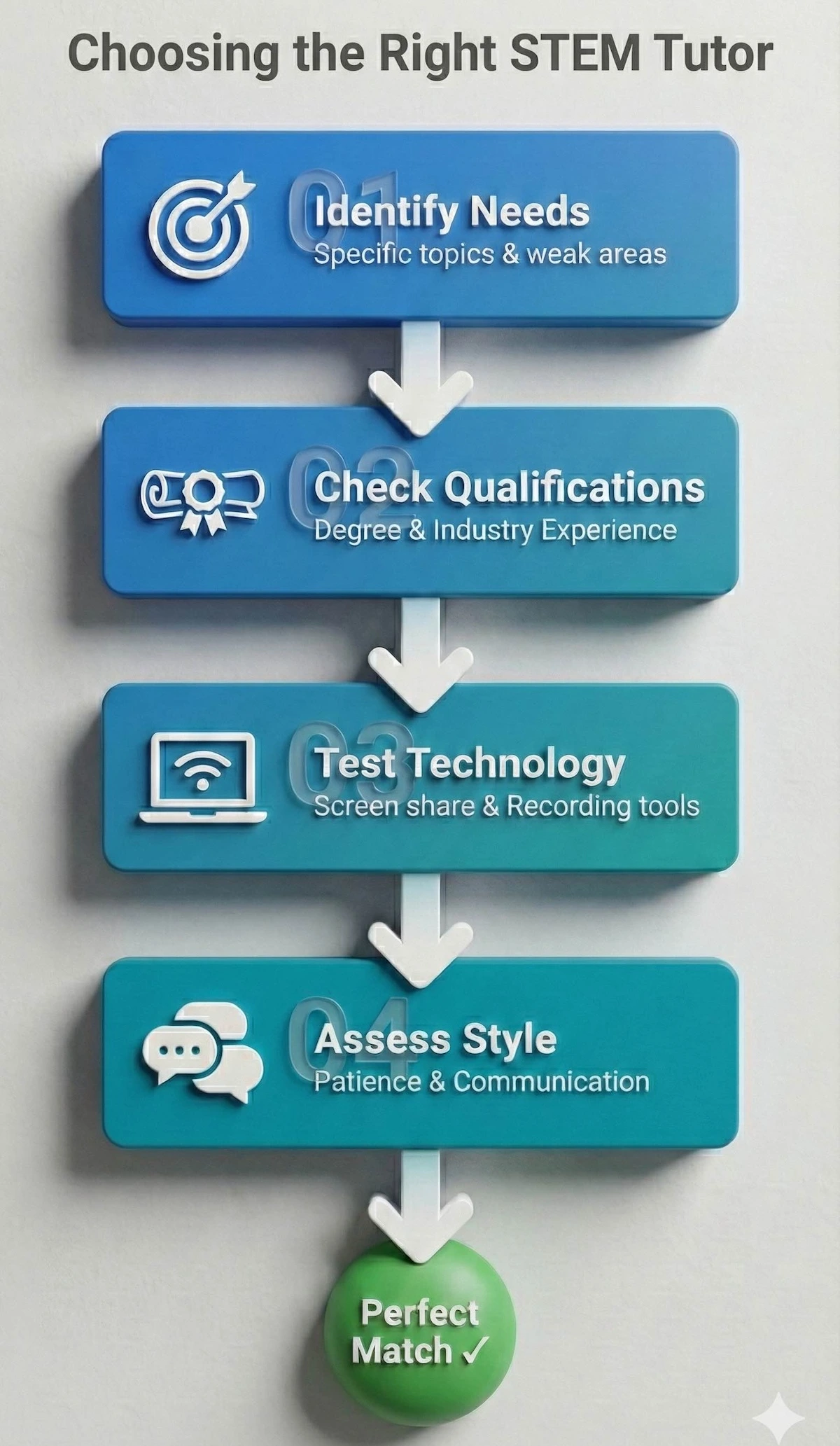
Follow this four-step checklist to find a tutor who matches your specific learning needs and technical requirements.
Following these four steps ensures you partner with an educator who fits your specific learning style.
Maximizing Your STEM Tutoring Experience
Getting the most value from STEM homework help requires active participation from students and clear communication about learning objectives. Successful tutoring relationships involve collaborative goal-setting and regular progress assessment.
Preparation and Goal Setting
Before beginning tutoring, identify specific learning objectives and areas where you need support. Are you struggling with particular mathematical concepts, or do you need help developing better problem-solving strategies? Clear goals help tutors customize their approach and measure progress effectively.
Prepare for sessions by reviewing recent coursework and identifying specific questions or problems where you’re stuck. This preparation maximizes the value of tutoring time and ensures you address the most pressing needs.
Active Learning Strategies
Effective STEM assignment help involves more than passive listening. Engage actively by asking questions, working through problems alongside your tutor, and explaining concepts back in your own words. This active participation reinforces learning and helps identify areas that need additional attention.
Take detailed notes during sessions and review them shortly afterward. Many students find it helpful to create summary sheets that connect tutoring content to their regular coursework, building bridges between different learning contexts.
To get the most out of every dollar spent on tutoring, you need a strategy. We call this the Active Learning Cycle.
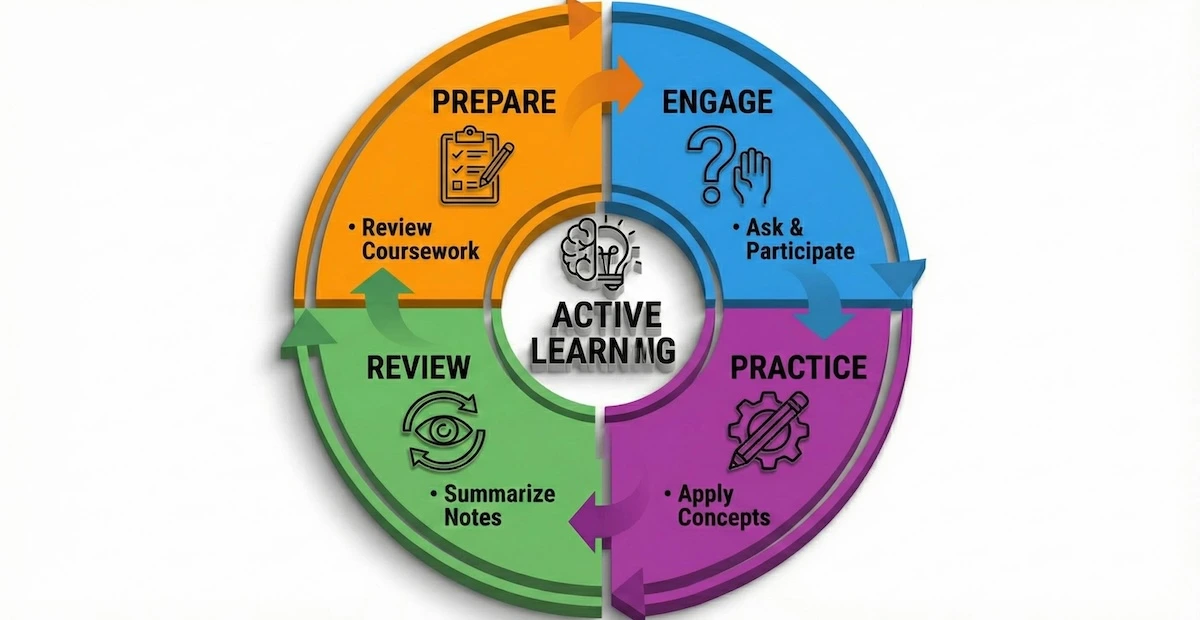
Maximize every tutoring session by following this continuous cycle of preparation, engagement, practice, and review.
By preparing beforehand and reviewing afterwards, you turn a one-hour session into long-term mastery.
Practice and Application
Learning STEM subjects requires consistent practice with immediate feedback. Work with your tutor to develop regular practice schedules that reinforce concepts between sessions. Many successful students schedule brief follow-up sessions to review practice work and address new questions that arise.
The Future of STEM Education and Tutoring
As technology continues advancing and STEM careers become even more central to economic growth, the demand for effective STEM education will only increase. China and India are projected to account for more than 60% of STEM graduates by 2030, compared to only 8% in Europe and 4% in the United States.
This global competition makes quality STEM education more critical than ever for students in developed countries. Those who invest in strong STEM foundations through tutoring and supplemental support will be best positioned to compete in tomorrow’s economy.
Artificial intelligence and machine learning are beginning to personalize tutoring experiences even further. AI-powered platforms can track learning patterns, predict areas where students might struggle, and automatically adjust difficulty levels to maintain optimal challenge.
Preparing for Emerging Technologies
The STEM fields themselves continue evolving rapidly. Today’s students must develop adaptable problem-solving skills and comfort with continuous learning rather than mastering fixed knowledge sets. Quality tutoring emphasizes these meta-cognitive skills alongside specific subject content.
Students who develop strong analytical thinking through mathematics tutoring, experimental design skills through science instruction, and systematic problem-solving through engineering projects will be prepared for careers that don’t yet exist.
Making STEM Accessible: Addressing Equity and Inclusion
One of the most promising aspects of online STEM tutoring is its potential to address educational inequities. Traditional tutoring often favors affluent families who can afford high hourly rates and transportation to tutoring centers. Online delivery models can significantly reduce these barriers.
Several organizations now offer scholarship programs and sliding-scale pricing specifically for STEM tutoring. These initiatives help ensure that students from all backgrounds can access the support they need to succeed in challenging STEM coursework.
Supporting Underrepresented Groups
Research consistently shows that women remain underrepresented in STEM occupations, with only 35% of STEM workers being female. Similarly, Black workers represent 11% of all jobs but only 9% of STEM jobs, while Hispanic workers represent 17% of all jobs but only 8% of STEM jobs.
Effective tutoring programs actively work to counter these disparities by providing encouraging, supportive learning environments that build confidence alongside competence. Role model tutors from underrepresented backgrounds can be particularly effective in inspiring students who might not otherwise see themselves in STEM careers.
Conclusion: Investing in STEM Success
STEM tutoring represents one of the most effective investments students and families can make in future academic and career success. With STEM careers offering significantly higher earning potential, better job security, and opportunities to solve meaningful global challenges, the stakes for STEM education have never been higher.
Whether you’re struggling with specific concepts, aiming to excel in advanced coursework, or preparing for competitive college admissions, quality STEM tutoring online provides the personalized support necessary for success. The combination of expert instruction, technological tools, and flexible scheduling makes online tutoring an increasingly attractive option for students worldwide.
As the demand for STEM professionals continues growing and educational systems struggle to keep pace, students who proactively seek supplemental support will gain significant competitive advantages. The investment in quality tutoring pays dividends not just in improved grades, but in developing the analytical thinking, problem-solving skills, and confidence necessary for lifelong success in our increasingly technical world.
Frequently Asked Questions About STEM Tutoring
Q1 Is online STEM tutoring as effective as in-person tutoring?
Research shows online tutoring can be equally effective when using interactive platforms and qualified instructors.
Q2 How much should I expect to pay for STEM tutoring?
Rates typically range from $20-40 per hour for high school subjects, with specialized topics commanding higher rates.
Q3 What qualifications should I look for in a STEM tutor?
Seek tutors with relevant degrees, teaching experience, and familiarity with current curricula and technology.
Q4 How often should I schedule STEM tutoring sessions?
Most students benefit from 1-2 sessions per week, with additional support during exam periods.
Q5 Can STEM tutoring help with college admission test preparation?
Yes, specialized tutors can effectively prepare students for SAT, ACT, and subject-specific AP exams.
Q6 What age students benefit most from STEM tutoring?
Students from middle school through college can benefit, with early intervention often preventing larger struggles later.
Related Subjects
Biology
Chemistry
Earth Science
Engineering
Environmental Science
Forensic Science
Health Sciences
Natural Sciences
Physics
Physics And Math
Science
******************************
This article provides general educational guidance only. It is NOT official exam policy, professional academic advice, or guaranteed results. Always verify information with your school, official exam boards (College Board, Cambridge, IB), or qualified professionals before making decisions. Read Full Policies & Disclaimer , Contact Us To Report An Error