




~1 min
Average Reply Time
~1 hour
To Be Matched With A Tutor
30 Min Trial
75% Find Their Tutor On The 1st Trial
$20-35+/hr
Premium Yet Affordable Learning
Hire The Best Earth Science Tutor



Most students don’t fail Earth Science because they’re not smart enough. They fail because plate tectonics, the rock cycle, and atmospheric systems were each taught in isolation — and no one connected them.
Earth Science Tutor Online
Earth Science is the study of Earth’s physical systems — including geology, meteorology, oceanography, and environmental science — equipping students to analyze natural processes, interpret data, and understand interactions between Earth’s spheres.
If you’ve searched for an Earth Science tutor near me, you’re likely staring down an exam date, a lab report, or a semester’s worth of material that hasn’t quite clicked. MEB connects you with a 1:1 online Earth Science tutor who knows your syllabus, your exam board, and the exact topics where students lose marks. Since 2008, MEB has served students across the US, UK, Canada, Australia, and the Gulf — and Earth Science is one of our most requested science subjects.
- 1:1 online sessions tailored to your course or syllabus
- Expert verified tutors with subject-specific knowledge in geology, meteorology, and related disciplines
- Flexible time zones — US, UK, Canada, Australia, Gulf
- Structured learning plan built after a diagnostic session
- Ethical homework and assignment guidance — you understand the material before you submit
52,000+ students across the US, UK, Canada, Australia, and the Gulf have used MEB since 2008 — including students in Earth Science subjects like geology tutoring, atmospheric science help, and oceanography tutoring.
Source: My Engineering Buddy, 2008–2025.
How Much Does an Earth Science Tutor Cost?
Earth Science tutoring with MEB starts at $20–$40/hr for most undergraduate and school-level courses. Niche or graduate-level work — such as advanced geophysics tutoring or research-level hydrogeology — may run up to $100/hr depending on tutor availability and topic depth. A $1 trial gets you 30 minutes of live 1:1 tutoring or a full explanation of one homework question.
| Level / Need | Typical Rate | What’s Included |
|---|---|---|
| Standard (most levels) | $20–$35/hr | 1:1 sessions, homework guidance |
| Advanced / Specialist | $35–$100/hr | Expert tutor, graduate or niche depth |
| $1 Trial | $1 flat | 30 min live session or 1 homework question explained |
Tutor availability tightens significantly in the weeks before AP, IB, and A Level exam windows. Book early.
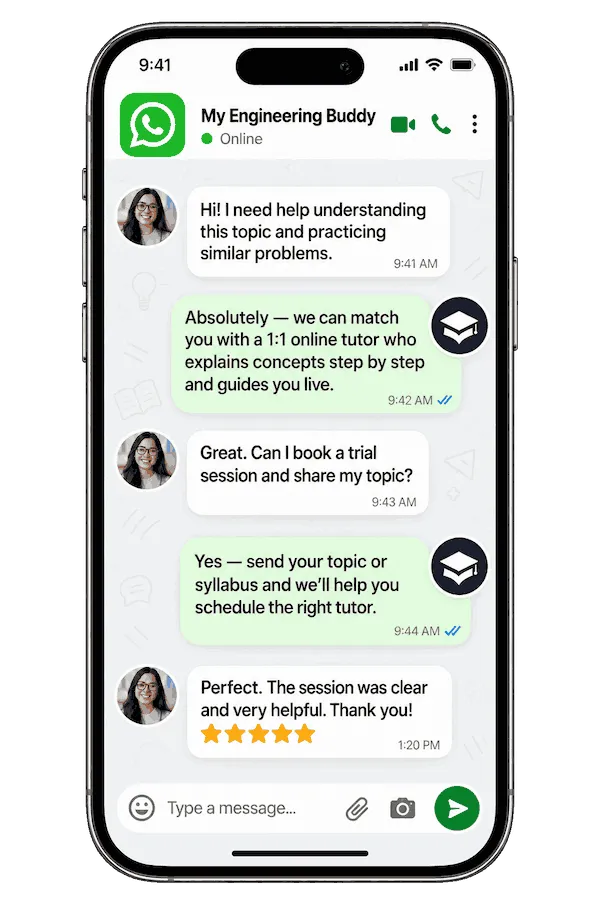
WhatsApp MEB for a quick quote — average response time under 1 minute.
Who This Earth Science Tutoring Is For
Earth Science spans a wide range of learners — from high school students working through their first plate tectonics unit to graduate students modeling groundwater systems. If you’re stuck anywhere in that range, MEB has a tutor who has been there before.
- High school and AP students preparing for Earth Science exams, lab reports, or final assessments
- IB and A Level students working through physical geography and environmental systems
- Early undergraduate students in geology, environmental science, or physical geography degree programs at universities including UC Santa Barbara, the University of Leeds, McGill, ANU, and Utrecht
- Graduate students needing support in hydrogeology, geochemistry, or sedimentology
- Students retaking after a failed first attempt who need a tutor who can identify exactly where the marks were lost
- Students with a university conditional offer that depends on their Earth Science grade this semester
- Parents watching a child’s confidence drop alongside their science grades
If you’re 4–6 weeks from a deadline with significant gaps to close, the $1 trial is the fastest way to find out whether MEB is the right fit.
1:1 Tutoring vs Self-Study vs AI vs YouTube vs Online Courses
Each option has a real place — but they’re not equivalent.
Self-study works if you’re disciplined, but Earth Science has too many interconnected systems — you need feedback to know when your model of the water cycle or rock cycle is subtly wrong. AI tools give fast explanations but can’t adapt live when you misidentify a metamorphic rock or misread a topographic map. YouTube covers the basics well; it stops cold the moment your question becomes specific to your syllabus or lab data. Online courses move at a fixed pace — useful for structure, poor for the student who needs to catch up on mineral identification while keeping pace with a current class. 1:1 tutoring with MEB is calibrated to your exact Earth Science course, corrects errors in the moment, and adjusts session focus based on what your last assignment actually revealed about your gaps.
Outcomes: What You’ll Be Able To Do in Earth Science
After working with an MEB Earth Science tutor, students can explain the mechanisms behind tectonic plate movement and apply them to real earthquake and volcanic activity data. They can analyze rock samples and stratigraphic sequences to reconstruct depositional environments. They write coherent lab reports interpreting soil profiles, hydrological data, or atmospheric readings. They model the interactions between Earth’s geosphere, hydrosphere, atmosphere, and biosphere. They present findings from field-based or data-driven investigations with the precision examiners and university instructors expect.
Supporting a student through Earth Science? MEB works directly with parents to set up sessions, track progress, and keep coursework on schedule. WhatsApp MEB — average response time is under a minute, 24/7.
“Based on feedback from 40,000+ sessions collected by MEB from 2022 to 2025, 58% of students improved by one full grade after approximately 20 hours of 1:1 tutoring in subjects like Earth Science. A further 23% achieved at least a half-grade improvement.”
Source: MEB session feedback data, 2022–2025.
What We Cover in Earth Science (Syllabus / Topics)

Track 1: Solid Earth — Geology, Tectonics, and Mineralogy
- Plate tectonics: convergent, divergent, and transform boundaries
- Rock cycle: igneous, sedimentary, and metamorphic formation processes
- Mineral identification: physical and chemical properties, crystal systems
- Geological time scale and stratigraphic principles
- Earthquake mechanics: seismic wave types, magnitude scales, fault systems
- Volcanic processes and landform formation
- Structural geology: folds, faults, and geologic mapping basics
Key texts include Tarbuck & Lutgens’ Earth: An Introduction to Physical Geology, Monroe & Wicander’s The Changing Earth, and Press, Siever, Grotzinger & Jordan’s Understanding Earth.
Track 2: Atmospheric and Oceanic Systems
- Atmospheric layers, composition, and energy transfer mechanisms
- Weather systems: fronts, pressure gradients, Coriolis effect
- Climate vs weather distinction; climate classification systems
- Ocean circulation: thermohaline conveyor, surface currents, upwelling
- Tides, wave mechanics, and coastal geomorphology
- El Niño and La Niña: drivers, global effects, and forecasting
- Greenhouse effect and radiative forcing — mechanisms and evidence
Core references include Ahrens’ Meteorology Today, Garrison’s Essentials of Oceanography, and Aguado & Burt’s Understanding Weather and Climate.
Track 3: Environmental Earth Science and Earth Systems
- Hydrological cycle: infiltration, runoff, groundwater recharge
- Soil science: formation, classification, and erosion processes
- Geomorphology and landscape evolution
- Natural hazards: landslides, floods, droughts — risk assessment frameworks
- Environmental impact of resource extraction and land use
- Remote sensing and GIS fundamentals in Earth Science contexts
Recommended texts include Botkin & Keller’s Environmental Science: Earth as a Living Planet and Huggett’s Fundamentals of Geomorphology.
Students consistently tell us that Earth Science feels overwhelming at first because it’s three or four disciplines packed into one course. The moment a tutor shows them how tectonic activity connects to ocean chemistry connects to climate — the whole thing starts to make sense. The connections are the course.
What a Typical Earth Science Session Looks Like
The tutor opens by checking the previous topic — often stratigraphic interpretation or a tectonic boundary question that came up in a recent assignment. From there, the session moves into the current problem: the student shares their screen, and both work through a rock cycle diagram or atmospheric pressure calculation on the digital pen-pad. The tutor doesn’t just correct the answer — they trace exactly where the reasoning broke down. The student then replicates the process independently. By the end, the tutor sets a focused practice task — usually two or three past-paper questions on the next topic — and notes what needs to be covered in the following session before the exam or submission date.
How MEB Tutors Help You with Earth Science (The Learning Loop)
Diagnose: In the first session, the tutor asks you to walk through a topic you found difficult — plate boundary mechanics, mineral classification, or interpreting a weather map. This reveals not just what you don’t know, but why the explanation you received didn’t land.
Explain: The tutor works through a problem live using a digital pen-pad — drawing cross-sections, annotating diagrams, stepping through calculations for seismic wave travel time or groundwater flow. You see the reasoning built from scratch.
Practice: You attempt the next problem while the tutor watches. No moving on until your logic holds.
Feedback: The tutor pinpoints exactly where marks would have been lost in an exam setting — whether it’s an imprecise definition of the rock cycle, a misread topographic contour, or a missing step in an energy budget calculation.
Plan: The session ends with a clear next topic, a short practice task, and a note on what the following session will cover. Nothing is ad hoc.
Sessions run over Google Meet with a digital pen-pad or iPad and Apple Pencil. Before your first session, have your syllabus or course outline ready, a recent assignment or past paper attempt you found difficult, and your exam or submission date. The first session doubles as your diagnostic. Start with the $1 trial — 30 minutes of live tutoring that serves as your first proper diagnostic at almost no cost.
At MEB, we’ve found that the biggest Earth Science gaps aren’t in the content — they’re in how students have learned to think about scale. Geological time, atmospheric pressure gradients, ocean basin depths. Once the scale intuition builds, the content follows faster than students expect.
MEB tutors have supported students working through meteorology homework help, volcanology tutoring, and seismology assignment help — across AP, IB, A Level, and undergraduate programs.
Source: My Engineering Buddy, 2008–2025.
Tutor Match Criteria (How We Pick Your Tutor)
Not every Earth Science tutor is the right fit for every student. MEB matches on four specific criteria.
Subject depth: The tutor must have worked at your level — AP Environmental Science, IB ESS, A Level Physical Geography, or undergraduate geology — and with your specific exam board or institutional syllabus.
Tools: Every MEB Earth Science tutor works on Google Meet with a digital pen-pad or iPad and Apple Pencil. No whiteboard apps that can’t handle geological diagrams or cross-section sketches.
Time zone: Matched to your region — US Eastern or Pacific, UK, Gulf Standard Time, AEST for Australia, or Canadian time zones. Sessions run at hours that actually work for your schedule.
Goals: Whether you need to pass an end-of-term exam, complete a field report, close a gap in sedimentary sequences, or build solid conceptual foundations for a geology degree — the tutor is matched to that specific aim, not assigned generically.
Unlike platforms where you fill out a form and wait, MEB responds in under a minute, 24/7. Tutor match takes under an hour. The $1 trial means you test before you commit. Everything runs over WhatsApp — no logins, no intake forms.
Study Plans (Pick One That Matches Your Goal)
MEB tutors don’t use generic session sequences. After the first diagnostic, your tutor builds a plan that fits your actual timeline. Catch-up (1–3 weeks): for students with immediate gaps — one or two specific units to close before an assessment. Exam prep (4–8 weeks): structured revision covering every major component of your Earth Science exam, with past paper practice woven in from week two. Weekly support: ongoing sessions aligned to your semester schedule, with homework guidance built in as each assignment comes up. The tutor maps the sequence after that first session.
Pricing Guide
Most Earth Science tutoring at MEB runs $20–$40/hr — covering school-level through standard undergraduate coursework. Graduate-level topics such as advanced geomorphology, petrology tutoring, or research-support sessions may reach up to $100/hr depending on tutor background and timeline urgency.
Rate factors include: course level, topic complexity, how quickly you need sessions to start, and tutor availability. Availability tightens noticeably in April–May (AP and IB window) and November–December (semester finals).
For students targeting top geology programs, environmental consultancy careers, or graduate research positions, MEB can match you with tutors who have professional field research or industry backgrounds — share your specific goal and MEB will align the tutor tier to your target.
Start with the $1 trial — 30 minutes, no registration, no commitment. WhatsApp MEB for a quick quote.
Try your first session for $1 — 30 minutes of live 1:1 tutoring or one homework question explained in full. No registration. No commitment. WhatsApp MEB now and get matched within the hour.
FAQ
Is Earth Science hard?
Earth Science is conceptually broad — it pulls from physics, chemistry, biology, and geography simultaneously. Most students find two or three topics manageable and two or three genuinely confusing. A tutor identifies which units are costing you marks and focuses there first.
How many sessions are needed?
Students with 4–8 weeks before an exam typically need 8–12 sessions. Students catching up on a single unit — mineral classification or atmospheric systems, for example — often need 3–5. The first session diagnostic shapes the plan.
Can you help with homework and assignments?
MEB tutoring is guided learning — you understand the work, then submit it yourself. The tutor explains the concept, walks through a similar problem, and lets you apply it independently. See our Academic Integrity policy and Why MEB page for full details on what we help with and what we don’t.
Will the tutor match my exact syllabus or exam board?
Yes. When you contact MEB, share your exam board (AP, IB, A Level, NGSS, or your university course code). The tutor matched to you will have worked with that specific syllabus — not a generic Earth Science curriculum that may not match your assessment.
What happens in the first session?
The tutor runs a short diagnostic — usually a past paper question or a concept walkthrough. This identifies exactly where your understanding breaks down. The session then covers one or two of those gaps directly, and the tutor outlines the plan for subsequent sessions.
Is online tutoring as effective as in-person?
For Earth Science, yes — geological diagrams, atmospheric models, and data interpretation work well on a shared digital screen. The digital pen-pad replicates what a tutor would do at a whiteboard. Students in our sessions report no meaningful difference in comprehension outcomes compared to face-to-face.
What’s the difference between AP Environmental Science and AP Earth Science?
AP Environmental Science focuses on human impact, ecosystems, pollution, and sustainability policy. AP Earth Science (where offered) covers physical systems — tectonics, rocks, weather, climate. They overlap but have distinct exam content and lab emphases. Tell MEB which you’re taking and the tutor is matched accordingly.
Does Earth Science tutoring cover fieldwork and lab reports?
Yes. Tutors help students interpret field data, structure lab reports, understand soil profile analysis, and work through GIS or remote sensing exercises. If your course has a coursework or lab component, share it before the first session so the tutor can prepare.
Can I get Earth Science help at midnight?
Yes. MEB operates across time zones, and tutors are available through the Gulf, Australia, and Asia-Pacific regions for students who need sessions late at night in US or UK time. WhatsApp MEB with your time zone and preferred hours — matching still happens within the hour.
What if I don’t like my assigned tutor?
Request a different one. MEB has tutors across all Earth Science sub-disciplines. If the match isn’t right after the trial session, message MEB on WhatsApp and a new match is arranged — usually within 24 hours, no questions asked.
How do I get started?
Three steps: WhatsApp MEB with your subject, exam board, and timeline. MEB matches you with a verified Earth Science tutor — usually within 24 hours. Start the $1 trial — 30 minutes live or one homework question explained in full, then decide.
Trust & Quality at My Engineering Buddy
Every MEB tutor goes through a subject-specific screening process: a credentials check, a live demo session evaluated against MEB’s teaching standards, and ongoing review based on student feedback. Tutors covering advanced Earth Science sub-disciplines — stratigraphy tutoring, paleontology help, or mineralogy tutoring — hold degrees and often professional research experience in those specific areas. Rated 4.8/5 across 40,000+ verified reviews on Google.
MEB tutoring is guided learning — you understand the work, then submit it yourself. For full details on what we help with and what we don’t, read our Academic Integrity policy and Why MEB.
MEB has been serving students since 2008 across 2,800+ subjects — from Earth Science and geophysics homework help to Quaternary geology tutoring and petroleum and structural geology help. Students come from the US, UK, Canada, Australia, the Gulf, and across Europe. The platform is built around one principle: if you can describe your gap clearly, MEB can find a tutor who has closed that exact gap before.
MEB has matched students in geomorphology help and hydrogeology tutoring with verified subject specialists — matched in under an hour, 24/7.
Source: My Engineering Buddy, 2008–2025.
Explore Related Subjects
Students studying Earth Science often also need support in:
- Volcanology
- Seismology
- Meteorology
- Sedimentology
- Paleontology
- Stratigraphy
- Quaternary Geology
- Petroleum and Structural Geology
Next Steps
Here’s how to start:
- Share your exam board or course outline, your hardest topic, and your exam or submission date
- Share your availability and time zone
- MEB matches you with a verified Earth Science tutor — usually within 24 hours
- First session starts with a diagnostic so every minute is used well
Before your first session, have ready: your exam board and syllabus (or course outline), a recent past paper attempt or homework question you struggled with, and your exam or deadline date. The tutor handles the rest.
Visit www.myengineeringbuddy.com for more on how MEB works.
WhatsApp to get started or email [email protected].
Reviewed by Subject Expert
This page has been carefully reviewed and validated by our subject expert to ensure accuracy and relevance.




