




~1 min
Average Reply Time
~1 hour
To Be Matched With A Tutor
30 Min Trial
75% Find Their Tutor On The 1st Trial
$20-35+/hr
Premium Yet Affordable Learning
Hire The Best Science Tutor










Three failed problem sets. One week to the midterm. Sound familiar? Most science students hit a wall not because the subject is impossible — but because no one ever showed them how to think through it step by step.
Science Tutor Online
Science is the systematic study of the natural world through observation, experimentation, and evidence-based reasoning. It spans physics, chemistry, biology, earth sciences, and environmental science, equipping students to design experiments, interpret data, and apply quantitative models.
MEB connects you with a 1:1 online science tutor matched to your exact course, exam board, and level — whether you’re working through A Level Chemistry, AP Biology, a first-year university physics module, or a graduate-level environmental science unit. If you’ve been searching for a science tutor near me, the session happens live on Google Meet — wherever you are. Our engineering tutoring platform covers 2,800+ subjects, and science sits at the heart of that. One clear outcome: students who stuck to 20 hours of structured 1:1 sessions consistently moved up a full grade.
- 1:1 online sessions tailored to your specific syllabus and course
- Expert-verified tutors with subject-specific academic and research backgrounds
- Flexible time zones — US, UK, Canada, Australia, Gulf
- Structured learning plan built after a diagnostic session in your first hour
- Ethical homework and assignment guidance — you understand the work before you submit it
52,000+ students across the US, UK, Canada, Australia, and the Gulf have used MEB since 2008 — including students in Engineering subjects like Science, chemical engineering tutoring, and biomedical engineering tutoring.
Source: My Engineering Buddy, 2008–2025.
How Much Does a Science Tutor Cost?
Most science tutoring at MEB runs $20–$40/hr depending on level and topic complexity. Start for just $1 — that gets you 30 minutes of live 1:1 tutoring or one homework question explained in full, with no registration required.
| Level / Need | Typical Rate | What’s Included |
|---|---|---|
| Standard (most levels) | $20–$35/hr | 1:1 sessions, homework guidance |
| Advanced / Specialist | $35–$100/hr | Expert tutor, graduate or research-level depth |
| $1 Trial | $1 flat | 30 min live session or 1 homework question |
Tutor availability tightens significantly in the weeks before AP exams, A Level sittings, and university finals. Book early to secure your preferred time slot.
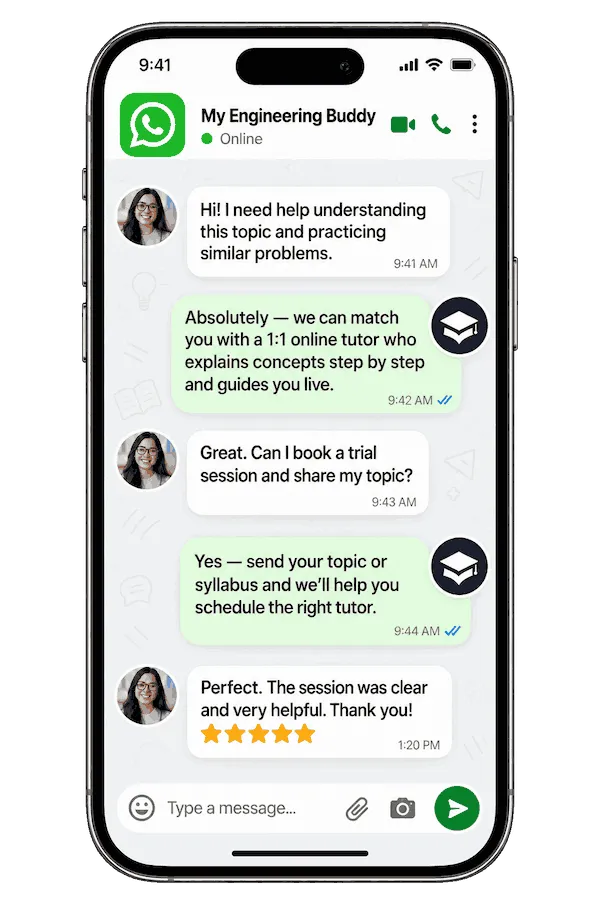
WhatsApp MEB for a quick quote — average response time under 1 minute.
Who This Science Tutoring Is For
If you’re carrying gaps from a previous term, preparing for a high-stakes exam, or simply drowning in lab reports and problem sets, this is for you. Science tutoring at MEB works across school, undergraduate, and graduate levels.
- Students retaking after a failed first attempt in physics, chemistry, or biology
- Students with a university conditional offer depending on their A Level or AP science grade
- Students 4–6 weeks from an exam with significant content gaps still to close
- Early undergraduates at institutions such as the University of Michigan, Imperial College London, University of Toronto, or ETH Zurich struggling with first-year physics or chemistry units
- Graduate students needing support with quantitative methods, thermodynamics, or biochemistry at master’s or PhD level
- Parents watching a child’s confidence drop alongside their science grades — and wanting a structured fix before the next exam cycle
Start with the $1 trial — it also functions as your first diagnostic session, so nothing is wasted.
At MEB, we’ve found that the students who improve fastest aren’t always the ones who work the most hours — they’re the ones who get clear on exactly which two or three topics are costing them marks, then target those first. A good science tutor identifies that in session one.
1:1 Tutoring vs Self-Study vs AI vs YouTube vs Online Courses
Self-study works if you’re disciplined, but there’s no feedback loop when your reasoning is wrong. AI tools give fast answers — they can’t watch you work through a titration calculation and catch the step where you went off course. YouTube covers concepts well but stops when your specific past-paper question doesn’t match any video. Online courses are structured but fixed-pace — they don’t pause when you’re stuck on Faraday’s law for the third time. 1:1 tutoring with MEB is live, calibrated to your exact syllabus, and corrects errors in the moment — which is exactly what science, with its layered conceptual prerequisites, requires.
Outcomes: What You’ll Be Able To Do in Science
After structured 1:1 sessions, students can solve multi-step physics problems involving energy conservation and circular motion without reverting to formula-hunting. They can analyze chemical equilibrium questions under timed exam conditions and write mechanistic explanations rather than rote answers. They apply biological models — like enzyme kinetics or population dynamics — to unfamiliar scenarios in extended-response questions. They write data analysis sections for lab reports with clear units, significant figures, and honest error discussion. And they present findings in viva or oral exam settings with the kind of precision that comes from actually understanding the underlying concepts, not just memorising them.
Based on feedback from 40,000+ sessions collected by MEB from 2022 to 2025, 58% of students improved by one full grade after approximately 20 hours of 1:1 tutoring in subjects like Science. A further 23% achieved at least a half-grade improvement.
Source: MEB session feedback data, 2022–2025.
Supporting a student through Science? MEB works directly with parents to set up sessions, track progress, and keep coursework on schedule. WhatsApp MEB — average response time is under a minute, 24/7.
What We Cover in Science (Syllabus / Topics)
MEB tutors cover science across three core discipline tracks. Whether your syllabus is Cambridge, Edexcel, AQA, College Board AP, IB, or a university course with its own structure, the tutor aligns to your specific content from session one.
Physics
- Mechanics: kinematics, Newton’s laws, energy, momentum, circular motion
- Electricity and magnetism: circuits, fields, electromagnetic induction
- Waves and optics: superposition, diffraction, refraction, lens equations
- Thermal physics and thermodynamics: ideal gas laws, heat engines, entropy
- Modern physics: quantum mechanics fundamentals, photoelectric effect, nuclear decay
- Experimental and data skills: uncertainty analysis, graph interpretation, SI units
Core texts include Halliday, Resnick & Krane’s Physics and OpenStax University Physics (freely available online).
Chemistry
- Atomic structure, bonding, and periodicity
- Stoichiometry, moles, and concentration calculations
- Organic chemistry: functional groups, reaction mechanisms, synthesis
- Physical chemistry: equilibrium, kinetics, thermodynamics, electrochemistry
- Analytical techniques: spectroscopy (IR, NMR, mass spec), chromatography
- Lab report writing: methodology, data analysis, error evaluation
Core texts include Atkins’ Physical Chemistry and Clayden’s Organic Chemistry. MEB tutors also support Oxford-style problem sets for students at competitive universities.
Biology and Environmental Science
- Cell biology: structure, membrane transport, cell signalling
- Genetics and molecular biology: DNA replication, transcription, translation, inheritance
- Ecology: population models, energy flow, biogeochemical cycles
- Human physiology: cardiovascular, respiratory, endocrine, nervous systems
- Evolution: natural selection, speciation, phylogenetics
- Environmental science: climate systems, biodiversity, sustainability frameworks
Core texts include Campbell’s Biology and Sadava’s Life: The Science of Biology. Get bioengineering tutoring if your course blends biological and engineering content.

What a Typical Science Session Looks Like
The tutor opens by checking the topic from the previous session — say, electrochemical cells or Hardy-Weinberg equilibrium — with one or two quick recall questions to confirm what held and what slipped. Then you move into the session’s main topic: the student shares their screen or the tutor annotates on a digital pen-pad, and you work through specific problems together — perhaps Le Chatelier’s principle applied to industrial ammonia synthesis, or a genetics pedigree with unexpected phenotype ratios. The tutor writes the working live, asks you to replicate the next step, and stops when the reasoning drifts. Misconceptions get named and corrected there and then, not at the end. The session closes with a concrete practice task — two or three past-paper questions on the same concept — and a note of what comes next.
Students consistently tell us that the moment things click in science is rarely when they read the explanation — it’s when the tutor watches them attempt the problem and says “stop there, that step is where everyone goes wrong.” Live error correction in science is not a luxury. It’s the whole point.
How MEB Tutors Help You with Science (The Learning Loop)
Diagnose. In the first session, the tutor works through a short set of questions spanning your syllabus. The goal isn’t to test you — it’s to find the specific gaps. A student who fails energy problems often has an underlying confusion about vector components from three topics back. The tutor finds that.
Explain. The tutor works through problems live on screen using a digital pen-pad. You watch the reasoning, not just the answer. For science, this matters: seeing how a professional thinker sets up a force diagram or constructs a reaction mechanism is different from reading a solution in a textbook.
Practice. You attempt the next problem with the tutor present. Not after the session. Right there. Science builds on itself — uncorrected errors compound fast.
Feedback. The tutor identifies exactly which step cost you the mark and why. Not “check your signs” — but “here’s why the sign convention in Kirchhoff’s voltage law works this way, and here’s the exam mark scheme wording.”
Plan. Each session ends with a confirmed topic for next time, a specific practice task, and an updated sense of where you are in the syllabus. No drift. No repeating covered ground by accident.
Sessions run over Google Meet. The tutor uses a digital pen-pad or iPad with Apple Pencil for live annotation. Before your first session, share your syllabus or course outline, one piece of recent work you found difficult, and your exam or submission date. The first session covers diagnostic questions, your priority topics, and a session plan for the weeks ahead. Start with the $1 trial — 30 minutes of live tutoring that also serves as your first diagnostic.
A common pattern MEB tutors observe is that students who struggle with science exams often understand individual concepts — but can’t connect them under timed conditions. That connection is what structured 1:1 sessions build.
Source: My Engineering Buddy, tutoring observations, 2008–2025.
Try your first session for $1 — 30 minutes of live 1:1 tutoring or one homework question explained in full. No registration. No commitment. WhatsApp MEB now and get matched within the hour.
Tutor Match Criteria (How We Pick Your Tutor)
Not every science tutor is right for every student. Here’s what MEB matches on.
Subject depth. The tutor holds a relevant degree or higher in the specific science discipline — physics, chemistry, biology, or environmental science — and has demonstrable experience with your exam board or university course structure.
Tools. Every MEB science tutor works with Google Meet and a digital pen-pad or iPad with Apple Pencil. Live annotation is non-negotiable for science — you can’t teach orbital hybridisation or vector resolution by talking.
Time zone. Matched to your region: US Eastern, UK, Gulf, Canada, or Australia. Sessions happen when they’re supposed to, not at 3am because the tutor is twelve time zones away.
Goals. Exam target, conceptual depth, homework completion, or research-level support — the tutor is matched to your specific stated goal, not to a generic “science help” request.
Unlike platforms where you fill out a form and wait, MEB responds in under a minute, 24/7. Tutor match takes under an hour. The $1 trial means you test before you commit. Everything runs over WhatsApp — no logins, no intake forms.
Study Plans (Pick One That Matches Your Goal)
MEB tutors build a session sequence after the diagnostic, but the structure follows one of three patterns. Catch-up (1–3 weeks): intensive focus on the highest-yield topics before a near-term exam — content gaps closed fast, past papers used from week one. Exam prep (4–8 weeks): systematic coverage of the full syllabus, timed practice built in from week three, mark scheme analysis in the final fortnight. Weekly support: ongoing sessions aligned to your semester schedule, homework reviewed each week, coursework deadlines tracked. The tutor maps the exact sequence after your first session.
Pricing Guide
Science tutoring at MEB starts at $20/hr for standard school and early undergraduate levels. Graduate-level and highly specialised topics — advanced quantum mechanics, biochemistry at PhD level, niche environmental science modelling — can reach $100/hr depending on tutor background and timeline pressure.
Rate factors: your level, topic complexity, how urgent the timeline is, and tutor availability during your exam window. Availability during peak periods (AP exam season in May, A Level revision season in April–May, university finals) is limited — sessions book up faster than most students expect.
For students targeting competitive programmes at research-intensive universities or places like the Woods Hole Oceanographic Institution for environmental science, tutors with active research or professional science backgrounds are available at higher rates. Share your specific goal and MEB will match the tier to your ambition.
Start with the $1 trial — 30 minutes, no registration, no commitment. WhatsApp MEB for a quick quote.
FAQ
Is science hard?
It depends on which part. Most students find science manageable at the conceptual level but struggle under exam conditions when multiple topics combine in one question. The difficulty is usually in integration, not in individual topics — which is exactly what 1:1 tutoring addresses.
How many sessions are needed?
Students closing a single topic gap typically need 3–5 sessions. Students preparing for an A Level, AP, or first-year university science exam from a standing start usually need 15–25 hours across 6–8 weeks. The diagnostic in session one gives a clearer picture of your specific timeline.
Can you help with homework and assignments?
Yes — MEB tutoring is guided learning. The tutor explains the concept and the method, you work through the problem and submit your own answer. MEB does not complete work on your behalf. See our Academic Integrity policy and Why MEB page for full details on what we help with and what we don’t.
Will the tutor match my exact syllabus or exam board?
Yes. When you message MEB, share your exam board (AQA, Edexcel, OCR, College Board AP, IB, Cambridge IGCSE, etc.) and your course outline. The tutor is matched to that exact syllabus — not a generic science curriculum.
What happens in the first session?
The tutor runs a short diagnostic — questions across your main topics to find where the gaps actually are, not just where you think they are. From that, you agree on a session plan. The rest of the hour goes into the highest-priority topic.
Is online tutoring as effective as in-person?
For science, yes — and in some ways more so. The digital pen-pad allows live annotation that’s clearer than a whiteboard. Students can share their own screen, paste in the exact question they’re stuck on, and record the session for later review. Most MEB students prefer it after the first session.
Can I get science help at midnight?
Yes. MEB operates 24/7 across time zones. WhatsApp response times average under a minute. If you’re in the Gulf, Australia, or the US West Coast at an unusual hour with a problem set due, you can still get matched and start a session.
What if I don’t like my assigned tutor?
Tell MEB via WhatsApp. A replacement tutor is arranged promptly — no lengthy process, no awkward forms. Fit matters in science tutoring. Not every teaching style suits every student, and MEB doesn’t expect you to stick with a mismatch.
Do you offer group science sessions?
No. MEB is 1:1 only. Group sessions slow down to the pace of the group — which is rarely your pace. Every MEB session is calibrated to exactly one student’s gaps, syllabus, and timeline.
How do I know which science topics to prioritise?
The tutor identifies this in the diagnostic. As a rough guide: for physics, mechanics and electricity typically carry the most exam marks. For chemistry, stoichiometry and organic mechanisms are high-yield. For biology, genetics and cell biology appear across almost every exam paper. The tutor will weight your plan accordingly.
What is the difference between AP Biology, AP Chemistry, and AP Physics — and can MEB help with all three?
All three are College Board Advanced Placement exams but they differ significantly in structure, skill emphasis, and scoring. AP Biology weights lab investigation and scientific reasoning; AP Chemistry is calculation-heavy with a demanding free-response section; AP Physics splits into Physics 1, 2, and C (calculus-based). MEB has tutors for all three — specify which exam when you message.
How do I get started?
WhatsApp MEB, share your subject, exam board, and timeline. You’re matched with a verified science tutor — usually within the hour. First session starts with a diagnostic and runs as a $1 trial: 30 minutes live, or one full homework question explained step by step. No registration needed.
Trust & Quality at My Engineering Buddy
Every MEB science tutor goes through a structured vetting process: subject-specific application review, a live demo session evaluated by a senior tutor, and ongoing review of student feedback after sessions. Tutors hold degrees in their discipline — many at master’s or PhD level — and several have professional or research experience in their field. Rated 4.8/5 across 40,000+ verified reviews on Google.
MEB tutoring is guided learning — you understand the work, then submit it yourself. For full details on what we help with and what we don’t, read our Academic Integrity policy and Why MEB.
MEB has served 52,000+ students since 2008 across the US, UK, Canada, Australia, Gulf, and Europe — in 2,800+ subjects spanning Engineering, science, and technical disciplines. Students working in materials science and engineering tutoring, nuclear engineering help, and STEM tutoring regularly move between subjects as their programmes demand — MEB covers the full breadth without the student needing to find a new service.
Our experience across thousands of sessions shows that students who commit to structured weekly tutoring — even just one hour a week — consistently outperform those who book only in crisis mode the week before an exam.
Source: My Engineering Buddy, tutoring observations, 2008–2025.
Explore Related Subjects
Students studying Science often also need support in:
- Mechanical Engineering
- Electrical Engineering
- Civil Engineering
- Aerospace Engineering
- Chemical Engineering
- Environmental Science
- Petroleum Engineering
- Industrial Engineering
Next Steps
Getting started takes about two minutes. Here’s what to do:
- Share your exam board or course name, your hardest topic right now, and how many weeks you have before your exam or deadline
- Share your availability and time zone — MEB covers US, UK, Canada, Australia, and the Gulf
- MEB matches you with a verified science tutor — usually within 24 hours, often within the hour
- First session starts with a diagnostic so every minute is used on what actually matters
Before your first session, have ready:
- Your exam board and syllabus (or course outline)
- A recent past paper attempt or homework question you struggled with
- Your exam date or submission deadline
The tutor handles everything else. Visit www.myengineeringbuddy.com for more on how MEB works.
WhatsApp to get started or email [email protected].
Reviewed by Subject Expert
This page has been carefully reviewed and validated by our subject expert to ensure accuracy and relevance.




