




~1 min
Average Reply Time
~1 hour
To Be Matched With A Tutor
30 Min Trial
75% Find Their Tutor On The 1st Trial
$20-35+/hr
Premium Yet Affordable Learning
Most students who struggle with immigration law don’t lack effort — they’re drowning in overlapping statutes, conflicting case law, and exam questions that penalise every gap in their regulatory knowledge.
Immigration Law Tutor Online
Immigration law governs the legal rules controlling entry, residence, work rights, asylum, and deportation within a country. It draws on statutory frameworks, treaty obligations, and administrative procedure, equipping students to analyse visa categories, refugee status, and enforcement policy.
If you’ve searched for an immigration law tutor near me, MEB matches you with a specialist tutor — online, within the hour — covering your exact course materials, case law set, and essay or exam format. Our 1:1 law tutoring model means every session is built around your gaps, not a generic syllabus. Students come in overwhelmed by the sheer volume of doctrine and leave with a working method for tackling any scenario question.
- 1:1 online sessions tailored to your specific course, module, or exam board
- Expert-verified tutors with subject-specific knowledge of immigration statutes and case law
- Flexible time zones — US, UK, Canada, Australia, Gulf
- Structured learning plan built after a diagnostic session
- Ethical homework and assignment guidance — you understand the work before you submit
52,000+ students across the US, UK, Canada, Australia, and the Gulf have used MEB since 2008 — including students in Law subjects like immigration law, constitutional law, and administrative law.
Source: My Engineering Buddy, 2008–2025.
How Much Does an Immigration Law Tutor Cost?
Most immigration law tutoring sessions run $20–$40/hr. Graduate-level or bar-exam-focused support reaches up to $100/hr depending on tutor background and topic depth. Start with the $1 trial — 30 minutes of live tutoring or one full question explained — before committing to a package.
| Level / Need | Typical Rate | What’s Included |
|---|---|---|
| Undergraduate / LLB modules | $20–$35/hr | 1:1 sessions, case law guidance, essay structuring |
| Graduate / LLM / Bar prep | $35–$100/hr | Expert tutor, complex statutory analysis, jurisdiction-specific prep |
| $1 Trial | $1 flat | 30 min live session or one full question explained |
Tutor availability tightens around law school exam periods and bar admission deadlines — book early if you’re working to a fixed date.
WhatsApp MEB for a quick quote — average response time under 1 minute.
Who This Immigration Law Tutoring Is For
Immigration law draws students from LLB programmes, LLM degrees, paralegal courses, and pre-bar study. The subject is dense with overlapping legislation — the Immigration and Nationality Act, EU Directives, the Refugee Convention — and exams reward precision, not broad familiarity.
- Undergraduate law students tackling immigration as a compulsory or elective module
- LLM students focusing on immigration, refugee, or human rights law
- Students retaking after a failed first attempt — particularly those who lost marks on statutory interpretation or scenario application
- Students with a university conditional offer depending on this grade
- Paralegals and practitioners who need to close knowledge gaps quickly
- Students 4–6 weeks from an exam with significant doctrine still to cover
Students have come to MEB from universities including Georgetown, UCLA, King’s College London, the University of Toronto, the Australian National University, and Sciences Po Paris — all facing the same core challenge: too much doctrine, too little time to make sense of it.
1:1 Tutoring vs Self-Study vs AI vs YouTube vs Online Courses
Self-study works if you’re disciplined, but immigration law’s statutory density means most students hit walls they can’t diagnose alone. AI tools give fast definitions but can’t walk you through a complex visa scenario or catch where your IRAC structure breaks down. YouTube covers broad overviews of refugee law or visa categories — it stops the moment your question gets jurisdiction-specific. Online courses move at a fixed pace with no room to linger on the Chevron doctrine or the Dublin Regulation when you’re stuck. 1:1 tutoring with MEB is calibrated to your exact module, your exam board’s marking scheme, and the specific cases on your reading list — with live correction in the moment immigration law gets complicated.
Outcomes: What You’ll Be Able To Do in Immigration Law
After consistent 1:1 immigration law tutoring, students can apply the IRAC method cleanly to multi-issue scenario questions, analyse visa eligibility under the relevant statutory framework, explain the grounds and procedure for asylum claims and appeals, present the legal basis for deportation and the defences against it, and write coherent critical essays on the tension between state sovereignty and international refugee obligations. These aren’t abstract skills — they map directly to the essay and problem questions set in LLB finals and LLM assessments.
At MEB, we’ve found that immigration law is one of those subjects where students know the cases but can’t apply them under exam conditions. The gap isn’t knowledge — it’s method. Fixing the method takes about three sessions of focused practice on structured scenario answers.
Based on feedback from 40,000+ sessions collected by MEB from 2022 to 2025, 58% of students improved by one full grade after approximately 20 hours of 1:1 tutoring in subjects like immigration law. A further 23% achieved at least a half-grade improvement.
Source: MEB session feedback data, 2022–2025.
Start with the $1 trial if you’re unsure where your gaps actually are — the first session doubles as a diagnostic.

What We Cover in Immigration Law (Syllabus / Topics)
Track 1: Foundations of Immigration Law
- Sources of immigration law — domestic statutes, bilateral treaties, international conventions
- The Refugee Convention 1951 and its 1967 Protocol — definition, exclusions, non-refoulement
- Visa categories: tourist, student, skilled worker, family reunification
- Admissibility and grounds for exclusion
- Citizenship and naturalisation pathways
- The role of administrative agencies (USCIS, UK Visas and Immigration, IRCC)
Core texts: Legomsky & Rodríguez, Immigration and Refugee Law and Policy (6th ed.); Clayton, Textbook on Immigration and Asylum Law (Oxford).
Track 2: Asylum, Refugee Status, and Human Rights
- Refugee status determination — well-founded fear of persecution, five Convention grounds
- Internal relocation alternative and state protection analysis
- Article 3 ECHR and subsidiary protection
- Stateless persons — the 1954 and 1961 Conventions
- Detention of asylum seekers — legal basis and human rights limits
- Family reunion for refugees and humanitarian cases
- Appeals procedure — Immigration Tribunals, UNHCR standards
Core texts: Hathaway & Foster, The Law of Refugee Status (2nd ed.); Goodwin-Gill & McAdam, The Refugee in International Law (Oxford).
Track 3: Enforcement, Removal, and Policy
- Deportation — grounds, procedure, and appeal rights
- Removal orders and country-of-origin information
- Employer sanctions and worksite enforcement
- Border control law — entry refusal, detention powers
- Immigration enforcement and constitutional limits (Fourth Amendment / Article 8 ECHR)
- Policy debates: points-based systems, family vs skills migration, irregular migration
Core texts: Aleinikoff, Martin, Motomura & Fullerton, Immigration and Citizenship: Process and Policy (8th ed.); also see the Australian Law Reform Commission for comparative enforcement frameworks.
What a Typical Immigration Law Session Looks Like
The tutor opens by checking where you left off — usually the statutory interpretation of a specific visa category or the five Refugee Convention grounds. You bring a past exam question or a problem from your assignment. The tutor walks through the IRAC structure on screen using a digital pen-pad, showing exactly where marks are awarded and where answers typically collapse under pressure. You attempt the same question type independently while the tutor watches and corrects reasoning in real time — not just the conclusion, but the path. The session closes with a specific practice task: two more scenario questions applying the asylum grounds, with a note on which statutory provisions to re-read before the next session.
How MEB Tutors Help You with Immigration Law (The Learning Loop)
Diagnose: In the first session, the tutor identifies whether your gaps are doctrinal (you don’t know the statute), analytical (you know it but can’t apply it), or structural (your essay or answer loses marks on organisation). Immigration law usually combines all three.
Explain: The tutor works through live problems on screen — walking through a deportation scenario step by step, or reconstructing a refugee status determination from scratch using the Convention grounds. The digital pen-pad makes the reasoning visible.
Practice: You attempt a parallel problem while the tutor watches. This is where immigration law tutoring earns its keep — students who only read cases cannot apply them under timed conditions without this step.
Feedback: The tutor marks your attempt the way an examiner would — identifying which statutory provisions you cited correctly, where your analysis was conclusory, and where you missed a counter-argument that costs marks.
Plan: Each session closes with the next topic, the cases to review, and a timed practice task. The tutor adjusts the plan after every session based on what you actually produced — not what you said you understood.
Sessions run on Google Meet with a digital pen-pad or iPad and Apple Pencil. Before your first session, have your module handbook, a recent assignment or past paper, and your exam date ready. The first session starts with a short diagnostic — 15 minutes that shape everything that follows. Start with the $1 trial — 30 minutes of live tutoring that also serves as your first diagnostic.
Students consistently tell us that the moment immigration law clicks is when they stop reading cases as stories and start reading them as arguments. Our tutors are trained to make that shift happen in session — not after three more weeks of independent reading.
Tutor Match Criteria (How We Pick Your Tutor)
Not every law tutor can teach immigration law. MEB matches based on specific criteria.
Subject depth: Tutors hold degrees in law at LLB, LLM, or JD level with demonstrable coursework or practice in immigration, refugee, or public international law specifically — not just general law.
Tools: All tutors use Google Meet with a digital pen-pad or iPad and Apple Pencil. Legal analysis requires annotating statutes and marking up essay structure in real time — not just talking through concepts.
Time zone: Matched to your region — US Eastern, UK/EU, Gulf, Canada, or Australia — so sessions run at a workable hour without compromise on tutor quality.
Goals: Whether you’re targeting a first-class LLB grade, passing an LLM seminar paper, or building competency for paralegal work, the tutor is matched to the level and purpose — not just the subject name.
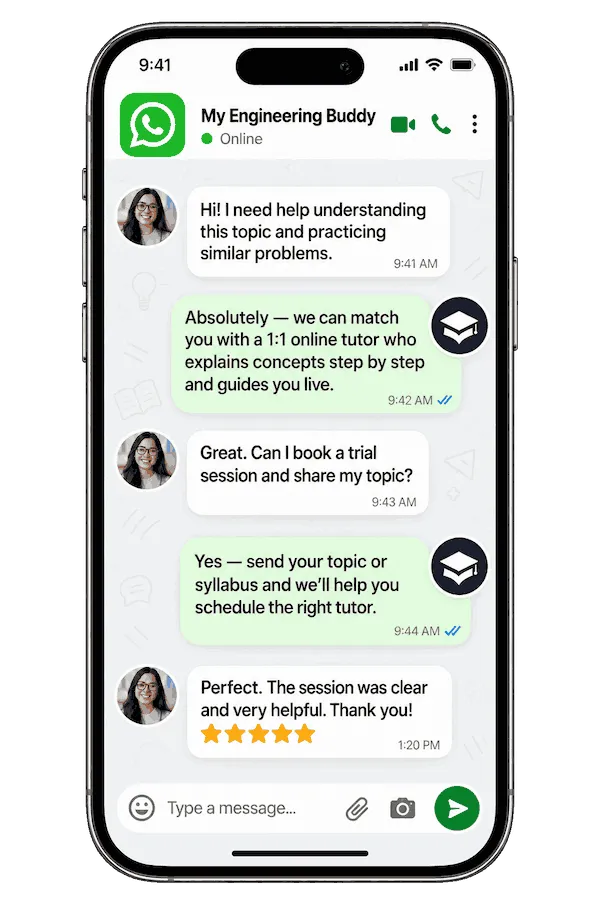
Unlike platforms where you fill out a form and wait, MEB responds in under a minute, 24/7. Tutor match takes under an hour. The $1 trial means you test before you commit. Everything runs over WhatsApp — no logins, no intake forms.
Study Plans (Pick One That Matches Your Goal)
Catch-up (1–3 weeks): students behind on doctrine with an exam approaching — sessions focus on the highest-yield topics first. Exam prep (4–8 weeks): structured revision covering all tracks with timed practice on past papers. Weekly support: ongoing sessions aligned to seminar schedule and coursework deadlines. The tutor builds the specific sequence after the first diagnostic — no generic revision plan imposed before understanding your gaps.
Pricing Guide
Immigration law tutoring runs $20–$40/hr for most undergraduate and graduate modules. Specialist support — bar exam immigration questions, LLM dissertation supervision, or jurisdiction-specific practice for US, UK, Canadian, or Australian frameworks — is available up to $100/hr. Rate depends on level, topic complexity, your timeline, and tutor availability.
For students targeting top law schools or LLM programmes at institutions like Harvard Law, Oxford, or NYU, tutors with research or practice backgrounds in immigration and refugee law are available at higher rates — share your specific goal and MEB matches the tier to your ambition.
Availability tightens sharply around law school finals and bar admission cycles in the US, UK, and Canada. Start with the $1 trial — 30 minutes, no registration, no commitment. WhatsApp MEB for a quick quote.
Immigration law sits at the intersection of domestic statute, international treaty, and administrative procedure — three areas where gaps in understanding compound fast. Tutors who have worked inside this subject at postgraduate level know exactly where marks are lost.
Source: My Engineering Buddy, 2008–2025.
A common pattern our tutors observe is that students arrive having read everything on the syllabus but having practised almost nothing under timed conditions. Immigration law exams reward speed and structure as much as knowledge. Both are skills — both can be trained.
FAQ
Is immigration law hard?
Yes — it combines statutory interpretation, international treaty law, and administrative procedure across multiple jurisdictions. Students who struggle most are those who try to memorise cases without building an analytical framework for applying them to unseen scenarios.
How many sessions are needed?
Most students see a meaningful improvement in essay and problem-question quality within 8–12 sessions. Students starting with significant gaps across the syllabus typically need 15–20 hours to reach consistent exam-ready performance.
Can you help with homework and assignments?
Yes. MEB tutoring is guided learning — you understand the work, then submit it yourself. See our Academic Integrity policy and Why MEB page for full details on what we help with and what we don’t.
Will the tutor match my exact syllabus or exam board?
Yes. Share your module handbook, reading list, and exam format — US law school, UK LLB, Australian JD, or LLM programme — and MEB matches a tutor who knows that specific framework rather than immigration law in the abstract.
What happens in the first session?
The tutor runs a 15-minute diagnostic covering your current knowledge of key doctrine, your essay or problem-question method, and your exam date. The remaining 45 minutes address the most urgent gaps identified — often statutory application or IRAC structure.
Is online tutoring as effective as in-person?
For immigration law — yes. The digital pen-pad replicates annotating statutes and marking up arguments on a whiteboard. Students in the US, UK, Canada, and Australia report no meaningful difference in learning outcome compared to face-to-face sessions.
What’s the difference between US and UK immigration law courses, and can MEB help with both?
US immigration law centres on the Immigration and Nationality Act, USCIS procedure, and constitutional limits. UK immigration law focuses on the Immigration Rules, the ECHR, and the Points-Based System. MEB has tutors experienced in both — specify your jurisdiction when you make contact.
Can you help with immigration law moot court preparation or oral argument?
Yes. MEB tutors can work through moot court problems on immigration and refugee law — helping you identify the strongest statutory and case-law arguments, anticipate the bench’s questions, and structure your oral submissions clearly.
Do you cover comparative immigration law across multiple jurisdictions?
Yes. LLM students and researchers studying comparative frameworks across the EU, US, UK, Canada, and Australia can be matched with tutors who have cross-jurisdictional knowledge. Share your specific comparison brief when you contact MEB.
Can you help at midnight if I have a submission due tomorrow?
Yes. MEB operates 24/7. WhatsApp the team at any hour — average response time is under a minute. A tutor can be matched and your first session started within the hour, including late night and weekends.
How do I get started?
Start with the $1 trial — 30 minutes of live 1:1 tutoring or one full question explained. Three steps: WhatsApp MEB, get matched with an immigration law tutor, start your trial session. No registration required.
Trust & Quality at My Engineering Buddy
Every MEB tutor goes through a structured screening process — subject-knowledge test, live demo session evaluation, and ongoing review based on student feedback after every session. Immigration law tutors hold law degrees at LLB, LLM, or JD level, with specific coursework or practice in immigration, refugee, or public law. Generic “law tutors” are not placed on immigration law sessions. Rated 4.8/5 across 40,000+ verified reviews on Google.
MEB tutoring is guided learning — you understand the work, then submit it yourself. For full details on what we help with and what we don’t, read our Academic Integrity policy and Why MEB.
MEB has served 52,000+ students across the US, UK, Canada, Australia, the Gulf, and Europe in 2,800+ subjects since 2008. In Law, that includes students in immigration law, human rights law tutoring, international law help, and administrative law tutoring. If immigration law intersects with your other modules — and it usually does — MEB covers the full map. Learn more about our approach at our tutoring methodology page.
Explore Related Subjects
Students studying immigration law often also need support in:
- International Humanitarian Law
- Civil Law
- Family Law
- Criminal Law
- Private International Law (Conflict of Laws)
- Jurisprudence
- Legal Research
Next Steps
When you contact MEB, share your exam board or course type (LLB module, LLM programme, paralegal qualification), the topics you’re finding hardest — statutory interpretation, asylum procedure, deportation appeals — and your current timeline.
Share your availability and time zone. MEB matches you with a verified immigration law tutor — usually within 24 hours, often within the hour.
Before your first session, have ready:
- Your module handbook or course outline and reading list
- A recent assignment, past paper attempt, or question you struggled with
- Your exam date or submission deadline
The tutor handles the rest — starting with a diagnostic that makes every subsequent session count.
Visit www.myengineeringbuddy.com for more on how MEB works.
WhatsApp to get started or email [email protected].
Try your first session for $1 — 30 minutes of live 1:1 tutoring or one homework question explained in full. No registration. No commitment. WhatsApp MEB now and get matched within the hour.
Reviewed by Subject Expert
This page has been carefully reviewed and validated by our subject expert to ensure accuracy and relevance.




