~1 min
Average Reply Time
~1 hour
To Be Matched With A Tutor
30 Min Trial
75% Find Their Tutor On The 1st Trial
$20-35+/hr
Premium Yet Affordable Learning
Most students don’t fail copyright law because the material is too abstract. They fail because they can’t connect fair use doctrine to a specific fact pattern under exam pressure.
Copyright Law Tutor Online
Copyright law governs the exclusive rights granted to creators over original works — literary, artistic, musical, and digital — covering infringement, fair use, licensing, moral rights, and enforcement across national and international frameworks.
MEB connects you with a specialist copyright law tutor near me — wherever you are — for 1:1 online tutoring and homework help in law subjects across the US, UK, Canada, Australia, and the Gulf. Whether you’re decoding the DMCA, unpacking Berne Convention obligations, or working through infringement problem questions, a dedicated online copyright law tutor builds your understanding session by session.
- 1:1 online sessions tailored to your course syllabus and exam board
- Expert-verified tutors with law degrees and subject-specific knowledge
- Flexible time zones — US, UK, Canada, Australia, Gulf
- Structured learning plan built after a diagnostic session
- Ethical homework and assignment guidance — you understand before you submit
52,000+ students across the US, UK, Canada, Australia, and the Gulf have used MEB since 2008 — including students in Law subjects like Copyright Law, Intellectual Property Law, and Patent Law.
Source: My Engineering Buddy, 2008–2025.
How Much Does a Copyright Law Tutor Cost?
Copyright law tutoring starts at $20–$40/hr for most undergraduate and postgraduate levels. Advanced IP litigation, international copyright, or specialist digital media copyright modules run up to $100/hr. The $1 trial gives you 30 minutes of live tutoring or a full explanation of one homework question before you commit to anything.
| Level / Need | Typical Rate | What’s Included |
|---|---|---|
| Standard (most undergrad levels) | $20–$35/hr | 1:1 sessions, assignment guidance |
| Advanced / Specialist (LLM, IP focus) | $35–$70/hr | Expert tutor, niche depth, case strategy |
| $1 Trial | $1 flat | 30 min live session or 1 homework question |
Tutor availability tightens significantly in the weeks before law school exams and LLM submission deadlines. Book early if your window is narrow.
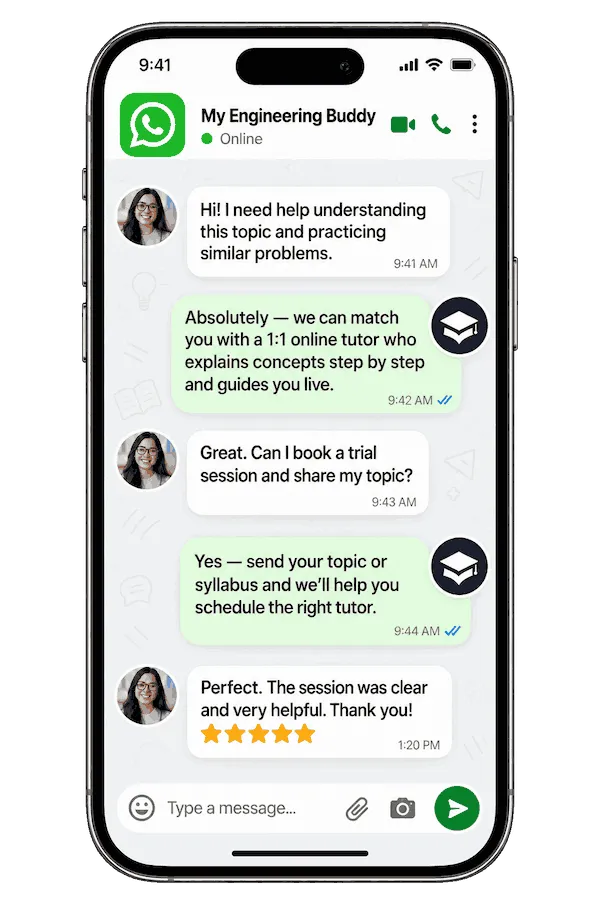
WhatsApp MEB for a quick quote — average response time under 1 minute.
Who This Copyright Law Tutoring Is For
Copyright law sits at the intersection of doctrine, policy, and real-world application. Students who struggle aren’t usually short on effort — they’re missing a framework for applying the law to unseen facts.
- Undergraduate law students covering IP modules for the first time
- LLM students specialising in intellectual property or technology law
- Students retaking after a failed first attempt at an IP or media law exam
- Students with a university conditional offer depending on this grade
- Students preparing coursework on digital copyright, music licensing, or software protection
- Professionals and paralegals needing structured grounding in copyright doctrine
Students studying copyright law often move into roles at firms handling IP portfolios, entertainment contracts, and tech licensing at organisations like the USPTO, WIPO, or major law firms in New York, London, and Sydney. MEB tutors understand the academic rigour those paths demand.
At MEB, we’ve found that copyright law students make the fastest progress when they stop reading cases passively and start applying the four-factor fair use test — or the UK substantial part test — to fact patterns they haven’t seen before. That shift from recognition to application is where grades move.
1:1 Tutoring vs Self-Study vs AI vs YouTube vs Online Courses
Self-study works if your reading discipline is strong — but copyright law problem questions demand applied reasoning that passive reading rarely builds. AI tools explain doctrine quickly but can’t probe your logic on a specific infringement scenario or spot where your analysis breaks down. YouTube covers the basics of fair use and the Berne Convention but stops when you’re stuck mid-problem. Online courses move at a fixed pace with no room for your specific exam board or module. A 1:1 copyright law tutor works through your actual case studies and past papers, corrects errors in argument structure in real time, and keeps the pace matched to your deadline.
Outcomes: What You’ll Be Able To Do in Copyright Law
After working with an MEB copyright law tutor, you’ll be able to apply the fair use or fair dealing doctrine to unseen fact patterns without hesitation. You’ll analyse originality thresholds, identify when a work qualifies for protection, and explain the scope of exclusive rights across reproduction, distribution, and derivative works. You’ll write structured problem answers that address infringement, defences, and remedies in a logical sequence. You’ll present arguments on digital copyright issues — from DMCA safe harbours to streaming platform liability — with the precision examiners reward.
Based on feedback from 40,000+ sessions collected by MEB from 2022 to 2025, 58% of students improved by one full grade after approximately 20 hours of 1:1 tutoring in subjects like Copyright Law. A further 23% achieved at least a half-grade improvement.
Source: MEB session feedback data, 2022–2025.
Supporting a student through Copyright Law? MEB works directly with parents to set up sessions, track progress, and keep coursework on schedule. WhatsApp MEB — average response time is under a minute, 24/7.
What We Cover in Copyright Law (Syllabus / Topics)

Foundations of Copyright Law
- Nature and rationale of copyright — utilitarian vs natural rights theories
- Requirements for protection: originality, fixation, and authorship
- Categories of protected works: literary, artistic, musical, dramatic, and digital
- Duration of copyright and public domain rules
- Ownership, authorship, and works made for hire
- Moral rights and their scope in the US, UK, EU, and internationally
Core texts include Goldstein & Hugenholtz International Copyright, Leaffer Understanding Copyright Law, and Bently & Sherman Intellectual Property Law.
Infringement, Defences, and Remedies
- Direct, contributory, and vicarious infringement — elements and case application
- Fair use (US four-factor test) and fair dealing (UK/Australia/Canada)
- The substantial part test and quantitative vs qualitative assessment
- Parody, satire, and transformative use as defences
- Statutory and actual damages, injunctions, and account of profits
- Safe harbour provisions under the DMCA (Section 512) and EU DSA/DSM Directive
- Secondary liability of internet platforms and user-generated content issues
Recommended reading: Nimmer on Copyright (US), Arnold Performers’ Rights, and the Australian Law Reform Commission reports on copyright reform.
International and Digital Copyright
- Berne Convention obligations and national treatment principle
- TRIPS Agreement and WTO enforcement mechanisms
- WIPO Copyright Treaty and digital rights management (DRM)
- Cross-border infringement: jurisdiction and applicable law
- Software copyright, database rights, and open-source licensing
- Music streaming, film distribution, and platform liability in the digital economy
Reference texts: Ricketson & Ginsburg International Copyright and Neighbouring Rights, and Ficsor The Law of Copyright and the Internet.
What a Typical Copyright Law Session Looks Like
The tutor starts by checking where you left off — usually the substantial part test or a specific fair use factor from the previous session. You open a past paper problem question together on screen; the tutor talks through how to identify the cause of action, then asks you to structure the first paragraph of your answer while they watch. When your analysis misses the originality threshold argument, the tutor pauses, marks up the gap on a digital pen-pad, and walks through a model answer line by line. You attempt the next question section independently. The session closes with a specific practice task — three unseen fact patterns to annotate before the next session — and the tutor notes which doctrine to cover next: moral rights or the DMCA safe harbour framework.
How MEB Tutors Help You with Copyright Law (The Learning Loop)
Diagnose: In the first session, the tutor identifies exactly where your reasoning breaks down — whether that’s structuring infringement arguments, applying the fair use test systematically, or distinguishing UK and US doctrine when your course covers both.
Explain: The tutor works through live examples on a digital pen-pad — annotating cases like Campbell v. Acuff-Rose or Designers Guild v. Russell Williams, and showing how the same legal test produces different outcomes depending on the facts.
Practice: You attempt problem questions or essay outlines while the tutor watches. No passive reading. You produce the analysis; the tutor responds to what you actually wrote.
Feedback: The tutor marks where your argument loses structure, where you missed a defence, or where case citation is thin — and explains exactly why those gaps cost marks in a real exam.
Plan: At the end of each session, the tutor sets the next topic and tracks progress toward your exam date or submission deadline. Start with the $1 trial — 30 minutes of live tutoring that also serves as your first diagnostic.
Sessions run over Google Meet. Tutors use a digital pen-pad or iPad with Apple Pencil for annotating problem questions and case extracts. Before your first session, share your course outline or module handbook, a recent assignment or past paper attempt, and your exam or coursework deadline. The first session maps your gaps and sets the sequence for everything that follows.
Try your first session for $1 — 30 minutes of live 1:1 tutoring or one homework question explained in full. No registration. No commitment. WhatsApp MEB now and get matched within the hour.
Tutor Match Criteria (How We Pick Your Tutor)
Not every law tutor is the right fit for copyright. Here’s what MEB matches on.
Subject depth: The tutor holds a law degree or higher, with demonstrable knowledge of your specific module — UK copyright, US IP law, international copyright treaties, or digital media law depending on your course.
Tools: Every tutor works over Google Meet with a digital pen-pad or iPad and Apple Pencil — essential for annotating problem questions and marking up argument structure in real time.
Time zone: Matched to your region — US Eastern through Pacific, UK/Europe, Gulf Standard Time, or Australian Eastern. No early-morning sessions booked without your consent.
Goals: Whether you need exam score improvement, stronger essay technique, help with a specific intellectual property law assignment, or ongoing support through a full semester, the tutor is selected for that specific target.
Unlike platforms where you fill out a form and wait, MEB responds in under a minute, 24/7. Tutor match takes under an hour. The $1 trial means you test before you commit. Everything runs over WhatsApp — no logins, no intake forms.
Copyright law sits within a broader IP framework — students who also get support in patent law tutoring and cyber law help consistently report stronger overall IP exam performance.
Source: My Engineering Buddy, 2008–2025.
Study Plans (Pick One That Matches Your Goal)
After the diagnostic, your tutor builds a sequence based on your timeline. A catch-up plan (1–3 weeks) targets the highest-yield doctrine — fair use, infringement elements, key defences — before a specific exam date. An exam prep plan (4–8 weeks) works through the full syllabus with past paper practice and timed essay drills built in. Weekly support runs alongside your semester, keeping pace with lectures and coursework deadlines as they arrive. The tutor adjusts the plan as you progress.
Pricing Guide
Copyright law tutoring runs at $20–$40/hr for most undergraduate and early postgraduate levels. Graduate-level IP courses, LLM modules, and highly specialist digital copyright topics can reach up to $100/hr depending on tutor background and subject depth required.
Rate factors include level of study, topic complexity (general copyright vs. international IP treaties vs. platform liability law), your timeline, and tutor availability. Rates firm up quickly in the weeks before law school finals and LLM submission periods.
For students targeting IP boutiques, Big Law technology practices, or graduate IP programmes at schools like NYU, Georgetown, or King’s College London, tutors with professional practice backgrounds in copyright litigation or licensing are available at higher rates — share your specific goal and MEB will match the tier to your ambition.
Start with the $1 trial — 30 minutes, no registration, no commitment. WhatsApp MEB for a quick quote.
Students consistently tell us that the hardest part of copyright law isn’t memorising the tests — it’s knowing which test applies to which set of facts, and then arguing it clearly under time pressure. That’s what the sessions focus on: applied reasoning, not rote recall.
FAQ
Is copyright law hard?
It’s conceptually demanding. The doctrine is precise — small factual differences change outcomes entirely. Students find fair use analysis, international treaty obligations, and digital platform liability the most challenging areas. Consistent problem-question practice with feedback makes the biggest difference.
How many sessions are needed?
Most students see clear improvement in essay structure and problem-question technique within 6–8 sessions. Closing significant doctrinal gaps or preparing for an LLM exam typically takes 15–20 hours. The first diagnostic session maps the exact number needed for your goal.
Can you help with homework and assignments?
MEB tutoring is guided learning — you understand the work, then submit it yourself. If you’re stuck on a fair use problem or an infringement essay, the tutor explains the doctrine and argument structure clearly. See our Academic Integrity policy and Why MEB page for full details on what we help with and what we don’t.
Will the tutor match my exact syllabus or exam board?
Yes. Before matching, MEB asks for your institution, module name, and exam board or course outline. A tutor familiar with that specific syllabus — US copyright, UK CDPA, Australian copyright act, or international IP law — is assigned. Generic law tutors are not used.
What happens in the first session?
The tutor runs a diagnostic — reviewing a recent assignment, past paper attempt, or identifying which doctrine areas are weakest. From that, they map a session plan with topic sequence, practice targets, and a timeline to your exam or submission date.
Is online tutoring as effective as in-person?
For law subjects, yes. Copyright law is entirely text and argument — problem questions, case analysis, essay structure. A digital pen-pad over Google Meet replicates the whiteboard session entirely. Students in the US, UK, and Australia report no meaningful difference in learning quality.
What’s the difference between fair use (US) and fair dealing (UK/Australia), and can a tutor cover both?
Fair use is an open-ended four-factor balancing test. Fair dealing is a closed list of permitted purposes. They produce different outcomes for the same facts. If your course covers comparative copyright law, MEB tutors experienced in both jurisdictions are available and regularly matched to students taking international IP modules.
Does MEB cover the DMCA and digital platform copyright issues?
Yes. Section 512 safe harbours, notice-and-takedown procedures, the EU Digital Single Market Directive, and upload filter obligations are all covered. These areas appear frequently in US and European law school exams and are among the most tested topics in current copyright courses.
Can I get copyright law help at short notice — even late at night?
MEB operates 24/7. WhatsApp the team at any hour and expect a response within a minute. Tutor matching typically completes within the hour. If you have a submission deadline tomorrow morning, message now — that’s exactly the situation MEB is set up for.
Do you offer group copyright law sessions?
MEB specialises in 1:1 tutoring only. Group sessions are not offered. The diagnostic-led, personalised approach that drives grade improvement requires individual sessions — group formats prevent the real-time error correction that makes 1:1 tutoring effective.
How do I get started?
Three steps: WhatsApp MEB with your course details and exam date. Get matched with a verified copyright law tutor — usually within the hour. Start with the $1 trial: 30 minutes of live tutoring or one homework question explained in full, no registration needed.
Trust & Quality at My Engineering Buddy
Every MEB tutor goes through a subject-specific screening process — law degree verification, a live demo session, and review of their explanation technique before they’re approved. Tutors are rated after every session; those below threshold are removed. Rated 4.8/5 across 40,000+ verified reviews on Google. Subject-specific vetting means a copyright law tutor has been assessed on exactly the doctrine and problem-question technique your exam requires — not just on general law knowledge.
MEB tutoring is guided learning — you understand the work, then submit it yourself. For full details on what we help with and what we don’t, read our Academic Integrity policy and Why MEB.
MEB has been serving students in the US, UK, Canada, Australia, Gulf, and Europe since 2008 — across 2,800+ subjects. In the Law category, that includes copyright law, business law tutoring, tort law help, and a wide range of specialist modules. The platform was built for students who need expert-matched, flexible, affordable support — not a subscription to a video library.
MEB has supported students through constitutional law tutoring, contract law, and copyright law modules across law schools in the US, UK, Canada, and Australia since 2008.
Source: My Engineering Buddy, 2008–2025.
Explore Related Subjects
Students studying Copyright Law often also need support in:
- Administrative Law
- Economic and Commercial Law
- International Law (Public & Comparative)
- Private International Law (Conflict of Laws)
- Legal Research
- Legal Theory
Next Steps
Before your first session, have ready: your exam board and syllabus or course outline, a recent past paper attempt or assignment you struggled with, and your exam or deadline date. The tutor handles the rest.
- Share your exam board, hardest topic (fair use? DMCA? international treaties?), and current timeline
- Share your availability and time zone
- MEB matches you with a verified copyright law tutor — usually within 24 hours
The first session starts with a diagnostic so every minute is used well. Visit www.myengineeringbuddy.com for more on how MEB works.
WhatsApp to get started or email [email protected].
Reviewed by Subject Expert
This page has been carefully reviewed and validated by our subject expert to ensure accuracy and relevance.