




~1 min
Average Reply Time
~1 hour
To Be Matched With A Tutor
30 Min Trial
75% Find Their Tutor On The 1st Trial
$20-35+/hr
Premium Yet Affordable Learning
Most students don’t fail Animal Law because the law is too complex. They fail because nobody ever explained how statutory frameworks, common law, and ethical theory interact — and their essay answers reflect that gap.
Animal Law Tutor Online
Animal Law is a legal field examining the rights, welfare, and status of animals under statutory and common law frameworks. It equips students to analyse legislation, case law, and policy across domestic, agricultural, and wildlife contexts.
MEB offers 1:1 online tutoring and homework help in 2800+ advanced subjects, including law and its specialist branches. If you’ve searched for an Animal Law tutor near me and found generic platforms with no subject depth, MEB is different — every tutor is matched to your exact course, module, or exam board. One session can close the gap between a scattered answer and a structured legal argument.
- 1:1 online sessions tailored to your course syllabus and assessment style
- Expert-verified tutors with specialist knowledge in animal law, welfare policy, and statutory interpretation
- Flexible time zones — US, UK, Canada, Australia, and the Gulf covered
- Structured learning plan built after a diagnostic in your first session
- Ethical homework and assignment guidance — you understand the work, then submit it yourself
52,000+ students across the US, UK, Canada, Australia, and the Gulf have used MEB since 2008 — including students in Law subjects like Animal Law, environmental law tutoring, and human rights law help.
Source: My Engineering Buddy, 2008–2025.
How Much Does an Animal Law Tutor Cost?
Most Animal Law tutoring sessions at MEB run $20–$40/hr. Graduate-level or highly specialised modules — think comparative animal welfare law or wildlife trade regulation — can reach $100/hr. Start with the $1 trial: 30 minutes of live tutoring or one homework question explained in full, no registration required.
| Level / Need | Typical Rate | What’s Included |
|---|---|---|
| Undergraduate modules | $20–$35/hr | 1:1 sessions, essay and case analysis guidance |
| Graduate / LLM / specialist | $35–$100/hr | Expert tutor, comparative law, thesis support |
| $1 Trial | $1 flat | 30 min live session or one homework question explained |
Tutor availability tightens during semester-end submission periods and bar exam prep season. Book early if you have a firm deadline.
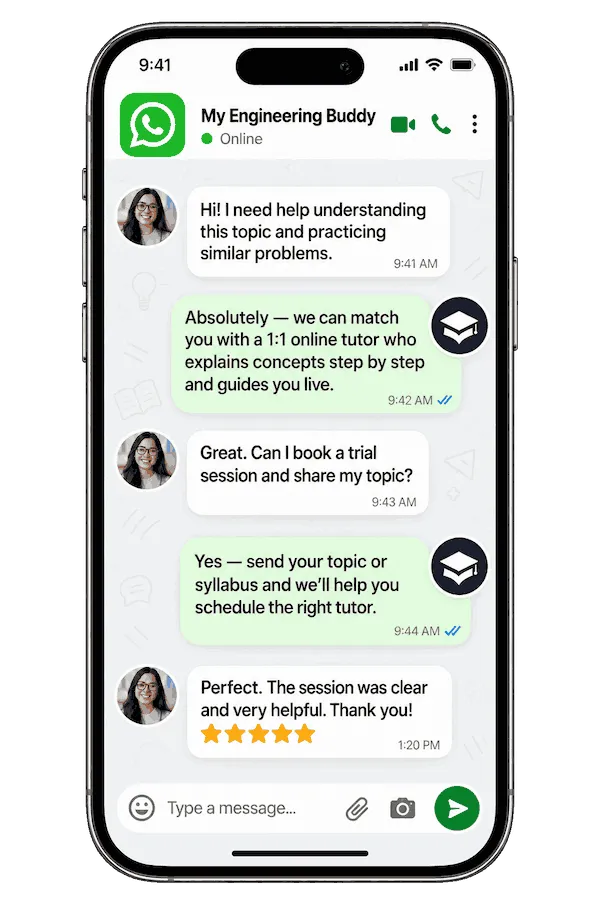
WhatsApp MEB for a quick quote — average response time under 1 minute.
Who This Animal Law Tutoring Is For
Animal Law sits at the crossroads of welfare science, statutory interpretation, and ethics. Students often find that lecture notes alone don’t translate into the analytical depth examiners expect.
- Undergraduate law students taking an elective or compulsory animal law module
- LLM and graduate students writing dissertations on welfare regulation, wildlife crime, or factory farming policy
- Students who failed their first attempt and need a structured re-approach before the resit
- Students with a conditional university offer resting on this module’s grade
- Pre-law students at universities like Georgetown, Lewis & Clark, Harvard, Melbourne, or Bristol building foundational knowledge before enrolment
- Professionals in veterinary practice, wildlife conservation, or agricultural policy who need legal grounding for their work
The $1 trial is the lowest-risk way to test whether the match is right before committing to weekly sessions.
1:1 Tutoring vs Self-Study vs AI vs YouTube vs Online Courses
Self-study works if you’re disciplined, but animal law requires applying multi-layered statutory frameworks to fact patterns — and a textbook won’t tell you where your reasoning breaks down. AI tools generate plausible-sounding legal summaries that are often outdated or jurisdiction-confused. YouTube covers the Animal Welfare Act in broad strokes; it stops when you’re trying to distinguish R v Brown from your specific problem question. Online courses are structured but fixed-pace, with no one checking your case analysis. 1:1 tutoring with MEB is live, calibrated to your exact module, and corrects your statutory interpretation errors in real time — before they cost marks.
Outcomes: What You’ll Be Able To Do in Animal Law
After working with an MEB Animal Law tutor, you’ll be able to apply welfare legislation — including the Animal Welfare Act 2006, the US Animal Welfare Act, and equivalent statutes in your jurisdiction — to real fact patterns with confidence. You’ll analyse case law critically, distinguish between animal welfare and animal rights frameworks, and write structured problem-question answers that examiners score highly. You’ll explain the legal status of animals as property versus emerging personhood arguments, and present a coherent position on contested policy questions like ag-gag laws or CITES enforcement. These are not generic legal skills — they’re specific to Animal Law assessment.
Based on feedback from 40,000+ sessions collected by MEB from 2022 to 2025, 58% of students improved by one full grade after approximately 20 hours of 1:1 tutoring in subjects like Animal Law. A further 23% achieved at least a half-grade improvement.
Source: MEB session feedback data, 2022–2025.
Supporting a student through Animal Law? MEB works directly with parents to set up sessions, track progress, and keep coursework on schedule. WhatsApp MEB — average response time is under a minute, 24/7.
What We Cover in Animal Law (Syllabus / Topics)

Track 1: Foundations of Animal Law
- Legal status of animals — property doctrine, legal personhood debates
- Animal welfare vs animal rights: philosophical and legal distinctions
- Historical development of animal protection statutes
- Cruelty offences and enforcement mechanisms under domestic law
- Comparative welfare standards across the US, UK, EU, and Australia
- Standing and locus standi in animal law litigation
Key texts include Favre’s Animal Law: Welfare, Interests, and Rights and Francione’s Introduction to Animal Rights. The Cornell Law School Legal Information Institute is a reliable reference for US statutory and case law materials.
Track 2: Welfare Legislation and Regulation
- The Animal Welfare Act 2006 (UK): five welfare needs, duty of care
- US Animal Welfare Act: scope, exclusions (farm animals, mice), enforcement by USDA
- Factory farming and agricultural exemptions — legal gaps and reform debates
- Ag-gag laws: First Amendment tensions and constitutional challenges
- Wildlife law: CITES, Endangered Species Act, Convention on Biological Diversity
- Transport, slaughter, and laboratory animal regulations
- EU Directive 2010/63/EU on the protection of animals used for scientific purposes
Texts include Radford’s Animal Welfare Law in Britain and Sunstein and Nussbaum’s Animal Rights: Current Debates and New Directions. Students taking environmental law courses will find significant overlap in wildlife and biodiversity regulation frameworks.
Track 3: Advanced Topics and Emerging Issues
- Animal personhood and habeas corpus petitions — case studies including Nonhuman Rights Project litigation
- Intersection of animal law with constitutional law — free speech, due process, equal protection
- International trade law and animal welfare: WTO consistency questions
- Companion animal law — custody disputes, emotional distress damages, breed-specific legislation
- Marine mammal protection and cetacean rights debates
- Emerging legislation: plant-based food labelling, cultivated meat regulation
Texts include Wise’s Rattling the Cage and Peters’s Animal Law: More Than the Sum of Its Parts. Students working across international and comparative law will find this track particularly useful for cross-jurisdictional analysis.
At MEB, we’ve found that Animal Law students who struggle most are usually trying to apply generic essay technique to a subject that demands statutory construction skills and ethical framework awareness simultaneously. Separating those two tasks — first identify the law, then apply the framework — unlocks markedly cleaner answers.
What a Typical Animal Law Session Looks Like
The tutor opens by checking your last topic — usually a welfare legislation question or a case analysis you attempted. You pull up the problem question on screen together. The tutor works through statutory interpretation step by step using a digital pen-pad, marking up the fact pattern and showing you exactly where the duty of care analysis begins and where the exemptions bite. You replicate the structure on your own version while the tutor watches. Where your argument drifts — say, conflating welfare standards with rights-based claims — the tutor catches it immediately and shows you the correction. The session closes with a specific task: one past-paper problem question on ag-gag legislation or wildlife trade law, with a note on which statutory provisions to anchor your argument to. Next session topic is agreed before you log off. You leave with a clear direction, not just a feeling that things went well.
How MEB Tutors Help You with Animal Law (The Learning Loop)
Diagnose: In the first session, the tutor identifies exactly where your Animal Law reasoning breaks down — whether that’s statutory construction, case law application, ethical framework confusion, or exam technique. No generic overview; just a targeted gap map.
Explain: The tutor works through live problems on screen — how to read a welfare statute, how to structure a problem question answer on cruelty offences, how to distinguish competing legal frameworks for animal personhood. The digital pen-pad makes every step visible.
Practice: You attempt the next problem with the tutor present. Not after the session. Right there, while support is available and errors can be caught in real time.
Feedback: Step-by-step correction. The tutor shows you precisely why a marker would deduct marks — missed statutory authority, unsupported policy argument, circular reasoning in the rights versus welfare analysis.
Plan: At the end of every session, the next topic is mapped. Whether it’s factory farming exemptions this week and wildlife trade law next, the progression is deliberate — not random.
Sessions run over Google Meet with a digital pen-pad or iPad and Apple Pencil. Before your first session, have your course outline, a recent essay or problem question attempt, and your submission or exam date ready. The tutor builds the plan from there. Start with the $1 trial — 30 minutes of live tutoring that also serves as your first diagnostic.
Students consistently tell us that the biggest shift in Animal Law comes not from reading more cases, but from learning to separate the descriptive question — what does the law say? — from the evaluative one — is the law adequate? Most undergraduate Animal Law essays muddle the two throughout.
Tutor Match Criteria (How We Pick Your Tutor)
Not every law tutor can teach Animal Law well. Here is what MEB checks before assigning yours.
Subject depth: The tutor must have studied or taught animal law specifically — not just general tort or administrative law. Familiarity with your jurisdiction’s welfare statutes and the specific module syllabus is verified before matching.
Tools: Every MEB tutor uses Google Meet with a digital pen-pad or iPad and Apple Pencil — so statutory text and case diagrams can be annotated live on screen.
Time zone: Matched to your region — US, UK, Gulf, Canada, or Australia — so sessions are scheduled at workable hours, not 2 am compromises.
Goals: Whether you need exam score improvement, deeper conceptual understanding of animal rights theory, help with legal research for a dissertation, or structured homework guidance — the tutor is briefed on your target before the first session.
Unlike platforms where you fill out a form and wait, MEB responds in under a minute, 24/7. Tutor match takes under an hour. The $1 trial means you test before you commit. Everything runs over WhatsApp — no logins, no intake forms.
Study Plans (Pick One That Matches Your Goal)
A catch-up plan (1–3 weeks) closes urgent gaps before a submission deadline — useful if you’ve fallen behind on welfare legislation or missed core lectures on wildlife law. An exam prep plan (4–8 weeks) runs structured revision across all module components with past-paper practice built in. Weekly ongoing support runs alongside your semester, keeping pace with each new topic as your module progresses. After the first diagnostic session, your tutor maps the specific sequence — topic by topic, week by week.
Pricing Guide
Animal Law tutoring at MEB starts at $20/hr for most undergraduate modules. Graduate, LLM, and highly specialised topics — comparative international welfare law, wildlife crime prosecution, animal personhood litigation strategy — run higher, up to $100/hr. Rate depends on level, topic complexity, timeline urgency, and tutor availability.
For students targeting top law school programmes at institutions like Lewis & Clark, Harvard, Georgetown, or Melbourne — or pursuing LLM specialisations in animal or environmental law — tutors with professional advocacy and policy backgrounds are available at higher rates. Share your goal and MEB will match the tier to your ambition.
Availability tightens in the weeks before law school finals and bar prep season. Book before the crunch.
Start with the $1 trial — 30 minutes, no registration, no commitment. WhatsApp MEB for a quick quote.
MEB has served students across law, legal studies, and jurisprudence since 2008. 18 years. 52,000+ students. The platform was built for exactly the kind of complex, niche subject that generic tutoring sites handle badly.
Source: My Engineering Buddy, 2008–2025.
A common pattern our tutors observe is that Animal Law students arrive with strong opinions about animal welfare but weak command of the statutory mechanics. The opinion is fine — even useful. But the mark comes from the mechanics. We fix the mechanics first.
FAQ
Is Animal Law hard?
It’s genuinely challenging — not because the concepts are abstract, but because it demands simultaneous fluency in statutory interpretation, case law application, and ethical theory. Students who struggle most are usually missing one of those three legs. A targeted tutor session identifies which one fast.
How many sessions are needed?
Most students see clear improvement in essay structure and statutory analysis within 4–6 sessions. A full-semester support plan typically runs 15–20 sessions. It depends on your starting point, your deadline, and how much independent practice you put in between sessions.
Can you help with homework and assignments?
MEB tutoring is guided learning — you understand the work, then submit it yourself. Your tutor will walk through how to structure a problem question, how to identify the relevant statute and authority, and where your argument currently falls short. See our Academic Integrity policy and Why MEB page for full details on what we help with and what we don’t.
Will the tutor match my exact syllabus or exam board?
Yes. Before your first session, share your course outline and institution. MEB matches a tutor familiar with your specific module — whether that’s a US law school animal law elective, a UK undergraduate welfare law course, or an LLM dissertation in international wildlife regulation.
What happens in the first session?
The tutor runs a diagnostic — working through a problem question or essay plan with you to identify where your reasoning breaks down. By the end of the first 30 minutes, you’ll have a clear picture of your gaps and a session plan to close them.
Is online tutoring as effective as in-person?
For law subjects, yes — often more so. Statutory text, case annotations, and essay drafts are easier to share and mark up on screen than across a table. Google Meet with a digital pen-pad replicates the whiteboard experience without the commute.
What’s the difference between animal welfare law and animal rights law — and does it matter for my exam?
It matters significantly. Welfare law accepts animals as property but imposes minimum standards; rights-based frameworks challenge that property status entirely. Examiners expect you to distinguish them cleanly and apply the correct framework to each problem question. Conflating them is one of the most common reasons marks are lost.
Can you help with an Animal Law dissertation or thesis?
Yes. MEB tutors assist with dissertation structure, argument development, legal research methodology, and chapter-by-chapter review. Share your working title and supervisor feedback — the tutor picks up from exactly where you are.
Do animal law tutors cover US, UK, and Australian law — or just one jurisdiction?
MEB matches tutors to your jurisdiction. If your course is US-focused, you get a tutor familiar with the Animal Welfare Act, Endangered Species Act, and state-level cruelty statutes. UK or Australian module? The tutor knows the relevant domestic framework and any comparative elements your syllabus includes.
Can I get Animal Law help at short notice — even late at night?
Yes. WhatsApp MEB any time — average response is under a minute, 24/7. If you have a submission due tomorrow or an exam in 48 hours, say so upfront. MEB prioritises urgent matches and can often get a first session started the same day.
What if the ag-gag or factory farming sections of my course are assessed separately?
Those topics are covered explicitly. Ag-gag law involves First Amendment analysis and varies by US state — your tutor will map the constitutional framework and the key cases. Factory farming exemptions involve welfare statute gaps and policy reform debates that appear frequently in problem questions and essays at both undergraduate and graduate level.
How do I get started?
Three steps: WhatsApp MEB, get matched to a verified Animal Law tutor — usually within the hour — then start your $1 trial session. Thirty minutes of live 1:1 tutoring, or one homework question explained in full. No registration. No commitment.
Trust & Quality at My Engineering Buddy
Every MEB tutor goes through subject-specific vetting — not a general law screening, but a check for actual knowledge of animal welfare legislation, case law, and the ethical frameworks your module assesses. Tutors complete a live demo evaluation before they teach, and ongoing session feedback is reviewed to ensure quality stays consistent. Rated 4.8/5 across 40,000+ verified reviews on Google. Degrees and professional experience in law and related fields are verified before any tutor is matched to a student.
MEB tutoring is guided learning — you understand the work, then submit it yourself. For full details on what we help with and what we don’t, read our Academic Integrity policy and Why MEB.
MEB has been serving students in the US, UK, Canada, Australia, the Gulf, and Europe since 2008 — across 2,800+ subjects. In Law, that includes administrative law tutoring, tort law help, and jurisprudence tutoring alongside Animal Law. Eighteen years of specialist subject matching. The infrastructure is built for exactly this kind of depth.
Animal Law is one of the fastest-growing law school electives in the US and UK. Demand for specialist tutoring in welfare legislation, wildlife law, and animal personhood has grown alongside enrolment — and MEB has covered it since the subject gained mainstream traction.
Source: My Engineering Buddy, 2008–2025.
Explore Related Subjects
Students studying Animal Law often also need support in:
Next Steps
Before your first session, have ready: your exam board and syllabus (or course outline), a recent essay or problem question you struggled with, and your exam or submission deadline date. The tutor handles the rest.
- Share your module, hardest topic, and current timeline
- Share your availability and time zone
- MEB matches you with a verified Animal Law tutor — usually within 24 hours
First session starts with a diagnostic so every minute is used well. Visit www.myengineeringbuddy.com for more on how MEB works.
WhatsApp to get started or email [email protected].
Try your first session for $1 — 30 minutes of live 1:1 tutoring or one homework question explained in full. No registration. No commitment. WhatsApp MEB now and get matched within the hour.
Reviewed by Subject Expert
This page has been carefully reviewed and validated by our subject expert to ensure accuracy and relevance.




