




~1 min
Average Reply Time
~1 hour
To Be Matched With A Tutor
30 Min Trial
75% Find Their Tutor On The 1st Trial
$20-35+/hr
Premium Yet Affordable Learning
Hire The Best Computer Science Tutor










Most students don’t fail Computer Science because they’re not smart. They fail because nobody showed them how recursion actually works, or why their pointer arithmetic is off by one.
Computer Science Tutor Online
Computer Science is the study of computation, algorithms, data structures, programming, and system design — equipping students to build, analyse, and reason about software and hardware systems across academic and professional contexts.
Finding a reliable Computer Science tutor near me — one who actually knows your course, your exam board, and the exact topic you’re stuck on — is harder than it should be. MEB has been matching students with specialist Computer Science tutors online since 2008. Whether you’re working through data structures and algorithms at undergrad level, debugging an operating systems assignment, or prepping for a final that covers everything from binary trees to network protocols — we have a tutor who has taught exactly that material before.
- 1:1 online sessions tailored to your course, university, and exam board
- Expert-verified tutors with degree-level Computer Science knowledge
- Flexible time zones — US, UK, Canada, Australia, Gulf
- Structured learning plan built after a diagnostic session
- Ethical homework and assignment guidance — you understand before you submit
52,000+ students across the US, UK, Canada, Australia, and the Gulf have used MEB since 2008 — including students in Computer Science and related subjects like cybersecurity, algorithms, and cloud computing.
Source: My Engineering Buddy, 2008–2025.
How Much Does a Computer Science Tutor Cost?
Most Computer Science tutoring sessions with MEB run $20–$40/hr. Graduate-level, research-focused, or highly specialist topics — compiler design, quantum computing, distributed systems — can reach up to $100/hr depending on tutor background. Before committing to a full package, you can test the service for $1: 30 minutes of live tutoring or one assignment question explained in full.
| Level / Need | Typical Rate | What’s Included |
|---|---|---|
| Standard (most undergrad levels) | $20–$35/hr | 1:1 sessions, homework guidance |
| Advanced / Specialist (grad, niche) | $35–$100/hr | Expert tutor, deep niche coverage |
| $1 Trial | $1 flat | 30 min live session or 1 homework question |
Tutor availability tightens sharply in the two weeks before finals and coursework deadlines — particularly in April–May and November–December. Book early if your exam date is set.
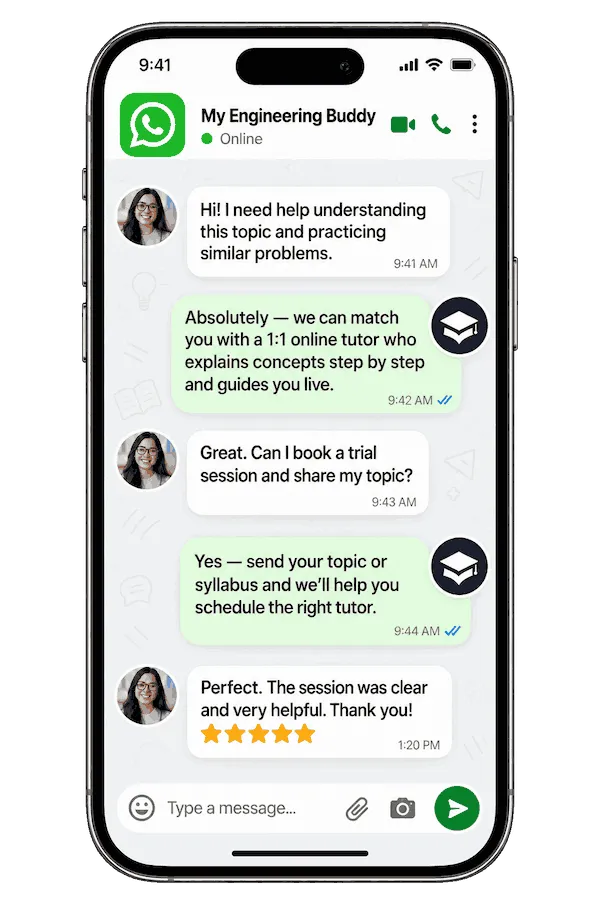
WhatsApp MEB for a quick quote — average response time under 1 minute.
Who This Computer Science Tutoring Is For
Computer Science covers a wider range than most students expect when they sign up for it. Syntax errors are the easy part. The real difficulty shows up in proofs, complexity analysis, and system-level reasoning — and that’s where most students hit a wall alone.
- Undergrad students stuck on object-oriented programming concepts or algorithm design
- Students retaking after a failed first attempt in a core CS module
- Students with a conditional university offer that depends on their CS grade — this is the most time-sensitive situation MEB handles
- Graduate and masters students needing support in distributed systems, compiler design, or research methods
- Students 4–6 weeks from an exam with significant gaps in data structures, networking, or theory of computation
- Parents tracking a child’s progress through A Level or AP Computer Science and wanting structured, accountable support
MEB students have come from universities including MIT, Carnegie Mellon, University of Toronto, Imperial College London, University of Melbourne, ETH Zürich, and Georgia Tech — as well as students progressing toward those institutions through A Level and AP programmes.
Students consistently tell us that the moment things click isn’t when they read the textbook — it’s when they try to explain the concept back to the tutor and realise exactly where their reasoning breaks down. That’s what 1:1 sessions create: that forced articulation moment. It doesn’t happen in a recorded lecture or a YouTube video.
1:1 Tutoring vs Self-Study vs AI vs YouTube vs Online Courses
Self-study works if you’re disciplined and the material is linear — Computer Science rarely is. AI tools like ChatGPT give fast code explanations but can’t watch you reason through a proof and catch the moment you make a wrong assumption. YouTube is solid for concept overviews, but it can’t tell you why your specific implementation of Dijkstra’s algorithm fails on weighted graphs. Online courses offer structure but move at a fixed pace and give no feedback on your particular errors. 1:1 tutoring with MEB is live, corrects mistakes in the moment, and maps directly to your exact syllabus — whether that’s ACM curriculum, a specific university module, or an AP Computer Science Principles exam.
Outcomes: What You’ll Be Able To Do in Computer Science
After working with an MEB Computer Science tutor, students consistently report being able to solve problems they previously had no entry point into. You’ll be able to analyse algorithm complexity using Big-O notation with confidence, write and debug programs across at least one major language, model system design problems using appropriate data structures, explain memory management and how the call stack behaves during recursion, and apply networking concepts such as TCP/IP, routing protocols, and socket-level communication to real scenarios. These aren’t abstract goals — they’re the specific things that show up in coursework submissions, viva questions, and final papers.
Supporting a student through Computer Science? MEB works directly with parents to set up sessions, track progress, and keep coursework on schedule. WhatsApp MEB — average response time is under a minute, 24/7.
Based on feedback from 40,000+ sessions collected by MEB from 2022 to 2025, 58% of students improved by one full grade after approximately 20 hours of 1:1 tutoring in subjects like Computer Science. A further 23% achieved at least a half-grade improvement.
Source: MEB session feedback data, 2022–2025.
What We Cover in Computer Science (Syllabus / Topics)

Core Programming and Software Fundamentals
- Variables, data types, control flow, and functions across procedural and OOP paradigms
- Recursion: call stack behaviour, base cases, and common failure patterns
- Object-oriented programming: classes, inheritance, polymorphism, encapsulation
- Design patterns: MVC, Singleton, Observer, Factory in practice
- Version control basics — Git workflows and branching strategy
- Testing: unit tests, integration tests, and test-driven development
- Concurrent programming: threads, locks, race conditions, deadlocks
Key texts: Clean Code by Robert C. Martin, Structure and Interpretation of Computer Programs (Abelson & Sussman), The Pragmatic Programmer by Hunt & Thomas.
Data Structures, Algorithms, and Complexity
- Arrays, linked lists, stacks, queues, heaps, hash tables
- Binary trees, balanced BSTs, tries, and segment trees
- Graph algorithms: BFS, DFS, Dijkstra, Bellman-Ford, Kruskal, Prim
- Sorting algorithms: merge sort, quicksort, heapsort — and when each applies
- Big-O notation, time complexity, and space complexity analysis
- Dynamic programming: memoisation vs tabulation, classic DP problems
- Algorithm design and analysis: divide and conquer, greedy strategies, NP-completeness
Key texts: Introduction to Algorithms (CLRS), Algorithm Design by Kleinberg & Tardos, Competitive Programmer’s Handbook by Laaksonen.
Systems, Networking, and Security
- Operating systems: process scheduling, memory management, file systems, virtualisation
- Computer networking: OSI model, TCP/IP stack, DNS, HTTP, sockets
- Network protocols and routing protocols: OSPF, BGP, RIP
- Cryptography: symmetric and asymmetric encryption, TLS, public key infrastructure
- Cybersecurity fundamentals: attack vectors, threat modelling, secure coding practices
- Database management systems: relational models, SQL, transactions, normalisation
- Computer organisation and architecture: CPU design, instruction sets, cache, memory hierarchy
Key texts: Computer Networks by Tanenbaum, Operating System Concepts by Silberschatz, Computer Security: Art and Science by Bishop.
Platforms, Tools & Textbooks We Support
Computer Science is one of the few subjects where your coding environment is as much a source of confusion as the theory. MEB tutors work directly inside or alongside the tools your course uses:
- IDEs: VS Code, PyCharm, IntelliJ IDEA, Eclipse, CLion
- Languages: Python, Java, C, C++, JavaScript, Haskell, SQL, Assembly
- Version control: Git, GitHub, GitLab
- Debugging and profiling: GDB, Valgrind, Chrome DevTools
- Cloud and deployment: AWS basics, Docker, Linux CLI
- University LMS: Canvas, Blackboard, Moodle — tutors can review submitted work shared via screen
What a Typical Computer Science Session Looks Like
The tutor opens by checking where you left off — usually something specific like whether you understood why your merge sort implementation had an off-by-one error, or how the paging algorithm behaved on last week’s problem set. From there, you and the tutor work through the current topic together on screen — often a new data structure, a proof, or a system design question from your actual coursework. The tutor uses a digital pen-pad to annotate diagrams, trace through code execution line by line, or draw memory layouts in real time. You’re expected to replicate the reasoning, not just watch. The session closes with a concrete task — two or three problems to attempt before next time — and a note on what the following session will open with.
Try your first session for $1 — 30 minutes of live 1:1 tutoring or one homework question explained in full. No registration. No commitment.
WhatsApp MEB now
and get matched within the hour.
How MEB Tutors Help You with Computer Science (The Learning Loop)
Diagnose. In the first session, the tutor asks you to walk through a problem you found difficult. This isn’t a test — it’s a map. Within 20 minutes, the tutor knows whether the gap is in your conceptual understanding, your implementation habits, or your exam technique.
Explain. The tutor works through the correct approach live — using a digital pen-pad or iPad with Apple Pencil to annotate code, draw call stacks, or sketch network diagrams. No pre-recorded slides. No generic walkthroughs.
Practice. You attempt a similar problem while the tutor is present. This is where most of the learning happens. Errors surface immediately rather than after you’ve submitted coursework.
Feedback. The tutor goes through every error: not just what went wrong, but why it went wrong and what mark scheme examiners would penalise. For algorithm questions, this often means re-tracing the logic step by step.
Plan. Each session ends with a written note — next topic, specific skills to consolidate, and the practice tasks set. Progress check-ins happen every 3–4 sessions.
Sessions run on Google Meet. You can share your screen to show your IDE, your terminal output, or a past paper attempt. Before your first session, have your course outline or module guide ready, plus any recent work you struggled with. Start with the $1 trial — 30 minutes of live tutoring that also serves as your first diagnostic.
A common pattern our tutors observe is that students who struggle most with Computer Science aren’t failing to code — they’re failing to reason about what their code does before they run it. The fix is practising with a live person who can interrupt that thinking at the right moment.
Source: MEB tutor observation, 2008–2025.
Tutor Match Criteria (How We Pick Your Tutor)
Not every CS tutor is right for every CS problem. Here’s how MEB matches:
Subject depth. The tutor must have covered your exact module or topic area — not just “Computer Science” broadly. A systems programming specialist is matched to systems programming students; a security expert handles ethical hacking and penetration testing modules.
Tools. Every tutor works on Google Meet with a digital pen-pad or iPad and Apple Pencil — no webcam-only sessions where the student can’t see working clearly.
Time zone. Matched to your region: US East/West, UK, UAE/Gulf, Canada, Australia. Late-night sessions are available.
Goals. Whether you need to pass a specific exam, complete a coursework project, or build conceptual depth before a viva — the match accounts for your actual goal, not a generic “tutoring” request.
At MEB, we’ve found that the tutor match matters more than students expect going in. A tutor who has marked exam scripts for your syllabus catches a very different set of errors than one who simply knows the material. That’s what we screen for — not just subject knowledge, but applied teaching at your specific level.
Study Plans (Pick One That Matches Your Goal)
Your tutor builds the specific sequence after the first diagnostic session. But most Computer Science students fall into one of three patterns: Catch-up (1–3 weeks) — you’re behind on a specific topic like recursion or database normalisation and need to close the gap before an exam or submission. Exam prep (4–8 weeks) — structured revision across the full syllabus, past papers, and timed practice. Weekly support — ongoing sessions aligned to your lecture schedule and coursework deadlines throughout the semester. The tutor adjusts week by week based on what’s coming up in your course.
Pricing Guide
Standard Computer Science sessions run $20–$40/hr. Graduate-level modules — distributed systems, quantum computing, compiler design — can run higher depending on tutor specialisation. Rate factors include: your level, topic complexity, turnaround timeline, and tutor availability.
Availability tightens in April–May (spring finals) and November–December (fall finals). If your exam date is fixed, don’t wait.
For students targeting top CS programmes at universities like MIT, Stanford, CMU, or Imperial College, tutors with industry research and professional engineering backgrounds are available at higher rates — share your specific goal and MEB will match the tier to your situation.
Start with the $1 trial — 30 minutes, no registration, no commitment. WhatsApp MEB for a quick quote.
FAQ
Is Computer Science hard?
It depends on the topic. Most students manage basic programming. The difficulty spike happens at recursion, algorithm complexity proofs, and system-level reasoning. These require a different kind of thinking — and they respond well to 1:1 explanation.
How many sessions are typically needed?
For a specific topic gap before an exam, 4–8 sessions of focused work usually shifts understanding significantly. For semester-long support, students typically run weekly sessions of 60–90 minutes throughout the term.
Can you help with homework and assignments?
MEB tutoring is guided learning — you understand the work, then submit it yourself. The tutor walks through the concepts and approach with you; the submitted work is yours. See our Academic Integrity policy and Why MEB page for full details on what we help with and what we don’t.
Will the tutor match my exact syllabus or exam board?
Yes. Tutors are matched to your specific module, syllabus, or exam board — whether that’s AP Computer Science, A Level Computer Science (AQA, OCR, Edexcel), an undergraduate course, or a specific university module guide you share.
What happens in the first session?
The tutor runs a short diagnostic — you walk through a recent problem or topic. Within 20 minutes, the plan is clear: which topics to cover first, what pace makes sense, and what the first homework task will be.
Is online Computer Science tutoring as effective as in-person?
For most CS students, yes — often more so. Screen sharing, live code annotation, and digital pen-pad explanations work better for debugging and algorithm tracing than a whiteboard across a table. MEB has run this format since 2008.
What’s the difference between AP Computer Science A and AP Computer Science Principles?
AP CS A focuses on Java programming, OOP, and algorithm design — it’s the more technical option. AP CS Principles is broader, covering computational thinking, data, and the internet with no single required language. MEB tutors cover both tracks and can help you decide which fits your goals.
Can you help with coding interviews and technical assessment prep?
Yes. Several MEB Computer Science tutors specialise in LeetCode-style problem solving, system design interviews, and behavioural framing for technical roles. Sessions cover data structures, algorithm patterns, and timed problem practice under realistic interview conditions.
Do you offer help specifically with Data Structures and Algorithms coursework?
Yes — DSA tutoring is one of MEB’s highest-demand areas. Tutors cover everything from linked lists and trees through to graph traversal, dynamic programming, and complexity proofs — matched to your specific university’s problem sets where possible.
Can I get Computer Science tutoring help at midnight or on weekends?
Yes. MEB operates 24/7 across all major time zones. Late-night sessions are regularly booked by students in the US, UK, Gulf, and Australia. WhatsApp MEB at any hour and the typical matching response is under a minute.
What if I don’t like my assigned tutor?
Tell MEB via WhatsApp. No form, no waiting period. A replacement tutor is matched — usually within the same day. The $1 trial session exists specifically so you can test the match before committing to a package.
How do I get started?
Three steps: WhatsApp MEB → share your subject, level, and exam date → get matched to a verified tutor within the hour. Your first session is the $1 trial — 30 minutes of live tutoring or one homework question explained in full, no registration required.
Trust & Quality at My Engineering Buddy
Every MEB Computer Science tutor goes through subject-specific vetting: degree-level credentials in CS or a related engineering field, a live demo session evaluated by MEB before they teach, and ongoing review against student feedback. Rated 4.8/5 across 40,000+ verified reviews on Google. Tutors are not generalists — a tutor assigned to theory of computation has taught that course specifically, not just “mathematics” broadly. Unlike platforms where you fill out a form and wait, MEB responds in under a minute, 24/7. Tutor match takes under an hour. Everything runs over WhatsApp — no logins, no intake forms.
MEB tutoring is guided learning — you understand the work, then submit it yourself. For full details on what we help with and what we don’t, read our Academic Integrity policy and Why MEB.
MEB has served 52,000+ students across the US, UK, Canada, Australia, Gulf, and Europe in 2,800+ subjects since 2008 — with particular depth in Computer Science and related areas including information systems and cloud computing help. Our tutoring methodology is built around diagnostic-first learning, not generic lesson plans.
Our experience across thousands of sessions shows that the single biggest predictor of improvement in Computer Science isn’t prior knowledge — it’s whether the student has regular, structured exposure to problems slightly beyond their current level, with immediate feedback on errors.
Source: MEB tutor observation, 2008–2025.
Explore Related Subjects
Students studying Computer Science often also need support in:
- Automata Theory
- Digital Logic Design
- Parallel Computing
- Human-Computer Interaction
- Formal Languages
- Knowledge Representation
- High Performance Computing
At MEB, we’ve found that students who bring a specific problem to the first session — not just “I’m struggling with CS” — get matched faster and start making progress within the first 30 minutes. Know your module name, your exam date, and the last thing that stumped you. That’s enough to get started.
Next Steps
Ready to get started? Here’s what to do:
- Share your exam board, module name, and hardest topic — one WhatsApp message is enough
- Share your availability and time zone
- MEB matches you with a verified Computer Science tutor — usually within the hour
- First session starts with a diagnostic so every minute is used well
Before your first session, have ready:
- Your exam board and syllabus or course outline
- A recent past paper attempt or homework question you struggled with
- Your exam or submission deadline date
The tutor handles the rest. Visit www.myengineeringbuddy.com for more on how MEB works.
WhatsApp to get started or email [email protected].
Reviewed by Subject Expert
This page has been carefully reviewed and validated by our subject expert to ensure accuracy and relevance.



