

Contact MEB Today To Get The Best
Human-computer interaction (HCI) Tutoring Online
Email: [email protected]



~1 min
Average Reply Time
~1 hour
To Be Matched With A Tutor
30 Min Trial
75% Find Their Tutor On The 1st Trial
$20-35+/hr
Premium Yet Affordable Learning
Most students fail their HCI project not because the code breaks — because the user study design was wrong from the start.
HCI Tutor Online
Human-computer interaction (HCI) is the study of how people interact with computing systems, covering interface design, usability evaluation, user research methods, and accessibility — equipping students to design and assess technology that works for real users.
If you’re searching for an HCI tutor near me, MEB connects you with a verified specialist who knows your exact course structure — whether that’s a university module on computer science, a UX-focused masters programme, or an undergrad project centred on user-centred design. Sessions run live, 1:1, and cover everything from interaction models to usability heuristics to ethics in AI interfaces. You understand the material. You submit the work.
- 1:1 online sessions tailored to your course syllabus and assignment requirements
- Expert verified tutors with subject-specific HCI knowledge and research backgrounds
- Flexible time zones — US, UK, Canada, Australia, Gulf covered
- Structured learning plan built after a diagnostic session
- Ethical homework and assignment guidance — you understand before you submit
52,000+ students across the US, UK, Canada, Australia, and the Gulf have used MEB since 2008 — including students in Computer Science subjects like Human-computer interaction, design patterns, and information systems.
Source: My Engineering Buddy, 2008–2025.
How Much Does an HCI Tutor Cost?
Most HCI tutoring sessions run $20–$40/hr depending on your level and topic complexity. Graduate-level and research-focused work goes up to $100/hr. Not sure yet? Start with the $1 trial — 30 minutes of live 1:1 tutoring or one homework question explained in full, before you commit to anything.
| Level / Need | Typical Rate | What’s Included |
|---|---|---|
| Undergraduate (most levels) | $20–$35/hr | 1:1 sessions, assignment guidance |
| Masters / Research / PhD | $35–$100/hr | Expert tutor, research depth, evaluation design |
| $1 Trial | $1 flat | 30 min live session or 1 homework question explained |
Tutor availability tightens during semester project deadlines and end-of-year submission windows. Book early if your deadline is within four weeks.
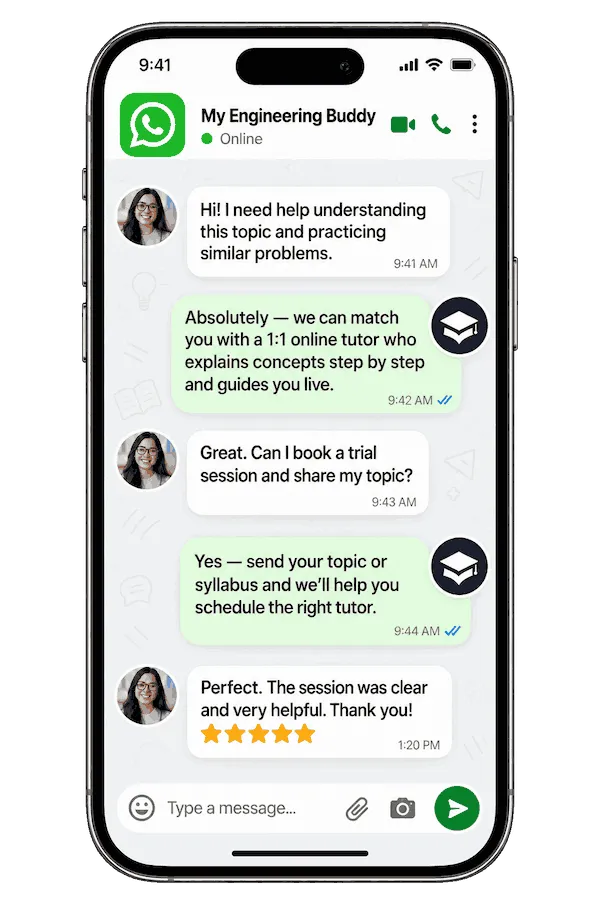
WhatsApp MEB for a quick quote — average response time under 1 minute.
Who This HCI Tutoring Is For
HCI sits at the crossroads of psychology, design, and computing. That makes it genuinely difficult to self-study — and it’s why a lot of students hit a wall when they move from lecture slides to their own user study or interface prototype.
- Undergraduates struggling with their usability evaluation or prototype report
- Masters students designing user studies who need help with methodology — think-aloud protocols, cognitive walkthroughs, heuristic evaluation
- Students retaking after a failed first attempt at their HCI module
- PhD candidates working on accessibility research or interaction design experiments
- Students with a coursework or project submission deadline approaching in the next few weeks
- Students at MIT, Carnegie Mellon, Georgia Tech, University of Michigan, UCL, University of Toronto, and University of Melbourne — all of which run strong HCI and UX research programmes
If you’re working on a group project and carrying most of the conceptual load alone, MEB can help you get your thinking straight before the submission date.
1:1 Tutoring vs Self-Study vs AI vs YouTube vs Online Courses
Self-study works if you’re disciplined, but HCI theory without feedback on your actual design decisions goes nowhere fast. AI tools give quick definitions — they can’t critique your user study protocol or tell you why your interface violates Fitts’s Law. YouTube covers Nielsen’s heuristics well enough; it stops when you need to apply them to your specific prototype. Online courses follow a fixed curriculum and won’t adapt to your assignment brief. MEB’s 1:1 online HCI tutoring is live, calibrated to your exact module, and corrects your reasoning in real time — not after you’ve already submitted.
Outcomes: What You’ll Be Able To Do in HCI
After working with an MEB tutor, you’ll be able to apply usability heuristics like Nielsen’s ten principles to a real interface and write a credible evaluation report. You’ll be able to design and justify a user study — selecting appropriate methods such as think-aloud, card sorting, or A/B testing — and analyse the data you collect. You’ll be able to explain interaction models including Fitts’s Law, the GOMS model, and mental models in the context of your coursework. You’ll be able to present an accessibility audit against WCAG 2.1 standards. And you’ll be able to defend your design decisions in a viva or written critique without second-guessing the theory behind them.
Based on feedback from 40,000+ sessions collected by MEB from 2022 to 2025, 58% of students improved by one full grade after approximately 20 hours of 1:1 tutoring in subjects like Human-computer interaction (HCI). A further 23% achieved at least a half-grade improvement.
Source: MEB session feedback data, 2022–2025.
What We Cover in HCI (Syllabus / Topics)

Track 1: Foundations of Human-Computer Interaction
- History and scope of HCI — from early command-line interfaces to touchscreens and voice UI
- Human perception, cognition, and memory — implications for interface design
- Interaction models: GOMS, KLM, Norman’s action cycle
- Fitts’s Law and motor control in pointing and gesture tasks
- Mental models and conceptual models — how users build expectations
- Affordances, signifiers, mappings, and feedback in design
- Gulf of execution and gulf of evaluation
Core texts: Dix et al. Human-Computer Interaction (4th ed.); Norman The Design of Everyday Things; Rogers, Sharp & Preece Interaction Design (5th ed.).
Track 2: Usability Evaluation and User Research Methods
- Heuristic evaluation — Nielsen’s 10 usability heuristics applied to real interfaces
- Think-aloud protocol design and analysis
- Cognitive walkthrough method
- Card sorting and tree testing for information architecture
- A/B testing and eye-tracking — when to use each method
- Quantitative usability metrics: task completion rate, error rate, time-on-task
- Writing and reporting usability study findings
Core texts: Rubin & Chisnell Handbook of Usability Testing; Lazar, Feng & Hochheiser Research Methods in Human-Computer Interaction.
Track 3: Interface Design, Accessibility, and Emerging Interactions
- User-centred design process — personas, scenarios, prototyping, iteration
- Wireframing and low-to-high fidelity prototyping
- Accessibility standards: WCAG 2.1, Section 508, assistive technology compatibility
- Multimodal interfaces — voice, gesture, haptic, and augmented reality
- HCI in AI systems — explainability, trust calibration, human-AI teaming
- Mobile and cross-device design challenges
- Ethics in HCI — dark patterns, persuasive technology, privacy by design
Core texts: Cooper et al. About Face: The Essentials of Interaction Design; Shneiderman et al. Designing the User Interface (6th ed.); ACM Turing Award lecture archives on computing and society.
What a Typical HCI Session Looks Like
The tutor opens by checking your last topic — usually your heuristic evaluation draft or the user study methodology you outlined in the previous session. If you submitted a think-aloud protocol plan, they’ll pull it up on screen and go through it line by line. From there, you work through a specific problem together: maybe your evaluation criteria aren’t mapped to measurable tasks, or your persona is too vague to generate testable scenarios. The tutor uses a digital pen-pad to annotate your interface screenshots or sketch out a corrected design flow while you explain your reasoning out loud. You replicate the corrected approach on your own version. By the end, you have a concrete task to complete before the next session — usually a revised section of your report or a prototype iteration — and the next topic is already noted down. No time wasted at the start of session two.
How MEB Tutors Help You with HCI (The Learning Loop)
Diagnose: In the first session, the tutor identifies exactly where your understanding breaks down. For most HCI students, it’s not the theory — it’s applying Norman’s model or Nielsen’s heuristics to a specific interface without slipping into vague generalisations. The tutor finds that gap fast.
Explain: Live worked examples using your actual materials. The tutor annotates interface screenshots with a digital pen-pad, walks through a cognitive walkthrough in real time, or rebuilds a flawed user study design step by step — so you see the reasoning, not just the answer.
Practice: You attempt the next problem while the tutor watches. That might mean running a heuristic evaluation on a new interface, drafting a think-aloud script, or justifying a design decision using Fitts’s Law. The tutor stays live and intervenes only when needed.
Feedback: Step-by-step error correction with clear explanations of why marks were lost. “Your evaluation listed violations but didn’t rate severity — that’s where the grade dropped.” Specific, not generic.
Plan: Every session ends with a documented next-topic sequence and a concrete task. The tutor tracks your progress across sessions and adjusts the plan if a new assignment brief changes priorities.
Sessions run over Google Meet with a digital pen-pad or iPad and Apple Pencil. Before your first session, have your course syllabus, any past assignment feedback, and your current project brief ready. The first session is a diagnostic — the tutor maps your gaps and builds a session plan from there. Start with the $1 trial — 30 minutes of live tutoring that also serves as your first diagnostic.
At MEB, we’ve found that HCI students who struggle most aren’t confused by the theory — they’re unsure how to move from a framework like Norman’s action cycle to a written evaluation of a real interface. That translation gap is exactly what 1:1 sessions close, faster than re-reading the textbook.
Tutor Match Criteria (How We Pick Your Tutor)
MEB doesn’t assign whoever is available. Here’s what actually goes into the match:
Subject depth: The tutor must have worked with HCI at your exact level — undergraduate module, UX research methods course, or masters-level interaction design. Syllabus fit matters more than a general computing background.
Tools: Every tutor uses Google Meet and a digital pen-pad or iPad with Apple Pencil. Visual subjects like HCI require annotation — a tutor who only talks doesn’t work here.
Time zone: Matched to your region — US, UK, Gulf, Canada, or Australia — so scheduling doesn’t require negotiation at midnight.
Goals: Whether you need help with a specific assignment, broader conceptual understanding, exam preparation, or research methodology support, the tutor is matched to that goal — not to a generic “CS tutor” profile.
Unlike platforms where you fill out a form and wait, MEB responds in under a minute, 24/7. Tutor match takes under an hour. The $1 trial means you test before you commit. Everything runs over WhatsApp — no logins, no intake forms.
Students consistently tell us that the tutor match is where other platforms lose them — they get someone technically strong but wrong for the module. MEB’s matching process prioritises syllabus fit over general subject knowledge every time.
Study Plans (Pick One That Matches Your Goal)
After the first diagnostic session, your tutor builds a plan tailored to your timeline. Catch-up (1–3 weeks): for students with a report or prototype submission coming fast — the tutor prioritises the highest-impact gaps and works through them in a set sequence. Exam prep (4–8 weeks): structured revision covering evaluation methods, interaction models, and interface design principles in the order your exam is likely to test them. Weekly support: ongoing sessions aligned to your module schedule, covering each topic as it comes up in lectures and assessments. The tutor adjusts the sequence whenever a new assignment brief changes priorities.
Pricing Guide
HCI tutoring starts at $20/hr for standard undergraduate modules. Graduate-level work — research methodology, interaction design evaluation, thesis support — runs $35–$100/hr depending on the tutor’s background and topic complexity. Rate factors include your level, how specialised the topic is, how close your deadline is, and tutor availability.
During semester project submission windows and end-of-year assessments, availability drops quickly. If your deadline is within three weeks, book as soon as possible.
For students targeting top HCI and UX research programmes or roles at major technology companies, tutors with professional industry and academic research backgrounds are available at higher rates — share your specific goal and MEB will match the tier to your ambition.
Start with the $1 trial — 30 minutes, no registration, no commitment. WhatsApp MEB for a quick quote.
MEB has served 52,000+ students since 2008 across 2,800+ subjects. Sessions start at $20/hr. The $1 trial gets you matched and started within the hour — no registration, no forms, just WhatsApp.
Source: My Engineering Buddy, 2008–2025.
FAQ
Is HCI hard?
HCI is conceptually demanding because it requires you to apply theory from psychology, computing, and design simultaneously. Most students find the frameworks clear enough in isolation — the difficulty is using them to evaluate a real interface or justify a design choice under assessment conditions.
How many sessions are needed?
Students with a single assignment gap typically need 3–5 sessions. Those covering a full module or building a user study from scratch usually work with a tutor over 8–15 sessions. The tutor sets a realistic estimate after the diagnostic.
Can you help with homework and assignments?
Yes. MEB tutoring is guided learning — you understand the work, then submit it yourself. That applies to heuristic evaluations, usability reports, interface critiques, and user study designs. See our Academic Integrity policy and Why MEB page for full details on what we help with and what we don’t.
Will the tutor match my exact syllabus or exam board?
Yes. Before the first session, share your course outline, module handbook, or assignment brief. The tutor confirms they know the syllabus and adjusts the session plan to match your exact module structure — not a generic HCI curriculum.
What happens in the first session?
The tutor runs a diagnostic — asking targeted questions about your current understanding, reviewing any past feedback you’ve received, and identifying the three or four areas most likely to cost you marks. A session plan follows from that conversation, not from a template.
Is online tutoring as effective as in-person?
For HCI specifically, online sessions work well. The tutor annotates your interface designs and prototype screenshots directly on screen using a digital pen-pad. You can share your Figma files, paper prototypes, or assignment documents in real time. Most students report the format feels more efficient than in-person for design critique.
Can you help me design a user study from scratch?
Yes. This is one of the most common requests MEB receives from HCI students. The tutor works through your research question, helps you select appropriate methods — think-aloud, heuristic evaluation, card sorting, or surveys — and reviews your protocol before you run participants. Assignment briefs and ethics checklists are covered too.
What’s the difference between UX and HCI — and does my tutor know both?
HCI is the academic field covering interaction models, usability theory, and research methods. UX is the industry application of those principles in product design. MEB tutors who cover HCI modules typically have experience in both — so whether your course leans theoretical or applied, the tutor can bridge that gap.
Do you cover HCI ethics and dark patterns?
Yes. Ethics in HCI — including persuasive technology, dark patterns, privacy by design, and accessibility obligations — appears in most contemporary HCI modules at undergraduate and masters level. If it’s on your syllabus, the tutor covers it. This is increasingly assessed in coursework and project reports.
Can I get HCI help at midnight?
Yes. MEB operates across time zones and responds to WhatsApp messages around the clock. If you’re in the US, Australia, or the Gulf and need a session outside standard UK hours, that’s not a problem. Response time is typically under a minute, any hour.
How do I get started?
WhatsApp MEB, share your course level and current challenge — assignment brief, exam date, or specific topic you’re stuck on. MEB matches you with a verified HCI tutor, usually within an hour. Your first session is the $1 trial: 30 minutes live or one question explained in full.
What if I don’t like my assigned tutor?
Tell MEB via WhatsApp. A replacement is arranged without question, typically within the same day. The $1 trial is specifically designed so you can test the match before committing to a longer plan — no sunk cost, no awkward conversation.
Try your first session for $1 — 30 minutes of live 1:1 tutoring or one homework question explained in full. No registration. No commitment.
WhatsApp MEB now
and get matched within the hour.
Trust & Quality at My Engineering Buddy
Every MEB tutor goes through subject-specific vetting — not a generic interview. For HCI, that means demonstrating working knowledge of usability evaluation methods, interaction design theory, and the ability to run a live annotated session using a digital pen-pad. Tutors are assessed on a live demo session before being matched to students, and feedback from every session is reviewed. Rated 4.8/5 across 40,000+ verified reviews on Google.
MEB tutoring is guided learning — you understand the work, then submit it yourself. For full details on what we help with and what we don’t, read our Academic Integrity policy and Why MEB.
MEB has been running since 2008 and now serves 52,000+ students across the US, UK, Canada, Australia, the Gulf, and Europe in 2,800+ subjects. Computer Science is one of the strongest subject families on the platform — covering design and analysis of algorithms tutoring, operating systems help, and distributed systems tutoring alongside HCI. If your programme spans more than one of these areas, MEB can cover all of them without switching platforms.
Explore Related Subjects
Students studying Human-computer interaction (HCI) often also need support in:
- Game Design & Development
- Digital Humanities
- Health Informatics
- Knowledge Representation
- ICT (Information and Communication Technology)
- Fuzzy Logic
- Information Technology
Next Steps
Before your first session, have ready: your course syllabus or module handbook, a recent assignment with feedback or a prototype you’ve been working on, and your submission or exam date. The tutor handles the rest.
- Share your exam board or university module code, the hardest component, and your current timeline
- Share your availability and time zone — US, UK, Gulf, Canada, or Australia
- MEB matches you with a verified HCI tutor, usually within 24 hours
The first session starts with a diagnostic so every minute is used well. Visit www.myengineeringbuddy.com for more on how MEB works.
WhatsApp to get started or email [email protected].
Reviewed by Subject Expert
This page has been carefully reviewed and validated by our subject expert to ensure accuracy and relevance.




