




~1 min
Average Reply Time
~1 hour
To Be Matched With A Tutor
30 Min Trial
75% Find Their Tutor On The 1st Trial
$20-35+/hr
Premium Yet Affordable Learning
Most students don’t fail Moral Science & Education because the content is hard — they fail because no one has ever made them defend a moral position out loud.
Moral Science & Education Tutor Online
Moral Science & Education is an academic discipline examining ethical principles, moral reasoning, and values-based decision-making. It equips students to analyse right and wrong, apply ethical frameworks to real-world scenarios, and engage critically with questions of justice, duty, and character.
Finding a reliable Moral Science & Education tutor near me is harder than it sounds — the subject sits at the crossroads of philosophy, ethics, and educational theory, and most generalist tutors don’t have the depth to cover all three. MEB has matched 52,000+ students with verified specialists since 2008. Whether you’re working through normative ethics, applied moral reasoning, or the pedagogical foundations of values education, a 1:1 online Moral Science & Education tutor builds the argument-construction and critical analysis skills that exams and coursework actually test.
- 1:1 online sessions tailored to your course syllabus and exam board
- Expert verified tutors with subject-specific knowledge in ethics and moral theory
- Flexible time zones — US, UK, Canada, Australia, Gulf
- Structured learning plan built after a diagnostic session
- Ethical homework and assignment guidance — you understand before you submit
52,000+ students across the US, UK, Canada, Australia, and the Gulf have used MEB since 2008 — including students in Philosophy subjects like Moral Science & Education, Ethics, and Moral Philosophy.
Source: My Engineering Buddy, 2008–2025.
How Much Does a Moral Science & Education Tutor Cost?
Most Moral Science & Education sessions run $20–$40/hr depending on level and syllabus complexity. Graduate-level or specialist coursework can reach $100/hr. Not sure if it’s worth it? The $1 trial lets you test a full 30-minute session before committing to anything.
| Level / Need | Typical Rate | What’s Included |
|---|---|---|
| Standard (most levels) | $20–$35/hr | 1:1 sessions, homework guidance |
| Advanced / Specialist | $35–$70/hr | Expert tutor, niche depth |
| Graduate / Research Level | $70–$100/hr | Thesis support, advanced frameworks |
| $1 Trial | $1 flat | 30 min live session or 1 homework question explained |
Tutor availability tightens around semester deadlines and end-of-year assessments. Book early if you’re within six weeks of a submission date.
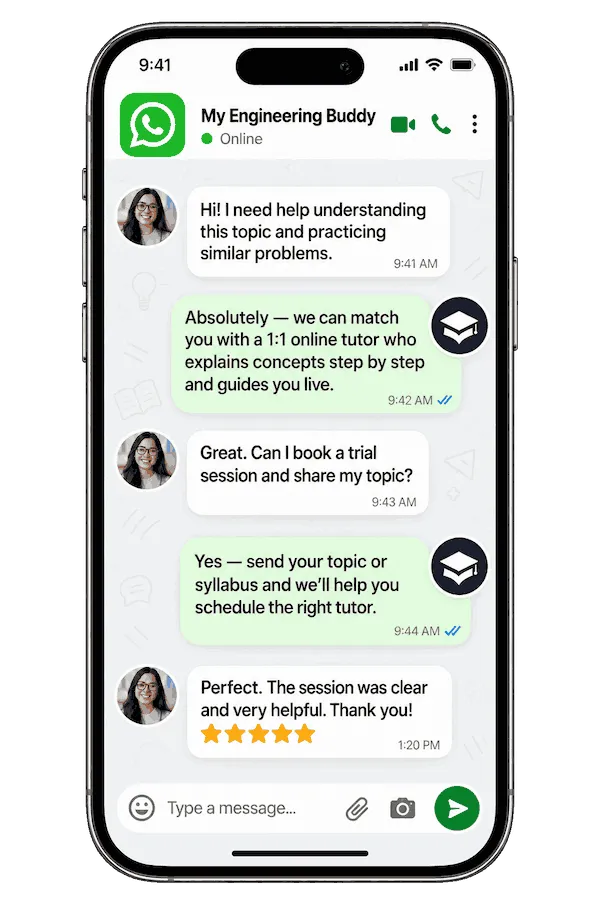
WhatsApp MEB for a quick quote — average response time under 1 minute.
Who This Moral Science & Education Tutoring Is For
Moral Science & Education attracts students who care about the questions but struggle with the academic rigour of answering them. If you can articulate a position but can’t structure it as a defensible argument under exam conditions, that gap is exactly what a 1:1 tutor closes.
- Undergraduate students writing their first ethics essay and unsure how to engage with primary sources
- Students with a university conditional offer depending on their final grade in a values-based module
- Students retaking after a failed first attempt — often because their arguments lacked philosophical grounding
- Parents watching a child’s confidence drop as essay feedback gets more critical and less constructive
- Graduate students working through applied ethics for a thesis, capstone, or policy analysis
- Students at universities including those in the US, UK, Canada, and Australia where moral philosophy modules are embedded in law, medicine, education, and social science degrees
Students who go on to programmes at institutions like Oxford, Cambridge, Toronto, NYU, Melbourne, and ANU often cite Moral Science & Education as the foundation course that sharpened their analytical writing. Getting it right early matters. The $1 trial is the lowest-risk way to find out where your gaps are.
1:1 Tutoring vs Self-Study vs AI vs YouTube vs Online Courses
Self-study works if you’re disciplined, but moral reasoning needs pushback — you can’t see your own weak arguments. AI tools give fast definitions but can’t challenge your logic in real time or spot the philosophical assumption you’ve smuggled into paragraph two. YouTube covers Kant and Mill well enough at an overview level, then leaves you alone with the essay prompt. Online courses follow a fixed syllabus at a fixed pace with no one checking whether your argument actually holds. 1:1 tutoring with MEB puts a subject specialist in the session with you — reading your draft, naming the gap, and showing you exactly how to fix it. In Moral Science & Education, where the exam question is often “evaluate this claim,” that live dialogue is the point.
Outcomes: What You’ll Be Able To Do in Moral Science & Education
After consistent 1:1 Moral Science & Education tutoring, students can construct and defend a normative ethical argument using deontological, consequentialist, or virtue-based frameworks without conflating them. They can analyse a moral dilemma — trolley problems, medical ethics cases, distributive justice scenarios — and identify which ethical theory best applies and why. Students learn to write tightly structured philosophical essays that move from premise to conclusion without logical gaps. They can apply the is-ought distinction, the harm principle, and Rawlsian fairness to real policy questions. They also develop the ability to present counterarguments fairly before dismantling them — a skill examiners reward at every level.
Supporting a student through Moral Science & Education? MEB works directly with parents to set up sessions, track progress, and keep coursework on schedule. WhatsApp MEB — average response time is under a minute, 24/7.
“Based on feedback from 40,000+ sessions collected by MEB from 2022 to 2025, 58% of students improved by one full grade after approximately 20 hours of 1:1 tutoring in subjects like Moral Science & Education. A further 23% achieved at least a half-grade improvement.”
Source: MEB session feedback data, 2022–2025.
At MEB, we’ve found that the biggest barrier in Moral Science & Education isn’t understanding the theories — it’s knowing when and how to apply them under exam pressure. Students who practise arguing both sides of a moral question out loud in sessions consistently perform better when the question is unfamiliar.
What We Cover in Moral Science & Education (Syllabus / Topics)

Ethical Theory and Moral Frameworks
- Deontological ethics — Kant’s categorical imperative and duty-based reasoning
- Consequentialism and utilitarianism — Mill, Bentham, act vs rule variants
- Virtue ethics — Aristotle, character, eudaimonia
- Contractarianism — Rawls, Hobbes, social contract foundations
- Care ethics and relational moral theory
- Moral relativism vs moral universalism
- The is-ought problem and naturalistic fallacy
Core texts include Groundwork of the Metaphysics of Morals (Kant), Utilitarianism (Mill), and A Theory of Justice (Rawls). Cambridge Assessment International Education sets several of these texts for examined courses — see Cambridge Assessment International Education for current syllabus specifications.
Applied Ethics and Moral Reasoning in Practice
- Bioethics — end-of-life decisions, consent, medical resource allocation
- Environmental ethics — duties to future generations, animal rights, climate obligations
- Political and social justice — distributive justice, rights, equality
- Business and professional ethics — corporate responsibility, whistleblowing
- Technology ethics — AI decision-making, data privacy, autonomous systems
- War, peace, and just war theory
- Global ethics and development — Singer’s obligations, cosmopolitanism
Texts include Practical Ethics (Singer), Justice: What’s the Right Thing to Do? (Sandel), and Environmental Ethics (DesJardins). Students working on bioethics tutoring or environmental ethics help will find direct overlap here.
Values Education, Moral Development, and Pedagogy
- Theories of moral development — Kohlberg’s stages, Gilligan’s critique
- Character education vs values clarification approaches
- Role of schooling in moral formation
- Citizenship education, civic virtue, and democratic participation
- Cross-cultural values education — secular vs religious frameworks
- Assessment and evaluation in moral education programmes
Key references include Kohlberg’s Essays on Moral Development and Noddings’ Caring: A Feminine Approach to Ethics and Moral Education. Students bridging into critical thinking tutoring will find Kohlberg and Noddings directly relevant.
What a Typical Moral Science & Education Session Looks Like
The tutor opens by checking the previous topic — say, the student’s attempt to distinguish act utilitarianism from rule utilitarianism in a past essay. From there, they work through a specific exam-style question on screen together, with the student reading their draft argument aloud. The tutor uses a digital pen-pad to annotate the argument in real time — circling the premise that needs a citation, marking where the counterargument was dropped too early. The student rewrites one paragraph while the tutor watches, then explains their reasoning out loud. The session closes with a specific task: a timed 20-minute response to a fresh question on Rawls’ veil of ignorance, to be attempted before the next session.
How MEB Tutors Help You with Moral Science & Education (The Learning Loop)
Diagnose: In the first session, the tutor reviews a recent essay or past paper attempt, identifies whether the problem is conceptual (misunderstanding a theory), structural (arguments that don’t follow), or procedural (not knowing how to use evidence). Most Moral Science & Education students have more than one gap.
Explain: The tutor works through live examples — not definitions, but scenarios. “Here’s a trolley problem variant. Which framework applies? Why does Kant give a different answer than Mill?” The digital pen-pad makes the logic visible as it’s built.
Practice: The student attempts the next question with the tutor present. No googling, no drafting in silence — the tutor asks questions in real time to surface where the reasoning breaks down before it reaches the page.
Feedback: The tutor marks the response as an examiner would — identifying exactly which marks were lost and why. Vague moral claims, unsupported assertions, and missing counterargument handling are named and corrected.
Plan: Each session ends with a clear next topic, a specific practice task, and a target date. The sequence moves from foundational frameworks through applied ethics to exam technique — structured, not random.
Sessions run on Google Meet with a digital pen-pad or iPad and Apple Pencil. Before your first session, bring a recent essay attempt, your course syllabus or exam board specification, and your submission or exam date. Start with the $1 trial — 30 minutes of live tutoring that also serves as your first diagnostic.
Students consistently tell us that the turning point in Moral Science & Education is the session where they argue a position they personally disagree with and realise they can defend it rigorously. That’s when the subject stops feeling like opinion and starts feeling like a discipline.
Tutor Match Criteria (How We Pick Your Tutor)
Not every philosophy graduate is the right fit for Moral Science & Education. MEB matches on four criteria.
Subject depth: The tutor must have studied moral theory at the level you’re working at — undergraduate modules, graduate seminars, or professional ethics programmes. Board-specific knowledge (Cambridge International, IB, A Level) is matched where relevant.
Tools: Every tutor uses Google Meet with a digital pen-pad or iPad and Apple Pencil. Written argument analysis requires visible annotation — not just conversation.
Time zone: Matched to your region — US, UK, Gulf, Canada, Australia. No scheduling across incompatible time zones.
Goals: Exam technique, essay structure, conceptual depth, or research-level engagement with moral theory. The match reflects your actual need, not a generic assignment.
Unlike platforms where you fill out a form and wait, MEB responds in under a minute, 24/7. Tutor match takes under an hour. The $1 trial means you test before you commit. Everything runs over WhatsApp — no logins, no intake forms.
Study Plans (Pick One That Matches Your Goal)
For students on a formal course or exam cycle, MEB builds a session sequence after the first diagnostic. Catch-up (1–3 weeks): closes the most critical gaps before a submission deadline — usually focused on essay structure and argument construction. Exam prep (4–8 weeks): systematic coverage of all assessed frameworks, past paper practice under timed conditions, and examiner-style marking feedback. Weekly support: ongoing sessions aligned to your module schedule, with each session building directly on the previous week’s coursework. The tutor maps the exact sequence after the diagnostic — no generic plans.
Pricing Guide
Moral Science & Education tutoring runs $20–$40/hr for most undergraduate and pre-university levels. Graduate and specialist sessions — thesis support, applied ethics for professional programmes, advanced moral theory — are available up to $100/hr. Rate factors include topic complexity, level of study, your timeline, and tutor availability.
For students targeting top-ranked programmes in law, medicine, education, or public policy where ethics modules carry significant weight, tutors with professional research or academic backgrounds in moral philosophy are available at higher rates. Share your specific goal and MEB will match the tier to your ambition.
Availability tightens during semester-end assessment windows. If you’re within six weeks of a deadline, book earlier rather than later.
Start with the $1 trial — 30 minutes, no registration, no commitment. WhatsApp MEB for a quick quote.
MEB has been running 1:1 online sessions since 2008 — across 2,800+ subjects, including meta-ethics tutoring, social and political philosophy help, and Moral Science & Education. The platform has never needed to advertise a money-back guarantee because the $1 trial does the same job without the risk.
Source: My Engineering Buddy, 2008–2025.
FAQ
Is Moral Science & Education hard?
The concepts are accessible. The difficulty is academic rigour — constructing arguments that hold up under examination, engaging correctly with primary texts, and writing to philosophy essay conventions. Students who read widely but write loosely tend to underperform until they get structured feedback.
How many sessions are needed?
Most students see measurable improvement in essay quality within 6–8 sessions. Exam prep programmes typically run 10–20 hours depending on how far out you are and how many frameworks need covering. The first diagnostic session sets the exact number.
Can you help with homework and assignments?
Yes. MEB tutoring is guided learning — you understand the work, then submit it yourself. The tutor explains the relevant frameworks, helps you develop your argument, and gives feedback on your draft. See our Academic Integrity policy and Why MEB page for full details on what we help with and what we don’t.
Will the tutor match my exact syllabus or exam board?
Yes. MEB matches tutors to your specific course — whether that’s Cambridge International, IB Theory of Knowledge with ethics components, A Level Religious Studies moral philosophy units, or a named undergraduate module. Share your syllabus and the tutor is briefed before session one.
What happens in the first session?
The tutor reviews a recent piece of written work or a past paper attempt, identifies the three most critical gaps, and outlines a session plan. By the end of the first hour, you’ll have a clearer view of exactly what’s holding your grade back and how to fix it.
Is online tutoring as effective as in-person?
For a text-heavy subject like Moral Science & Education, online is often better. The tutor can annotate your essay in real time, pull up primary sources during the session, and share a marked-up version after. There’s a permanent record of every correction. In-person rarely offers that.
What’s the difference between Moral Science and Ethics as academic subjects?
Moral Science is the broader discipline — it includes ethical theory, moral psychology, and values education. Ethics, as a standalone course, usually focuses on normative and applied ethical frameworks. Many university modules use the terms interchangeably; MEB tutors cover both without distinction.
Can MEB help with the ethics components embedded in other degrees?
Yes. Moral Science & Education content appears in law, medicine, nursing, education, social work, and business programmes. MEB tutors work with students on standalone ethics modules within professional degrees — not just dedicated philosophy courses. Share your module outline and MEB matches accordingly.
Do you offer group Moral Science & Education sessions?
MEB is built for 1:1 sessions. All sessions are individual by design — the diagnostic, pacing, and feedback are calibrated to one student. Group format would remove the personalisation that produces the results. Study groups are a complement, not a substitute.
Can I get Moral Science & Education help at midnight?
Yes. MEB operates across time zones. WhatsApp messages receive responses in under a minute on average. Session booking and tutor matching happen 24/7. If you’re in the US, Gulf, or Australia and working late, there’s always someone available.
How do I get started?
Three steps: WhatsApp MEB with your course details and availability, get matched with a verified tutor within the hour, then start your $1 trial — 30 minutes of live 1:1 tutoring or one full homework question explained. No registration required, no commitment beyond the dollar.
What if I don’t like my assigned tutor?
Tell MEB on WhatsApp. Tutor reassignment happens within hours. The match criteria are revisited, and a different tutor with a better fit is confirmed before the next session. You don’t lose the trial credit.
A common pattern our tutors observe is that Moral Science & Education students arrive with strong opinions and weak arguments. The subject doesn’t reward passion — it rewards precision. The fastest improvement comes when a student stops writing what they believe and starts writing what they can prove.
Trust & Quality at My Engineering Buddy
Every MEB tutor goes through subject-specific screening before their first session. That means a live demo evaluation in their subject area, credential verification, and review of their academic or professional background in moral theory or values education. Tutors are monitored via session feedback after every booking. Rated 4.8/5 across 40,000+ verified reviews on Google. The screening is why the match works — MEB doesn’t assign the next available tutor. It assigns the right one for epistemology tutoring, ethics assignment help, Moral Science & Education, or any of 2,800+ subjects on the platform.
MEB tutoring is guided learning — you understand the work, then submit it yourself. For full details on what we help with and what we don’t, read our Academic Integrity policy and Why MEB.
MEB has served students across the US, UK, Canada, Australia, the Gulf, and Europe since 2008 — in Philosophy subjects including Moral Science & Education, analytic philosophy tutoring, and metaphysics help. The platform covers 2,800+ advanced subjects. Find more at MEB’s tutoring methodology.
Try your first session for $1 — 30 minutes of live 1:1 tutoring or one homework question explained in full. No registration. No commitment.
WhatsApp MEB now
and get matched within the hour.
Explore Related Subjects
Students studying Moral Science & Education often also need support in:
- Aesthetics
- Ancient Philosophy
- Continental Philosophy
- Eastern Philosophy
- Existentialism
- Feminist Philosophy
- Philosophy of Religion
- Philosophy of Science
Next Steps
Getting started takes less than five minutes. Here’s what to do:
- Share your exam board or course name, the component you’re struggling with most, and your exam or submission date
- Share your availability and time zone
- MEB matches you with a verified Moral Science & Education tutor — usually within 24 hours, often within the hour
- Your first session starts with a diagnostic so every minute is used on the right thing
Before your first session, have ready: your exam board and syllabus (or course outline), a recent essay attempt or homework question you struggled with, and your exam or deadline date. The tutor handles the rest.
Visit www.myengineeringbuddy.com for more on how MEB works.
WhatsApp to get started or email [email protected].
Reviewed by Subject Expert
This page has been carefully reviewed and validated by our subject expert to ensure accuracy and relevance.




