




~1 min
Average Reply Time
~1 hour
To Be Matched With A Tutor
30 Min Trial
75% Find Their Tutor On The 1st Trial
$20-35+/hr
Premium Yet Affordable Learning
Hire The Best Theory of Machines Tutor










Velocity diagrams. Gear trains. Cam profiles. Balancing of rotating masses. Most students hit a wall somewhere in Theory of Machines — and a wall at week 8 of semester means a resit you didn’t plan for.
Theory of Machines Tutor Online
Theory of Machines is an undergraduate mechanical engineering subject covering mechanisms, kinematics, dynamics, gear systems, and vibrations. It equips students to analyze and design mechanical systems that transmit force and motion in real engineering applications.
MEB connects you with a verified Theory of Machines tutor online — someone who has taught exactly this syllabus, not a generalist who once opened a dynamics textbook. Whether you are working through Mechanical Engineering modules at undergraduate level or pushing into advanced machine dynamics at postgraduate level, MEB has a tutor matched to your course. If you have searched for a Theory of Machines tutor near me and found nobody local worth booking, online is better anyway — same whiteboard, same worked problems, no commute. Start for $1 and see the difference in the first session.
- 1:1 online sessions tailored to your specific university syllabus and exam board
- Expert-verified tutors with mechanical engineering degrees and subject-specific teaching experience
- Flexible scheduling across US, UK, Canada, Australia, and Gulf time zones
- Structured learning plan built after a diagnostic in the first session
- Ethical homework and assignment guidance — you understand the work, then submit it yourself
52,000+ students across the US, UK, Canada, Australia, and the Gulf have used MEB since 2008 — including students in Mechanical Engineering subjects like Theory of Machines, Kinematics of Machines, and Dynamics of Machine.
Source: My Engineering Buddy, 2008–2025.
How Much Does a Theory of Machines Tutor Cost?
Rates run $20–$40/hr for most undergraduate Theory of Machines modules. Advanced topics — rotor dynamics, nonlinear vibrations, advanced mechanism synthesis — sit at the higher end or up to $100/hr for specialist postgraduate support. The $1 trial gets you 30 minutes of live 1:1 tutoring or a full explanation of one homework question before you commit to anything.
| Level / Need | Typical Rate | What’s Included |
|---|---|---|
| Standard undergraduate | $20–$35/hr | 1:1 sessions, homework guidance |
| Advanced / Postgraduate | $35–$100/hr | Expert tutor, niche depth |
| $1 Trial | $1 flat | 30 min live session or 1 homework question explained |
Tutor availability tightens significantly in the six weeks before end-of-semester exams. If you are reading this in October, February, or April, book sooner rather than later.
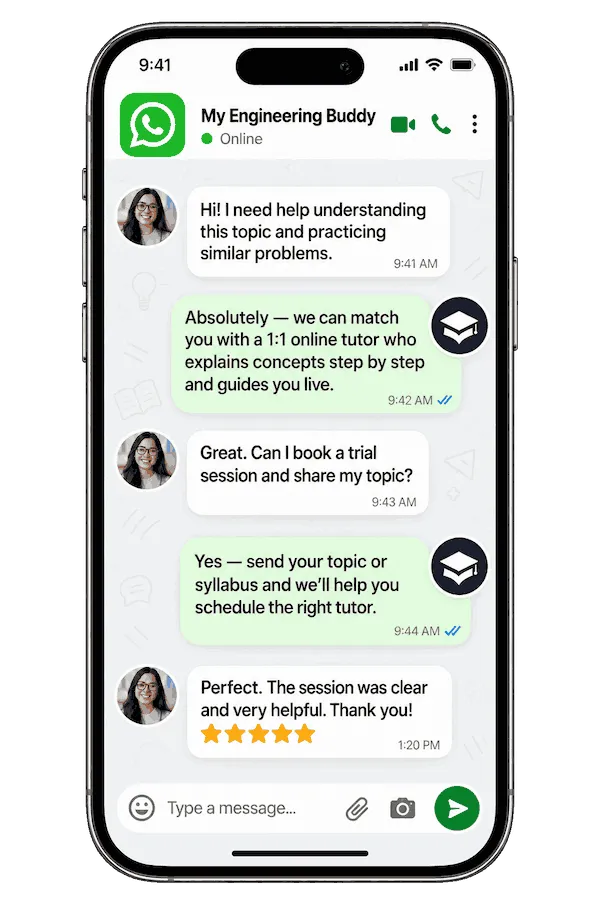
WhatsApp MEB for a quick quote — average response time under 1 minute.
Who This Theory of Machines Tutoring Is For
Theory of Machines sits in years 2–3 of most mechanical engineering degrees. It demands solid ground in statics and dynamics — and punishes students who skipped those foundations. The topics are visual and mathematical at the same time, which is exactly where most students get stuck.
- Undergraduate mechanical engineering students struggling with velocity/acceleration diagrams or gear train analysis
- Students retaking a failed Theory of Machines module and needing a structured plan, not just more lecture slides
- Students with a conditional university offer depending on passing this subject this semester
- Students 4–6 weeks from finals with significant gaps still to close in cam design, balancing, or vibration analysis
- Parents supporting a student whose grades and confidence have both dropped mid-semester
- Graduate students needing support in rotor dynamics, mechanism synthesis, or advanced vibrations for research coursework
Students working through Theory of Machines at universities including MIT, Georgia Tech, Purdue, the University of Michigan, Imperial College London, the University of Toronto, UNSW Sydney, and TU Delft have used MEB tutors to close specific gaps without repeating entire modules.
1:1 Tutoring vs Self-Study vs AI vs YouTube vs Online Courses
Self-study works if your fundamentals are solid — but Theory of Machines is a subject where one wrong assumption about a velocity diagram cascades through every answer on the paper. AI tools give fast explanations, but they cannot watch you draw a mechanism and catch the exact moment your velocity triangle goes wrong. YouTube covers the overview well; it stops when your specific cam profile problem needs another step. Online courses are structured but move at their own pace, not yours. 1:1 tutoring with MEB is live, calibrated to your exact module, and corrects errors the moment they form — which in Theory of Machines is the only way to stop a single misconception from costing you an entire question.
Outcomes: What You’ll Be Able To Do in Theory of Machines
After working 1:1 with an MEB tutor, you will be able to solve velocity and acceleration problems for multi-link mechanisms using both graphical and analytical methods. You will analyze gear trains — simple, compound, and epicyclic — and calculate speed ratios with confidence. You will model cam-follower systems, select appropriate follower profiles, and justify your choices. You will apply balancing techniques to rotating and reciprocating masses in real machine designs. You will explain vibration concepts — natural frequency, resonance, damping — and apply them to single- and multi-degree-of-freedom systems.
Based on feedback from 40,000+ sessions collected by MEB from 2022 to 2025, 58% of students improved by one full grade after approximately 20 hours of 1:1 tutoring in subjects like Theory of Machines. A further 23% achieved at least a half-grade improvement.
Source: MEB session feedback data, 2022–2025.
Supporting a student through Theory of Machines? MEB works directly with parents to set up sessions, track progress, and keep coursework on schedule. WhatsApp MEB — average response time is under a minute, 24/7.
What We Cover in Theory of Machines (Syllabus / Topics)

Track 1: Mechanisms and Kinematics
- Types of kinematic pairs and chains — lower and higher pairs
- Inversions of four-bar linkage, slider-crank, and double-slider mechanisms
- Velocity analysis: relative velocity method and instantaneous centre method
- Acceleration analysis: graphical and analytical approaches
- Synthesis of mechanisms for specified motion requirements
- Cam and follower systems: types, follower motions, pressure angle, undercutting
Core texts include Rattan’s Theory of Machines, S.S. Rattan (S. Chand), and Shigley’s Theory of Machines and Mechanisms by Uicker, Pennock, and Shigley. Students using Kinematics of Machines tutoring alongside this track close gaps faster.
Track 2: Gear Systems and Drives
- Gear terminology, law of gearing, conjugate tooth profiles
- Involute and cycloidal tooth profiles — comparison and applications
- Simple, compound, and reverted gear trains
- Epicyclic gear trains: tabular method and velocity ratio calculation
- Gear forces, efficiency, and power transmission
- Belt drives, rope drives, and chain drives — slip, creep, velocity ratio
Recommended: Norton’s Machine Design for gear force chapters; Ghosh and Mallik’s Theory of Machines and Mechanisms for Indian university syllabi. Students also benefit from Design of Machine Elements tutoring to connect gear design with stress analysis.
Track 3: Dynamics — Balancing and Vibrations
- Static and dynamic balancing of rotating masses in the same and different planes
- Balancing of reciprocating masses — primary and secondary forces
- Free and forced vibration of single-degree-of-freedom systems
- Damping: viscous, Coulomb, and structural — response equations
- Vibration isolation and transmissibility
- Multi-degree-of-freedom systems: natural frequencies and mode shapes
- Critical speed of shafts and whirling of shafts
Key references: Thomson and Dahleh’s Theory of Vibration with Applications; Rao’s Mechanical Vibrations. Students working on the vibrations track often also need Mechanical Vibrations tutoring for deeper coverage.
A common pattern our tutors observe is that students who struggle with balancing problems have not actually missed the balancing content — they have a gap in vector resolution from statics that nobody flagged. One session on that gap fixes three weeks of confusion.
What a Typical Theory of Machines Session Looks Like
The tutor starts by checking where you left off — usually a velocity diagram for a specific four-bar linkage or a gear train problem from the previous session’s practice task. You share your screen or written work. The tutor uses a digital pen-pad to draw directly on the diagram with you, showing exactly where the velocity polygon closes and why your triangle was slightly off. You work through a cam follower displacement curve together, you replicate the method on a parallel problem while the tutor watches, and you explain your reasoning step by step. The session closes with a specific practice problem on epicyclic gear trains set for before the next session, and the tutor notes which balancing topic comes next.
How MEB Tutors Help You with Theory of Machines (The Learning Loop)
Diagnose. In the first session the tutor identifies exactly where your understanding breaks down — often a gap in free-body diagrams or a misapplication of the instantaneous centre method that has been generating wrong answers for weeks without anyone catching it.
Explain. The tutor works live problems on screen using a digital pen-pad — drawing velocity polygons, tracing cam profiles, annotating gear force diagrams. You see the method built from first principles, not memorised from a formula sheet.
Practice. You attempt problems with the tutor present. Not after the session. Not from a solution manual. Live, so errors are caught immediately rather than reinforced through repetition.
Feedback. The tutor identifies exactly which step lost you marks and why — whether that is an incorrect reference line on a velocity diagram, a sign error in a balancing equation, or a misread of damping ratio from a graph.
Plan. The next topic is mapped before you leave the session. The tutor tracks where you are against your exam date, adjusts pace, and flags when to start past-paper practice on full mechanism analysis questions.
Sessions run over Google Meet. Your tutor uses a digital pen-pad or iPad with Apple Pencil. Before your first session, share your module outline, a recent assignment or past paper question you struggled with, and your exam date. The first session covers a short diagnostic and then gets straight into the topic that needs the most work. Start with the $1 trial — 30 minutes of live tutoring that also serves as your first diagnostic.
At MEB, we’ve found that students in Theory of Machines almost always know more than they think they do. The problem is usually one broken link in the chain — velocity analysis that was never fully resolved — not a fundamental inability to handle the subject.
Tutor Match Criteria (How We Pick Your Tutor)
Not every mechanical engineering tutor covers Theory of Machines to the depth this subject demands. Here is what MEB checks before matching you.
Subject depth. The tutor must have taught — or studied to postgraduate level — the specific tracks you need: mechanisms, gear trains, balancing, vibrations. A tutor who only covers statics is not matched to a Theory of Machines student.
Tools. Every tutor uses Google Meet with a digital pen-pad or iPad and Apple Pencil. Theory of Machines is a visual subject — a tutor who cannot draw mechanism diagrams live is not useful here.
Time zone. Matched to your region — US, UK, Gulf, Canada, Australia — so sessions happen at a time that actually works, not at 2 a.m. because the tutor is twelve time zones away.
Goals. Exam performance, concept depth, homework completion, or research-level coursework — the match is tuned to what you actually need, not a standard package.
Unlike platforms where you fill out a form and wait, MEB responds in under a minute, 24/7. Tutor match takes under an hour. The $1 trial means you test before you commit. Everything runs over WhatsApp — no logins, no intake forms.
Study Plans (Pick One That Matches Your Goal)
After the diagnostic, your tutor builds the specific sequence. But most Theory of Machines students fall into one of three situations: a catch-up plan (1–3 weeks, closing specific gaps — usually velocity diagrams or balancing — before an upcoming test); an exam prep plan (4–8 weeks, systematic coverage of all tracks with past-paper practice in the final two weeks); or weekly ongoing support aligned to semester pacing, so you never fall behind in the first place. The tutor maps the session plan after the first diagnostic and adjusts it as your understanding develops.
Pricing Guide
Theory of Machines tutoring starts at $20/hr for standard undergraduate modules. Niche or postgraduate-level work — rotor dynamics, advanced vibration analysis, mechanism synthesis for research — runs up to $100/hr. Rate factors include topic complexity, your timeline, and tutor availability at your preferred hours.
Availability tightens fast in the four to six weeks before semester finals. If your exam is soon, book now rather than in two weeks.
For students targeting top mechanical engineering programmes or roles at aerospace, automotive, or industrial machinery firms, MEB has tutors with professional design and research backgrounds available at higher rates. Share your specific goal and MEB will match the tier to your ambition.
Start with the $1 trial — 30 minutes, no registration, no commitment. WhatsApp MEB for a quick quote.
FAQ
Is Theory of Machines hard?
Harder than most students expect, primarily because it combines visual reasoning — drawing mechanism diagrams — with mathematical analysis. Students who struggled with Engineering Mechanics or statics find it particularly demanding. With targeted 1:1 support, the core topics are learnable even on a short timeline.
How many sessions are needed?
For closing a specific gap — velocity diagrams or one gear train topic — two to four sessions often suffice. Full exam preparation covering mechanisms, gears, balancing, and vibrations typically takes 10–20 hours spread over four to eight weeks. The diagnostic in your first session gives a clearer answer for your specific situation.
Can you help with homework and assignments?
Yes. MEB tutoring is guided learning — you understand the work, then submit it yourself. The tutor explains the method, works through a comparable example, and checks your reasoning. See our Academic Integrity policy and Why MEB page for full details on what we help with and what we don’t.
Will the tutor match my exact syllabus or exam board?
Yes. Theory of Machines syllabi vary significantly between universities and countries. When you contact MEB, share your module outline or past paper. The tutor is matched specifically to your coverage — not a generic mechanics tutor who has to guess what your course requires.
What happens in the first session?
The tutor runs a short diagnostic — usually two or three targeted questions across different topics — to identify where your understanding is strong and where it breaks down. The rest of the first session addresses the most urgent gap. You leave with a clear plan for subsequent sessions.
Is online tutoring as effective as in-person for Theory of Machines?
For a visual subject like this, the digital pen-pad makes online tutoring at least as effective as in-person — and often more so, because diagrams are cleaner and recordings are available. Students consistently report that seeing a tutor build a velocity polygon step by step on screen is clearer than watching it on a whiteboard from three metres away.
What is the difference between Theory of Machines and Kinematics of Machines?
Kinematics of Machines covers motion analysis — position, velocity, acceleration — without considering forces. Theory of Machines extends this to include dynamics, force analysis, gear systems, balancing, and vibrations. Most undergraduate programmes teach them as a combined module or in sequence. MEB tutors cover both, and the overlap is covered cleanly.
Do I need to know advanced mathematics before starting?
You need solid ground in basic calculus, vector algebra, and Newton’s laws. Students who are shaky on those foundations benefit from a session or two on prerequisite gaps before diving into mechanism analysis. The tutor assesses this in the diagnostic and addresses it if needed.
Can you help at midnight or on weekends?
Yes. MEB tutors cover multiple time zones and many are available evenings and weekends. WhatsApp MEB at any hour — average response time is under a minute — and the team will confirm the earliest available slot with a tutor matched to your syllabus.
How do I find a Theory of Machines tutor if I am outside the US?
MEB operates across the UK, Canada, Australia, UAE, Saudi Arabia, Qatar, Germany, the Netherlands, and more. Time zone matching is part of the booking process. Share your location when you WhatsApp MEB and the match will reflect your available hours.
What if my Theory of Machines exam uses a specific software for simulation?
Some advanced modules require MATLAB, Simulink, or ADAMS for dynamic simulation. MEB has tutors who cover these tools in the context of Theory of Machines coursework. Mention the software requirement when you first contact MEB so the match reflects it.
How do I get started?
WhatsApp MEB, share your module name and exam date, and you are matched with a verified tutor — usually within the hour. The first session starts with a diagnostic so no time is wasted. The $1 trial covers 30 minutes of live tutoring or one homework question explained in full. No registration needed.
Trust & Quality at My Engineering Buddy
Every MEB tutor goes through subject-specific screening — not a general aptitude test. For Theory of Machines, that means the tutor demonstrates working knowledge of mechanism analysis, gear train calculation, balancing techniques, and vibration theory before being matched with any student. Tutors are evaluated through a live demo session and reviewed continuously based on student feedback. Rated 4.8/5 across 40,000+ verified reviews on Google. MEB has operated since 2008 and has served 52,000+ students.
MEB tutoring is guided learning — you understand the work, then submit it yourself. For full details on what we help with and what we don’t, read our Academic Integrity policy and Why MEB.
MEB serves students across the US, UK, Canada, Australia, the Gulf, and Europe in 2,800+ subjects — from core Mechanical Engineering modules through to Engineering Dynamics tutoring, Solid Mechanics help, and Finite Element Analysis tutoring. The platform is built for advanced subjects where a generic tutor simply will not do.
Students consistently tell us that what they value most is not just the explanation — it’s that the tutor has seen the same exam question patterns before and knows exactly which step gets marked, and which common error the examiner will penalise.
Explore Related Subjects
Students studying Theory of Machines often also need support in:
- Engineering Statics
- Strength of Materials
- Mechanics of Materials
- Continuum Mechanics
- Computational Mechanics
- Nonlinear Control Systems
- Heat Transfer
Next Steps
Before your first session, have ready: your module outline or syllabus, a recent past paper question or assignment you struggled with, and your exam or submission deadline date. The tutor handles the rest.
- Share your exam board or university module name, the hardest topic so far, and your current timeline
- Share your availability and time zone
- MEB matches you with a verified Theory of Machines tutor — usually within 24 hours, often faster
The first session starts with a diagnostic so every minute is used well. Visit www.myengineeringbuddy.com for more on how MEB works.
Try your first session for $1 — 30 minutes of live 1:1 tutoring or one homework question explained in full. No registration. No commitment.
WhatsApp MEB now and get matched within the hour.
WhatsApp to get started or email [email protected].
Theory of Machines is one of the subjects where the gap between a student who passes and one who doesn’t is rarely intelligence — it’s usually 10–15 hours of the right kind of practice with someone who can see exactly where the method breaks down.
Source: My Engineering Buddy, 2008–2025.
ASTM International and professional engineering bodies consistently highlight mechanism design and vibration analysis as core competencies for practising mechanical engineers — the same topics that most students find hardest in Theory of Machines.
Source: ASTM International.
Reviewed by Subject Expert
This page has been carefully reviewed and validated by our subject expert to ensure accuracy and relevance.




