

Contact MEB Today To Get The Best
A/AS Level Art & Design (9479) Tutoring Online
Email: [email protected]



~1 min
Average Reply Time
~1 hour
To Be Matched With A Tutor
30 Min Trial
75% Find Their Tutor On The 1st Trial
$20-35+/hr
Premium Yet Affordable Learning
Hire The Best A/AS Level Art & Design (9479) Tutor





Most Art & Design students don’t fail on ideas — they lose marks on critical studies, formal annotation, and contextual analysis they were never properly taught.
A/AS Level Art & Design (9479) Tutor Online
A/AS Level Art & Design (9479) is a Cambridge International qualification that develops students’ practical art-making skills alongside critical and contextual understanding. It equips learners to produce a personal portfolio, analyse artist influences, and communicate visual ideas at an advanced level.
Finding a qualified A/AS Level Art & Design (9479) tutor who understands the Cambridge syllabus — not just general art teaching — is harder than it should be. MEB connects you with verified subject specialists for online A/AS Level Art & Design tutoring built around your specific components, whether that’s your personal investigation, critical studies essay, or externally set assignment. If you’ve been searching for an A/AS Level Art & Design (9479) tutor near me, online is faster, more flexible, and just as effective.
- 1:1 online sessions tailored to the Cambridge 9479 syllabus
- Expert verified tutors with A Level Art & Design subject knowledge
- Flexible time zones — US, UK, Canada, Australia, Gulf
- Structured learning plan built after a diagnostic session
- Ethical homework and assignment guidance — you understand before you submit
“52,000+ students across the US, UK, Canada, Australia, and the Gulf have used MEB since 2008 — across 2,800+ subjects, from AP Calculus to A Level Music Technology to Data Science.”
Source: My Engineering Buddy, 2008–2025.
How Much Does an A/AS Level Art & Design (9479) Tutor Cost?
Sessions start at $20–$40/hr for most levels. Specialist tutors with professional studio or curatorial backgrounds are available at higher rates. The $1 trial gives you 30 minutes of live 1:1 tutoring or a full explanation of one assignment question before you commit to anything.
| Level / Need | Typical Rate | What’s Included |
|---|---|---|
| AS Level (standard) | $20–$35/hr | 1:1 sessions, annotation & critical studies guidance |
| A Level / Portfolio intensive | $35–$60/hr | Expert tutor, personal investigation, contextual analysis |
| $1 Trial | $1 flat | 30 min live session or one assignment question explained |
Tutor availability in Art & Design narrows sharply in the six weeks before submission deadlines. Book early.
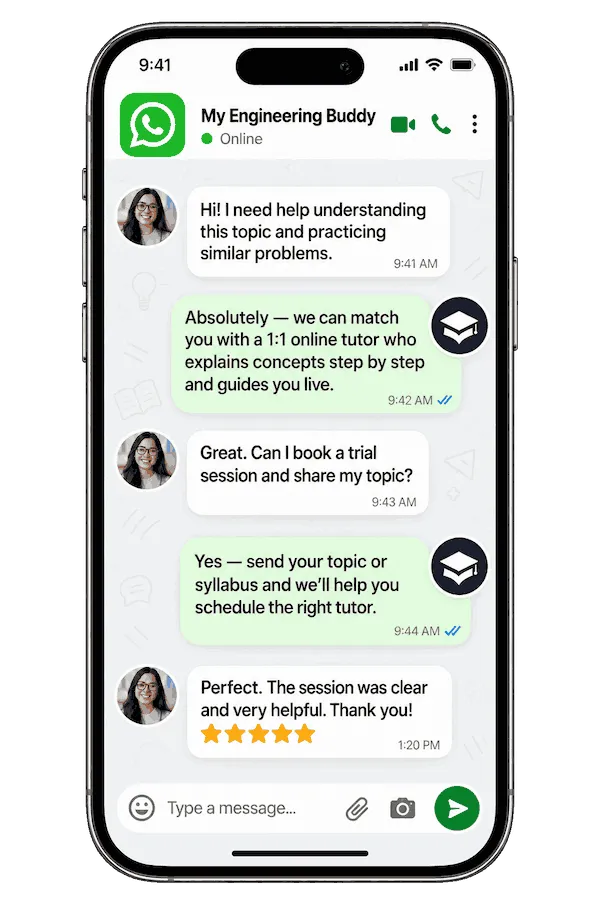
WhatsApp MEB for a quick quote — average response time under 1 minute.
Who This A/AS Level Art & Design (9479) Tutoring Is For
This is for students who are serious about the qualification — whether you’re just starting your personal investigation or you’re three weeks from a submission and your critical studies essay isn’t where it needs to be.
- AS Level students struggling to connect their practical work to contextual sources
- A Level students whose personal investigation lacks analytical depth
- Students with a university conditional offer depending on this grade — and a NEA submission deadline approaching
- Students retaking after an unsatisfactory first attempt and needing a clear plan
- Students who want structured assignment guidance — understand the work, then submit it yourself
- Parents of students whose confidence has dropped alongside their portfolio marks
Students who go on to study Fine Art, Graphic Design, or Architecture at institutions like Central Saint Martins, Goldsmiths, the Royal College of Art, Parsons School of Design, RMIT, and Emily Carr University of Art + Design often cite A Level Art & Design as the qualification that shaped how they think visually.
1:1 Tutoring vs Self-Study vs AI Tools
Self-study works for building a studio practice, but the Cambridge 9479 syllabus also demands structured critical analysis — and most students repeat the same annotation mistakes without realising it because no one corrects them in the moment. AI tools can explain what contextual analysis is, but they cannot look at your actual sketchbook page, diagnose why your written commentary lacks evaluative language, or show you in real time how to link a visual decision to an artist reference. That real-time annotation feedback — specific to your work, your examiner’s mark scheme — is exactly where live human instruction makes the measurable difference. MEB’s online sessions give you the flexibility of remote learning with the structured feedback loop of a specialist who knows the 9479 components inside out.
Outcomes: What You’ll Be Able To Do in A/AS Level Art & Design (9479)
After structured 1:1 sessions, students can analyse artist influences with specific reference to formal elements — line, tone, texture, colour — and connect them credibly to their own practice. They can write critical studies responses that meet the evaluative language standard Cambridge examiners expect. Students apply contextual research to justify practical decisions in annotation, rather than describing what they made. They present a personal investigation that demonstrates a coherent development from initial sources through to a resolved outcome. And they approach the externally set assignment with a preparation process that turns the starting point into a genuinely personal response rather than a generic one.
Supporting a student through A/AS Level Art & Design (9479)? MEB works directly with parents to set up sessions, track progress, and keep coursework on schedule. WhatsApp MEB — average response time is under a minute, 24/7.
“Based on feedback from 40,000+ sessions collected by MEB from 2022 to 2025, 58% of students improved by one full grade after approximately 20 hours of 1:1 tutoring in a single subject. A further 23% achieved at least a half-grade improvement.”
Source: MEB session feedback data, 2022–2025.
What We Cover in A/AS Level Art & Design (9479) (Syllabus / Topics)

Personal Investigation and Portfolio Development
- Identifying and developing a personal theme or starting point
- Building a body of work that shows clear visual development
- Annotation — linking practical decisions to intentions and influences
- Using sketchbooks as a working and thinking tool, not just a display document
- Selecting and presenting final pieces with coherent rationale
- Responding to feedback and demonstrating iterative refinement
Key reference: The Art and Design Teacher’s Handbook by Susie Hodge; Cambridge 9479 Learner Guide (Cambridge Assessment International Education).
Critical and Contextual Studies
- Researching and writing about artists, movements, and cultural contexts
- Using formal element vocabulary (line, tone, texture, form, colour, space) accurately in writing
- Constructing evaluative arguments rather than descriptive summaries
- Connecting contextual sources to personal practice in annotation and essays
- Structuring a critical studies essay to Cambridge mark scheme requirements
- Understanding how to cite and reference visual sources correctly
Key reference: Ways of Seeing by John Berger; The Story of Art by E.H. Gombrich — both widely used as contextual reading at this level.
Externally Set Assignment (ESA) Preparation
- Interpreting the starting point and generating genuinely personal initial responses
- Planning a preparation period that produces sufficient evidence of development
- Understanding the supervised time requirements and how to maximise them
- Avoiding generic or derivative responses to the set theme
- Coordinating materials, techniques, and scale decisions in advance
Key reference: Cambridge International 9479 Specimen Papers and Mark Schemes (available via the NCES resource framework for international curriculum benchmarking); tutor-provided ESA planning templates.
At MEB, we’ve found that Art & Design students who struggle most with the Cambridge 9479 qualification are rarely struggling with making art — they’re struggling with the written language of art. Annotation, critical analysis, and evaluative commentary are learnable skills, and a specialist tutor teaches them the same way any other skill is taught: one clear example at a time, with practice and correction built in.
What a Typical A/AS Level Art & Design (9479) Session Looks Like
The tutor opens by checking what you worked on since the last session — if you were developing annotation for a Basquiat-influenced study, they’ll ask to see what you wrote and how you connected it to your own mark-making decisions. From there, you and the tutor work through a specific component on screen: maybe it’s restructuring your critical studies paragraph to include evaluative rather than descriptive language, or mapping a development sequence in your personal investigation that Cambridge examiners can follow. The tutor uses a digital pen-pad to annotate your work directly — marking where the argument drops, where the visual link is missing, where the formal element analysis is strongest. You then replicate the approach on the next page or section yourself, with the tutor present. The session closes with a specific task: annotate two more sketchbook pages using the structure you just practised, and identify one further contextual source to introduce next time.
How MEB Tutors Help You with A/AS Level Art & Design (9479) (The Learning Loop)
Diagnose: In the first session, the tutor reviews your current sketchbook, recent critical writing, and the component you’re most behind on — personal investigation, critical studies, or ESA preparation. They identify exactly where marks are being lost.
Explain: The tutor works through a live example on a digital pen-pad — showing you how to annotate a page with evaluative language, or how to build a contextual argument that references an artist accurately without just describing their work.
Practice: You attempt the same task in the session — a new annotation, a critical paragraph, a development sequence — with the tutor watching and guiding in real time.
Feedback: The tutor marks exactly where the Cambridge examiner would take off marks and explains why. Not “this needs more detail” — but “this sentence describes rather than evaluates; here’s the sentence structure that fixes it.”
Plan: Each session ends with a specific task and a topic for next time. You’re never left with a vague instruction to “do more research.”
Sessions run over Google Meet. The tutor uses a digital pen-pad or iPad with Apple Pencil to annotate your work directly on screen. Before your first session, share your Cambridge 9479 component focus, your most recent sketchbook pages or critical writing, and your submission or exam date. The first session is your diagnostic — the tutor maps exactly where to start and builds the session plan from there. Start with the $1 trial — 30 minutes of live tutoring that also serves as your first diagnostic.
Students consistently tell us that the turning point in their A Level Art & Design work came when a tutor showed them exactly what evaluative language looks like in practice — not in a textbook definition, but applied to their own sketchbook page. That moment of “oh, that’s what they mean” is what 1:1 tutoring delivers that no written guide can replicate.
Tutor Match Criteria (How We Pick Your Tutor)
Not every art teacher knows the Cambridge 9479 syllabus. Here’s what MEB checks before matching you.
Subject depth: Tutors are matched to your specific component — personal investigation, critical studies, or ESA — and to your current level, AS or A Level.
Tools: Every session uses Google Meet with a digital pen-pad or iPad and Apple Pencil so the tutor can annotate your actual work on screen in real time.
Time zone: Tutors cover New York, Los Angeles, Chicago, London, Dubai, Toronto, Sydney, Melbourne — all US, UK, Gulf, Canadian, Australian, and European time zones, including evenings and weekends.
Learning style: The tutor calibrates their approach after the first session — some students need more structured writing frameworks; others need visual mapping of their development process.
Communication: Clear English, adapted to your level. No assumptions about prior art history knowledge.
Goals: Whether you’re targeting a specific grade for a university conditional offer, catching up after a gap, or strengthening one weak component, the tutor knows your objective from session one.
Unlike platforms where you fill out a form and wait, MEB responds in under a minute, 24/7. Tutor match takes under an hour. The $1 trial means you test before you commit. Everything runs over WhatsApp — no logins, no intake forms.
Study Plans (Pick One That Matches Your Goal)
Catch-up (1–3 weeks): for students with a submission deadline close and clear gaps — the tutor prioritises the highest-mark components first. Exam prep (4–8 weeks): structured sessions across personal investigation, critical studies, and ESA preparation, with weekly targets. Weekly support: ongoing sessions aligned to your coursework calendar, keeping your portfolio development and written work on track together. The tutor builds a specific sequence after the diagnostic — no generic schedules.
Pricing Guide
Most A/AS Level Art & Design (9479) sessions run at $20–$40/hr. Portfolio-intensive work with tutors who have professional studio, gallery, or critical studies backgrounds is available at higher rates — up to $100/hr for highly specialised support. Rate factors include your current level, the component you’re focusing on, how close your deadline is, and tutor availability.
Availability in Art & Design tightens considerably in the final six weeks before Cambridge submission windows. Book before that window closes.
For students targeting top art foundation programmes or competitive fine art degrees at institutions like the Slade or RISD, tutors with professional studio and critical writing backgrounds are available at higher rates — share your specific goal and MEB will match the tier to what you’re aiming for.
Start with the $1 trial — 30 minutes, no registration, no commitment. WhatsApp MEB for a quick quote.
FAQ
Is A/AS Level Art & Design (9479) hard?
The practical work is demanding but manageable for most students. The written components — annotation, critical studies, contextual analysis — catch many students off guard. These require specific vocabulary and essay structure that art lessons alone rarely teach in enough depth.
How many sessions are needed?
For students targeting a grade improvement, 10–20 hours of focused 1:1 work is typical. Students with a specific submission deadline and one weak component (critical studies, for example) often see a clear shift in 4–6 sessions.
Can you help with homework and assignments?
Yes — tutors explain annotation frameworks, critical essay structure, and development sequencing so you can complete and submit the work yourself. MEB tutoring is guided learning — you understand the work, then submit it yourself. For full details, read our Academic Integrity policy and Why MEB.
Will the tutor match my exact syllabus or exam board?
Yes. Tutors are matched specifically to Cambridge International 9479. If you’re following a variation or a school-adapted version, share that when you contact MEB and the match will account for it.
What happens in the first session?
The tutor reviews your current work — sketchbook pages, critical writing, or ESA preparation — and identifies the highest-priority gaps. The session plan for subsequent weeks is built directly from that diagnostic. No time is wasted on topics you’ve already handled well.
Is online tutoring as effective as in-person?
For A Level Art & Design, yes — tutors annotate your actual sketchbook images and written work on screen using a digital pen-pad, which is often more precise than in-person feedback. Students in the US, UK, and Gulf consistently report the same quality of guidance.
Can I get A/AS Level Art & Design help at short notice or late at night?
MEB operates 24/7. WhatsApp response time is typically under one minute. Tutor matching usually takes under an hour. If you have a deadline the next day, contact MEB immediately and the team will find the fastest available match.
What if I don’t connect well with my assigned tutor?
Request a change. MEB reassigns without friction. The $1 trial is specifically designed so you can test the match before committing to a longer plan — if it doesn’t feel right, say so and MEB finds someone better suited.
Do you help with the Personal Investigation specifically?
Yes. The Personal Investigation is the highest-weighted component in 9479. Tutors help you develop a coherent theme, build your development sequence, strengthen annotation, and connect contextual sources to your practical decisions — across every stage of the process.
How do I get started?
WhatsApp MEB with your Cambridge component, current level, and submission date. MEB matches you with a verified A/AS Level Art & Design tutor — usually within the hour. Your first session is the $1 trial: 30 minutes live or one full assignment question explained.
Trust & Quality at My Engineering Buddy
Every MEB tutor goes through subject-specific screening: degree-level or professional background in Art & Design, demonstrated knowledge of the Cambridge 9479 mark scheme, a live demo evaluation before they take students, and ongoing review based on session feedback. Rated 4.8/5 across 40,000+ verified reviews on Google. That rating is built session by session — not from a marketing campaign.
MEB tutoring is guided learning — you understand the work, then submit it yourself. For full details on what we help with and what we don’t, read our Academic Integrity policy and Why MEB.
MEB has served 52,000+ students across the US, UK, Canada, Australia, the Gulf, and Europe in 2,800+ subjects since 2008. Students working on other Cambridge creative and humanities subjects can also get A/AS Level Drama tutoring, A/AS Level Design & Technology help, and A/AS Level Design and Textiles tutoring through the same platform.
A common pattern our tutors observe is this: a student arrives with technically strong artwork and genuinely weak written commentary. The two scores diverge sharply on the mark sheet. Three or four sessions of focused work on evaluative language and annotation structure is usually enough to close that gap substantially. It’s one of the most correctable problems in the entire Cambridge 9479 qualification.
Explore Related Subjects
Students studying A/AS Level Art & Design (9479) often also need support in:
- A/AS Level Digital Media Design (9481)
- A/AS Level Drama (9482)
- A/AS Level Design & Technology (9705)
- A/AS Level Design and Textiles
- A/AS Level Media Studies (9607)
- A/AS Level English Literature (9695)
- A/AS Level Global Perspectives & Research (9239)
Next Steps
Here’s what to share when you contact MEB:
- Your Cambridge 9479 component focus — personal investigation, critical studies, or ESA
- Your submission or exam date and your current timeline
- Your availability and time zone
Before your first session, have ready: your Cambridge 9479 syllabus or component breakdown, recent sketchbook pages or critical writing you’ve been working on, and your submission or exam date. The tutor handles the rest.
MEB matches you with a verified A/AS Level Art & Design tutor — usually within 24 hours. The first session begins with a diagnostic so every minute is used on what actually moves your mark. Visit www.myengineeringbuddy.com to read more about how the MEB process works.
WhatsApp to get started or email [email protected].
Reviewed by Subject Expert
This page has been carefully reviewed and validated by our subject expert to ensure accuracy and relevance.




