




~1 min
Average Reply Time
~1 hour
To Be Matched With A Tutor
30 Min Trial
75% Find Their Tutor On The 1st Trial
$20-35+/hr
Premium Yet Affordable Learning
Most students who struggle with powertrain engineering aren’t missing intelligence — they’re missing someone who can work through a torque-speed curve or a planetary gear set with them, live, on screen.
Powertrain Engineering Tutor Online
Powertrain Engineering covers the design, analysis, and integration of engines, transmissions, drivelines, and hybrid or electric drive systems. A Powertrain Engineering tutor helps students apply thermodynamic cycles, gear theory, and vehicle dynamics to real-world drivetrain problems at undergraduate and graduate level.
If you’ve searched for a Powertrain Engineering tutor near me, MEB connects you with 1:1 online Powertrain Engineering tutoring from verified specialists — across every time zone in the US, UK, Canada, Australia, and the Gulf. Sessions are structured around your exact course, not a generic syllabus. You will leave each session able to work problems independently.
- 1:1 online sessions aligned to your university course or module
- Expert verified tutors with degree-level powertrain and vehicle dynamics knowledge
- Flexible scheduling across US, UK, Canada, Australia, and Gulf time zones
- Structured learning plan built after an initial diagnostic session
- Ethical homework and assignment guidance — you understand the work before you submit
52,000+ students across the US, UK, Canada, Australia, and the Gulf have used MEB since 2008 — across 2,800+ subjects, from AP Calculus to A Level Music Technology to Data Science.
Source: My Engineering Buddy, 2008–2025.
How Much Does a Powertrain Engineering Tutor Cost?
Most Powertrain Engineering tutoring sessions at MEB run $20–$40 per hour. Graduate-level and highly specialised topics — such as hybrid transmission calibration or NVH analysis — can reach up to $100/hr depending on tutor background and depth required. A $1 trial gets you 30 minutes of live 1:1 tutoring or a full explanation of one homework question.
| Level / Need | Typical Rate | What’s Included |
|---|---|---|
| Undergraduate (most levels) | $20–$35/hr | 1:1 sessions, homework guidance |
| Graduate / Specialist | $35–$100/hr | Expert tutor, advanced depth |
| $1 Trial | $1 flat | 30 min live session or 1 homework question |
Tutor availability tightens significantly around semester finals and project submission deadlines. Book early if you have a fixed exam or submission date.
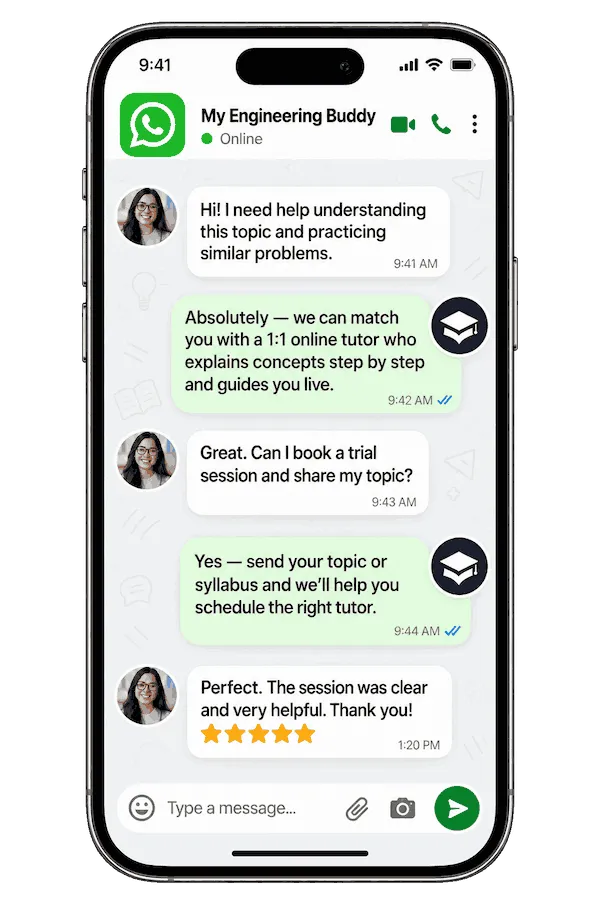
WhatsApp MEB for a quick quote — average response time under 1 minute.
Who This Powertrain Engineering Tutoring Is For
MEB’s online Powertrain Engineering tutoring serves students at every stage — from second-year undergraduates hitting their first real thermodynamics wall to MEng and MSc students working through complex driveline simulation. If you have a specific gap and a deadline, this is built for you. You can also find relevant support through our automotive electronics tutoring page if your coursework spans both areas.
- Undergraduate engineering students taking vehicle systems, driveline design, or propulsion modules
- MEng and MSc students working on powertrain modelling, transmission design, or hybrid system integration
- Students with a university conditional offer depending on their final-year grade in a powertrain or vehicle engineering module
- Students 4–6 weeks from a submission or exam with significant topic gaps still open
- Engineers in industry returning to formal study or upskilling in EV and hybrid drivetrain principles
- Students at universities including Michigan, Loughborough, TU Munich, RMIT, Waterloo, and Delft who need structured support beyond lecture notes
1:1 Tutoring vs Self-Study vs AI Tools
Self-study works for motivated students, but without feedback you can spend three hours on a torque converter problem and still be solving it the wrong way. AI tools are fast at explaining thermodynamic cycles or gear ratios in plain language, but they cannot watch you set up a planetary gear equation, catch the sign error on line three, and redirect your method in real time — which is exactly where most powertrain students lose marks. A 1:1 online Powertrain Engineering tutor through MEB gives you live problem-solving with annotated diagrams, calibrated to the exact module and assessment format your course uses.
Outcomes: What You’ll Be Able To Do in Powertrain Engineering
After structured sessions with an online Powertrain Engineering tutor, students consistently report being able to analyze torque and power delivery across a full drivetrain from engine through final drive, solve planetary gearset kinematics for both automatic and CVT configurations, model hybrid energy flow including regenerative braking losses, apply thermodynamic efficiency analysis to combustion and electric drive cycles, and explain NVH sources in driveline components with enough depth to support a written engineering report.
Supporting a student through Powertrain Engineering? MEB works directly with parents to set up sessions, track progress, and keep coursework on schedule. WhatsApp MEB — average response time is under a minute, 24/7.
Based on feedback from 40,000+ sessions collected by MEB from 2022 to 2025, 58% of students improved by one full grade after approximately 20 hours of 1:1 tutoring in a single subject. A further 23% achieved at least a half-grade improvement.
Source: MEB session feedback data, 2022–2025.
What We Cover in Powertrain Engineering (Syllabus / Topics)

Engine and Combustion Systems
- Thermodynamic cycles: Otto, Diesel, and Atkinson — efficiency calculations and P-V diagrams
- Engine breathing: volumetric efficiency, valve timing, and intake/exhaust design
- Combustion chemistry and emissions: NOx, HC, CO, and aftertreatment systems
- Engine performance mapping: torque curves, BSFC maps, and operating point selection
- Turbocharged and supercharged induction systems
- Engine friction and mechanical losses
Core texts include Heywood’s Internal Combustion Engine Fundamentals and Stone’s Introduction to Internal Combustion Engines.
Transmission, Driveline, and Vehicle Dynamics
- Manual, automatic, dual-clutch, and CVT transmission design and ratio selection
- Planetary gearset kinematics and torque multiplication analysis
- Driveshaft, differential, and axle loading under traction and braking
- Vehicle performance: acceleration, gradeability, and tractive effort calculations
- Drivetrain NVH: sources, transfer paths, and mitigation strategies
- Tyre-road interface and longitudinal slip modelling
Recommended references include Gillespie’s Fundamentals of Vehicle Dynamics and Naunheimer’s Automotive Transmissions.
Hybrid and Electric Drivetrain Systems
- Series, parallel, and power-split hybrid architectures — energy flow and control logic
- Electric motor types: PMSM, induction, and switched reluctance — torque-speed characteristics
- Battery systems: state of charge, energy density, thermal management, and pack sizing
- Regenerative braking: energy recovery modelling and system integration
- Powertrain control strategy: rule-based and optimisation-based energy management
- Charging infrastructure and grid interaction basics
Useful texts include Ehsani’s Modern Electric, Hybrid Electric, and Fuel Cell Vehicles and Larminie and Lowry’s Electric Vehicle Technology Explained. Further reading on ASTM International covers standards relevant to drivetrain testing and materials qualification.
At MEB, we’ve found that students make the fastest progress in powertrain engineering when they stop treating topics like thermodynamics and transmission design as separate subjects. The real breakthroughs happen when a tutor connects the engine output map directly to the gearbox ratio selection — and suddenly the whole drivetrain makes sense as one system.
What a Typical Powertrain Engineering Session Looks Like
The tutor opens by checking the previous topic — usually something specific like where you got stuck on a BSFC map or a planetary gear problem set. From there, you and the tutor work through new material on screen: the tutor annotates diagrams of torque converter lockup or hybrid energy split in real time using a digital pen-pad, talking through every step. You then attempt the next problem while the tutor watches and intervenes only when your method goes off track. The session closes with a concrete task — two or three practice problems on driveline efficiency or transmission shift logic — and a note of exactly what to prepare before the next session.
How MEB Tutors Help You with Powertrain Engineering (The Learning Loop)
Diagnose: In the first session, the tutor identifies specifically where your understanding breaks down — whether that’s setting up a torque balance on a multi-speed gearbox, working through an efficiency chain from engine to wheel, or interpreting a hybrid control strategy. It takes about 20 minutes and shapes every session after it.
Explain: The tutor works through problems live, using a digital pen-pad to annotate P-V diagrams, gear kinematic chains, or electric motor torque-speed curves as they speak. Nothing is assumed. Every step is visible.
Practice: You attempt the next problem yourself, with the tutor present. This is where most platforms stop at videos — and where MEB is different. You work; the tutor watches.
Feedback: The tutor corrects errors step by step, explaining not just what went wrong but why — and what the examiner or marker is looking for in a powertrain analysis question.
Plan: At the end of each session, the tutor sets the next topic, recommends specific practice problems from your course materials, and confirms what to have ready next time.
Sessions run on Google Meet. The tutor uses a digital pen-pad or iPad with Apple Pencil. Before your first session, share your module outline or lecture slides and any past assignments you’ve found difficult. The first session covers your diagnostic and the first concept gap the tutor identifies. Start with the $1 trial — 30 minutes of live tutoring that also serves as your first diagnostic. Whether you need a quick catch-up before a submission, structured revision over 4–8 weeks, or ongoing weekly support through the semester, the tutor maps the session plan after that first diagnostic.
Students consistently tell us that the shift from passive note-taking to active problem-solving in a 1:1 session is where powertrain engineering finally starts to click. It’s not that the content changes — it’s that someone is watching your method and correcting it before a bad habit gets locked in.
Tutor Match Criteria (How We Pick Your Tutor)
MEB does not assign the next available tutor. Every match is made on specific criteria.
Subject depth: Your tutor holds a degree in mechanical, automotive, or vehicle engineering — or a closely related field — and has tutored at the level of your specific module. Tutors covering hybrid and EV systems have working knowledge of powertrain control and battery management beyond textbook level.
Tools: All sessions use Google Meet. Tutors use a digital pen-pad or iPad with Apple Pencil for live annotation of schematics, efficiency maps, and gear diagrams. If your coursework involves simulation in MSC Adams, the tutor matched to you will have direct experience with the software.
Time zone: MEB covers New York, Los Angeles, Chicago, London, Dubai, Toronto, Sydney, Melbourne, and all major European time zones — evenings and weekends included.
Learning style: Calibrated from the first session. Some students need heavy worked examples; others need to be pushed to attempt first and receive correction second.
Communication: Clear English, adapted to your level. No assumed knowledge beyond what your syllabus covers.
Goals: Whether you’re chasing a grade threshold, closing a gap before a resit, or building depth for a research project, the tutor’s approach is set to match.
Unlike platforms where you fill out a form and wait, MEB responds in under a minute, 24/7. Tutor match takes under an hour. The $1 trial means you test before you commit. Everything runs over WhatsApp — no logins, no intake forms.
Study Plans (Pick One That Matches Your Goal)
Your tutor builds the exact sequence after the first diagnostic session, but most students fall into one of three plans. Catch-up (1–3 weeks): closing specific gaps — a missed topic on torque converter theory or a weak transmission kinematics foundation — before a submission deadline. Exam prep (4–8 weeks): structured coverage of every assessed topic with past problem practice and timed answer review. Weekly support: ongoing sessions aligned to your lecture schedule, keeping coursework and module assessments on track across the semester.
Pricing Guide
Powertrain Engineering tutoring at MEB starts at $20/hr for standard undergraduate modules. Graduate-level work — drivetrain optimisation, hybrid control strategy, research project support — typically runs $35–$100/hr depending on depth and tutor background. Rate factors include your level, the complexity of the specific topic, your timeline, and tutor availability.
Demand spikes around May and November exam periods and before January project deadlines. Tutors book up fast in those windows.
For students targeting graduate programmes at universities like Michigan, Loughborough, or TU Munich, or working toward professional accreditation, tutors with industry backgrounds in OEM powertrain development are available at higher rates — share your specific goal and MEB will match the tier to your ambition.
Start with the $1 trial — 30 minutes, no registration, no commitment. WhatsApp MEB for a quick quote.
Try your first session for $1 — 30 minutes of live 1:1 tutoring or one homework question explained in full. No registration. No commitment. WhatsApp MEB now and get matched within the hour.
FAQ
Is Powertrain Engineering hard?
Most students find it hard at the point where thermodynamics, gear kinematics, and vehicle dynamics intersect — usually mid-course. The content isn’t abstract, but the calculations are interdependent. A tutor who can show the full chain from engine output to wheel torque makes it significantly more manageable.
How many sessions are needed?
Students closing a single topic gap — say, planetary gearset analysis or hybrid energy management — typically need 4–6 sessions. Students needing full module coverage usually work across 10–20 sessions over a semester. The tutor confirms a realistic plan after the first diagnostic.
Can you help with homework and assignments?
Yes. MEB tutors explain the method and work through similar problems with you so you understand the approach before you attempt your own submission. The work you submit is always your own.
MEB tutoring is guided learning — you understand the work, then submit it yourself. For full details on what we help with and what we don’t, read our Academic Integrity policy and Why MEB.
Will the tutor match my exact syllabus or exam board?
Yes. Before matching, MEB asks for your university, module name, and any course outline you can share. Tutors are selected on fit with your specific content — not assigned generically. If your module uses a specific simulation tool or textbook, that’s factored into the match.
What happens in the first session?
The first session is a diagnostic. The tutor works through your current understanding of one or two core topics, identifies exactly where your method breaks down, and outlines a session plan from there. It takes about 20 minutes, then moves straight into the first topic gap.
Is online tutoring as effective as in-person?
For powertrain engineering specifically, the digital pen-pad and screen sharing make live diagram annotation and step-by-step problem solving just as clear as a whiteboard in person. Most MEB students across the US, UK, and Gulf report no meaningful difference in learning quality once they’ve had two or three sessions.
Can I get Powertrain Engineering help at midnight or on weekends?
Yes. MEB operates across all major time zones and tutors are available evenings and weekends. WhatsApp response typically comes back in under a minute, any day of the week. Tutors across US, UK, Australian, and Gulf time zones cover most late-evening requests without delay.
What if I don’t like my assigned tutor?
The $1 trial exists precisely for this. If the tutor isn’t the right match — style, depth, pace — tell MEB over WhatsApp and you’ll be rematched before the next session. There’s no fee and no process beyond a single message.
How do I find a Powertrain Engineering tutor in my city?
MEB sessions are fully online, so city location doesn’t limit your options. Students in New York, London, Dubai, Toronto, Sydney, and across Europe all access the same tutor pool. The match is based on your syllabus and goals, not your postcode.
How do I get started?
Start with the $1 trial — 30 minutes of live 1:1 tutoring or one homework question explained in full. Three steps: WhatsApp MEB with your subject and level, get matched with a verified Powertrain Engineering tutor, and start your trial session. No registration required.
Trust & Quality at My Engineering Buddy
Every MEB tutor goes through subject-specific screening: a live demo evaluation reviewed by a senior subject specialist, ongoing session feedback review, and regular performance checks. Powertrain Engineering tutors hold degrees in mechanical, automotive, or vehicle engineering — many with postgraduate qualifications or industry backgrounds at OEMs and tier-one suppliers. Rated 4.8/5 across 40,000+ verified reviews on Google.
MEB tutoring is guided learning — you understand the work, then submit it yourself. For full details on what we help with and what we don’t, read our Academic Integrity policy and Why MEB.
MEB has been serving students across the US, UK, Canada, Australia, the Gulf, and Europe since 2008 — across 2,800+ subjects. Students who need support in related areas can find expert help through our electric and hybrid vehicle tutoring, autonomous vehicles tutoring, and automotive electronics tutoring pages.
MEB has operated since 2008 across 2,800+ engineering and applied science subjects, serving students from undergraduate level to PhD research and professional development — all in 1:1 online sessions matched to your exact course and level.
Source: My Engineering Buddy, 2008–2025.
A common pattern our tutors observe is that powertrain engineering students who struggle with hybrid systems aren’t weak on electrics or on thermodynamics — they’re struggling to integrate the two. That’s a teaching gap, not a student gap. One session that maps the power flow from battery through inverter to wheel usually resolves it.
Explore Related Subjects
Students studying Powertrain Engineering often also need support in:
Next Steps
Getting started takes one message. Have these ready before your first session:
- Your university module name and course outline, or the exam board and syllabus if applicable
- A recent past paper attempt, problem set, or assignment you’ve found difficult
- Your exam date, submission deadline, or preferred weekly schedule and time zone
Share your details over WhatsApp and MEB will match you with a verified Powertrain Engineering tutor — usually within 24 hours. The first session opens with a diagnostic so every minute is used well. Visit www.myengineeringbuddy.com for more on how the MEB process works.
WhatsApp to get started or email [email protected].
Reviewed by Subject Expert
This page has been carefully reviewed and validated by our subject expert to ensure accuracy and relevance.




