

Contact MEB Today To Get The Best
Speech-Language Pathology and Audiology Tutoring Online
Email: [email protected]



~1 min
Average Reply Time
~1 hour
To Be Matched With A Tutor
30 Min Trial
75% Find Their Tutor On The 1st Trial
$20-35+/hr
Premium Yet Affordable Learning
Clinical practicum failing. Praxis scores stuck. Audiology coursework piling up. MEB Speech-Language Pathology and Audiology tutors fix the gaps — one session at a time.
Speech-Language Pathology and Audiology Tutor Online
Speech-Language Pathology and Audiology is the clinical health science covering the assessment and treatment of communication disorders, swallowing dysfunction, and hearing conditions — equipping students and clinicians to evaluate, diagnose, and manage a full spectrum of speech, language, and auditory impairments.
Finding a qualified Speech-Language Pathology and Audiology tutor near me is harder than it sounds — this field spans neurogenic language disorders, aural rehabilitation, fluency, voice, AAC, and pediatric speech, and most tutors only cover part of it. MEB connects you with verified specialists across the full scope of Medicine, including SLP and Audiology tutors who know the ASHA certification framework, Praxis exam structure, and graduate-level clinical coursework inside out. One diagnostic session identifies your gaps. Every hour after that closes them.
- 1:1 online sessions aligned to your programme, supervisor expectations, and Praxis/certification timeline
- Expert-verified tutors with clinical and academic backgrounds in SLP and Audiology
- Flexible time zones — US, UK, Canada, Australia, Gulf
- Structured learning plan built after a diagnostic session
- Ethical homework and assignment guidance — you understand the work before you submit it
52,000+ students across the US, UK, Canada, Australia, and the Gulf have used MEB since 2008 — including students in Medicine subjects like Speech-Language Pathology and Audiology, Neurology, and Gross Anatomy.
Source: My Engineering Buddy, 2008–2025.
How Much Does a Speech-Language Pathology and Audiology Tutor Cost?
Most SLP and Audiology tutoring sessions run $20–$40/hr. Graduate-level clinical coursework, Praxis prep, and specialist Audiology topics can reach $60–$100/hr depending on the tutor’s professional background. The $1 trial gets you 30 minutes of live tutoring or one homework question fully worked through — no registration needed.
| Level / Need | Typical Rate | What’s Included |
|---|---|---|
| Undergraduate SLP / Audiology | $20–$35/hr | 1:1 sessions, homework guidance |
| Graduate / Clinical coursework | $35–$70/hr | Expert tutor, case study depth |
| Praxis / Certification prep | $40–$100/hr | Exam strategy, targeted content |
| $1 Trial | $1 flat | 30 min live session or 1 HW question |
Tutor availability tightens significantly in the weeks before Praxis exam windows and end-of-semester clinical practicums. Book early if you’re working to a hard deadline.
WhatsApp MEB for a quick quote — average response time under 1 minute.
Who This Speech-Language Pathology and Audiology Tutoring Is For
This is for students who are past the “I’ll just re-read the textbook” stage and need someone who actually knows the material. Graduate SLP students, Audiology PhD candidates, and undergraduates preparing for clinical placement all use MEB for different reasons — but the underlying need is the same: real explanations, not re-stated notes.
- Graduate SLP students struggling with neurogenic disorders, fluency, or AAC coursework
- Audiology students working through hearing science, audiogram interpretation, or hearing aid fitting
- Students retaking the Praxis in Speech-Language Pathology after a first failed attempt
- Students with a clinical placement conditional on passing a specific module or exam
- Parents of undergraduates watching coursework grades slip as practicum hours pile on
- Students 4–6 weeks from the Praxis exam with significant content gaps still to close
Students from programmes at institutions including NYU Steinhardt, Northwestern, Vanderbilt, the University of Toronto, the University of Queensland, and City, University of London have used MEB for SLP and Audiology support. The $1 trial is the lowest-friction way to see if the fit is right before committing to a regular schedule.
1:1 Tutoring vs Self-Study vs AI vs YouTube vs Online Courses
Self-study works if you’re disciplined — but SLP and Audiology requires clinical reasoning, not just recall, and a textbook won’t tell you where your reasoning breaks down. AI tools explain concepts fast but can’t run through a differential diagnosis with you in real time or flag why your treatment plan logic has a gap. YouTube covers acoustics and articulation well at a surface level, then stops when you need to apply it to a specific disorder profile. Online courses are structured but fixed-pace — they won’t slow down for posterior cortical atrophy or speed up past phonological awareness if you already have it. 1:1 tutoring with MEB is live, calibrated to your exact module and clinical supervisor’s expectations, and corrects errors in the moment — the kind of error that costs marks in Praxis or raises red flags on placement.
Outcomes: What You’ll Be Able To Do in Speech-Language Pathology and Audiology
After consistent 1:1 Speech-Language Pathology and Audiology tutoring, students work through real clinical scenarios with confidence rather than anxiety. Solve differential diagnosis questions across aphasia subtypes, apraxia, and dysarthria without second-guessing the classification. Analyze audiograms to distinguish sensorineural, conductive, and mixed hearing loss with accuracy. Apply evidence-based intervention frameworks — PROMPT, PECS, Lidcombe — in case study responses and clinical documentation. Explain the anatomy of the vocal tract and auditory pathway clearly enough to teach it. Write diagnostic reports that meet ASHA’s clinical writing standards. Present treatment plans that hold up under supervisor questioning.
Based on feedback from 40,000+ sessions collected by MEB from 2022 to 2025, 58% of students improved by one full grade after approximately 20 hours of 1:1 tutoring in subjects like Speech-Language Pathology and Audiology. A further 23% achieved at least a half-grade improvement.
Source: MEB session feedback data, 2022–2025.
At MEB, we’ve found that SLP and Audiology students often know the theory but struggle to apply it under exam or clinical conditions. The sessions that move the needle fastest are the ones where the student explains their reasoning out loud — and the tutor catches exactly where the logic drifts.
What We Cover in Speech-Language Pathology and Audiology (Syllabus / Topics)

Speech-Language Pathology: Disorders and Clinical Practice
- Neurogenic communication disorders: aphasia, apraxia of speech, dysarthria
- Fluency disorders: stuttering assessment, Lidcombe Programme, school-age intervention
- Voice disorders: vocal hygiene, laryngeal pathology, resonance issues
- Language disorders across the lifespan: developmental, acquired, and literacy-based
- Augmentative and Alternative Communication (AAC): PECS, SGDs, symbol-based systems
- Swallowing and dysphagia: oral, pharyngeal, oesophageal phase assessment and management
- Clinical documentation: SOAP notes, diagnostic reports, treatment plans to ASHA standards
Core texts: Brookshire’s Introduction to Neurogenic Communication Disorders, Paul and Norbury’s Language Disorders from Infancy Through Adolescence, Logemann’s Evaluation and Treatment of Swallowing Disorders.
Audiology: Hearing Science and Clinical Practice
- Anatomy and physiology of the auditory system: outer, middle, and inner ear
- Audiogram interpretation: pure-tone averages, speech recognition scores, tympanometry
- Sensorineural, conductive, and mixed hearing loss: differential diagnosis and management
- Hearing aid technology: fitting principles, verification, real-ear measurement
- Aural rehabilitation: counselling, communication strategies, group programmes
- Paediatric audiology: ABR, OAE, behavioural testing, early intervention
- Vestibular assessment: BPPV, ENG/VNG, balance function testing
Core texts: Katz’s Handbook of Clinical Audiology, Stach’s Comprehensive Dictionary of Audiology, Martin and Clark’s Introduction to Audiology.
Research Methods and Evidence-Based Practice in SLP and Audiology
- Study design: RCTs, single-subject designs, systematic reviews in communication sciences
- Outcome measurement: standardised assessments — CELF, GFTA, PPVT, SCAN
- Statistical analysis for clinical research: sensitivity, specificity, effect size
- Evidence hierarchy: applying ASHA’s evidence-based practice framework to clinical decisions
- Ethics in clinical research and practice: ASHA Code of Ethics, informed consent
Core texts: Dollaghan’s The Handbook for Evidence-Based Practice in Communication Disorders, Maxwell and Satake’s Research and Statistical Methods in Communication Disorders.
What a Typical Speech-Language Pathology and Audiology Session Looks Like
The tutor opens by checking where you left off — usually a specific topic like aphasia classification or audiogram interpretation from the previous session. You share your screen or a past assignment, and the tutor works through the problem with you using a digital pen-pad, annotating an audiogram or mapping out a differential diagnosis in real time. When you’re working on dysphagia or a treatment plan case, the tutor asks you to explain your clinical reasoning step by step — not just give the answer. Errors get caught and corrected immediately, with a clear explanation of why the reasoning went wrong. The session closes with a specific practice task — two or three case vignettes, a tympanogram to interpret, or a set of Praxis-style questions — and a note on what the next session will tackle. You leave with a clear direction, not just a feeling that you covered some material.
How MEB Tutors Help You with Speech-Language Pathology and Audiology (The Learning Loop)
Diagnose: In the first session, the tutor identifies which areas are genuinely weak versus which feel weak because of gaps in prerequisite knowledge — for example, students who struggle with audiogram interpretation often have a shaky foundation in acoustic physics, not audiology itself. That distinction matters for how the sessions are structured.
Explain: Live worked examples using a digital pen-pad — annotating audiograms, mapping aphasia subtypes, walking through a dysphagia assessment protocol. Not a lecture. A demonstration you can stop and question at any point.
Practice: You attempt clinical vignettes, case study questions, or clinical research methodology problems with the tutor present. The tutor watches your reasoning, not just your answer.
Feedback: Step-by-step error correction — why the differential diagnosis logic broke down, where the treatment plan missed a key ASHA criterion, what the audiogram was actually showing. Feedback is specific, not generic.
Plan: Next session topic confirmed. Weak areas tracked. Praxis or placement timeline built into the session sequence so nothing important gets left until the week before.
Sessions run on Google Meet with a digital pen-pad or iPad and Apple Pencil. Before your first session, send MEB your course outline or Praxis content area breakdown, a recent assignment or practice question you struggled with, and your exam or placement date. Start with the $1 trial — 30 minutes of live tutoring that doubles as your first diagnostic.
Students consistently tell us that the moment things click in SLP and Audiology is when they stop trying to memorise disorder categories and start reasoning through cases. The tutor’s job is to get you to that point — and keep you there under exam pressure.
Tutor Match Criteria (How We Pick Your Tutor)
Not every SLP or Audiology tutor is screened for the same things. MEB matches on four criteria, in order of priority:
Subject depth: Tutors are matched to your specific programme level — undergraduate communication sciences, graduate SLP clinical coursework, Audiology doctoral programmes, or public health contexts where SLP intersects with community hearing programmes. Praxis prep tutors are screened specifically on Praxis content area coverage.
Tools: Every tutor uses Google Meet with a digital pen-pad or iPad and Apple Pencil — essential for annotating audiograms and clinical diagrams in real time.
Time zone: Matched to your region — US, UK, Gulf, Canada, Australia. No early-morning 3am sessions unless you specifically want them.
Goals: Exam scores, clinical reasoning depth, specific coursework modules, or research methodology support for dissertations. The tutor’s briefing includes your stated goal, not just your subject.
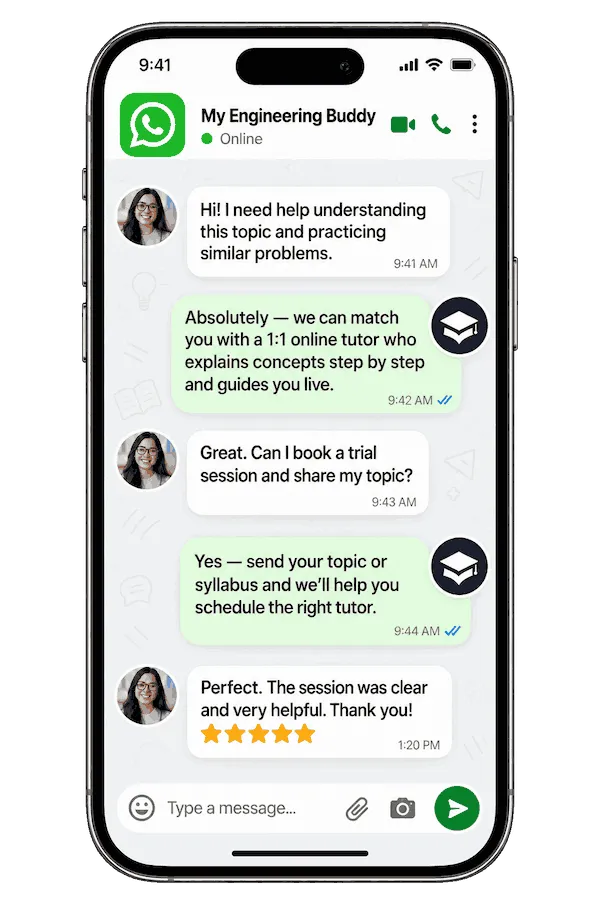
Unlike platforms where you fill out a form and wait, MEB responds in under a minute, 24/7. Tutor match takes under an hour. The $1 trial means you test before you commit. Everything runs over WhatsApp — no logins, no intake forms.
Study Plans (Pick One That Matches Your Goal)
After the first diagnostic session, the tutor builds a specific sequence based on your timeline. Students 1–3 weeks out from an exam or placement get a focused catch-up plan targeting the highest-yield content areas first. Students 4–8 weeks out follow a structured revision plan covering each Praxis domain or module systematically, with practice questions and case vignettes built in. Students who want ongoing weekly support through the semester get a plan aligned to their coursework schedule and clinical supervisor’s expectations. The tutor adjusts the sequence as you progress — it’s not a fixed syllabus, it’s a working plan.
Pricing Guide
Standard Speech-Language Pathology and Audiology tutoring runs $20–$40/hr for most undergraduate and graduate course modules. Praxis prep, specialist Audiology topics like vestibular assessment, and dissertation methodology support can run $60–$100/hr depending on tutor background and topic complexity. Rate factors include your level, the complexity of the topic, how close the exam or deadline is, and tutor availability at your preferred times.
Demand spikes in the six weeks before Praxis exam windows and at the end of clinical semesters. If you’re working to a fixed date, starting early is the straightforward move.
For students targeting competitive SLP graduate programmes, ASHA Fellowship pathways, or specialist Audiology clinical positions, tutors with professional clinical or research backgrounds are available at higher rates — share your specific goal and MEB will match the tier to your ambition.
Start with the $1 trial — 30 minutes, no registration, no commitment. WhatsApp MEB for a quick quote.
MEB has matched students with Speech-Language Pathology and Audiology, Neurology, and Pathophysiology tutors since 2008 — across 18 years of online tutoring, every session runs on the same diagnostic-first model.
Source: My Engineering Buddy, 2008–2025.
Try your first session for $1 — 30 minutes of live 1:1 tutoring or one homework question explained in full. No registration. No commitment.
WhatsApp MEB now
and get matched within the hour.
FAQ
Is Speech-Language Pathology and Audiology hard?
It depends on your background. Students with a strong biology and linguistics foundation adapt faster. The clinical reasoning component — applying disorder frameworks to novel cases — is where most students struggle, not the definitions themselves. A tutor who works through cases with you closes that gap quickly.
How many sessions are needed?
Most students see meaningful improvement in 6–10 sessions targeting specific weak areas. Praxis preparation typically runs 12–20 sessions across 6–8 weeks depending on starting point and content area gaps. The diagnostic first session gives the tutor enough to map a realistic timeline.
Can you help with homework and assignments?
Yes. MEB tutoring is guided learning — you understand the work, then submit it yourself. See our Academic Integrity policy and Why MEB page for full details on what we help with and what we don’t. Tutors work through case study questions, diagnostic reports, and treatment plan assignments with you — they don’t write them for you.
Will the tutor match my exact syllabus or exam board?
Yes. MEB matches tutors to your specific programme, whether that’s an ASHA-accredited US graduate programme, a UK Speech and Language Therapy degree, an Australian programme under Speech Pathology Australia, or Praxis preparation for a specific content area. Share your course outline when you WhatsApp MEB.
What happens in the first session?
The tutor runs a short diagnostic — usually 10–15 minutes — working through one or two topic areas to identify where reasoning breaks down versus where knowledge is solid. The rest of the session addresses the most urgent gap. You finish with a clear plan for the next two to three sessions.
Is online tutoring as effective as in-person?
For SLP and Audiology coursework, yes. Annotating audiograms and clinical diagrams on a shared digital pen-pad works as well as a whiteboard — often better because you can save and review the annotated session later. The diagnostic and feedback loop is identical to in-person.
What’s the difference between Speech-Language Pathology and Audiology as a subject, and which should I focus on?
SLP focuses on communication and swallowing disorders — assessment, diagnosis, and intervention across speech, language, fluency, and voice. Audiology focuses on hearing and vestibular function. Graduate programmes typically specialise in one; MEB tutors cover both, matched to your programme’s emphasis and your clinical placement requirements.
Can MEB help with Praxis in Speech-Language Pathology exam preparation?
Yes. Praxis SLP preparation is one of the most common reasons students come to MEB for this subject. Tutors cover all nine Praxis content areas — including the high-weight areas of language disorders, speech sound disorders, and fluency — with practice questions and case vignettes modelled on the actual exam format.
Do you offer group Speech-Language Pathology and Audiology sessions?
MEB specialises in 1:1 sessions. Group sessions are not offered. The diagnostic-first model requires individual attention — group formats cannot replicate the real-time error correction and personalised case reasoning that makes 1:1 work for clinical subjects like SLP and Audiology.
Can I get Speech-Language Pathology and Audiology help at midnight?
Yes. MEB operates 24/7 via WhatsApp. Tutors are available across time zones, and session booking responds in under a minute at any hour. Late-night sessions before a submission deadline or early-morning slots for Gulf-based students are both standard.
How do I get started?
WhatsApp MEB, share your subject, exam board or programme, and your timeline. MEB matches you with a verified tutor — usually within the hour. The first session is the $1 trial: 30 minutes of live tutoring or one question worked through fully. Three steps: WhatsApp, match, start.
Trust & Quality at My Engineering Buddy
Every MEB tutor goes through a multi-stage screening process — subject knowledge verification, a live demo session evaluated by a senior subject specialist, and ongoing review based on student feedback. Tutors in Speech-Language Pathology and Audiology hold degrees and professional backgrounds in communication sciences, clinical audiology, or related health disciplines. Rated 4.8/5 across 40,000+ verified reviews on Google. MEB has operated since 2008 — 18 years in online tutoring means the screening process has been tested across 52,000+ students, and tutors who don’t maintain quality don’t stay on the platform.
MEB tutoring is guided learning — you understand the work, then submit it yourself. For full details on what we help with and what we don’t, read our Academic Integrity policy and Why MEB.
MEB covers 2,800+ subjects across Medicine, health sciences, and allied health disciplines. Beyond Speech-Language Pathology and Audiology, the platform supports students in Neurology tutoring, Pediatrics help, Pathophysiology tutoring, and across the broader Medicine category — students from the US, UK, Canada, Australia, and the Gulf use MEB throughout their undergraduate and graduate clinical programmes.
MEB tutors bring clinical and academic depth across Speech-Language Pathology, Audiology, and allied health — screened, reviewed, and matched to your exact programme. See how the MEB tutoring methodology works.
Source: My Engineering Buddy, 2008–2025.
A common pattern our tutors observe is that SLP and Audiology students arrive knowing they’re struggling but not knowing exactly where. The first session almost always surfaces something specific — a misunderstood concept in phonological processing, a gap in audiogram reading — that explains why revision hasn’t been working.
Explore Related Subjects
Students studying Speech-Language Pathology and Audiology often also need support in:
- Gerontology
- Physical Therapy / Physiotherapy
- Medical Ethics
- Dietetics
- Preventive Medicine
- Internal Medicine
- Nursing
Next Steps
Here is what to do before your first session:
- Have your course outline, Praxis content area list, or clinical programme syllabus ready
- Bring a recent assignment, case study question, or practice exam you struggled with
- Note your exam date, placement start date, or submission deadline
Share your availability and time zone when you message MEB. A verified Speech-Language Pathology and Audiology tutor is matched — usually within 24 hours, often within the hour. The first session starts with a diagnostic so every minute is used on what actually matters.
Visit www.myengineeringbuddy.com for more on how MEB works.
WhatsApp to get started or email [email protected].
Reviewed by Subject Expert
This page has been carefully reviewed and validated by our subject expert to ensure accuracy and relevance.




