Contact MEB Today To Get The Best
Intercultural Communication Tutoring Online
Email: [email protected]



~1 min
Average Reply Time
~1 hour
To Be Matched With A Tutor
30 Min Trial
75% Find Their Tutor On The 1st Trial
$20-35+/hr
Premium Yet Affordable Learning
Most students don’t fail Intercultural Communication because the ideas are too hard. They fail because no one showed them how to apply Hofstede’s dimensions to a real case study under exam pressure.
Intercultural Communication Tutor Online
Intercultural Communication is the academic study of how people from different cultural backgrounds exchange meaning, manage misunderstandings, and adapt behaviour across linguistic and social boundaries — equipping students to analyse cultural frameworks, communication breakdowns, and cross-cultural interaction patterns.
If you’re searching for an Intercultural Communication tutor near me, MEB matches you with a verified specialist in Communication & Media Studies — covering everything from cultural identity theory to workplace communication ethics. Sessions run 1:1, online, and are built around your exact course syllabus. One outcome you can reasonably expect: clearer, more confident analysis in written assignments and discussions.
- 1:1 online sessions tailored to your specific course or syllabus
- Expert-verified tutors with subject-specific academic backgrounds
- Flexible time zones — US, UK, Canada, Australia, Gulf
- Structured learning plan built after a diagnostic session
- Ethical homework and assignment guidance — you understand the work before you submit
52,000+ students across the US, UK, Canada, Australia, and the Gulf have used MEB since 2008 — including students in Communication & Media Studies subjects like Intercultural Communication, Interpersonal Communication, and Cultural Studies.
Source: My Engineering Buddy, 2008–2025.
How Much Does an Intercultural Communication Tutor Cost?
Most Intercultural Communication tutoring sessions run $20–$40/hr. Graduate-level or specialist theory work can reach $70–$100/hr. The $1 trial gets you 30 minutes of live 1:1 tutoring or one assignment question explained in full.
| Level / Need | Typical Rate | What’s Included |
|---|---|---|
| Undergraduate / Standard | $20–$35/hr | 1:1 sessions, essay and assignment guidance |
| Graduate / Specialist Theory | $35–$100/hr | Expert tutor, advanced frameworks, thesis support |
| $1 Trial | $1 flat | 30 min live session or one full homework question |
Tutor availability tightens during semester submission peaks — particularly in November and April. Book early if you’re working toward a deadline.
WhatsApp MEB for a quick quote — average response time under 1 minute.
Who This Intercultural Communication Tutoring Is For
This isn’t just for students who are struggling. Some of the most common requests come from students who understand the theory but can’t seem to apply it under assessment conditions — a gap that shows up sharply in case study questions and reflective essays.
- Undergraduate students in Communication, Sociology, International Relations, or Business programmes
- Graduate students writing theses on cross-cultural workplace dynamics, diaspora communication, or global media
- Students retaking after a failed first attempt at a course unit or written exam
- Students with a university conditional offer depending on this grade
- Parents watching a child’s confidence drop alongside their grades in a communication-heavy course
- Students preparing reflective essays, group project analyses, or intercultural competence portfolios
Students at universities including the University of Toronto, University of Amsterdam, USC Annenberg, University of Warwick, and NYU have sought help with coursework in this exact area. The $1 trial is a low-risk way to find out whether 1:1 support closes the gap.
At MEB, we’ve found that students who struggle with Intercultural Communication aren’t usually confused by the concepts — they get Hofstede, Hall, and Ting-Toomey in isolation. The problem is connecting those frameworks to specific case scenarios with enough precision to earn marks. That’s what we work on first.
1:1 Tutoring vs Self-Study vs AI vs YouTube vs Online Courses
Self-study works if you’re disciplined, but Intercultural Communication essay feedback doesn’t come from a textbook. AI tools can summarise Hofstede or define high-context communication, but they can’t read your draft and tell you why your argument isn’t landing. YouTube covers the concepts well enough for an introduction — it stops short when your assignment requires original critical analysis. Online courses move at a fixed pace with no adaptation to your specific course rubric. 1:1 tutoring with MEB is live, calibrated to your exact syllabus, and corrects the specific gaps showing up in your actual assessed work.
Outcomes: What You’ll Be Able To Do in Intercultural Communication
After consistent 1:1 sessions, you’ll be able to apply cultural dimension frameworks — Hofstede’s six dimensions, Hall’s high/low-context model, and Ting-Toomey’s face-negotiation theory — to real organisational or media case studies with precision. You’ll analyse cross-cultural communication breakdowns not just descriptively but analytically, explaining the structural reasons behind them. You’ll write reflective essays that demonstrate genuine intercultural competence rather than surface-level awareness. And you’ll present arguments in seminars or oral assessments with enough theoretical grounding to hold up under questioning.
“Based on feedback from 40,000+ sessions collected by MEB from 2022 to 2025, 58% of students improved by one full grade after approximately 20 hours of 1:1 tutoring in subjects like Intercultural Communication. A further 23% achieved at least a half-grade improvement.”
Source: MEB session feedback data, 2022–2025.
Supporting a student through Intercultural Communication? MEB works directly with parents to set up sessions, track progress, and keep coursework on schedule. WhatsApp MEB — average response time is under a minute, 24/7.
What We Cover in Intercultural Communication (Syllabus / Topics)
Cultural Frameworks and Theory
- Hofstede’s six cultural dimensions: power distance, individualism, uncertainty avoidance, long-term orientation, indulgence
- Hall’s high-context vs low-context communication model
- Ting-Toomey’s face-negotiation theory and conflict styles
- Trompenaars’ seven dimensions of culture
- Bennett’s Developmental Model of Intercultural Sensitivity (DMIS)
- Cultural identity formation and code-switching
- Stereotype, prejudice, and ethnocentrism in communication contexts
Core texts include Hofstede’s Cultures and Organizations, Ting-Toomey & Dorjee’s Communicating Across Cultures, and Martin & Nakayama’s Intercultural Communication in Contexts.
Applied Intercultural Communication
- Cross-cultural workplace communication and organisational behaviour
- Intercultural competence models: Byram’s ICC framework, Deardorff’s process model
- Verbal and nonverbal communication differences across cultures — gesture, silence, proxemics
- Language, translation, and meaning-making in multilingual settings
- Global media, diaspora communication, and digital intercultural spaces
- Health communication across cultural contexts
- Nonverbal communication patterns specific to cross-cultural interaction
Recommended reading includes Gudykunst’s Theorizing About Intercultural Communication and Scollon, Scollon & Jones’s Intercultural Communication: A Discourse Approach.
Research Methods and Critical Analysis
- Ethnographic and qualitative approaches to intercultural research
- Critical discourse analysis in cross-cultural settings
- Positionality, reflexivity, and researcher bias in intercultural fieldwork
- Writing literature reviews that synthesise cross-cultural theory
- Structuring case study arguments using cultural frameworks as analytical lenses
- Communication theory applied to intercultural research design
Students in this track often reference Creswell’s Research Design and Flick’s An Introduction to Qualitative Research alongside discipline-specific intercultural texts.

Students consistently tell us that the hardest part of Intercultural Communication isn’t memorising frameworks — it’s knowing which one to reach for when a case study deliberately sits between two models. We drill that exact decision process in every session.
What a Typical Intercultural Communication Session Looks Like
The tutor opens by checking the previous topic — usually a framework application question or a draft essay paragraph the student submitted before the session. From there, the two of you work through a specific problem on screen: perhaps applying Ting-Toomey’s face-negotiation theory to a workplace conflict scenario, or restructuring a thesis argument that conflates cultural dimension scores with individual behaviour. The tutor uses a digital pen-pad to annotate your text or diagram the framework relationships in real time. You replicate the reasoning on a new example — same framework, different cultural context. The session closes with one concrete task: a practice paragraph, a framework comparison table, or a timed response to a past essay question. The next topic is logged before you disconnect.
How MEB Tutors Help You with Intercultural Communication (The Learning Loop)
Diagnose: In the first session, the tutor identifies the specific gap. Is it that you’re describing frameworks instead of applying them? Using Hofstede as a checklist rather than an analytical tool? Writing reflective essays that stay at the level of personal anecdote? The problem is named before anything else happens.
Explain: The tutor works through a live example using a digital pen-pad — annotating a case study, marking where the argument breaks down, showing what a distinction-level answer looks like at the sentence level, not just the structural level.
Practice: You attempt a new problem with the tutor present. That means no waiting 48 hours for feedback — errors are caught in the moment, before they harden into habits.
Feedback: The tutor explains exactly why a particular sentence loses marks: is it too descriptive? Missing a second theoretical lens? Failing to connect the cultural variable to the communication outcome? Specific, not general.
Plan: After each session, the tutor maps the next topic and adjusts the plan based on how quickly you moved through today’s material. Progress is tracked across sessions, not reset each time.
Sessions run on Google Meet. The tutor uses a digital pen-pad or iPad with Apple Pencil. Before your first session, share your course syllabus or module outline, any recent marked work, and your submission deadline. The first session covers the diagnostic and starts working on the highest-priority gap immediately. Start with the $1 trial — 30 minutes of live tutoring that also serves as your first diagnostic.
Tutor Match Criteria (How We Pick Your Tutor)
Not every Communication tutor has depth in intercultural theory. MEB matches on specifics.
Subject depth: tutors are matched by academic background — degree-level study or teaching in Intercultural Communication, cross-cultural psychology, or applied linguistics. Syllabus fit is checked before the match is confirmed.
Tools: every tutor works on Google Meet with a digital pen-pad or iPad and Apple Pencil — essential for real-time annotation of essays and framework diagrams.
Time zone: matched to your region — US, UK, Gulf, Canada, or Australia — so sessions run at workable hours without negotiation.
Goals: whether you need essay marks, conceptual depth, assignment guidance, or thesis-level support, the tutor match reflects that goal from the start.
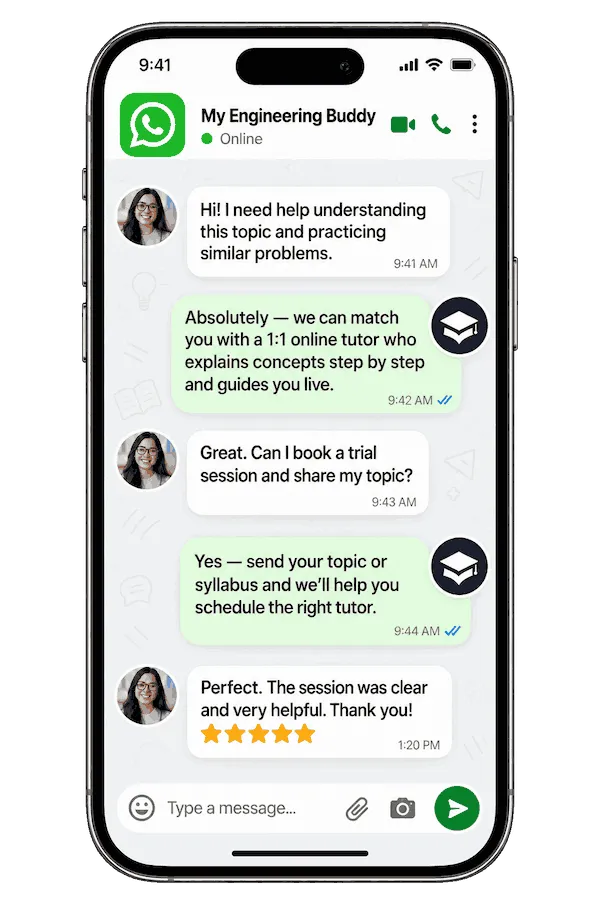
Unlike platforms where you fill out a form and wait, MEB responds in under a minute, 24/7. Tutor match takes under an hour. The $1 trial means you test before you commit. Everything runs over WhatsApp — no logins, no intake forms.
Study Plans (Pick One That Matches Your Goal)
After the diagnostic, the tutor builds a session sequence specific to your timeline. Catch-up (1–3 weeks): for students with an imminent submission and clear gaps in framework application or essay structure. Exam prep (4–8 weeks): structured revision through theory, case study practice, and timed essay work. Weekly support: ongoing sessions aligned to your module schedule, covering new topics as your course progresses and building on previous sessions rather than starting from scratch each week. The tutor sets the sequence after the first diagnostic — you don’t need to decide in advance.
Pricing Guide
Intercultural Communication tutoring runs $20–$40/hr for most undergraduate-level sessions. Graduate-level work — thesis supervision, advanced theory, research methodology — can reach $70–$100/hr depending on the tutor’s background and the depth required.
Rate factors include your level, the complexity of the topic (applied case work vs pure theory), your timeline, and tutor availability. Availability tightens in November and April — the two main semester submission periods across US, UK, and Australian universities.
For students targeting top programmes at research universities or preparing for competitive postgraduate admissions where writing samples matter, tutors with academic research and publication backgrounds are available at higher rates — share your specific goal and MEB will match accordingly.
Start with the $1 trial — 30 minutes, no registration, no commitment. WhatsApp MEB for a quick quote.
Try your first session for $1 — 30 minutes of live 1:1 tutoring or one homework question explained in full. No registration. No commitment. WhatsApp MEB now and get matched within the hour.
FAQ
Is Intercultural Communication hard?
The concepts aren’t difficult to understand in isolation. The challenge is applying multiple frameworks simultaneously to a single case — and writing that analysis in a way that earns marks. Students who struggle usually need practice with application, not more reading of the theory itself.
How many sessions are needed?
Most students see meaningful improvement in essay quality within 5–8 sessions. Students preparing for a full module assessment or thesis chapter typically work over 10–20 hours. The tutor gives a clearer estimate after the first diagnostic session.
Can you help with homework and assignments?
MEB tutoring is guided learning — you understand the work, then submit it yourself. The tutor explains frameworks, works through practice examples with you, and gives feedback on your reasoning. See our Academic Integrity policy and Why MEB page for full details on what we help with and what we don’t.
Will the tutor match my exact syllabus or exam board?
Yes. Share your module outline, course code, or reading list when you WhatsApp MEB. Tutors are matched based on syllabus fit — not just general subject knowledge. This matters especially in Intercultural Communication, where course emphases vary significantly by institution and programme.
What happens in the first session?
The tutor runs a short diagnostic — reviewing your recent work, asking a few targeted questions, and identifying the specific gap. From there, the first session moves directly into the highest-priority area. No generic introductory material, no recap of things you already know.
Is online tutoring as effective as in-person?
For a text and theory-heavy subject like Intercultural Communication, online is often more effective. Screen sharing, real-time document annotation, and the ability to paste in essay drafts mid-session make the feedback loop faster than most in-person setups. The digital pen-pad replaces a whiteboard without losing anything.
Can I get Intercultural Communication help at midnight or on weekends?
Yes. MEB tutors are available across time zones, including evenings and weekends. WhatsApp response time is under a minute around the clock. If you’re in the Gulf, Australia, or the US West Coast, late-night sessions are a practical option, not an exception.
What if I don’t like my assigned tutor?
Request a replacement via WhatsApp. MEB will match you with a different tutor, usually within the same day. The $1 trial exists precisely so you can assess the fit before committing to paid sessions — no pressure to continue if the match isn’t right.
Do I need to know the theory before my first session?
No. Students start at all levels — some have read the core texts and need help applying them, others need the frameworks explained from scratch. The diagnostic identifies where you are and the tutor builds from there. Bring whatever you’ve got: lecture slides, a past assignment, or just a list of topics you’re uncertain about.
How do Hofstede’s dimensions actually get used in assignments — and why do students keep losing marks on them?
Most students describe the dimensions correctly but apply them at the surface level — noting that a country scores high on individualism without explaining how that shapes the specific communication dynamic in the case. Tutors work through the analytical step that connects the score to the behaviour to the communication outcome, which is where marks are won or lost.
What’s the difference between Intercultural Communication and Cross-Cultural Communication — and does it matter for my assignment?
It can matter significantly. Cross-cultural communication typically compares cultures using shared variables. Intercultural communication focuses on the actual exchange between people from different backgrounds — process, adaptation, and identity negotiation. Some courses treat them as synonymous; others penalise conflation. Your tutor will check how your module uses the terms.
How do I get started?
WhatsApp MEB, share your course details and deadline, and you’ll be matched with a verified tutor — usually within the hour. The first session starts with a diagnostic. Three steps: WhatsApp → matched → start the $1 trial.
Trust & Quality at My Engineering Buddy
Every MEB tutor goes through academic verification, a live demo session evaluation, and ongoing feedback review before working with students. Intercultural Communication tutors hold degrees in Communication Studies, Cultural Anthropology, Applied Linguistics, or directly adjacent fields — and are assessed specifically on their ability to teach framework application, not just recite theory. Rated 4.8/5 across 40,000+ verified reviews on Google.
MEB tutoring is guided learning — you understand the work, then submit it yourself. For full details on what we help with and what we don’t, read our Academic Integrity policy and Why MEB.
MEB has been running since 2008 and has served 52,000+ students across the US, UK, Canada, Australia, the Gulf, and Europe — across 2,800+ subjects. Within Communication & Media Studies, that includes Intercultural Communication and closely related areas like Communication Studies tutoring and Mass Communication tutoring. Subject-specific vetting means the tutor sitting with a student on a Hofstede case study actually knows the framework in depth — not just the name.
MEB has matched students with specialist tutors in Intercultural Communication and related fields across 30+ countries since 2008 — with tutor verification, live demo screening, and an ongoing feedback loop built into every match.
Source: My Engineering Buddy, 2008–2025.
Explore Related Subjects
Students studying Intercultural Communication often also need support in:
- Interpersonal Communication
- Communication Skills
- Social Communication
- Public Speaking
- Personal Development
- Journalism
- Advertising
Next Steps
When you WhatsApp MEB, share the following: your course level and institution, the component you’re struggling with most (essay structure, framework application, case study analysis), and your nearest deadline or exam date. Also share your time zone and typical availability — the tutor match works around your schedule, not the other way around.
Before your first session, have ready:
- Your module outline or syllabus (or course code if you don’t have the document)
- A recent past essay or assignment you struggled with
- Your submission deadline or exam date
MEB matches you with a verified tutor usually within 24 hours — often faster. The first session starts with a diagnostic so every minute is used on what actually matters. Visit www.myengineeringbuddy.com for more on how MEB works.
WhatsApp to get started or email [email protected].
Our experience across thousands of sessions shows that the students who improve fastest in Intercultural Communication are the ones who bring a specific piece of work to the first session — a marked essay, a returned assignment, or a draft they know isn’t landing. That’s the fastest diagnostic there is.
Reviewed by Subject Expert
This page has been carefully reviewed and validated by our subject expert to ensure accuracy and relevance.