Contact MEB Today To Get The Best
O-Level Islamic Studies (2068) Tutoring Online
Email: [email protected]



~1 min
Average Reply Time
~1 hour
To Be Matched With A Tutor
30 Min Trial
75% Find Their Tutor On The 1st Trial
$20-35+/hr
Premium Yet Affordable Learning
Most students who struggle with O-Level Islamic Studies 2068 aren’t weak on faith — they’re losing marks on source analysis, Arabic term precision, and structured essay technique.
O-Level Islamic Studies (2068) Tutor Online
O-Level Islamic Studies (2068) is a Cambridge IGCSE/O-Level qualification examining the Quran, Hadith, Islamic history, and practice. It equips students to interpret primary texts, explain Islamic law, and demonstrate understanding of Muslim beliefs at secondary level.
Finding a qualified O-Level Islamic Studies (2068) tutor online is harder than it sounds. The syllabus demands both textual knowledge and analytical writing — two skills that rarely get equal attention in classroom settings. MEB connects you with tutors who know the 2068 paper inside out, from Surah-based source questions to the structured argument essays that decide grades. If you’ve searched for an O-Level Islamic Studies (2068) tutor near me, online 1:1 is faster, more flexible, and better matched to your exact exam board. Browse our full O-Level tutoring range to see how we cover every subject in the qualification.
- 1:1 online sessions tailored to the Cambridge 2068 syllabus
- Expert-verified tutors with subject-specific knowledge of Islamic texts and exam technique
- Flexible time zones — US, UK, Canada, Australia, Gulf
- Structured learning plan built after a diagnostic session
- Ethical homework and assignment guidance — you understand the work before you submit
52,000+ students across the US, UK, Canada, Australia, and the Gulf have used MEB since 2008 — including students in O-Level subjects like Islamic Studies (2068), Islamiyat (2058), and Religious Studies (2048).
Source: My Engineering Buddy, 2008–2025.
How Much Does an O-Level Islamic Studies (2068) Tutor Cost?
Sessions start at $20–$40/hr for most O-Level levels. Specialist tutors with deeper Arabic or Islamic jurisprudence backgrounds are available at higher rates. Before committing to a package, you can try the $1 trial — 30 minutes of live 1:1 tutoring or one full homework question explained.
| Level / Need | Typical Rate | What’s Included |
|---|---|---|
| Standard O-Level | $20–$35/hr | 1:1 sessions, syllabus coverage, homework guidance |
| Advanced / Specialist | $35–$70/hr | Expert tutor, Arabic text depth, essay technique |
| $1 Trial | $1 flat | 30 min live session or one homework question explained |
Tutor availability tightens significantly in the May/June and October/November Cambridge exam windows. Book early if your exam is within eight weeks.
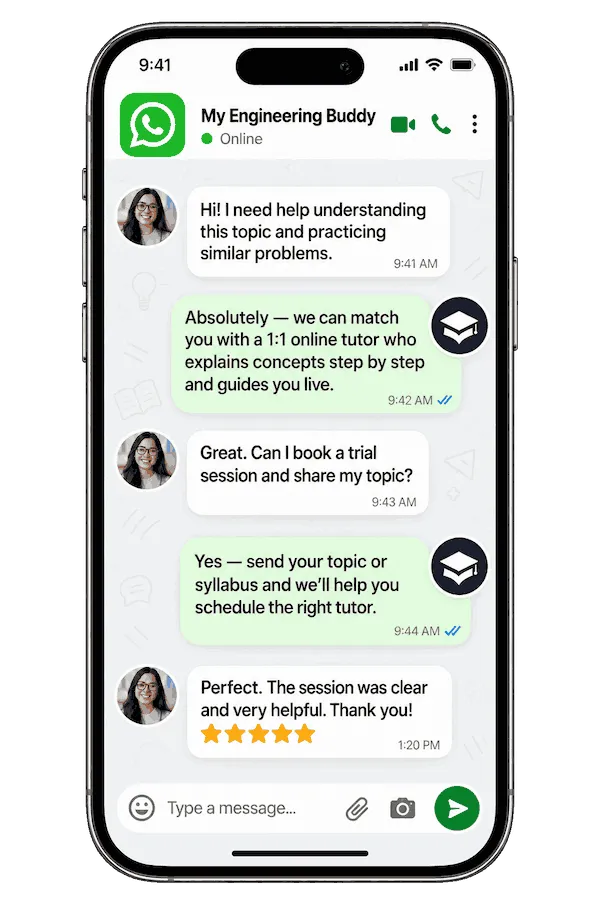
WhatsApp MEB for a quick quote — average response time under 1 minute.
Who This O-Level Islamic Studies (2068) Tutoring Is For
This isn’t just for students who’ve fallen behind. It’s for anyone who knows the content but keeps dropping marks on the written paper — and for those who genuinely need to catch up before their Cambridge session closes.
- Students retaking after a failed first attempt and needing a different approach to source-based questions
- Students with a university conditional offer depending on their O-Level grade
- Students 4–6 weeks from their Cambridge exam with Paper 2 essay technique still to close
- Home-educated students following the 2068 syllabus without classroom support
- Students strong on Islamic knowledge but weak on exam structure and mark-scheme language
- Parents watching a child’s confidence drop alongside their grades in a subject that matters personally to the family
Students who go on to study Islamic theology, Arabic, or religious studies at universities such as the University of Edinburgh, SOAS University of London, Georgetown University, the University of Toronto, or the American University of Sharjah typically need a solid O-Level foundation. The $1 trial is the lowest-risk way to find out where the gaps are.
1:1 Tutoring vs Self-Study vs AI vs YouTube vs Online Courses
Self-study works if you’re disciplined, but there’s no one to tell you why your essay lost three marks. AI tools explain concepts fast but can’t read your draft answer and pinpoint where your argument collapsed. YouTube gives strong overviews of Islamic history and Quranic context but stops the moment you hit a specific source-analysis question. Online courses move at a fixed pace with no adjustment for your exact 2068 paper variant. 1:1 tutoring with MEB is live, calibrated to the Cambridge 2068 mark scheme, and corrects your actual errors — not generic ones.
Outcomes: What You’ll Be Able To Do in O-Level Islamic Studies (2068)
After working with an MEB tutor, students can analyze Quranic ayat and Hadith passages using the source-based method the Cambridge mark scheme rewards. They can apply key Islamic terms — Tawakkul, Shirk, Ijma — accurately in structured responses. Students write coherent argument essays on Islamic law and ethics that follow the point-evidence-explain framework examiners look for. They explain the significance of events in early Islamic history with chronological precision. And they present comparisons between different schools of Islamic thought in a way that demonstrates genuine understanding, not surface recall.
Supporting a student through O-Level Islamic Studies (2068)? MEB works directly with parents to set up sessions, track progress, and keep coursework on schedule. WhatsApp MEB — average response time is under a minute, 24/7.
Based on feedback from 40,000+ sessions collected by MEB from 2022 to 2025, 58% of students improved by one full grade after approximately 20 hours of 1:1 tutoring in subjects like O-Level Islamic Studies (2068). A further 23% achieved at least a half-grade improvement.
Source: MEB session feedback data, 2022–2025.
What We Cover in O-Level Islamic Studies (2068) (Syllabus / Topics)
The Cambridge 2068 syllabus is split across two papers. Paper 1 focuses on knowledge and understanding of Islamic belief and practice. Paper 2 tests source-based skills and extended writing on Islamic history and ethics. MEB tutors cover both.
| Component | Description | Typical Weighting |
|---|---|---|
| Paper 1 | Islamic beliefs, pillars, Quran, Hadith, law and practice | 50% |
| Paper 2 | Source-based questions and extended essays on Islamic history and ethics | 50% |
Track 1: Islamic Belief, Quran, and Hadith
- The six articles of faith (Iman) and their practical implications
- Quranic themes: Tawhid, prophethood, the Day of Judgement
- Selected Surahs and their context, meaning, and application
- Hadith classification, chains of transmission, and scholarly use
- The Five Pillars: theological basis and practical observance
- Angels, revealed books, and their role in Islamic theology
Key texts include the Cambridge O-Level Islamic Studies syllabus document and Islam: Beliefs and Teachings by Ghulam Sarwar.
Track 2: Islamic Law, Ethics, and Practice
- Sources of Islamic law: Quran, Sunnah, Ijma, Qiyas
- Key concepts: Halal, Haram, Makruh, Fard — definitions and exam application
- Islamic ethics in family life, business, and social conduct
- Zakat, Sawm, and Hajj — ritual detail and wider significance
- Differences between Sunni and Shia practice — exam-relevant distinctions
- Contemporary ethical debates: bioethics, social justice, environmental responsibility in Islamic thought
Reference texts include Islam: Faith and Practice by Mufti Muhammad Taqi Usmani and the official Cambridge 2068 past papers and mark schemes.
Track 3: Islamic History and Source-Based Skills
- The life of the Prophet Muhammad (PBUH): key events and their significance
- The Rightly Guided Caliphs: leadership, achievements, and challenges
- Early expansion of Islam: Arabian Peninsula, Persia, and beyond
- Source analysis technique: extracting evidence, evaluating significance, cross-referencing
- Extended essay structure: thesis, evidence, argument, conclusion
- Common mark-scheme errors: vague evidence, missing Islamic terminology, unsupported assertions
Useful resources include A History of Islamic Societies by Ira Lapidus and Cambridge-published specimen papers for 2068.

At MEB, we’ve found that students who lose marks on Paper 2 of the 2068 exam almost always know the content — the problem is structural. They write what they know rather than what the question asks. The fix is usually two or three sessions of guided essay deconstruction against the actual mark scheme.
What a Typical O-Level Islamic Studies (2068) Session Looks Like
The tutor opens by checking the previous topic — for example, whether the student can correctly explain the difference between Ijma and Qiyas in a timed response. Then the session moves to the current focus: often a source-based question from a past Paper 2. The student reads the passage aloud, identifies the relevant evidence, and drafts a response. The tutor uses a digital pen-pad to annotate the student’s answer directly — marking where evidence is vague, where Islamic terminology is missing, and where the argument loses the examiner. The student rewrites the weak sections. The session closes with a specific practice task: one timed source question to complete before the next session, and the next topic — perhaps the Rightly Guided Caliphs — noted for preparation.
How MEB Tutors Help You with O-Level Islamic Studies (2068) (The Learning Loop)
Diagnose: In the first session, the tutor identifies exactly where marks are being lost — whether that’s in knowledge recall, Arabic terminology, source-analysis method, or essay structure. This isn’t a guess. It’s based on a past paper or homework attempt the student brings to the session.
Explain: The tutor works through a model answer live on screen using a digital pen-pad. For Islamic Studies, this means annotating source texts, building an argument step by step, and showing what a mark-scheme response actually looks like at distinction level.
Practice: The student attempts a similar question with the tutor present. For Paper 1 content questions, this might mean explaining the significance of Surah Al-Baqarah under timed conditions. For Paper 2, it means drafting a structured argument on a set historical event.
Feedback: The tutor goes through the attempt line by line — identifying where marks were gained, where they were dropped, and why. This is the step most classroom teaching skips entirely.
Plan: Next topics are mapped in order of exam weight and student weakness. The tutor tracks which Surahs, which historical periods, and which essay types still need work before the exam date.
Sessions run on Google Meet with a digital pen-pad or iPad and Apple Pencil for annotation. Before the first session, share your Cambridge exam timetable, your most recent past paper attempt, and any specific topics your teacher has flagged. The first session covers the diagnostic and the two or three highest-priority gaps. Start with the $1 trial — 30 minutes of live tutoring that also serves as your first diagnostic.
Students consistently tell us that the biggest shift in O-Level Islamic Studies isn’t learning new content — it’s learning how to present what they already know in the way Cambridge examiners reward it. That shift typically happens within two to four sessions.
Source: My Engineering Buddy, tutor and student feedback, 2022–2025.
Try your first session for $1 — 30 minutes of live 1:1 tutoring or one homework question explained in full. No registration. No commitment. WhatsApp MEB now and get matched within the hour.
Tutor Match Criteria (How We Pick Your Tutor)
Not every tutor who knows Islamic Studies knows the Cambridge 2068 mark scheme. MEB matches on four criteria.
Subject depth: tutors must demonstrate knowledge of both the content tracks and the source-analysis methodology specific to the 2068 paper — not just general Islamic knowledge.
Tools: all tutors use Google Meet with a digital pen-pad or iPad and Apple Pencil — so annotation of texts and essay responses happens live on screen.
Time zone: matched to your region — US Eastern, UK, Gulf Standard Time, Canadian, or Australian time zones.
Goals: whether you need exam-score improvement, conceptual depth in Islamic law, essay technique, or ongoing homework support, the tutor is selected for that specific brief.
Unlike platforms where you fill out a form and wait, MEB responds in under a minute, 24/7. Tutor match takes under an hour. The $1 trial means you test before you commit. Everything runs over WhatsApp — no logins, no intake forms.
Study Plans (Pick One That Matches Your Goal)
After the diagnostic session, your tutor builds a specific sequence. Three plans fit most students: Catch-up (1–3 weeks) closes the highest-priority gaps fast — usually source-analysis technique and key content areas — for students very close to their exam date. Exam prep (4–8 weeks) works systematically through both papers, with past paper practice built in from week two. Weekly support runs alongside your school term, aligned to what your class is covering each week and your assignment deadlines. Get O-Level History tutoring alongside Islamic Studies if your exam prep overlaps.
Pricing Guide
O-Level Islamic Studies (2068) tutoring is priced at $20–$40/hr for standard sessions. Tutors with specialist Arabic language depth or Islamic jurisprudence research backgrounds are available at up to $100/hr.
Rate factors include the level of syllabus complexity, how close your exam date is, and tutor availability in your time zone. Urgency pricing applies during the Cambridge May/June and October/November windows — early booking locks in the standard rate.
For students targeting theology or Islamic studies programmes at competitive universities, tutors with academic research backgrounds in Islamic history and classical Arabic are available at higher rates — share your specific goal and MEB will match the tier to your ambition.
Start with the $1 trial — 30 minutes, no registration, no commitment. WhatsApp MEB for a quick quote.
MEB has covered O-Level subjects — from Biblical Studies and Hinduism to Islamic Studies — since 2008. The same exam-technique rigour applies across every faith and humanities paper we support.
Source: My Engineering Buddy, 2008–2025.
FAQ
Is O-Level Islamic Studies (2068) hard?
The content is accessible for students with some background in Islamic practice, but the exam is harder than it looks. Paper 2 source-based questions and extended essays catch most students off guard. Mark-scheme language and analytical structure are the main stumbling blocks — both are teachable with the right guidance.
How many sessions are needed?
Most students need 8–15 sessions depending on starting level and exam timeline. Students with 4–6 weeks to their Cambridge date and specific gaps in Paper 2 technique typically see meaningful improvement in 6–10 focused sessions. The diagnostic sets the exact number.
Can you help with homework and assignments?
Yes — MEB tutoring is guided learning. You understand the work, then submit it yourself. For structured essays, source-analysis practice, and past paper preparation, the tutor explains the method and you apply it. See our Academic Integrity policy and Why MEB page for full details on what we help with and what we don’t.
Will the tutor match my exact syllabus or exam board?
Yes. MEB tutors are matched to the Cambridge 2068 specification specifically — not a generic Islamic Studies curriculum. If you’re sitting a different board variant, share the syllabus code when you message and MEB will confirm the right tutor before you start.
What happens in the first session?
The tutor reviews a past paper attempt or homework you bring to the session, identifies the two or three highest-priority gaps, and begins targeted work immediately. No generic introductions. The first session is productive from minute one — that’s the point of the diagnostic structure.
Is online tutoring as effective as in-person?
For a text-based, essay-heavy subject like Islamic Studies 2068, online is often more effective. Screen annotation lets the tutor mark up your essay draft live. Shared past papers, source texts, and mark schemes are visible to both student and tutor simultaneously — something a kitchen table rarely allows.
Can I get O-Level Islamic Studies help at midnight?
Yes. MEB operates across time zones, and WhatsApp response time is under a minute at most hours. Tutors in Gulf and UK time zones cover late evening and early morning slots for students in the US, Canada, and Australia. Message anytime — availability is confirmed within the hour.
What if I don’t like my assigned tutor?
Request a swap over WhatsApp. MEB re-matches without charge. The $1 trial is specifically designed to let you test fit before committing to a package. If the first tutor isn’t the right match, MEB finds another — usually within 24 hours.
What is the difference between O-Level Islamic Studies 2068 and Islamiyat 2058?
Both are Cambridge O-Level qualifications covering Islamic belief, practice, and history, but they are separate syllabuses with different paper structures and slightly different content emphasis. MEB tutors are available for O-Level Islamiyat (2058) tutoring and 2068 separately. Confirm your syllabus code before the first session.
How do I prepare for the Paper 2 source-based questions?
Practice with real Cambridge 2068 past papers under timed conditions, then compare your answers to the published mark scheme. Most students find this gap alarming — that’s exactly where MEB tutoring is most useful. The tutor trains you to extract evidence, apply Islamic terminology, and structure a response the mark scheme actually rewards. Get O-Level English Language help alongside if essay writing mechanics are also a barrier.
How do I get started?
Start with the $1 trial — 30 minutes of live tutoring or one homework question fully explained. Three steps: WhatsApp MEB with your syllabus code and exam date, get matched with a verified 2068 tutor within the hour, and begin your first session. No forms, no waiting.
Trust & Quality at My Engineering Buddy
Every MEB tutor goes through subject-specific vetting — not a general knowledge check. For Islamic Studies 2068, that means demonstrating familiarity with the Cambridge mark scheme, the Paper 2 source-analysis method, and the specific content tracks in the 2068 syllabus. Tutors sit a live demo evaluation before any student session. Ongoing feedback from sessions is reviewed to maintain quality. Rated 4.8/5 across 40,000+ verified reviews on Google. MEB has been running since 2008 — 18 years of subject-specific tutor vetting across 2,800+ courses.
MEB tutoring is guided learning — you understand the work, then submit it yourself. For full details on what we help with and what we don’t, read our Academic Integrity policy and Why MEB.
MEB serves students across the US, UK, Canada, Australia, the Gulf, and Europe in 2,800+ subjects — from O-Level Global Perspectives tutoring and O-Level Sociology help to the full Cambridge O-Level humanities range. The platform is built around the MEB tutoring methodology — diagnostic first, structured plan, regular feedback review.
Explore Related Subjects
Students studying O-Level Islamic Studies (2068) often also need support in:
- O-Level Arabic
- O-Level Pakistan Studies
- O-Level History
- O-Level Geography
- O-Level Literature in English
- O-Level Urdu First Language
- O-Level Bangladesh Studies
Next Steps
When you message MEB, share your Cambridge exam date, which paper you find hardest, and your current level. Share your time zone and weekly availability. MEB matches you with a verified 2068 tutor — usually within 24 hours, often much faster.
Before your first session, have ready: your Cambridge 2068 syllabus (or confirm code 2068 with MEB), a recent past paper attempt or essay you struggled with, and your exam date. The tutor handles the rest.
- Bring your exam timetable and syllabus code
- Bring a past paper attempt — even a rough one
- Note the two topics you feel least confident about
Visit www.myengineeringbuddy.com for more on how MEB works.
WhatsApp to get started or email [email protected].
Reviewed by Subject Expert
This page has been carefully reviewed and validated by our subject expert to ensure accuracy and relevance.