

Hire Verified & Experienced
AP Physics 1 Tutors
4.8/5 40K+ session ratings collected on the MEB platform



Hire The Best AP Physics 1 Tutor
Top Tutors, Top Grades. Without The Stress!



52,000+ Happy Students From Various Universities






How Much For Private 1:1 Tutoring & Hw Help?
Private 1:1 Tutoring and HW help Cost $20 – 35 per hour* on average.
Most AP Physics 1 students lose points on free-response — not because they can’t do physics, but because no one ever showed them how to structure an answer.
AP Physics 1 Tutor Online
AP Physics 1 is an algebra-based introductory physics course developed by the College Board for high school students. It covers mechanics, waves, and electric circuits, equipping students to reason quantitatively, design experiments, and apply physics to real-world scenarios on the AP exam.
If you’re searching for an AP Physics 1 tutor near me, MEB connects you with 1:1 online AP Physics 1 tutoring and homework help across every unit of the College Board curriculum — from kinematics to rotational dynamics. Our tutors work with your exact course pacing, not a generic syllabus. You won’t just memorise formulas; you’ll understand when and why to apply them.
- 1:1 online sessions matched to the College Board AP Physics 1 framework
- Expert verified tutors with subject-specific knowledge of AP exam structure
- Flexible time zones — US, UK, Canada, Australia, Gulf
- Structured learning plan built after a diagnostic session
- Ethical homework and assignment guidance — you understand the work, then submit it yourself
52,000+ students across the US, UK, Canada, Australia, and the Gulf have used MEB since 2008 — across 2,800+ subjects, from AP Calculus to A Level Music Technology to Data Science.
Source: My Engineering Buddy, 2008–2025.
How Much Does an AP Physics 1 Tutor Cost?
Most AP Physics 1 tutoring sessions run $20–$40 per hour. Advanced exam prep with a specialist tutor can reach $70/hr. Not sure if it’s worth it? The $1 trial gets you 30 minutes of live tutoring — no registration required.
| Level / Need | Typical Rate | What’s Included |
|---|---|---|
| Standard (most AP levels) | $20–$35/hr | 1:1 sessions, homework guidance |
| Advanced / Specialist | $35–$70/hr | Expert tutor, deep exam prep |
| $1 Trial | $1 flat | 30 min live session or 1 homework question explained |
Tutor availability tightens significantly in April and May. If your exam is within eight weeks, don’t wait.
WhatsApp MEB for a quick quote — average response time under 1 minute.
Who This AP Physics 1 Tutoring Is For
AP Physics 1 trips up students who are strong in maths but haven’t been taught to reason through a physics scenario rather than just plug numbers into an equation. This tutoring is built for that gap — and for the students carrying it into exam season.
- High school students taking AP Physics 1 for the first time
- Students with a university conditional offer that depends on their AP score this May
- Students who scored below a 3 on a practice exam and need targeted help fast
- Students stuck on free-response structure — knowing the physics but losing marks on explanation
- Parents who want session updates and can see their child’s confidence dropping week by week
- Students preparing to move into AP Physics 2 tutoring or AP Physics C help the following year
Students aiming for engineering programmes at universities like MIT, Caltech, Georgia Tech, University of Michigan, Imperial College London, or ETH Zurich often use AP Physics 1 as a foundation course. Getting a 4 or 5 matters for credit transfer and placement.
1:1 Tutoring vs Self-Study vs AI Tools
Self-study works for students who already know what they’re doing wrong. Most AP Physics 1 students don’t — they repeat the same reasoning errors on every practice problem without realising it, and a textbook won’t catch that. AI tools can explain Newton’s second law clearly, but they can’t watch you misapply a torque equation in real time, ask you why you chose that approach, and redirect you before the habit sets in. AP Physics 1 free-response questions require structured argumentation — that’s a skill developed through live, annotated practice with feedback, not through reading explanations. MEB sessions run online with full flexibility, but the feedback loop is real and calibrated to the exact College Board rubric.
Outcomes: What You’ll Be Able To Do in AP Physics 1
After targeted 1:1 AP Physics 1 tutoring, students can solve multi-step kinematics problems without defaulting to memorised formulas, analyze forces in rotational systems using torque and angular momentum correctly, model energy transformations across conservative and non-conservative systems, explain wave interference and standing wave patterns with enough precision to score on the written justification portions of the AP exam, and apply Kirchhoff’s laws to simple DC circuit problems — including those framed as experimental design questions.
Supporting a student through AP Physics 1? MEB works directly with parents to set up sessions, track progress, and keep coursework on schedule. WhatsApp MEB — average response time is under a minute, 24/7.
Based on feedback from 40,000+ sessions collected by MEB from 2022 to 2025, 58% of students improved by one full grade after approximately 20 hours of 1:1 tutoring in a single subject. A further 23% achieved at least a half-grade improvement.
Source: MEB session feedback data, 2022–2025.
What We Cover in AP Physics 1 (Syllabus / Topics)
The College Board AP Physics 1 curriculum is divided into units. MEB tutors work through all of them — or just the ones you’re behind on.
For full official curriculum details, see the College Board AP course pages — AP Physics 1 follows the same framework structure.
Mechanics: Kinematics, Forces, and Energy
- 1D and 2D kinematics — displacement, velocity, acceleration, projectile motion
- Newton’s three laws applied to single objects and systems
- Friction, normal force, tension — free-body diagram construction
- Work, kinetic energy, potential energy, conservation of energy
- Impulse and linear momentum, including collisions (elastic and inelastic)
- Circular motion and gravitational force — centripetal acceleration
- Torque, rotational inertia, angular momentum, and rotational kinematics
Core textbook: College Physics by Serway & Vuille; Physics: Principles with Applications by Giancoli. Both align directly with the AP Physics 1 algebra-based scope.
Waves, Sound, and Simple Harmonic Motion
- Properties of waves — amplitude, frequency, wavelength, wave speed
- Simple harmonic motion — springs and pendulums
- Standing waves and resonance in strings and open/closed pipes
- Wave interference — constructive and destructive, beats
- Doppler effect — qualitative and quantitative treatment
Reference: AP Physics 1 Prep by Princeton Review; Barron’s AP Physics 1 for worked examples on wave problems and FRQ practice.
Electric Circuits and Charge
- Electric charge, conservation of charge, Coulomb’s law (qualitative)
- Electric current, resistance, Ohm’s law
- Series and parallel resistor circuits — current and voltage rules
- Kirchhoff’s current and voltage laws applied to multi-loop circuits
- Capacitors in circuits — charge storage and energy
Reference: 5 Steps to a 5: AP Physics 1 by Greg Jacobs; Cracking the AP Physics 1 Exam by Princeton Review for circuit problem sets.

What a Typical AP Physics 1 Session Looks Like
The tutor opens by checking where you left off — usually the specific unit you last worked on, such as rotational dynamics or wave interference. From there, you and the tutor work through problems on screen together: a free-body diagram problem first, then a more complex multi-step scenario. The tutor uses a digital pen-pad to annotate the working in real time, and you’re expected to replicate the reasoning — not just watch. When you get something wrong, the tutor stops and asks you to explain your logic before correcting it. At the end, you’re given a concrete problem set to attempt before the next session, and the next topic is noted based on what came up as a gap that day.
How MEB Tutors Help You with AP Physics 1 (The Learning Loop)
Diagnose: In the first session, the tutor identifies exactly which unit or reasoning pattern is costing you marks — not just “you struggle with mechanics” but “you’re treating torque as a scalar and losing points on every rotational FRQ.”
Explain: The tutor works through problems live, writing out full solutions on a digital pen-pad. You see the thinking, not just the answer.
Practice: You attempt the next problem with the tutor present. The tutor doesn’t step in immediately — they let you work through it, then probe your reasoning.
Feedback: Every error is traced back to a specific step. You learn why the College Board rubric expects a particular structure in your written justification, not just a correct numerical answer.
Plan: The session ends with a clear topic sequence for the coming week, based on your exam date and the gaps identified so far.
All sessions run over Google Meet. The tutor uses a digital pen-pad or iPad with Apple Pencil. Before your first session, share your most recent practice exam or a homework problem you couldn’t finish — the tutor uses that as the diagnostic starting point. Start with the $1 trial — 30 minutes of live tutoring that also serves as your first diagnostic.
At MEB, we’ve found that AP Physics 1 students who struggle with free-response questions almost always have the same underlying issue: they know the formula but haven’t been asked to explain the physics behind it. One session spent on written justification structure changes how they approach every question after that.
Tutor Match Criteria (How We Pick Your Tutor)
Every tutor match starts with your specifics. Here’s what goes into it.
Subject depth: The tutor must know AP Physics 1 specifically — not just general physics. That means familiarity with the College Board curriculum, the seven science practices, and the FRQ scoring rubric.
Tools: All AP Physics 1 tutors use Google Meet and a digital pen-pad or iPad with Apple Pencil. Every diagram, free-body analysis, and circuit sketch is done live on screen.
Time zone: MEB covers New York, Los Angeles, Chicago, London, Dubai, Toronto, Sydney, Melbourne, and all major US, UK, Gulf, Canadian, Australian, and European time zones — including evenings and weekends.
Learning style: Calibrated from the first session. Some students need more worked examples; others need to be pushed to attempt problems independently. The tutor adapts.
Communication: Clear English, adjusted to the student’s level. No jargon without explanation.
Goals: Whether you’re targeting a 5, trying to pass for credit transfer, or working through AP Physics homework help week by week — the tutor is matched to that specific aim.
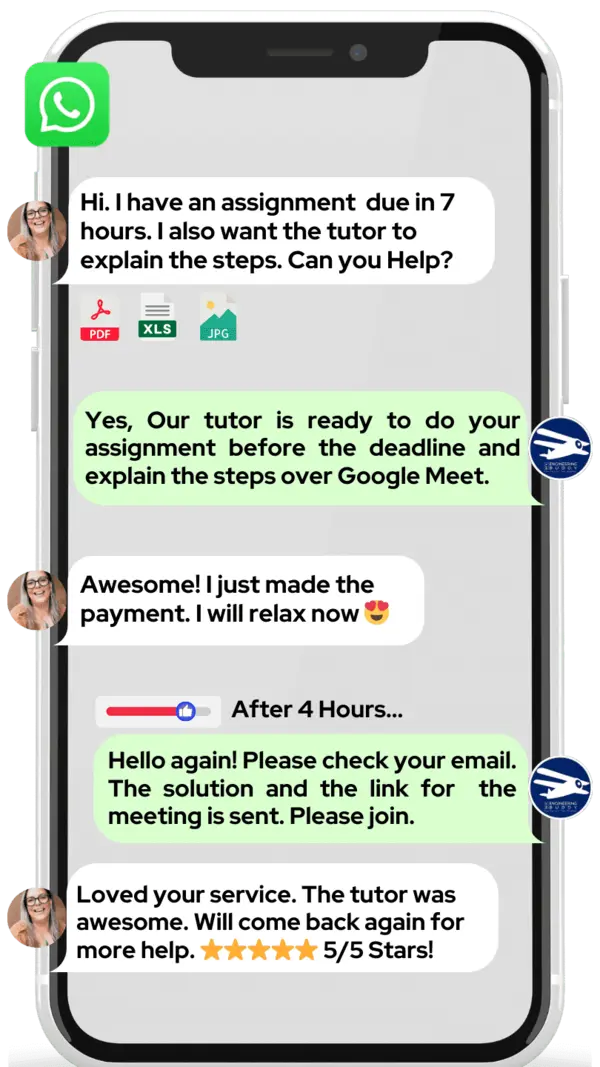
Unlike platforms where you fill out a form and wait, MEB responds in under a minute, 24/7. Tutor match takes under an hour. The $1 trial means you test before you commit. Everything runs over WhatsApp — no logins, no intake forms.
Study Plans (Pick One That Matches Your Goal)
After the first diagnostic session, the tutor builds your specific sequence. Three common structures: a catch-up plan (one to three weeks, closing the biggest gaps before an exam), a structured exam prep plan (four to eight weeks, working through every unit with timed practice problems and FRQ drilling), or ongoing weekly support aligned to your school’s semester and homework deadlines. The tutor decides which fits after session one — not before.
Pricing Guide
AP Physics 1 tutoring starts at $20/hr for standard exam prep and homework support. Specialist tutors with research or engineering backgrounds — useful for students targeting competitive university placement — are available at higher rates. Rate factors include topic complexity, your timeline to the exam, and tutor availability.
For students targeting engineering programmes at universities like MIT, Caltech, or Imperial College London, tutors with undergraduate physics or engineering research backgrounds are available at higher rates — share your target and MEB matches the tutor tier to your goal.
Availability drops sharply in late March through May. Start with the $1 trial — 30 minutes, no registration, no commitment. WhatsApp MEB for a quick quote.
MEB has served students across 2,800+ subjects since 2008 — from AP-level physics and calculus to graduate-level engineering. Every tutor goes through subject-specific vetting before their first session.
Source: My Engineering Buddy, 2008–2025.
FAQ
Is AP Physics 1 hard?
It’s one of the more demanding AP courses because it tests reasoning, not just formula recall. The free-response section requires written physical justification, which many students haven’t practised. With structured 1:1 AP Physics 1 tutoring, the reasoning approach becomes learnable and repeatable.
How many sessions are needed?
It depends on where you’re starting. Students with moderate gaps and eight weeks to their exam typically need eight to twelve sessions. Students closer to the exam or with larger gaps across multiple units may need more. The tutor maps this out after the diagnostic.
Can you help with AP Physics 1 homework and assignments?
Yes — the tutor walks through problems with you, explains the reasoning step by step, and makes sure you understand the method before you submit your own work. MEB tutoring is guided learning — you understand the work, then submit it yourself. For full details on what we help with and what we don’t, read our Academic Integrity policy and Why MEB.
Will the tutor match my exact AP Physics 1 syllabus?
Yes. MEB tutors work from the College Board AP Physics 1 curriculum framework — including the seven science practices and the specific unit weightings on the exam. If your school uses a different pacing or textbook, share that before the first session and the tutor adjusts.
What happens in the first session?
The tutor runs a short diagnostic — usually a mix of a few problems across units you’ve covered so far. From that, they identify the specific reasoning gaps and rank them by exam impact. The session plan for the following weeks comes from that first conversation, not a generic template.
Is online AP Physics 1 tutoring as effective as in-person?
For AP Physics 1, the digital pen-pad replicates exactly what an in-person whiteboard does. You see the tutor work through diagrams and equations in real time. Students who’ve tried both report no meaningful difference in what they learn — and online removes the scheduling friction entirely.
Can I get AP Physics 1 help at midnight?
Yes. MEB operates across all major time zones and has tutors available for late-night sessions, including in the US, Gulf, and Australia. WhatsApp MEB with your availability and you’ll get a match within the hour regardless of the time.
What if I don’t like my assigned tutor?
Say so — over WhatsApp, immediately. MEB will match you with a different tutor, usually the same day. There’s no form to fill out and no waiting period. The $1 trial exists precisely so you can test the match before committing to a session package.
Do you offer group AP Physics 1 sessions?
No. MEB is 1:1 only. Group sessions average out the pace and rarely address the specific reasoning gap that’s costing any individual student marks. Everything at MEB is built around your exact problem, your exact timeline.
How do I get started with AP Physics 1 tutoring?
Three steps: WhatsApp MEB, get matched with a verified AP Physics 1 tutor within the hour, then start your $1 trial — 30 minutes of live 1:1 tutoring or one homework question explained in full. No registration. No commitment. The first session is also your diagnostic.
Try your first session for $1 — 30 minutes of live 1:1 tutoring or one homework question explained in full. No registration. No commitment. WhatsApp MEB now and get matched within the hour.
Trust & Quality at My Engineering Buddy
Every MEB tutor goes through subject-specific screening before their first session: a live demo evaluation, degree and credential verification, and ongoing review against session feedback. AP Physics 1 tutors are assessed on their command of the College Board curriculum, their ability to explain physical reasoning clearly, and their familiarity with the FRQ scoring rubric. Rated 4.8/5 across 40,000+ verified reviews on Google.
MEB tutoring is guided learning — you understand the work, then submit it yourself. For full details on what we help with and what we don’t, read our Academic Integrity policy and Why MEB.
MEB has been running since 2008, serving 52,000+ students across the US, UK, Canada, Australia, the Gulf, and Europe in 2,800+ subjects. Students working through related courses often also need AP Calculus AB tutoring, AP Calculus BC help, or AP Chemistry homework help. Read more about our approach at our tutoring methodology.
Students consistently tell us that the biggest shift in AP Physics 1 comes not from covering more content, but from being asked to explain their reasoning out loud for the first time. Most students have never had to justify a physics answer in words — once they practise it, their FRQ scores move fast.
MEB tutors cover every AP Physics 1 unit — kinematics through electric circuits — working live on screen with a digital pen-pad, calibrated to the College Board rubric and your specific exam date.
Source: My Engineering Buddy, 2008–2025.
Explore Related Subjects
Students studying AP Physics 1 often also need support in:
- AP Physics 2
- AP Physics C
- AP Calculus
- AP Statistics
- AP Biology
- AP Environmental Science
- AP Computer Science A
Next Steps
Here’s what to do right now.
- Share your exam date, the units you’re most behind on, and your current practice score
- Share your time zone and weekly availability
- MEB matches you with a verified AP Physics 1 tutor — usually within the hour
Before your first session, have ready: your AP Physics 1 unit guide or course outline, a recent practice exam attempt or homework problem you couldn’t finish, and your exam date. The tutor handles the rest.
Visit www.myengineeringbuddy.com to read more about how the MEB process works from first contact through to exam day.
WhatsApp to get started or email meb@myengineeringbuddy.com.
A common pattern our tutors observe is this: students who start AP Physics 1 support four to six weeks before the exam and commit to two sessions per week almost always close at least two full units of gaps before test day. The timeline is tight but workable — if you start now.
Reviewed by Subject Expert
This page has been carefully reviewed and validated by our subject expert to ensure accuracy and relevance.
