ADVANCED SUBJECTS · LIVE 1:1 TUTORING
Bioprocess engineering Tutoring Online
Personalized instruction for demanding courses and technical subjects. Learn with a tutor selected for your topic, level, and learning goals.
University · Master’s & PhD · Professional Upskilling
Request tutor availability and a quote. Or email [email protected].

Since 2008
Established Tutoring Service
~1 min
Average First Response
Specialist Match
For Your Subject & Level
30-Min Trial
Try Tutoring Before a Longer Plan
Hire The Best Bioprocess engineering Tutor

Your bioreactor design failed peer review. Your fermentation kinetics are wrong. Again. Here’s how to fix that — fast.
Bioprocess Engineering Tutor Online
Bioprocess engineering applies biological systems — microorganisms, enzymes, and living cells — to industrial processes in pharmaceuticals, food, and biofuels. A qualified bioprocess engineering tutor helps students master reactor design, upstream and downstream processing, and process scale-up.
Finding a bioprocess engineering tutor near me used to mean accepting whoever was available locally, regardless of fit. MEB connects you with a verified agricultural biotechnology tutor or bioprocess specialist online — matched to your exact course, exam board, and level. Sessions run over Google Meet with a digital pen-pad, so you see every calculation worked out live.
- 1:1 online sessions tailored to your specific course or syllabus
- Expert verified tutors with subject-specific bioprocess knowledge
- Flexible time zones — US, UK, Canada, Australia, Gulf
- Structured learning plan built after a diagnostic session
- Ethical academic guidance — you understand the work before you submit it
52,000+ students across the US, UK, Canada, Australia, and the Gulf have used MEB since 2008 — across 2,800+ subjects, from AP Calculus to A Level Music Technology to Data Science.
Source: My Engineering Buddy, 2008–2025.
How Much Does a Bioprocess Engineering Tutor Cost?
Most bioprocess engineering tutoring sessions run $20–$40/hr depending on level. Graduate and specialist topics — upstream processing, bioreactor modelling, downstream purification — typically fall in the $40–$100/hr range. There is a $1 trial: 30 minutes of live 1:1 tutoring or one homework question explained in full.
| Level / Need | Typical Rate | What’s Included |
|---|---|---|
| Undergraduate (standard) | $20–$35/hr | 1:1 sessions, homework guidance |
| Graduate / Specialist | $40–$100/hr | Expert tutor, advanced depth |
| $1 Trial | $1 flat | 30 min live session or 1 homework question |
Tutor availability tightens sharply around end-of-semester submission windows — particularly in April–May and November–December. Book early if your deadline is within four weeks.
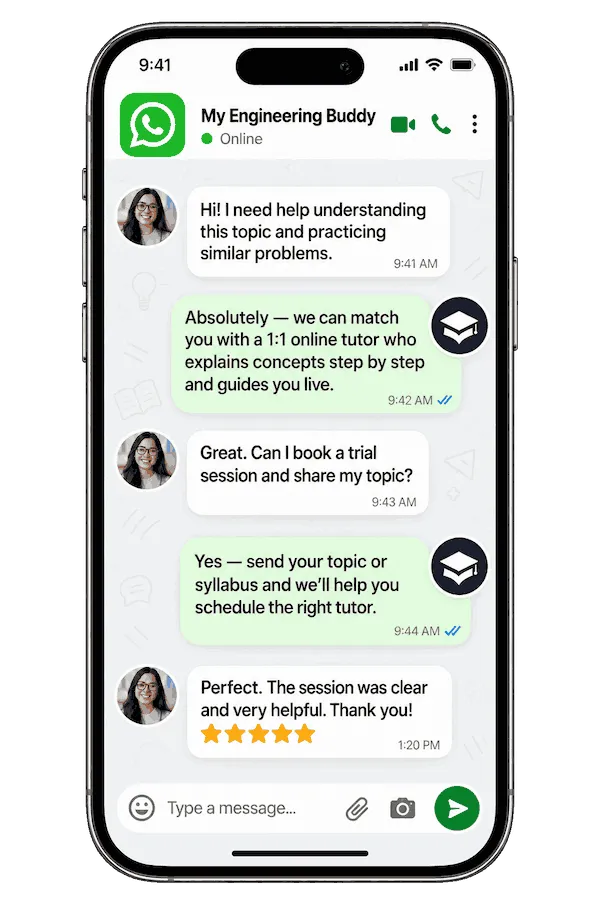
WhatsApp MEB for a quick quote — average response time under 1 minute.
Who This Bioprocess Engineering Tutoring Is For
Bioprocess engineering sits at the intersection of chemical engineering, microbiology, and industrial design. Students often hit walls not because the concepts are impossible, but because their foundational biology or mass-balance skills have gaps. This tutoring is built for exactly that situation.
- Undergraduate students in chemical, biochemical, or biological engineering programmes
- Graduate students working on thesis projects involving fermentation, cell culture, or process optimisation
- Students who passed the theory modules but are now struggling with design projects or lab reports
- Students with a university conditional offer dependent on their final bioprocess engineering grade — with the exam or submission less than six weeks away
- Students at institutions including ETH Zurich, Delft, Imperial College London, MIT, UC Davis, and Wageningen who need support outside formal office hours
- Students who need structured academic guidance to understand the material before they submit
1:1 Tutoring vs Self-Study vs AI Tools
Self-study works for students who already know which gaps to close — but most bioprocess engineering students don’t. They read the same derivation three times and still can’t apply it to a stirred-tank reactor problem. AI tools give fast explanations and will generate a Monod equation on demand, but they cannot watch you attempt a fed-batch mass balance in real time, catch where your volumetric flow assumption breaks down, and redirect you before you repeat the same error in an exam. That live correction loop — specific to your reasoning, not a generic worked example — is what actually changes marks. MEB combines the flexibility of online tutoring with a structured feedback cycle calibrated to your exact course and submission deadlines.
Outcomes: What You’ll Be Able To Do in Bioprocess Engineering
After targeted 1:1 agricultural chemistry tutoring or dedicated bioprocess engineering sessions, students move from passive reading to active problem-solving. You will solve bioreactor design problems from first principles — including batch, fed-batch, and continuous configurations. You will analyse fermentation kinetics using Michaelis-Menten and Monod models without prompting. You will model oxygen transfer rates and calculate volumetric mass transfer coefficients in aerated systems. You will explain upstream and downstream processing unit operations clearly enough to write a coherent process design report. You will apply scale-up criteria to bench-scale data and present justified engineering decisions in coursework submissions.
Based on feedback from 40,000+ sessions collected by MEB from 2022 to 2025, 58% of students improved by one full grade after approximately 20 hours of 1:1 tutoring in a single subject. A further 23% achieved at least a half-grade improvement.
Source: MEB session feedback data, 2022–2025.
Supporting a student through bioprocess engineering? MEB works directly with parents to set up sessions, track progress, and keep coursework on schedule. WhatsApp MEB — average response time is under a minute, 24/7.
What We Cover in Bioprocess Engineering (Syllabus / Topics)

Track 1: Upstream Processing and Fermentation
- Microbial growth kinetics — Monod model, specific growth rate, substrate limitation
- Batch, fed-batch, and continuous fermentation modes
- Bioreactor types — stirred tank, airlift, bubble column
- Oxygen transfer and kLa determination in aerated systems
- Sterilisation methods — in-situ and continuous heat sterilisation design
- Media formulation and nutrient stoichiometry
- Cell immobilisation and solid-state fermentation systems
Recommended texts: Bioprocess Engineering: Basic Concepts by Shuler & Kargi; Biochemical Engineering Fundamentals by Bailey & Ollis; Bioprocess Engineering by Blanch & Clark.
Track 2: Downstream Processing and Purification
- Cell disruption methods — mechanical, chemical, and enzymatic
- Centrifugation and filtration — design and scale-up
- Chromatography — ion exchange, affinity, size exclusion
- Membrane separation — ultrafiltration, diafiltration
- Precipitation and crystallisation unit operations
- Freeze-drying and final formulation steps
- Product recovery yield calculations and purity assessment
Recommended texts: Downstream Processing of Proteins by Desai; Bioseparations Science and Engineering by Harrison et al.; Bioprocess Engineering by Doran.
Track 3: Process Design, Scale-Up, and Regulation
- Dimensional analysis and scale-up criteria — power-to-volume, tip speed, mixing time
- Process mass and energy balances
- Process flow diagrams and P&ID notation
- GMP principles and regulatory frameworks (FDA, EMA) for biopharmaceutical manufacture
- Economic analysis of bioprocess — capital and operating cost estimation
- Sustainability metrics — atom economy, E-factor in bioprocesses
Recommended texts: Chemical Engineering Design by Towler & Sinnott; Industrial Biotechnology by Soetaert & Vandamme; Bioprocess Engineering Principles by Doran.
At MEB, we’ve found that students who struggle with bioprocess engineering are rarely weak at biology or chemistry individually — they’ve simply never been shown how to apply both simultaneously to a reactor design problem. That’s exactly what the first session addresses.
What a Typical Bioprocess Engineering Session Looks Like
The tutor opens by checking your previous topic — usually oxygen transfer coefficient calculations or a fermentation kinetics problem set from last time. You share your screen or whiteboard, and the tutor walks through a fed-batch reactor mass balance with you using a digital pen-pad, annotating each step in real time. When you make an assumption error in the dilution rate calculation, the tutor stops, shows you exactly where the logic broke, and asks you to re-derive it yourself. By the final 15 minutes, you are attempting a new bioreactor sizing problem independently while the tutor monitors. You leave with one practice problem and a specific topic — say, kLa determination in non-Newtonian broths — to prepare before the next session.
How MEB Tutors Help You with Bioprocess Engineering (The Learning Loop)
Diagnose: In the first session, the tutor identifies which of your gaps are conceptual — such as confusing volumetric productivity with specific productivity — and which are mechanical, like misapplying stoichiometric coefficients in yield calculations. This shapes the entire session sequence that follows.
Explain: The tutor works through problems live on a digital pen-pad, narrating every decision. You see a bioreactor design built from scratch — assumptions stated, equations applied, units checked — not a polished solution handed to you at the end.
Practice: You attempt the next problem with the tutor present. Not watching — present. You talk through your reasoning out loud, and the tutor intervenes only when your logic goes off-track, not before.
Feedback: Every error gets a root-cause explanation. If you dropped a term in a Monod kinetics derivation, the tutor explains why that term exists, not just that it was missing. Marks are not lost randomly — they are lost for specific, correctable reasons.
Plan: The session ends with a clear note on what you covered, what the next topic is, and one assigned task. Nothing vague. No “review Chapter 7.” A specific problem or derivation to attempt before the next session.
Sessions run over Google Meet with a digital pen-pad or iPad and Apple Pencil. Before your first session, share your course outline, any recent assignment you found difficult, and your exam or submission date. The tutor handles the rest. Start with the $1 trial — 30 minutes of live tutoring that also serves as your first diagnostic.
Students consistently tell us that the moment bioprocess engineering clicks is when they stop treating mass balances and microbiology as separate subjects. Once a tutor connects those two in the context of a real reactor problem, the rest of the course falls into place much faster.
Tutor Match Criteria (How We Pick Your Tutor)
Not every strong biochemist can teach fed-batch reactor design. MEB matches on specifics, not general subject area.
Subject depth: Tutors are screened for the exact level and topic — whether that’s undergraduate fermentation kinetics, graduate-level downstream chromatography, or industry-aligned GMP process design. A tutor with only pharmaceutical chemistry experience is not matched to a bioprocess scale-up problem.
Tools: All sessions use Google Meet with a digital pen-pad or iPad and Apple Pencil for live annotation. Students sharing process flow diagrams or lab data can screen-share directly.
Time zone: Tutors are available across New York, Los Angeles, Chicago, London, Dubai, Toronto, Sydney, Melbourne, and all major European time zones — including evenings and weekends.
Learning style: Calibrated from the first session. Some students need slow-step derivations; others need rapid problem-drilling. The tutor adjusts from session one.
Communication: Clear English, adapted to your level. No assumption that you know the terminology before you do.
Goals: Whether the goal is passing a specific exam component, completing a design project, or building solid conceptual foundations for graduate research, the tutor is matched to that outcome specifically.
Unlike platforms where you fill out a form and wait, MEB responds in under a minute, 24/7. Tutor match takes under an hour. The $1 trial means you test before you commit. Everything runs over WhatsApp — no logins, no intake forms.
Study Plans (Pick One That Matches Your Goal)
For a catch-up in one to three weeks, the tutor focuses on your highest-weighted exam topics first — typically reactor design and fermentation kinetics — closing the largest gaps before your submission date. For structured exam prep over four to eight weeks, sessions follow a sequenced syllabus with weekly progress checks. For ongoing weekly support through a semester, sessions align to your coursework deadlines and lecture schedule. The tutor maps the specific session sequence after the first diagnostic.
Bioprocess engineering draws on microbiology, chemical engineering, and industrial design simultaneously. Students who improve fastest are those who get structured, subject-specific feedback rather than generic study advice — and who start that process before the last two weeks.
Source: Nature Biotechnology — Bioprocess and industrial biotechnology research.
Pricing Guide
Standard undergraduate bioprocess engineering sessions run $20–$40/hr. Graduate-level work — bioreactor modelling, downstream processing design, thesis support — typically runs $40–$100/hr depending on the tutor’s background and your timeline.
Rate factors include your level, topic complexity, how quickly you need sessions scheduled, and tutor availability. Availability is tightest in the four weeks before end-of-semester submission deadlines.
For students targeting graduate programmes at institutions like MIT, ETH Zurich, or Imperial College London, tutors with active research or industry backgrounds in biopharmaceutical manufacturing are available at higher rates. Share your specific goal and MEB will match the tier to your ambition.
Start with the $1 trial — 30 minutes, no registration, no commitment. WhatsApp MEB for a quick quote.
FAQ
Is bioprocess engineering hard?
It is genuinely demanding. The subject requires applying mass balances, reaction kinetics, and microbiology simultaneously. Most students find reactor design and downstream processing the steepest parts. With targeted 1:1 support, those areas become workable within a few focused sessions.
How many sessions will I need?
For closing specific gaps before an exam, three to five sessions is a realistic minimum. For full-semester support or thesis-level project work, weekly sessions across eight to twelve weeks are more typical. The tutor gives a clearer estimate after the first diagnostic session.
Can you help with practice exercises?
Yes — through guided explanation. The tutor works through the problem-solving approach with you so you understand the method and submit your own work. MEB tutoring is guided learning — you understand the work, then submit it yourself. For full details on what we help with and what we don’t, read our Academic Integrity policy and Why MEB.
Will the tutor match my exact syllabus or exam board?
Yes. Before matching, MEB asks for your institution, course code, and current topic. Tutors are matched based on that, not just broad subject area. A tutor who knows fermentation kinetics at undergraduate level is not assigned to a graduate-level GMP process design project without the right background.
What happens in the first session?
The tutor runs a short diagnostic — asking you to attempt a problem or explain a concept — to identify where the actual gaps are. From that, they map the session sequence. Most students find the first session more practical than any lecture they’ve attended on the same material.
Is online tutoring as effective as in-person?
For engineering and science subjects, yes — provided the platform supports live annotation. MEB uses Google Meet with a digital pen-pad, so worked solutions and diagrams are drawn in real time. Students in the US, UK, Australia, and Gulf consistently report the same quality as face-to-face sessions.
Can I get bioprocess engineering help at midnight or on weekends?
Yes. MEB operates 24/7 across all major time zones. WhatsApp response time averages under one minute regardless of when you send a message. Tutors in compatible time zones are available for evening and weekend sessions, including at short notice.
What if I don’t get on with my assigned tutor?
Say so over WhatsApp. MEB reassigns immediately — no forms, no delay. The $1 trial is specifically designed so you test the match before committing to a full session block. If it isn’t right, MEB finds a better fit the same day.
Do you support bioprocess engineering at graduate and PhD level?
Yes. MEB has tutors with research and industry backgrounds covering graduate-level bioreactor modelling, downstream purification process design, and thesis support. Rates for specialist PhD-level work are higher — share your topic and MEB will confirm availability and cost.
How do I get started?
Start with the $1 trial: 30 minutes of live 1:1 tutoring or one homework question explained in full. Three steps: WhatsApp MEB with your subject and level, get matched within the hour, start the trial. No registration required.
Trust & Quality at My Engineering Buddy
Every MEB tutor goes through subject-specific screening that includes a live demo session evaluated by an experienced subject reviewer. Tutors hold relevant degrees — typically at master’s or PhD level for specialist bioprocess topics — and many have professional or research backgrounds in biopharmaceutical manufacturing, fermentation process development, or industrial biotechnology. Ongoing session feedback is reviewed to maintain quality. Rated 4.8/5 across 40,000+ verified reviews on Google.
MEB tutoring is guided learning — you understand the work, then submit it yourself. For full details on what we help with and what we don’t, read our Academic Integrity policy. We guide — you submit your own work.
MEB has served 52,000+ students across the US, UK, Canada, Australia, Gulf, and Europe since 2008 — across 2,800+ subjects. Students working on related areas also use MEB for agricultural engineering tutoring, soil science academic guidance, and animal science academic guidance. For more on how MEB sessions are structured, see our tutoring methodology.
Try your first session for $1 — 30 minutes of live 1:1 tutoring or one homework question explained in full. No registration. No commitment. WhatsApp MEB now and get matched within the hour.
MEB tutors have supported students across undergraduate and graduate bioprocess engineering programmes in the US, UK, Canada, Australia, and the Gulf — covering fermentation design, downstream processing, and process scale-up since 2008.
Source: My Engineering Buddy internal data, 2008–2025.
Explore Related Subjects
Students studying bioprocess engineering often also need support in:
- Agricultural Chemistry
- Agricultural Engineering
- Agricultural Biotechnology
- Animal Science
- Aquaculture
- Soil Science
Next Steps
Getting started takes less than five minutes. Here is what to do:
- Share your course name, exam board or university, and the topics giving you the most trouble right now
- Share your availability and time zone — evenings, weekends, or daytime slots all work
- MEB matches you with a verified bioprocess engineering tutor, usually within 24 hours
Before your first session, have ready:
- Your exam board and syllabus, or course outline from your institution
- A recent past paper attempt, homework, or lab report you struggled with
- Your exam or submission deadline date — the tutor builds the session plan around it
Visit www.myengineeringbuddy.com for more on how MEB matches tutors and structures sessions.
WhatsApp to get started or email [email protected].
Reviewed by Subject Expert
This page has been carefully reviewed and validated by our subject expert to ensure accuracy and relevance.