
ADVANCED SUBJECTS · LIVE 1:1 TUTORING
Poultry science Tutoring Online
Personalized instruction for demanding courses and technical subjects. Learn with a tutor selected for your topic, level, and learning goals.
University · Master’s & PhD · Professional Upskilling
Request tutor availability and a quote. Or email [email protected].

Since 2008
Established Tutoring Service
~1 min
Average First Response
Specialist Match
For Your Subject & Level
30-Min Trial
Try Tutoring Before a Longer Plan
Broiler FCR calculations, hatchery biosecurity protocols, layer flock health — most students hit a wall on at least one of these. MEB poultry science tutors have seen all three.
Poultry Science Tutor Online
Poultry science is the applied study of poultry production, health, nutrition, genetics, and processing — covering broilers, layers, and turkeys within agricultural science programmes. A poultry science tutor helps students understand production systems, disease management, and the biology behind commercial and small-flock operations.
MEB connects you with a poultry science tutor online who knows your exact course material — whether that’s an undergraduate animal agriculture programme, a graduate production systems unit, or a practical poultry management module. If you’ve searched for a poultry science tutor near me and found little, online tutoring solves that immediately. Our tutors work across US, UK, Canada, Australia, and Gulf universities, and we offer ethical academic guidance — you understand the work before you submit it. Sessions are matched to your syllabus, scheduled around your time zone, and structured from a diagnostic from day one. Visit animal science tutoring if your programme crosses both disciplines.
- 1:1 online sessions tailored to your course syllabus and exam structure
- Expert verified tutors with subject-specific poultry science knowledge
- Flexible scheduling across US, UK, Canada, Australia, and Gulf time zones
- Structured learning plan built after a diagnostic first session
- Ethical academic guidance — you understand before you submit
52,000+ students across the US, UK, Canada, Australia, and the Gulf have used MEB since 2008 — across 2,800+ subjects, from AP Calculus to A Level Music Technology to Data Science.
Source: My Engineering Buddy, 2008–2025.
How Much Does a Poultry Science Tutor Cost?
Most poultry science tutoring sessions run $20–$40/hr depending on level and topic complexity. Graduate-level or highly specialised topics — feed formulation modelling, commercial hatchery management, or poultry genetics — can reach up to $100/hr. You can start with a $1 trial: 30 minutes of live 1:1 tutoring or one homework question explained in full.
| Level / Need | Typical Rate | What’s Included |
|---|---|---|
| Undergraduate (most units) | $20–$35/hr | 1:1 sessions, homework guidance |
| Graduate / Specialist Topics | $35–$100/hr | Expert tutor, niche subject depth |
| $1 Trial | $1 flat | 30 min live session or 1 homework question |
Tutor availability tightens during end-of-semester assessment periods — book early if you have a fixed deadline approaching.
WhatsApp MEB for a quick quote — average response time under 1 minute.
Who This Poultry Science Tutoring Is For
Poultry science draws students from animal agriculture, veterinary pre-med, food science, and agribusiness programmes. The coursework moves fast — from flock physiology to processing plant operations — and lectures rarely slow down for students still building the foundations.
- Undergraduate students in animal science or agricultural programmes with a poultry unit
- Graduate students working on poultry nutrition, genetics, or production systems research
- Students retaking a failed poultry science module with a grade threshold to clear for progression
- Students with a coursework or lab report submission deadline approaching in the next two weeks
- Parents supporting a first or second-year student whose grades have slipped since the semester began
- Students at universities including Auburn, University of Georgia, Kansas State, Wageningen, Harper Adams, and the University of Queensland who need targeted support beyond lecture content
1:1 Tutoring vs Self-Study vs AI Tools
Self-study works if your notes are solid and the topic is straightforward — but poultry science involves a lot of interconnected systems, and it’s easy to misread a feed conversion ratio formula or misapply a disease prevention protocol without anyone catching it. AI tools are useful for quick definitions of Newcastle disease or Marek’s disease biology, but they cannot look at your specific flock management case study, identify where your biosecurity plan breaks down, and walk you through the correction live. That’s where real-time instruction matters most in this subject — the gap between knowing a concept and applying it to a production scenario is where most marks are lost. MEB tutors work through your actual course material with you, adapted to your syllabus, with structured feedback after every attempt.
Outcomes: What You’ll Be Able To Do in Poultry Science
After working with an online poultry science tutor at MEB, you’ll be able to analyze feed conversion ratios and identify inefficiencies in a broiler production system. You’ll apply principles of poultry nutrition to formulate or critique a ration for layers or meat birds at different growth stages. You’ll explain the aetiology and control measures for common respiratory and enteric diseases, including the immunological basis for vaccination programmes. You’ll model flock health data to present reasoned biosecurity recommendations. You’ll write production reports that connect live performance metrics to management decisions — the kind of applied analysis that separates strong students in poultry science assessments.
Supporting a student through poultry science? MEB works directly with parents to set up sessions, track progress, and keep coursework on schedule. WhatsApp MEB — average response time is under a minute, 24/7.
Based on feedback from 40,000+ sessions collected by MEB from 2022 to 2025, 58% of students improved by one full grade after approximately 20 hours of 1:1 tutoring in a single subject. A further 23% achieved at least a half-grade improvement.
Source: MEB session feedback data, 2022–2025.
At MEB, we’ve found that poultry science students often know the theory but struggle the moment it’s applied to a production case. The tutor’s job is to close that gap — not by re-explaining the textbook, but by working through your specific scenario until the reasoning clicks.
What We Cover in Poultry Science (Syllabus / Topics)

Poultry Nutrition and Feed Management
- Energy and protein requirements across broiler, layer, and turkey production stages
- Feed ingredient evaluation: amino acid profiles, digestibility coefficients
- Ration formulation using least-cost methods
- Feed conversion ratio analysis and flock performance benchmarking
- Mycotoxin contamination risks and mitigation strategies
- Water quality and its relationship to feed intake and production efficiency
Key texts include Poultry Feeds and Nutrition (Austic & Nesheim) and Commercial Chicken Meat and Egg Production (Bell & Weaver) — both standard references in undergraduate and graduate programmes.
Poultry Health, Disease, and Biosecurity
- Common viral diseases: Newcastle disease, infectious bronchitis, Marek’s disease, avian influenza
- Bacterial and parasitic conditions: Salmonella, coccidiosis, Clostridium
- Vaccination programme design and immune response mechanisms
- Biosecurity protocols for commercial and small-flock operations
- Welfare indicators and their connection to production performance
- Antimicrobial resistance considerations in poultry production
Recommended references: Diseases of Poultry (Swayne et al.) and the Australian Government Department of Health resources on zoonotic disease management for relevant animal health frameworks.
Poultry Genetics, Reproduction, and Production Systems
- Genetic selection principles for growth rate, feed efficiency, and egg production traits
- Breeder flock management and hatchery operations
- Incubation parameters: temperature, humidity, turning, and hatch analysis
- Integrated broiler and layer production systems — from placement to processing
- Environmental control in housing: ventilation, lighting programmes, stocking density
- Sustainability and welfare considerations in commercial poultry production
Core texts: Poultry Production (North & Bell) and Handbook of Poultry Science and Technology (Guerrero-Legarreta) — useful for both coursework and applied assignment work.
What a Typical Poultry Science Session Looks Like
The tutor opens by checking where you left off — usually the previous topic, whether that was layer flock mortality analysis or hatchery temperature curves. From there, you work through the current problem together on screen: the tutor annotates a flock health case study or walks through a feed ration calculation using a digital pen-pad, then asks you to replicate the reasoning or explain the next step out loud. If you’re preparing a lab report on broiler weight gain data, the tutor doesn’t rewrite it — they show you where your interpretation diverges from the data and why. The session closes with a specific task: a past question to attempt, a topic to review, or a section of your assignment to draft before the next session. Get agricultural engineering tutoring if your programme includes related technical modules.
How MEB Tutors Help You with Poultry Science (The Learning Loop)
Diagnose: In the first session, the tutor identifies exactly where your understanding breaks down — whether that’s the biochemistry behind amino acid requirements, the logic of a vaccination schedule, or how to read a hatchery analysis report. This shapes every session that follows.
Explain: The tutor works through live problems using a digital pen-pad — annotating diagrams, working biosecurity decision trees, or stepping through a least-cost ration calculation line by line. Nothing is assumed. Every step is shown.
Practice: You attempt the next problem with the tutor present. No moving on until the reasoning is solid — not just the answer.
Feedback: The tutor reviews your attempt step by step. For assignment questions, this means identifying where marks would be lost and why — specific to the marking criteria your programme uses.
Plan: Each session ends with a clear next step: the topic to cover, the past question to attempt, or the homework section to complete. The tutor tracks your progress across sessions.
Sessions run over Google Meet. The tutor uses a digital pen-pad or iPad with Apple Pencil for annotations. Before your first session, share your course outline or unit guide, any assignment you’re currently working on, and your submission or exam date. The first session covers diagnostics and starts topic work in the same hour. Start with the $1 trial — 30 minutes of live tutoring that also serves as your first diagnostic.
Students consistently tell us that the biggest shift happens not when the tutor explains a concept, but when the student explains it back. Our tutors are trained to pause and ask — “walk me through your reasoning” — because that’s where the real gaps appear.
Tutor Match Criteria (How We Pick Your Tutor)
Every MEB tutor goes through subject-specific screening before being matched with students. Here’s what the match is built on:
Subject depth: The tutor holds a relevant degree or professional background in animal science, poultry science, veterinary science, or agricultural production. They know your syllabus — not just the general field.
Tools: All sessions use Google Meet. Tutors annotate using a digital pen-pad or iPad with Apple Pencil, so working through diagrams, flock data tables, or ration calculations is clear on screen.
Time zone: MEB covers New York, Los Angeles, Chicago, London, Dubai, Toronto, Sydney, Melbourne, and all major US, UK, Gulf, Canadian, Australian, and European time zones — including evenings and weekends.
Learning style: The tutor calibrates pace and approach from the first session — some students need concept-first, others need problem-first. Both work.
Communication: Clear English, adapted to your level. No unnecessary jargon when plain language works better.
Goals: Whether you need to pass a resit, improve a grade, get a specific assignment over the line, or build deeper research-level understanding, the tutor adjusts accordingly. Need help across related areas? MEB also offers animal science academic guidance and agricultural biotechnology tutoring.
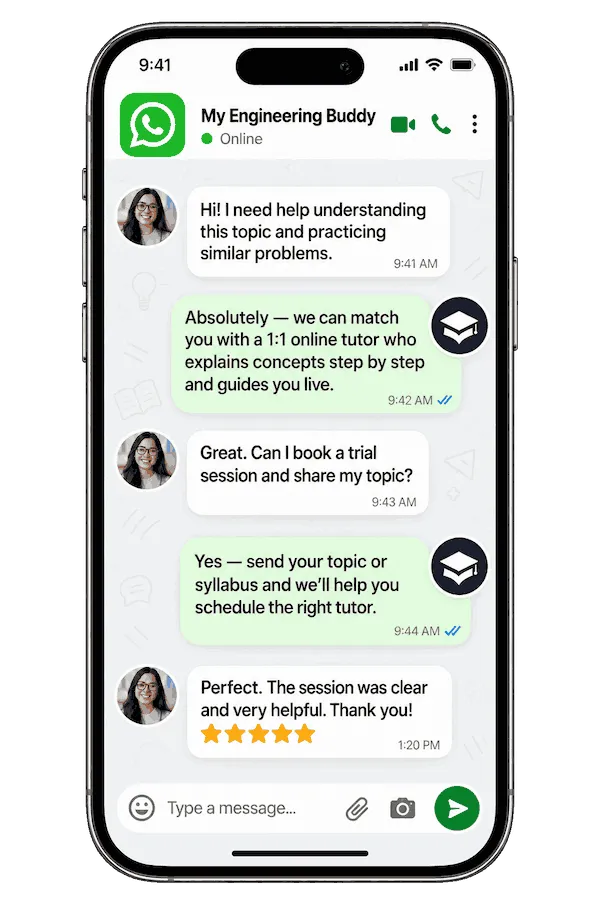
Unlike platforms where you fill out a form and wait, MEB responds in under a minute, 24/7. Tutor match takes under an hour. The $1 trial means you test before you commit. Everything runs over WhatsApp — no logins, no intake forms.
Study Plans (Pick One That Matches Your Goal)
If you have two weeks before a lab report is due, the tutor focuses every session on the specific units and skills that report requires. If you’re revising for end-of-semester exams, an 4–8 week structured plan covers all major topics in sequence, with past question practice built in. Ongoing weekly support follows your semester timeline — new topics covered as they come up in lectures, assignments addressed when deadlines approach. The tutor maps the specific session sequence after the first diagnostic. Students needing broader agricultural context can combine this with agricultural chemistry help.
Pricing Guide
Poultry science tutoring starts at $20/hr for standard undergraduate units. Graduate-level topics — production systems modelling, poultry genetics research support, advanced nutrition — run $35–$100/hr. Rate depends on the level, topic complexity, timeline urgency, and tutor availability.
For students targeting postgraduate research programmes or roles in commercial poultry production, tutors with professional industry or research backgrounds are available at higher rates — share your specific goal and MEB will match the tier accordingly.
Availability is tighter during end-of-semester exam and submission periods. Start with the $1 trial — 30 minutes, no registration, no commitment. WhatsApp MEB for a quick quote.
FAQ
Is poultry science hard?
It depends on your background. Students from general biology or agriculture programmes usually find the production systems and nutrition sections manageable. The harder areas tend to be disease immunology, genetic selection statistics, and applying production data to case-based exam questions — these benefit most from 1:1 tutoring.
How many sessions do most students need?
Students working through a single weak topic — feed formulation or biosecurity protocols — typically need 4–8 sessions. Those preparing for a full end-of-semester exam or catching up across multiple units usually work with a tutor for 10–20 sessions over 4–8 weeks. The diagnostic first session gives a clearer estimate.
Can you help with practice exercises?
Yes. MEB tutors explain the underlying concepts, work through the method with you, and help you understand what the question is asking. You write and submit your own work.
Academic Integrity policy and Why MEB cover exactly what we help with and what we don’t.
Will the tutor match my exact syllabus or exam board?
Yes. When you contact MEB, share your university, unit name, and any course materials you have. The tutor is matched specifically to your programme — not just to “poultry science” in general. This applies whether you’re at an agricultural college in the US, UK, Australia, or the Gulf.
What happens in the first session?
The tutor starts with a short diagnostic — a few questions across the main topic areas to identify your strongest and weakest areas. From there, the session moves into actual content work. By the end, you’ll have a clear topic plan and a specific task to complete before the next session.
Is online tutoring as effective as in-person?
For most poultry science topics, yes. Working through nutrition calculations, disease case studies, or production data analysis is as effective on screen with annotation tools as it would be in person. The feedback loop — attempt, correction, retry — is what matters, and that works the same way online.
Can I get poultry science help late at night or on weekends?
Yes. MEB tutors are available across all major time zones, including evenings and weekends. Many students in the US, Australia, and the Gulf book late-night or Sunday sessions regularly. Contact via WhatsApp — response time is typically under a minute regardless of the hour.
What if I don’t get along with the tutor I’m matched with?
Tell MEB via WhatsApp. A replacement match is arranged quickly — usually within a few hours. The $1 trial is specifically designed to let you check the fit before committing to a longer tutoring arrangement. No pressure to continue if it’s not right.
Do you offer group poultry science sessions?
MEB specialises in 1:1 tutoring only. Group sessions aren’t offered because the diagnostic and feedback approach that makes MEB effective depends on the tutor focusing entirely on one student’s specific gaps and course requirements.
How do I get started?
Three steps: WhatsApp MEB with your subject, university, and the topic or assignment you need help with. You’ll be matched with a tutor — usually within an hour. Your first session starts with a diagnostic and costs $1 for 30 minutes of live tutoring or one question explained in full.
Trust & Quality at My Engineering Buddy
Every MEB tutor completes a subject-specific screening process — including a live demo evaluation — before working with students. Tutors hold relevant degrees and, in many cases, professional experience in agricultural or animal production fields. Ongoing session feedback is reviewed to maintain quality. Rated 4.8/5 across 40,000+ verified reviews on Google. MEB has been matching students with subject-specific tutors since 2008 — that’s 18 years of subject-specific matching, not a generalised tutoring marketplace. Find out more about how tutors are selected at MEB’s tutoring methodology page.
MEB tutoring is guided learning — you understand the work, then submit it yourself. For full details on what we help with and what we don’t, read our Academic Integrity policy and Why MEB.
MEB serves students in the US, UK, Canada, Australia, Gulf, and across Europe — across 2,800+ subjects since 2008, with 52,000+ students supported to date. Beyond poultry science, students on related agricultural programmes regularly use MEB for soil science tutoring, aquaculture academic guidance, and bioprocess engineering help.
A common pattern our tutors observe is that students lose marks not because they don’t know the subject but because they haven’t been shown how to structure a production case answer or a disease analysis response under exam conditions. That’s fixable. Quickly.
Explore Related Subjects
Students studying poultry science often also need support in:
- Animal Science
- Agricultural Chemistry
- Agricultural Engineering
- Agricultural Biotechnology
- Aquaculture
- Soil Science
- Farm Machinery
Next Steps
Getting started takes less than five minutes.
- Share your exam board or university, your hardest topic, and your current timeline
- Share your availability and time zone
- MEB matches you with a verified tutor — usually within 24 hours
Before your first session, have ready: your course outline or unit guide, a recent assignment or past paper attempt you struggled with, and your exam or submission deadline. The tutor handles the rest.
Visit www.myengineeringbuddy.com to learn more about the MEB process.
Try your first session for $1 — 30 minutes of live 1:1 tutoring or one homework question explained in full. No registration. No commitment. WhatsApp MEB now and get matched within the hour.
WhatsApp to get started or email [email protected].
Reviewed by Subject Expert
This page has been carefully reviewed and validated by our subject expert to ensure accuracy and relevance.




