

Hire Verified & Experienced
Nuclear Physics Tutors
4.8/5 40K+ session ratings collected on the MEB platform



Hire The Best Nuclear Physics Tutor
Top Tutors, Top Grades. Without The Stress!
52,000+ Happy Students From Various Universities





How Much For Private 1:1 Tutoring & Hw Help?
Private 1:1 Tutoring and HW help Cost $20 – 35 per hour* on average.
Most students don’t fail Nuclear Physics because it’s impossible. They fail because nobody stops to explain why a nucleus is stable in the first place — and everything after that compounds the confusion.
Nuclear Physics Tutor Online
Nuclear physics is the branch of physics studying atomic nuclei, their composition, stability, radioactive decay, fission, fusion, and nuclear reactions — equipping students to analyze binding energy, decay chains, and radiation interactions at a foundational level.
MEB offers 1:1 online tutoring and homework help in 2,800+ advanced subjects, including Physics and its specialist branches. If you’ve searched for a Nuclear Physics tutor near me and found generic results, MEB gives you a verified expert matched to your exact course — A Level, IB, undergraduate, or graduate. Sessions run live, one-to-one, and build real understanding — not surface recall. An online Nuclear Physics tutor from MEB is available within the hour.
- 1:1 online sessions tailored to your specific course or syllabus
- Expert-verified tutors with subject-specific Nuclear Physics knowledge
- Flexible time zones — US, UK, Canada, Australia, Gulf
- Structured learning plan built after a diagnostic session
- Ethical homework and assignment guidance — you understand before you submit
52,000+ students across the US, UK, Canada, Australia, and the Gulf have used MEB since 2008 — including students in Physics subjects like Nuclear Physics, Particle Physics, and Quantum Mechanics.
Source: My Engineering Buddy, 2008–2025.
How Much Does a Nuclear Physics Tutor Cost?
Most Nuclear Physics sessions run $20–$40/hr. Graduate-level or highly specialised topics — reactor theory, nuclear instrumentation, advanced particle interactions — can reach up to $100/hr. New students start with the $1 trial: 30 minutes of live tutoring or one full homework question explained in detail.
| Level / Need | Typical Rate | What’s Included |
|---|---|---|
| Standard (A Level, IB, early undergrad) | $20–$35/hr | 1:1 sessions, homework guidance |
| Advanced / Specialist (graduate, research) | $35–$100/hr | Expert tutor, niche depth, research support |
| $1 Trial | $1 flat | 30 min live session or 1 full homework question |
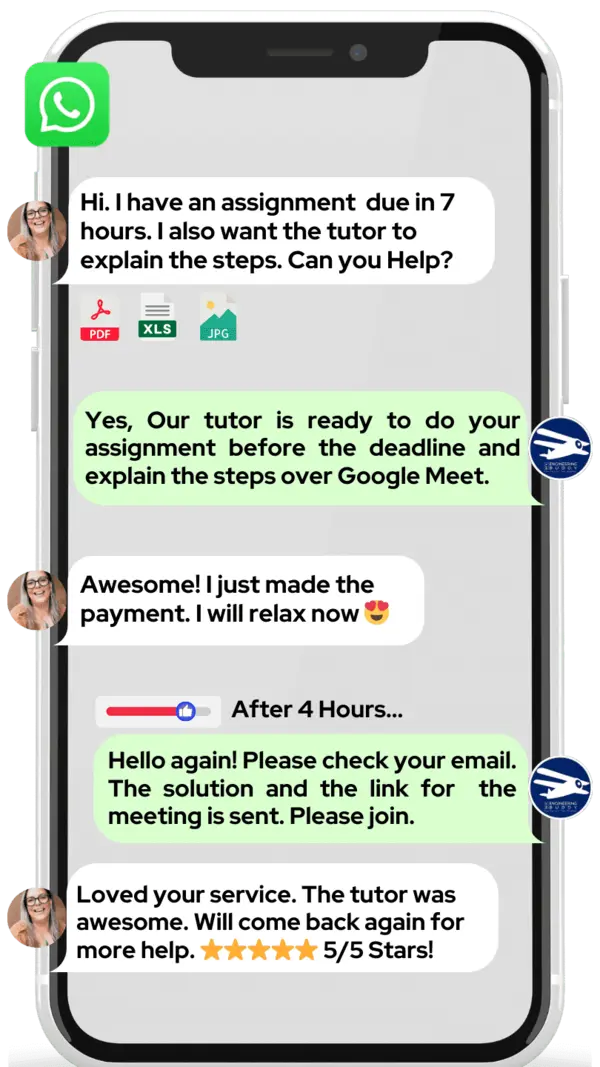
Tutor availability tightens significantly in the weeks before major exam windows. WhatsApp MEB for a quick quote — average response time under 1 minute.
Who This Nuclear Physics Tutoring Is For
Nuclear Physics attracts students who are strong in general physics — until the subject pivots to quantum mechanical models, binding energy curves, and decay mathematics. The jump catches people off guard. MEB tutoring is built for students at exactly that point.
- A Level and IB students covering radioactivity, fission, and nuclear energy for the first time
- Undergraduate physics majors tackling the nuclear shell model, cross-sections, and reaction kinematics
- Graduate students working through reactor physics, neutron transport, or nuclear instrumentation courses
- Students retaking after a failed first attempt — particularly those who lost marks on decay chain calculations or binding energy questions
- Students with a university conditional offer depending on their Physics or Nuclear Physics grade
- Parents watching a capable student’s confidence drop as the maths in nuclear topics becomes denser
MEB tutors in Nuclear Physics have worked with students at institutions including MIT, Imperial College London, University of Michigan, ETH Zürich, University of Toronto, McGill, and Australian National University.
At MEB, we’ve found that Nuclear Physics problems don’t defeat students because the physics is impenetrable — they create a wall when a student skips the underlying reasoning and tries to memorise equations instead. One session rebuilding that reasoning usually unlocks three or four topics that felt stuck.
1:1 Tutoring vs Self-Study vs AI vs YouTube vs Online Courses
Self-study works if you’re disciplined — but in Nuclear Physics, no textbook tells you where your specific reasoning broke down. AI tools explain concepts quickly but can’t watch you solve a Bateman equation and catch where you misapplied the decay constant. YouTube is excellent for an overview of fission or the liquid drop model, but it stops when you’re stuck mid-problem. Online courses give structure at a fixed pace — which doesn’t help the student who is two weeks from an exam and four topics behind. 1:1 tutoring with MEB runs live, calibrated to your exact Nuclear Physics syllabus, and corrects errors in the moment — including the specific calculation mistakes that cost the most marks.
Outcomes: What You’ll Be Able To Do in Nuclear Physics
After working with an MEB Nuclear Physics tutor, students can solve radioactive decay problems — including multi-step decay chains — without reaching for a formula sheet as a crutch. They can analyze binding energy per nucleon graphs to explain why fission releases energy for heavy nuclei and fusion for light ones. Students learn to model neutron moderation and apply cross-section concepts to reactor criticality conditions. They can explain Q-values for nuclear reactions and apply conservation laws to both elastic and inelastic collisions at the nuclear scale. Confidence in exam conditions follows — especially on the calculation-heavy questions where most marks are dropped.
Based on feedback from 40,000+ sessions collected by MEB from 2022 to 2025, 58% of students improved by one full grade after approximately 20 hours of 1:1 tutoring in subjects like Nuclear Physics. A further 23% achieved at least a half-grade improvement.
Source: MEB session feedback data, 2022–2025.
Supporting a student through Nuclear Physics? MEB works directly with parents to set up sessions, track progress, and keep coursework on schedule. WhatsApp MEB — average response time is under a minute, 24/7.
Try your first session for $1 — 30 minutes of live 1:1 tutoring or one homework question explained in full. No registration. No commitment. WhatsApp MEB now and get matched within the hour.
What We Cover in Nuclear Physics (Syllabus / Topics)

Track 1: Nuclear Structure and Stability
- Proton-neutron composition; nuclide notation and isotopes
- Nuclear binding energy and mass defect calculations
- The semi-empirical mass formula (liquid drop model)
- Nuclear shell model and magic numbers
- Valley of stability; N-Z charts and stable nuclide distributions
- Nuclear spin, parity, and angular momentum coupling
Core texts for this track: Krane’s Introductory Nuclear Physics, Heyde’s The Nuclear Shell Model, and Blatt & Weisskopf’s Theoretical Nuclear Physics for graduate depth.
Track 2: Radioactive Decay and Radiation Interactions
- Alpha, beta (β⁻ and β⁺), and gamma decay — mechanisms and selection rules
- Radioactive decay law; activity, half-life, and mean lifetime
- Bateman equations for decay chains and secular equilibrium
- Interaction of charged particles, neutrons, and photons with matter
- Stopping power, linear attenuation coefficient, and shielding calculations
- Detectors: Geiger-Müller, scintillation, semiconductor — operating principles
Recommended reading: Turner’s Atoms, Radiation, and Radiation Protection and Knoll’s Radiation Detection and Measurement — the standard detector reference at undergraduate and graduate level.
Track 3: Nuclear Reactions and Reactor Physics
- Q-values and threshold energies for nuclear reactions
- Reaction cross-sections, neutron flux, and reaction rates
- Fission — spontaneous and induced; prompt and delayed neutrons
- Fusion reactions and energy balance (D-T, D-D reactions)
- Four-factor formula and criticality conditions
- Neutron moderation, slowing-down theory, and diffusion basics
- Reactor types: PWR, BWR, CANDU — design principles and safety parameters
Key references: Lamarsh & Baratta’s Introduction to Nuclear Engineering and Glasstone & Sesonske’s Nuclear Reactor Engineering for applied reactor content.
What a Typical Nuclear Physics Session Looks Like
The tutor opens by checking the previous topic — usually decay chain calculations or binding energy from the last session. If the student attempted problems in between, those go on screen first. The tutor watches the student work through a Q-value calculation or a cross-section problem, asking questions as they go rather than correcting after the fact. Errors in applying conservation of momentum at the nuclear scale or sign conventions in beta decay get caught and fixed live, on a digital pen-pad, with the working shown step by step. The student then replicates the method independently. The session closes with a specific practice set — three to five problems on the next topic, usually neutron moderation or reactor criticality — and a note on what the following session will open with. Nothing is left open-ended.
How MEB Tutors Help You with Nuclear Physics (The Learning Loop)
Diagnose: The first session identifies exactly where understanding breaks down — whether that’s the mathematics of decay constants, the physical interpretation of binding energy curves, or the application of conservation laws to reaction kinematics. The tutor doesn’t assume — they ask, watch, and map the gaps.
Explain: Live worked examples on a digital pen-pad. The tutor solves problems step-by-step on screen — deriving the semi-empirical mass formula term by term, or walking through a full decay chain from uranium-238. Students see the reasoning, not just the answer.
Practice: The student attempts problems with the tutor present. No waiting until the next session to find out what went wrong. Errors in cross-section calculations or incorrect application of Bateman equations surface immediately.
Feedback: Step-by-step error correction — the tutor identifies not just what went wrong but why, and which part of the method needs rethinking. Students learn which mistakes actually cost marks in exams.
Plan: Each session closes with a topic sequence for the next one, accountable practice tasks, and a check against the student’s exam date or submission deadline. Progress doesn’t drift.
Sessions run on Google Meet with a digital pen-pad or iPad and Apple Pencil. Before the first session, share your course outline or exam board, your most recent past paper attempt, and your exam or deadline date. The tutor builds from there. Start with the $1 trial — 30 minutes of live tutoring that also serves as your first diagnostic.
Students consistently tell us that the moment Nuclear Physics clicks is when a tutor draws the binding energy per nucleon curve from scratch and asks: “Why does this peak at iron?” That one question — and the reasoning behind the answer — connects fission, fusion, and stability into a single picture. It takes about eight minutes.
Tutor Match Criteria (How We Pick Your Tutor)
Not every physics tutor can teach Nuclear Physics at graduate level. MEB vets specifically for the sub-field.
Subject depth: Tutors are matched by level — A Level and IB, undergraduate, or graduate and research — and by sub-area, so a student working on reactor physics gets a tutor with that background, not a general physicist. Find Radiation Physics tutoring and adjacent specialist areas through the same matching process.
Tools: All tutors use Google Meet with a digital pen-pad or iPad and Apple Pencil. Nuclear Physics requires live written working — sessions don’t run on chat alone.
Time zone: Matched to your region — US, UK, Gulf, Canada, or Australia. Late-night availability is common.
Goals: Exam grade targets, conceptual depth for research, homework completion, or dissertation support — the tutor is briefed on your specific goal before the first session.
Unlike platforms where you fill out a form and wait, MEB responds in under a minute, 24/7. Tutor match takes under an hour. The $1 trial means you test before you commit. Everything runs over WhatsApp — no logins, no intake forms.
Study Plans (Pick One That Matches Your Goal)
After a diagnostic session, your tutor builds a specific sequence. Three common structures: a catch-up plan (1–3 weeks) for students behind on decay theory, nuclear reactions, or reactor physics with an exam approaching; an exam prep plan (4–8 weeks) covering the full syllabus with past paper practice woven in from week two; and weekly ongoing support aligned to your semester schedule, covering new material as it appears in lectures. The tutor adjusts pacing after each session — no plan runs on autopilot.
Pricing Guide
Nuclear Physics tutoring starts at $20/hr for A Level and standard undergraduate work. Graduate-level topics — reactor kinetics, nuclear instrumentation, neutron transport theory — typically run $50–$100/hr depending on tutor specialisation and timeline.
Rate factors include the level of the course, how niche the topic is (general radioactivity vs. advanced reactor design), how close the exam is, and tutor availability during peak periods. Availability tightens sharply in April–May and October–November for most exam boards.
For students targeting programmes at institutions like MIT, Imperial, or ETH Zürich — or professional roles in nuclear engineering and medical physics — tutors with research or industry backgrounds in nuclear instrumentation and reactor design are available at higher rates. Share your specific goal and MEB will match the right tier.
Start with the $1 trial — 30 minutes, no registration, no commitment. WhatsApp MEB for a quick quote.
MEB has covered Physics and its branches — including Atomic Physics tutoring, Modern Physics help, and Nuclear Physics — across 52,000+ students since 2008. Sessions are available around the clock across every major time zone.
Source: My Engineering Buddy, 2008–2025.
FAQ
Is Nuclear Physics hard?
It’s genuinely demanding — particularly the mathematical treatment of decay chains, cross-sections, and reactor criticality. Students who struggled with quantum mechanics or differential equations will feel that here. A good tutor makes the maths traceable rather than abstract.
How many sessions are needed?
Most students see clear improvement in 6–10 sessions. A full syllabus review for an undergraduate course typically takes 15–25 hours. Graduate-level work varies by topic and depth. The $1 trial diagnostic helps the tutor estimate this accurately.
Can you help with homework and assignments?
MEB tutoring is guided learning — you understand the work, then submit it yourself. The tutor explains the method and works through the reasoning with you. See our Academic Integrity policy and Why MEB page for full details on what we help with and what we don’t.
Will the tutor match my exact syllabus or exam board?
Yes. MEB tutors are matched by course — A Level (AQA, OCR, Edexcel), IB Physics, AP Physics C, undergraduate modules, and graduate courses all have different emphases. Share your syllabus or course outline when you contact MEB.
What happens in the first session?
The tutor runs a diagnostic — asking you to work through a problem or explain a concept — to map exactly where understanding breaks down. From there, the session plan is built. Nothing is assumed; nothing is wasted.
Is online tutoring as effective as in-person?
For Nuclear Physics, yes — the digital pen-pad replicates whiteboard working exactly. Students share screens, work problems live, and get real-time correction. The format suits calculation-heavy physics better than many students expect before they try it.
What’s the difference between Nuclear Physics and Particle Physics at the undergraduate level?
Nuclear Physics focuses on atomic nuclei — structure, stability, decay, and reactions involving known nucleons. Particle Physics help deals with sub-nuclear constituents — quarks, leptons, and the Standard Model. The two overlap at the quark model of nucleons but are typically taught as separate courses.
Do Nuclear Physics tutors cover reactor engineering topics?
Yes, where the course includes them. Criticality, four-factor formula, neutron diffusion, and basic reactor types (PWR, CANDU, BWR) are covered at undergraduate and graduate level. Students on nuclear engineering programmes get tutors with applied reactor backgrounds.
Can I get Nuclear Physics help at midnight?
Yes. MEB operates 24/7 across all major time zones. WhatsApp response time is typically under a minute regardless of when you contact. Tutor availability varies by time zone, but late-night sessions are common for US, Gulf, and Australian students.
What if I don’t like my assigned tutor?
Request a different tutor over WhatsApp. MEB will rematch within the hour. The $1 trial exists precisely so you can test the fit before committing to a full series of sessions — no cost, no obligation.
How do I get started?
Start with the $1 trial — 30 minutes of live Nuclear Physics tutoring or one full question explained step by step. WhatsApp MEB, get matched within the hour, and begin the trial session. Three steps: message, match, start.
Trust & Quality at My Engineering Buddy
Every MEB tutor in Nuclear Physics goes through subject-specific vetting — not a generic physics screen. Tutors hold relevant degrees (BSc, MSc, or PhD in Physics, Nuclear Engineering, or Applied Physics), complete a live demo evaluation, and are reviewed after every session. Rated 4.8/5 across 40,000+ verified reviews on Google. MEB has served 52,000+ students since 2008 and has tutors with backgrounds in reactor design, medical physics, and nuclear instrumentation — not just general physics. Find Quantum Mechanics tutoring and Statistical Mechanics help through the same verified network.
MEB tutoring is guided learning — you understand the work, then submit it yourself. For full details on what we help with and what we don’t, read our Academic Integrity policy and Why MEB.
MEB has operated since 2008, serving students in the US, UK, Canada, Australia, the Gulf, and Europe across 2,800+ subjects. Physics is one of MEB’s largest subject areas — covering Nuclear Physics, Computational Physics tutoring, and Plasma Physics help, among many others. The platform’s tutoring methodology is built around diagnostic-first sessions, structured feedback, and verified tutor matching — not algorithmic assignment.
Explore Related Subjects
Students studying Nuclear Physics often also need support in:
- Quantum Field Theory
- Special Relativity
- Thermal Physics
- Condensed Matter Physics
- Astrophysics
- General Relativity
- Solid State Physics
Next Steps
When you contact MEB, share your exam board or course name, the topics where you’re losing the most marks, and how much time you have before your exam or deadline. Include your time zone and typical availability — morning, evening, or weekend.
MEB matches you with a verified Nuclear Physics tutor, usually within 24 hours. The first session opens with a diagnostic so every minute is used on what actually matters.
Before your first session, have ready:
- Your exam board and syllabus (or university course outline)
- A recent past paper attempt or a homework problem you couldn’t finish
- Your exam date or submission deadline
The tutor handles the rest. Visit www.myengineeringbuddy.com for more on how MEB works.
WhatsApp to get started or email meb@myengineeringbuddy.com.
Reviewed by Subject Expert
This page has been carefully reviewed and validated by our subject expert to ensure accuracy and relevance.
