




~1 min
Average Reply Time
~1 hour
To Be Matched With A Tutor
30 Min Trial
75% Find Their Tutor On The 1st Trial
$20-35+/hr
Premium Yet Affordable Learning
Most students hit a wall in radiographic physics somewhere between X-ray production and image quality factors — and a textbook doesn’t tell you why your answer was wrong. MEB has been matching students with specialist tutors since 2008. If you need a radiographic physics tutor near me or online, this is where to start.
Radiographic Physics Tutor Online
Radiographic physics is the applied physics discipline underpinning medical imaging — covering X-ray production, beam attenuation, image receptors, radiation dosimetry, and quality assurance in diagnostic radiography and related imaging sciences.
MEB provides 1:1 online tutoring and homework help in 2800+ advanced subjects, including radiographic physics. Our tutors cover the full scope of physics and its medical imaging applications — whether you are working through an undergraduate radiography programme in the US, UK, Canada, or Australia, or preparing for a certification exam in medical imaging science. One focused session can close the gap that weeks of re-reading lecture slides hasn’t.
- 1:1 online sessions tailored to your specific radiography course and syllabus
- Expert verified tutors with subject-specific knowledge in imaging physics and dosimetry
- Flexible time zones — US, UK, Canada, Australia, Gulf
- Structured learning plan built after a diagnostic session
- Ethical homework and assignment guidance — you understand the work before you submit
52,000+ students across the US, UK, Canada, Australia, and the Gulf have used MEB since 2008 — including students in Physics subjects like Radiographic Physics, Radiation Physics, and Nuclear Physics.
Source: My Engineering Buddy, 2008–2025.
How Much Does a Radiographic Physics Tutor Cost?
Most radiographic physics sessions run $20–$40/hr. Graduate-level or specialist dosimetry topics can reach up to $100/hr depending on tutor background and topic complexity. The $1 trial gets you 30 minutes of live tutoring or a full explanation of one homework question — no registration needed.
| Level / Need | Typical Rate | What’s Included |
|---|---|---|
| Standard (most undergraduate levels) | $20–$35/hr | 1:1 sessions, homework guidance |
| Advanced / Specialist (dosimetry, QA, graduate) | $35–$70/hr | Expert tutor, niche imaging physics depth |
| $1 Trial | $1 flat | 30 min live session or 1 homework question explained in full |
Tutor availability tightens during end-of-semester exam periods. Book early if you have a fixed deadline approaching.
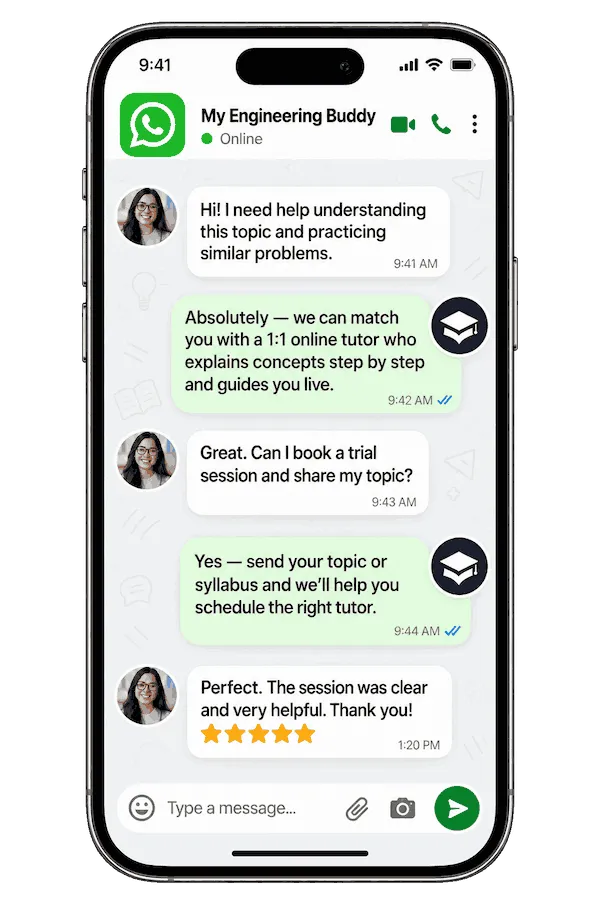
WhatsApp MEB for a quick quote — average response time under 1 minute.
Who This Radiographic Physics Tutoring Is For
Radiographic physics sits at the junction of physics, anatomy, and clinical practice. The concepts are precise and the stakes are real — errors in your understanding of beam quality or dose calculation don’t just cost marks, they matter professionally.
- Undergraduate radiography and radiological sciences students at universities including the University of Toronto, King’s College London, Queensland University of Technology, and Thomas Jefferson University
- Students retaking after a failed first attempt in radiographic physics modules
- Students with a university conditional offer depending on passing this unit — start the $1 trial before you fall further behind
- Graduate students working through medical physics or health physics programmes
- Students behind on coursework with a submission deadline approaching
- Parents supporting a child through a demanding allied health sciences degree
At MEB, we’ve found that radiographic physics students almost always get stuck in the same place: they can recall the definition of HVL or the inverse square law, but they can’t apply it to a scanner setup they’ve never seen before. That’s a problem you solve live, not by reading the chapter again.
1:1 Tutoring vs Self-Study vs AI vs YouTube vs Online Courses
Self-study works if you’re disciplined, but there’s no feedback when your attenuation calculation is wrong. AI tools give fast answers — they cannot watch you work through a dose calculation and catch the step where your reasoning breaks. YouTube handles overview explanations well; it stops when you’re stuck on a specific kVp-vs-contrast problem. Online courses follow a fixed pace with no adjustment for your specific gaps. 1:1 tutoring with MEB is live, calibrated to your exact radiographic physics module, and corrects errors in the moment — before they become habits that cost you in assessments.
Outcomes: What You’ll Be Able To Do in Radiographic Physics
After working with an MEB radiographic physics tutor, you will be able to solve beam attenuation problems using the exponential decay equation, apply the inverse square law accurately to clinical distance scenarios, analyze how kVp and mAs affect image contrast and density, explain the physics of X-ray production at the anode including characteristic and Bremsstrahlung radiation, and present scatter radiation control strategies — including grid ratios and air-gap technique — with the clarity expected in written and practical assessments.
Based on feedback from 40,000+ sessions collected by MEB from 2022 to 2025, 58% of students improved by one full grade after approximately 20 hours of 1:1 tutoring in subjects like Radiographic Physics. A further 23% achieved at least a half-grade improvement.
Source: MEB session feedback data, 2022–2025.
Try your first session for $1 — 30 minutes of live 1:1 tutoring or one homework question explained in full. No registration. No commitment. WhatsApp MEB now and get matched within the hour.
What We Cover in Radiographic Physics (Syllabus / Topics)
X-ray Production and Beam Characteristics
- Structure and function of the X-ray tube — anode, cathode, focal spot
- Bremsstrahlung and characteristic X-ray production mechanisms
- Effect of kVp on beam energy and penetrating power
- Effect of mAs on beam quantity and patient dose
- X-ray beam filtration — inherent and added, HVL calculation
- Inverse square law applied to intensity and dose at varying distances
- Heel effect and its clinical implications for image uniformity
Core texts: Bushberg et al., The Essential Physics of Medical Imaging (3rd ed.); Carlton & Adler, Principles of Radiographic Imaging.
Image Formation and Image Quality
- Attenuation coefficients — linear, mass, and their dependence on Z and energy
- Photoelectric effect and Compton scattering — when each dominates
- Image receptors: computed radiography (CR), digital radiography (DR), film-screen systems
- Spatial resolution, contrast resolution, noise, and signal-to-noise ratio
- Modulation transfer function (MTF) and detective quantum efficiency (DQE)
- Scatter radiation: causes, effects on image quality, and control methods including grids
- Exposure factors and their effect on image density and contrast
Core texts: Huda, Review of Radiological Physics (4th ed.); Sprawls, Physical Principles of Medical Imaging.
Radiation Dosimetry and Radiation Protection
- Quantities and units: absorbed dose (Gray), equivalent dose (Sievert), effective dose
- Dose–response models: linear no-threshold (LNT) and its application in clinical settings
- Patient dose optimisation — ALARA principle in diagnostic imaging
- Radiation protection methods: distance, shielding, collimation, exposure time
- Occupational dose limits and regulatory frameworks (ICRP recommendations)
- Dosimetry instrumentation: ionisation chambers, TLDs, OSLDs
Core texts: Khan & Gibbons, Khan’s The Physics of Radiation Therapy; ICRP Publication 103.

What a Typical Radiographic Physics Session Looks Like
The tutor opens by checking your previous topic — usually attenuation calculations or exposure factor relationships — to see where understanding is solid and where the gap actually sits. From there, you and the tutor work through live problems on screen: a beam quality question involving HVL, a scatter control scenario with grid ratios, or a dose calculation using mAs and distance. The tutor writes out each step using a digital pen-pad so you can follow the reasoning in real time, then hands the problem back — you replicate or explain the steps aloud. Errors get caught immediately, not three days later when you see a marked paper. The session closes with a specific practice problem to attempt before next time and a clear note of which topic comes next.
How MEB Tutors Help You with Radiographic Physics (The Learning Loop)
Diagnose: In the first session, the tutor asks you to attempt a beam attenuation or image quality problem unprompted. This reveals exactly where your reasoning breaks — not just what you got wrong, but at which step.
Explain: The tutor works through the concept live, using a digital pen-pad to draw beam diagrams, annotate spectra, or walk through dosimetry calculations step by step. No pre-recorded slides.
Practice: You attempt a similar problem while the tutor watches. This is where most students discover that they understood the explanation but stall when executing independently — and the tutor catches that in real time.
Feedback: Every error gets a why. If you dropped a factor of 100 converting mGy to Gy, the tutor explains exactly where that cost you marks and how to build the habit of unit checks.
Plan: At the end of each session, the tutor sets the next topic in sequence — whether that’s moving from beam quality to scatter control or shifting to dosimetry for the following week.
Sessions run on Google Meet with a digital pen-pad or iPad and Apple Pencil. Before your first session, have your course syllabus, a recent assignment or past paper attempt, and your exam or submission date ready. The first session functions as your diagnostic — start with the $1 trial and that 30 minutes is already doing double duty.
Students consistently tell us that radiographic physics clicks differently when someone draws the beam path and attenuation curve live, rather than pointing to a static diagram in a textbook. Seeing it built step by step — with your question answered mid-construction — is what changes the understanding.
Tutor Match Criteria (How We Pick Your Tutor)
Not every physics tutor can handle the clinical specificity of radiographic physics. Here is what MEB screens for:
Subject depth: Tutors hold degrees in medical physics, radiological sciences, or a closely related discipline — and can demonstrate working knowledge of image receptor systems, dosimetry instruments, and regulatory frameworks, not just general physics.
Tools: Every session uses Google Meet with a digital pen-pad or iPad and Apple Pencil — essential for annotating beam diagrams and working through attenuation calculations in real time.
Time zone: Matched to your region — US, UK, Gulf, Canada, or Australia — so early-morning or late-night sessions are actually available.
Goals: Whether you need exam score improvement, conceptual depth in image formation, help with your radiation physics coursework, or ongoing weekly support through a semester, the tutor is matched to that specific aim.
Unlike platforms where you fill out a form and wait, MEB responds in under a minute, 24/7. Tutor match takes under an hour. The $1 trial means you test before you commit. Everything runs over WhatsApp — no logins, no intake forms.
Study Plans (Pick One That Matches Your Goal)
After the diagnostic session, your tutor maps a session plan to your timeline. Catch-up (1–3 weeks): targeted work on beam physics or image quality factors before an imminent exam. Exam prep (4–8 weeks): structured progression through X-ray production, attenuation, image formation, and dosimetry with past paper practice built in. Weekly support: ongoing sessions aligned to your semester schedule and coursework deadlines, covering each module as your course advances.
Pricing Guide
Rates start at $20/hr for standard undergraduate radiographic physics content. Graduate-level dosimetry, medical physics board prep, or specialist image quality analysis can reach up to $100/hr depending on tutor background and timeline. Rate factors include topic complexity, your exam date, and tutor availability.
For students targeting medical physics residency programmes or certification by bodies such as the American Board of Radiology, tutors with clinical and research backgrounds in imaging physics are available at higher rates — share your specific goal and MEB will match the tier to your target.
Availability tightens during clinical exam windows and end-of-semester periods. Start with the $1 trial — 30 minutes, no registration, no commitment. WhatsApp MEB for a quick quote.
MEB has served 52,000+ students across 2,800+ subjects since 2008. Whether you need help with Biophysics or are working through Modern Physics alongside your radiography degree, the tutor matching process is the same — fast, specific, and testable for $1.
Source: My Engineering Buddy, 2008–2025.
FAQ
Is radiographic physics hard?
Yes — it combines abstract physics principles with clinical precision. Students who struggle usually have gaps in basic attenuation theory or unit conversion habits. A tutor identifies those specific gaps in the first session rather than making you revisit everything.
How many sessions are needed?
Most students see clear improvement in 8–12 sessions. A focused exam sprint can achieve a lot in 4–6 sessions if your gaps are specific. The diagnostic session in your $1 trial defines the realistic timeline for your situation.
Can you help with homework and assignments?
Yes — MEB tutoring is guided learning. You understand the work, then submit it yourself. The tutor explains the physics, walks through the method, and checks your reasoning. See our Academic Integrity policy and Why MEB page for full details on what we help with and what we don’t.
Will the tutor match my exact syllabus or exam board?
Yes. Before matching, MEB asks for your institution, course name, and assessment structure. Tutors are selected based on familiarity with your specific syllabus — whether that is a North American radiography degree, a UK BSc programme, or an Australian medical imaging science course.
What happens in the first session?
The tutor runs a short diagnostic — usually one attenuation or exposure factor problem — to map exactly where your understanding breaks down. From that point, every remaining minute is spent on your actual gaps, not a generic revision of the whole topic.
Is online tutoring as effective as in-person?
For radiographic physics, yes. The digital pen-pad replicates whiteboard work precisely — beam diagrams, attenuation curves, and dosimetry calculations all translate well to screen. Most MEB students who have tried both prefer the flexibility of online without losing quality.
Can I get radiographic physics help at midnight or on weekends?
Yes. MEB operates 24/7. Tutors are available across time zones, so whether you are in the Gulf, Australia, or Canada and need a session outside standard business hours, WhatsApp MEB and someone responds within minutes.
What if I don’t get along with my assigned tutor?
Request a change — no form, no delay. WhatsApp MEB and a new match happens within the hour. The $1 trial exists precisely so you can test the fit before committing to a longer plan.
What is the difference between radiographic physics and radiation physics?
Radiographic physics focuses specifically on diagnostic imaging — X-ray production, image receptors, image quality, and patient dose in radiography. Radiation physics is broader, covering nuclear decay, particle interactions, and therapeutic applications beyond imaging. There is significant overlap in dosimetry and attenuation theory.
Do I need a strong maths background before starting?
Solid algebra and an understanding of exponential functions are enough for most radiographic physics content. The tutor will identify any maths gaps in the diagnostic session and address them directly as part of your tutoring plan.
How is radiographic physics assessed — and what do students most often fail on?
Assessment varies by institution but typically includes written exams covering beam physics, image quality, and dosimetry, plus practical or lab components. Students most often lose marks on multi-step dose calculations, unit errors, and applying scatter control theory to unfamiliar clinical setups.
How do I get started?
WhatsApp MEB, share your course and timeline, and you are matched with a verified radiographic physics tutor — usually within the hour. Your first session is the $1 trial: 30 minutes of live tutoring or one homework question explained in full.
Trust & Quality at My Engineering Buddy
Every MEB tutor goes through subject-specific vetting: degree verification, a live demo session evaluated by senior staff, and ongoing review based on student feedback. For radiographic physics, that means tutors must demonstrate working knowledge of imaging physics beyond general optics or nuclear theory — including image receptor systems, dosimetry instrumentation, and regulatory frameworks. Rated 4.8/5 across 40,000+ verified reviews on Google.
MEB tutoring is guided learning — you understand the work, then submit it yourself. For full details on what we help with and what we don’t, read our Academic Integrity policy and Why MEB.
MEB has been serving students in the US, UK, Canada, Australia, Gulf, and Europe across 2,800+ subjects since 2008. Within Physics, we cover everything from Applied Physics and Atomic Physics to specialist imaging and clinical physics subjects. Every tutor in this category is matched by sub-discipline, not just by the parent subject label. Read more about how we match tutors on our tutoring methodology page.
Explore Related Subjects
Students studying radiographic physics often also need support in:
- Quantum Mechanics
- Optics
- Laser Physics
- Thermal Physics
- Electromagnetism and Electrodynamics
- Computational Physics
- Photonics
Next Steps
When you WhatsApp MEB, share your exam board or course name, the topic you are most stuck on, and your exam or submission date. Include your time zone and availability — sessions can start within 24 hours of matching. Your first session opens with a diagnostic so every minute is spent on what actually matters.
Before your first session, have ready:
- Your course outline or syllabus (or exam board name)
- A recent past paper attempt or homework question you struggled with
- Your exam or coursework deadline date
The tutor handles everything from there. Visit www.myengineeringbuddy.com for more on how MEB works.
WhatsApp to get started or email [email protected].
Our experience across thousands of sessions shows that the students who improve fastest are the ones who arrive with a specific question — not a vague sense that everything is confusing. Even “I can’t get this one attenuation problem right” is enough. That’s all the tutor needs to build the session around.
Reviewed by Subject Expert
This page has been carefully reviewed and validated by our subject expert to ensure accuracy and relevance.




