
ADVANCED SUBJECTS · LIVE 1:1 TUTORING
Supply Chain Management Tutoring Online
Personalized instruction for demanding courses and technical subjects. Learn with a tutor selected for your topic, level, and learning goals.
University · Master’s & PhD · Professional Upskilling
Request tutor availability and a quote. Or email [email protected].

Since 2008
Established Tutoring Service
~1 min
Average First Response
Specialist Match
For Your Subject & Level
30-Min Trial
Try Tutoring Before a Longer Plan
Hire The Best Supply Chain Management Tutor



Your SCM grade is slipping — not because you’re not trying, but because procurement models and network optimization don’t explain themselves.
Supply Chain Management Tutor Online
Supply Chain Management (SCM) covers the end-to-end coordination of sourcing, procurement, production, logistics, and distribution. It equips students to design, analyze, and optimize supply networks using quantitative models and strategic frameworks.
If you’ve searched for a Supply Chain Management tutor near me, MEB gives you something better: a verified SCM specialist online, available across US, UK, Canada, Australia, and the Gulf, matched to your exact course in under an hour. Whether you’re working through Business Management modules or a dedicated SCM programme, our tutors cover everything from demand forecasting to supplier risk. One focused session can shift how an entire unit clicks.
- 1:1 online sessions tailored to your course syllabus and assessment structure
- Expert verified tutors with subject-specific knowledge in SCM and operations
- Flexible time zones — US, UK, Canada, Australia, Gulf covered
- Structured learning plan built after a diagnostic session
- Ethical academic guidance — you understand before you submit
52,000+ students across the US, UK, Canada, Australia, and the Gulf have used MEB since 2008 — including students in Business Management subjects like Supply Chain Management, Operations & Production Management, and Logistics.
Source: My Engineering Buddy, 2008–2025.
How Much Does a Supply Chain Management Tutor Cost?
Most Supply Chain Management tutoring at MEB runs $20–$40/hr. Graduate-level or highly specialized SCM topics — reverse logistics modelling, S&OP design, global sourcing strategy — can reach up to $100/hr. Start with the $1 trial: 30 minutes live or one full homework question explained.
| Level / Need | Typical Rate | What’s Included |
|---|---|---|
| Standard (undergraduate, MBA) | $20–$40/hr | 1:1 sessions, homework guidance |
| Advanced / Specialist (PhD, niche SCM) | $40–$100/hr | Expert tutor, research-level depth |
| $1 Trial | $1 flat | 30 min live session or 1 homework question |
Tutor availability tightens during semester end and MBA exam blocks. WhatsApp MEB for a quick quote — average response time under 1 minute.
Who This Supply Chain Management Tutoring Is For
SCM sits at the intersection of quantitative methods and business strategy. Students who find it hard are usually strong in one — not both. MEB tutors bridge that gap directly.
- Undergraduate students in business, engineering, or operations programmes struggling with inventory models or network design
- MBA students hitting the quantitative wall — LP formulations, EOQ, safety stock calculations
- Students retaking after a failed first attempt in an SCM or Logistics module
- Students with a university conditional offer depending on this grade
- Graduate students working on supply chain thesis chapters or case study assignments
- Parents watching a student’s confidence drop as supply chain coursework piles up
Students come from programmes at schools including Arizona State, Michigan State, Penn State, University of Warwick, Rotterdam School of Management, HEC Paris, and Queen’s University Canada — among many others.
1:1 Tutoring vs Self-Study vs AI vs YouTube vs Online Courses
Self-study works if you’re disciplined — but SCM has too many interdependent models to catch your own errors. AI tools give fast formula explanations; they can’t tell you why your LP constraint is set up wrong. YouTube is solid for demand planning overviews, not for walking through a bullwhip effect problem set. Online courses move at a fixed pace — your exam doesn’t. With MEB’s 1:1 Supply Chain Management tutoring, a live tutor sees exactly where your reasoning breaks down and corrects it before it costs you marks.
Outcomes: What You’ll Be Able To Do in Supply Chain Management
After working with an MEB Supply Chain Management tutor, students can solve EOQ and safety stock problems without formula-hunting, analyze bullwhip effect causes across a multi-tier supply network, model procurement decisions under demand uncertainty, explain trade-offs between lean and agile supply strategies in case study responses, and present a coherent S&OP or inventory policy recommendation with quantitative backing. These aren’t generic outcomes — they map directly to the assessments SCM courses actually use.
Supporting a student through Supply Chain Management? MEB works directly with parents to set up sessions, track progress, and keep coursework on schedule. WhatsApp MEB — average response time is under a minute, 24/7.
Based on feedback from 40,000+ sessions collected by MEB from 2022 to 2025, 58% of students improved by one full grade after approximately 20 hours of 1:1 tutoring in subjects like Supply Chain Management. A further 23% achieved at least a half-grade improvement.
Source: MEB session feedback data, 2022–2025.
What We Cover in Supply Chain Management (Syllabus / Topics)
Track 1: Inventory Management & Demand Planning
- EOQ, reorder point, and safety stock calculations
- Demand forecasting methods — moving average, exponential smoothing, regression
- ABC analysis and SKU classification
- The bullwhip effect — causes, measurement, and mitigation strategies
- Just-in-time (JIT) vs. safety stock trade-offs
- Inventory carrying costs and service level optimization
- Multi-echelon inventory models
Core textbooks for this track include Chopra & Meindl’s Supply Chain Management: Strategy, Planning, and Operation and Nahmias & Olsen’s Production and Operations Analysis.
Track 2: Procurement, Sourcing & Supplier Management
- Strategic sourcing frameworks and make-vs-buy decisions
- Supplier evaluation, selection, and risk scoring
- Total cost of ownership (TCO) analysis
- Contract types — fixed price, cost-plus, incentive-based
- Global sourcing risks: currency, lead time, geopolitical disruption
- Corporate Social Responsibility in procurement — ethical sourcing standards
- Supplier relationship management (SRM) and performance metrics
Recommended reading: Van Weele’s Purchasing and Supply Chain Management and Monczka et al.’s Purchasing and Supply Chain Management.
Track 3: Logistics, Network Design & SCM Technology
- Transportation modes, routing, and cost modelling
- Warehouse design and distribution centre optimization
- Network design — facility location models, linear programming applications
- Sales & Operations Planning (S&OP) process design
- ERP systems in supply chain — SAP, Oracle SCM modules
- Digital supply chain: IoT, blockchain in traceability, demand sensing
- Reverse logistics and returns management
Useful references: Ballou’s Business Logistics Management and Simchi-Levi et al.’s Designing and Managing the Supply Chain.

What a Typical Supply Chain Management Session Looks Like
The tutor opens by reviewing the previous session’s topic — say, safety stock calculations where the student struggled to set the service level correctly. From there, student and tutor work through a new problem on screen: a multi-supplier sourcing scenario with demand variability. The tutor uses a digital pen-pad to break down the LP constraint setup step by step. The student then replicates the logic on a similar problem while explaining each decision aloud — the tutor listens for where the reasoning slips. The session closes with a specific practice task: two EOQ problems with different holding cost structures, and a note that next session covers network design fundamentals.
How MEB Tutors Help You with Supply Chain Management (The Learning Loop)
Diagnose: In the first session, the tutor identifies exactly where understanding breaks down — whether it’s the mathematical side (LP formulations, cost functions) or the conceptual side (lean vs. agile trade-offs, supplier risk frameworks). These are not the same problem and need different fixes.
Explain: The tutor works through live examples using a digital pen-pad — building a demand forecast from raw data, walking through a make-vs-buy decision tree, or structuring a network design model. You see the reasoning, not just the answer.
Practice: You attempt a parallel problem with the tutor present. No moving on until the logic holds.
Feedback: The tutor marks up your work in real time — flagging where your constraint missed a variable, where your TCO analysis skipped a cost category, or where your written answer lost marks for vagueness.
A common pattern our tutors observe is that SCM students can memorize the EOQ formula but can’t explain why holding cost and ordering cost trade off the way they do — and that gap costs marks on every applied question that follows.
Plan: Each session ends with a clear next topic and a short task. If you have an assignment due, the tutor maps the remaining sessions to your deadline.
Sessions run on Google Meet. The tutor uses a digital pen-pad or iPad with Apple Pencil. Before your first session, have your course syllabus or module outline, a recent assignment you struggled with, and your exam or submission date. The first session is diagnostic — the tutor uses it to build a session sequence that fits your timeline. Whether you need a quick catch-up before a semester deadline, structured revision over 4–8 weeks, or ongoing weekly support through the term, the plan is built after that first diagnostic. Start with the $1 trial — 30 minutes of live tutoring that also serves as your first diagnostic.
Students consistently tell us that the shift happens when they stop treating SCM as two separate subjects — the maths and the strategy — and start seeing every quantitative model as a decision tool with a business context behind it.
Source: My Engineering Buddy tutor feedback, 2022–2025.
Tutor Match Criteria (How We Pick Your Tutor)
Match quality is everything. Here’s what MEB checks before assigning your tutor.
Subject depth: The tutor must have worked with SCM at your exact level — undergraduate operations course, MBA core, or postgraduate research — not just general business knowledge.
Tools: Every tutor works on Google Meet with a digital pen-pad or iPad and Apple Pencil. No slides-only sessions.
Time zone: Matched to your region — US East/West, UK, Gulf, Canada, Australia. No 3am sessions unless you want them.
Goals: Whether the goal is passing a resit, hitting a distinction, or working through a thesis chapter on supply chain resilience, the tutor is picked for that specific target.
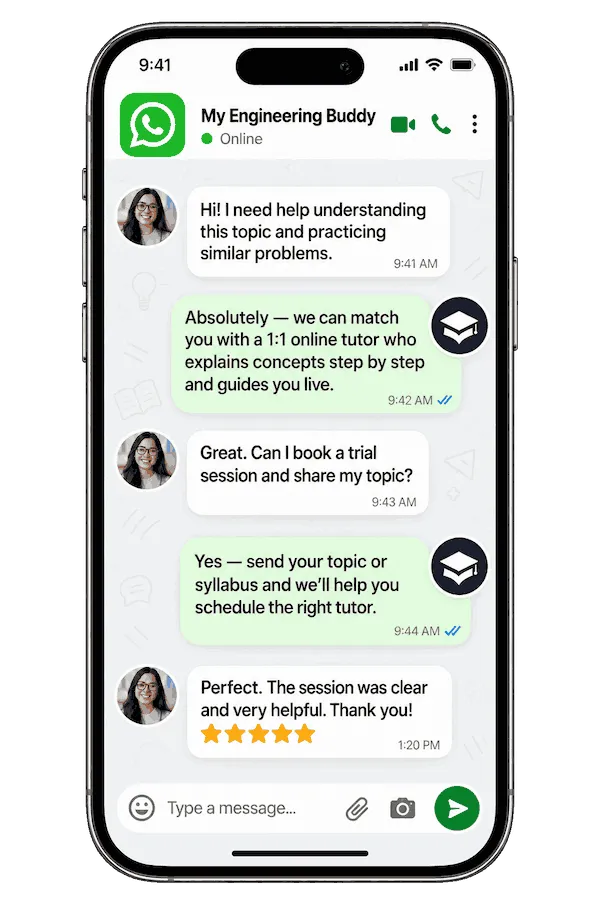
Unlike platforms where you fill out a form and wait, MEB responds in under a minute, 24/7. Tutor match takes under an hour. The $1 trial means you test before you commit. Everything runs over WhatsApp — no logins, no intake forms.
Pricing Guide
Supply Chain Management tutoring at MEB runs $20–$40/hr for most undergraduate and MBA levels. Specialist topics — network optimization modelling, S&OP design, graduate research support — reach up to $100/hr. Rate depends on the level, topic complexity, your timeline, and tutor availability.
For students targeting top MBA programmes or professional SCM certifications (APICS CPIM, CSCP), tutors with industry backgrounds in procurement and operations are available at higher rates — share your specific goal and MEB will match the tier to your ambition.
Availability tightens at semester end and during MBA application cycles. Book early. Start with the $1 trial — 30 minutes, no registration, no commitment. WhatsApp MEB for a quick quote.
Try your first session for $1 — 30 minutes of live 1:1 tutoring or one homework question explained in full. No registration. No commitment. WhatsApp MEB now and get matched within the hour.
FAQ
Is Supply Chain Management hard?
It’s harder than most students expect. SCM combines quantitative methods — LP models, statistical forecasting, cost optimization — with strategic frameworks. Students who are strong in one area often struggle in the other. Most gaps close quickly with direct 1:1 attention on the specific weak point.
How many sessions are needed?
Most students working on a specific SCM module or assignment see clear progress in 3–5 sessions. For a full semester of support or exam preparation over 4–8 weeks, tutors build a session sequence after the first diagnostic. There’s no minimum commitment.
Can you help with homework and assignments?
Yes. MEB tutoring is guided learning — you understand the work, then submit it yourself. The tutor explains the model, walks through the logic, and checks your reasoning. See our Academic Integrity policy and Why MEB page for full details on what we help with and what we don’t.
Will the tutor match my exact syllabus or exam board?
Yes. Before the first session, you share your course outline or module guide. The tutor reviews it and builds sessions around your actual assessments — not a generic SCM curriculum. This applies whether you’re at a US university, a UK business school, or an Australian institution.
What happens in the first session?
The tutor runs a short diagnostic — asks you to explain a concept or attempt a problem — to pinpoint exactly where the gaps are. From there, the session plan is set. You don’t sit through content you already know. The $1 trial is your first session.
Is online tutoring as effective as in-person?
For SCM — yes. The tutor shares their screen, uses a digital pen-pad for live problem-solving, and can pull up your assignment or case study directly. Most students report that online sessions are easier to schedule and just as productive as face-to-face sessions.
What’s the difference between CPIM and CSCP, and can MEB help with both?
CPIM (Certified in Planning and Inventory Management) focuses on internal operations and inventory control. CSCP (Certified Supply Chain Professional) covers end-to-end supply chain strategy including global sourcing. MEB tutors cover both — exam prep, concept explanation, and practice questions for either certification.
Can MEB help with supply chain case studies and simulation assignments?
Yes. Case studies, beer game simulations, and scenario-based assignments are common in SCM programmes. Tutors help you structure your analysis, identify the right frameworks to apply, and build a coherent argument — you write and submit the final work yourself.
Can I get Supply Chain Management help at midnight?
Yes. MEB operates 24/7. WhatsApp response averages under a minute regardless of time zone. If you have a submission due at 9am and need help at midnight, message MEB — a tutor will be matched and ready to start.
What if I don’t like my assigned tutor?
Request a new match. MEB reassigns at no extra cost and no explanation required. The $1 trial exists partly for this reason — you test the fit before committing to a full session block.
How do I get started?
Three steps: WhatsApp MEB with your subject, level, and deadline. Get matched with a verified SCM tutor — usually within the hour. Start your $1 trial: 30 minutes of live tutoring or one homework question explained in full. No registration needed.
Trust & Quality at My Engineering Buddy
Every MEB tutor goes through a multi-stage screening process: degree verification, subject-specific knowledge testing, a live demo session evaluation, and ongoing review based on student feedback after every session. Rated 4.8/5 across 40,000+ verified reviews on Google. For Supply Chain Management tutoring, MEB vets for both quantitative depth — LP models, forecasting, cost analysis — and applied experience in procurement, logistics, or operations roles.
MEB tutoring is guided learning — you understand the work, then submit it yourself. For full details on what we help with and what we don’t, read our Academic Integrity policy and Why MEB.
MEB has served 52,000+ students across the US, UK, Canada, Australia, Gulf, and Europe in 2,800+ subjects since 2008. In Business Management and related fields, this includes students working on Operations & Production Management tutoring, Risk Management help, and Management Science tutoring alongside their SCM coursework. Read more about our approach on the tutoring methodology page.
At MEB, we’ve matched students with SCM tutors who’ve worked inside procurement teams, 3PL operations, and demand planning functions — not just academics who teach the theory. That background changes what gets explained and how.
Source: My Engineering Buddy, 2008–2025.
At MEB, we’ve found that students who struggle with SCM assignments are almost never struggling with effort — they’re struggling with the connection between the quantitative model and the decision it’s supposed to inform. That’s the gap tutors close fastest.
Explore Related Subjects
Students studying Supply Chain Management often also need support in:
- Business Analysis
- Business Intelligence
- Business Process Management
- International Business
- Product Management
- Corporate Strategy
- Management Information Systems
Our experience across thousands of sessions shows that students who engage with their tutor between sessions — even 20 minutes reviewing the worked example from the previous session — retain concepts at a noticeably higher rate than those who review only before the next live session.
Next Steps
Share your exam board or course outline, the component you find hardest, and your current deadline. Share your availability and time zone. MEB matches you with a verified Supply Chain Management tutor — usually within 24 hours, often within the hour.
Before your first session, have ready:
- Your course syllabus or module guide
- A recent assignment or problem set you struggled with
- Your exam date or submission deadline
The tutor handles the rest. Visit www.myengineeringbuddy.com for more on how MEB works.
WhatsApp to get started or email [email protected].
Reviewed by Subject Expert
This page has been carefully reviewed and validated by our subject expert to ensure accuracy and relevance.



