~1 min
Average Reply Time
~1 hour
To Be Matched With A Tutor
30 Min Trial
75% Find Their Tutor On The 1st Trial
$20-35+/hr
Premium Yet Affordable Learning
Most students hit a wall the first time they see the Einstein field equations — not because they lack ability, but because no one has worked through the tensor notation with them line by line.
General Relativity Tutor Online
General Relativity is Einstein’s geometric theory of gravitation, describing how mass and energy curve spacetime. Studied at advanced undergraduate and graduate level, it equips students to model gravitational phenomena, black holes, and cosmological dynamics using tensor calculus.
MEB offers 1:1 online tutoring and homework help in 2,800+ advanced subjects, including General Relativity. If you’ve searched for a General Relativity tutor near me and found only generic platforms, MEB connects you directly with a verified physicist who knows the subject at research depth. Our Physics tutoring programme spans everything from classical foundations to cutting-edge theoretical topics — and General Relativity sits at the heart of it. Tutors work with your exact course structure, your problem sets, and your exam deadlines.
- 1:1 online sessions tailored to your university course or syllabus
- Expert-verified tutors with postgraduate-level subject knowledge
- Flexible time zones — US, UK, Canada, Australia, Gulf
- Structured learning plan built after a diagnostic session
- Ethical homework and assignment guidance — you understand the work before you submit it
52,000+ students across the US, UK, Canada, Australia, and the Gulf have used MEB since 2008 — including students in Physics subjects like General Relativity, Quantum Mechanics, and Special Relativity.
Source: My Engineering Buddy, 2008–2025.
How Much Does a General Relativity Tutor Cost?
General Relativity tutoring at MEB starts at $20/hr for most undergraduate levels and runs up to $100/hr for advanced graduate or research-level support. The $1 trial gets you 30 minutes of live 1:1 tutoring or a full worked explanation of one homework question — no registration required.
| Level / Need | Typical Rate | What’s Included |
|---|---|---|
| Undergraduate (standard) | $20–$40/hr | 1:1 sessions, homework guidance |
| Graduate / Research-level | $40–$100/hr | Expert tutor, deep theoretical depth |
| $1 Trial | $1 flat | 30 min live session or 1 homework question explained |
Tutor availability tightens significantly around semester finals and dissertation submission windows. WhatsApp MEB for a quick quote — average response time under 1 minute.
Who This General Relativity Tutoring Is For
General Relativity is taught at third- and fourth-year undergraduate level and into graduate programmes at universities including MIT, Caltech, Cambridge, Oxford, ETH Zurich, Princeton, and the University of Toronto. The subject demands fluency in differential geometry, tensor analysis, and Special Relativity before the core material even begins. Most students who struggle aren’t weak at physics — they’re under-supported at a critical transition point.
MEB General Relativity tutoring is for:
- Undergraduate physics and mathematics students hitting the tensor calculus barrier
- Graduate students preparing for qualifying exams or tackling GR in a field theory context
- PhD candidates needing support with gravitational wave physics, cosmological perturbation theory, or numerical relativity
- Students retaking after a failed first attempt who need the conceptual scaffolding rebuilt from scratch
- Students with a conditional offer or programme continuation depending on passing their GR module
- Self-learners working through Carroll, Wald, or Misner-Thorne-Wheeler who’ve run into a derivation they cannot follow
Start with the $1 trial to see whether the tutor match is right before committing to a longer plan.
1:1 Tutoring vs Self-Study vs AI vs YouTube vs Online Courses
Self-study works if you’re highly disciplined, but General Relativity has almost no margin for undetected errors — a wrong sign convention in the Riemann tensor will corrupt everything downstream. AI tools can define the Christoffel symbols in seconds but cannot watch you make an index-placement error and correct it in the moment. YouTube is excellent for building intuition around spacetime diagrams but stops well short of problem-set-level derivations. Online courses are structured yet move at a fixed pace, with no room to pause on the geodesic equation until it clicks. 1:1 tutoring with MEB is live, paced to your exact course, and corrects errors at the point they form — which in General Relativity is the only way most students actually get through it.
Outcomes: What You’ll Be Able To Do in General Relativity
After working through General Relativity with an MEB tutor, students can solve geodesic equations for Schwarzschild and Kerr spacetimes, apply the Einstein field equations to derive known solutions, analyze the behavior of light and matter near black holes, model cosmological expansion using the Friedmann equations, explain gravitational redshift and time dilation in both weak and strong field limits, and write up derivations clearly enough to satisfy a graduate-level examiner. These are not vague promises — they’re the specific skills your course is graded on, and they are what the sessions are built around.
Based on feedback from 40,000+ sessions collected by MEB from 2022 to 2025, 58% of students improved by one full grade after approximately 20 hours of 1:1 tutoring in subjects like General Relativity. A further 23% achieved at least a half-grade improvement.
Source: MEB session feedback data, 2022–2025.
Try your first session for $1 — 30 minutes of live 1:1 tutoring or one homework question explained in full. No registration. No commitment. WhatsApp MEB now and get matched within the hour.
What We Cover in General Relativity (Syllabus / Topics)
Track 1: Mathematical Foundations
- Manifolds, charts, and smooth maps
- Tensors, index notation, and the Einstein summation convention
- Covariant derivatives and the Levi-Civita connection
- Christoffel symbols — computation and physical meaning
- The Riemann curvature tensor, Ricci tensor, and Ricci scalar
- Parallel transport and geodesic deviation
- Differential forms and integration on manifolds
Key texts: Sean Carroll’s Spacetime and Geometry (Chapters 1–4), Bernard Schutz’s A First Course in General Relativity (Chapters 5–6), Robert Wald’s General Relativity (Appendix B).
Track 2: Einstein’s Field Equations and Exact Solutions
- The stress-energy tensor and energy-momentum conservation
- Derivation of the Einstein field equations (with and without cosmological constant)
- The Schwarzschild solution — derivation and physical interpretation
- Geodesics in Schwarzschild spacetime: planetary orbits and light bending
- The Kerr metric and rotating black holes
- Penrose diagrams and causal structure
- The Reissner-Nordström solution
Key texts: Carroll’s Spacetime and Geometry (Chapters 5–6), Misner, Thorne & Wheeler’s Gravitation (Chapters 31–33), Hartle’s Gravity: An Introduction to Einstein’s General Relativity.
Track 3: Cosmology and Gravitational Waves
- The cosmological principle and FLRW metric
- Friedmann equations and cosmological expansion
- Redshift, Hubble’s law, and distance measures
- Linearised gravity and the weak-field approximation
- Gravitational wave generation and detection principles
- Connection to Astrophysics and observational tests of GR
Key texts: Carroll’s Spacetime and Geometry (Chapters 7–8), Weinberg’s Gravitation and Cosmology, Peter & Uzan’s Primordial Cosmology.

What a Typical General Relativity Session Looks Like
The tutor opens by checking where the previous session ended — usually the derivation of the Christoffel symbols or the Schwarzschild metric. If you’ve attempted a problem set question on geodesic equations between sessions, that goes on the shared screen first. The tutor works through it alongside you using a digital pen-pad, showing every index manipulation step by step, flagging the point where the sign convention was dropped or the contraction was applied incorrectly. Then you attempt a parallel problem yourself while the tutor watches. If you stall, they don’t give the answer — they ask the right question. The session closes with one concrete derivation set as practice and a note on which topic opens next time. For General Relativity specifically, tutors also flag connections to Quantum Field Theory where the course requires them.
How MEB Tutors Help You with General Relativity (The Learning Loop)
Diagnose. In the first session, the tutor identifies exactly where the breakdown is — whether that’s index notation, variational principles, or the physical interpretation of curvature. Most students arrive believing the problem is the math. Often it’s a conceptual gap in the physics of spacetime that makes the math impossible to follow.
Explain. The tutor works through live problems on screen with a digital pen-pad, showing derivations at the speed you can track. No skipped steps. No “it follows that.” Every line is justified.
Practice. You attempt problems with the tutor present. This is where most of the learning actually happens — not during explanation, but during your first solo attempt under real-time observation.
At MEB, we’ve found that students who struggle with General Relativity almost always have a specific gap — usually in how tensors transform under coordinate changes — not a general inability. Identifying that gap in session one changes the entire trajectory of the tutoring.
Feedback. Step-by-step error correction, not just “that’s wrong.” The tutor explains why a particular step costs marks, what the examiner is looking for, and how to restructure the argument.
Plan. After each session, the next topic is set, practice tasks are assigned, and progress is tracked session to session. For General Relativity, the tutor maps the sequence from mathematical foundations through to the specific exam topics your course grades on.
Sessions run on Google Meet. The tutor uses a digital pen-pad or iPad with Apple Pencil for all written work. Before your first session, have your course syllabus, a recent problem set you’ve attempted, and your exam or submission date ready. The first session is both a diagnostic and a working session — no time is wasted on intake forms.
Start with the $1 trial — 30 minutes of live tutoring that also serves as your first diagnostic.
Tutor Match Criteria (How We Pick Your Tutor)
Not every physicist who can solve the Einstein field equations is equipped to teach them. MEB selects tutors on four criteria.
Subject depth. Tutors hold postgraduate degrees in physics, mathematics, or a closely related field and have demonstrable coursework or research experience in General Relativity — not just adjacent topics. Tools. Every tutor uses Google Meet with a digital pen-pad or iPad and Apple Pencil. For GR, visual derivation in real time is non-negotiable. Time zone. Matched to your region — US East and West Coast, UK and Europe, Gulf states, Canada, Australia. Goals. Whether you’re targeting a first-class mark on your GR module, passing a qualifying exam, or working through a dissertation chapter, the tutor is matched to that specific aim.
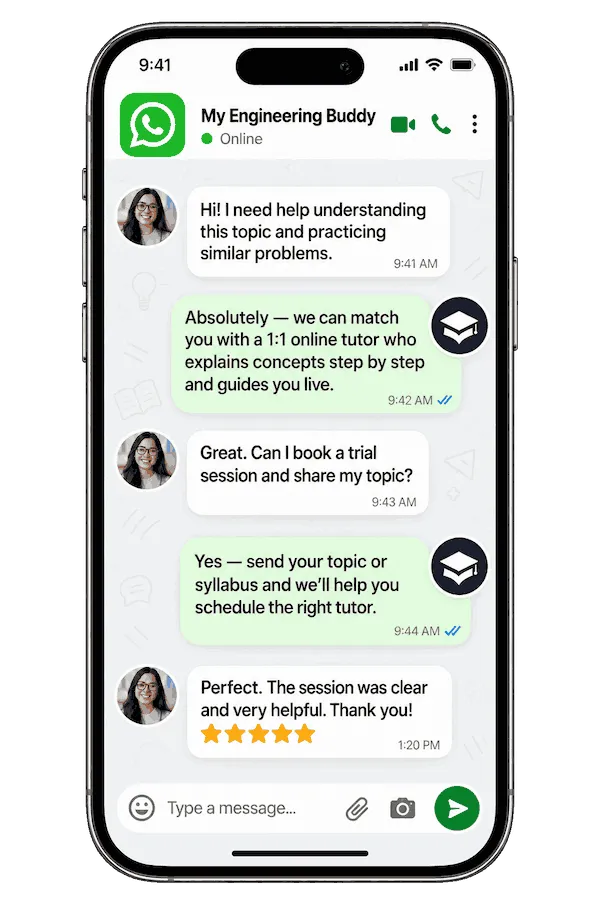
Unlike platforms where you fill out a form and wait, MEB responds in under a minute, 24/7. Tutor match takes under an hour. The $1 trial means you test before you commit. Everything runs over WhatsApp — no logins, no intake forms.
Study Plans (Pick One That Matches Your Goal)
After the diagnostic session, the tutor builds the plan. Three common structures: Catch-up (1–3 weeks) for students who’ve fallen behind on tensor calculus or missed key lectures and need the gap closed before assessments. Exam prep (4–8 weeks) for students with a specific module exam or qualifying exam date, working through past papers, derivation practice, and conceptual review systematically. Weekly support for students who want ongoing help aligned to their semester — problem sets reviewed, new topics introduced before lectures, and progress tracked continuously. The tutor sequences sessions after the diagnostic; you don’t need to come in knowing what to ask for first.
For students working through Cosmology, Particle Physics, or General Relativity at graduate level, MEB tutors bring research-depth knowledge — not just textbook familiarity.
Source: My Engineering Buddy, 2008–2025.
Pricing Guide
General Relativity tutoring runs $20–$40/hr for most undergraduate levels. Graduate and research-level sessions, where the tutor needs active knowledge of current literature and numerical methods, reach $40–$100/hr. Rate factors include the level of the course, how quickly you need to start, and tutor availability for your time zone.
For students targeting graduate programme admission, qualifying exam passes, or dissertation support in gravitational physics, tutors with active research backgrounds in GR and Computational Physics are available at higher rates — share your specific goal and MEB will match the tier to your ambition.
Peak exam periods — typically April–May and November–December — see reduced tutor availability. Book early. Start with the $1 trial — 30 minutes, no registration, no commitment. WhatsApp MEB for a quick quote.
Students consistently tell us that the biggest surprise with MEB is how quickly the tutor identifies the actual sticking point. In General Relativity, it’s almost never what the student thinks it is. The first session changes the question from “why don’t I understand GR?” to “why wasn’t this explained this way before?”
FAQ
Is General Relativity hard?
Yes — it’s one of the most technically demanding courses in an undergraduate physics degree. The difficulty is the mathematical language (tensor calculus and differential geometry), not the physics concepts themselves. Most students need direct, step-by-step support to get through the first third of the course before momentum builds.
How many sessions are needed?
Students catching up on a specific gap typically need 5–10 sessions. Students preparing for a full module exam or graduate qualifying exam usually need 15–25 sessions spread over 4–8 weeks. The tutor gives a clearer estimate after the first diagnostic session.
Can you help with homework and assignments?
MEB tutoring is guided learning — you understand the work, then submit it yourself. The tutor works through the method with you, identifies where your approach breaks down, and helps you reach the correct reasoning independently. See our Academic Integrity policy and Why MEB page for full details on what we help with and what we don’t.
Will the tutor match my exact syllabus or exam board?
Yes. Before the first session, share your course outline or module guide. MEB tutors align to your specific syllabus — whether that’s a Carroll-based graduate course, a Hartle-based undergraduate module, or a departmental course with custom notes. The tutor won’t waste sessions on topics your course doesn’t examine.
What happens in the first session?
The tutor runs a short diagnostic — asking you to work through a representative problem or explain a concept while they observe. This identifies the exact gap within 20–30 minutes. The remainder of the first session is active tutoring, not assessment. You leave with a concrete next step and a session plan.
Is online tutoring as effective as in-person?
For General Relativity specifically, online with a digital pen-pad is often more effective than in-person. The tutor can annotate derivations in real time, zoom into specific steps, and share reference diagrams without losing the working. Students report following the logic more clearly than on a physical whiteboard at a distance.
Do I need to have studied Special Relativity before starting?
Yes — fluency in Special Relativity and Classical Mechanics is assumed in virtually every General Relativity course. If you’re shaky on Lorentz transformations, four-vectors, or the action principle, the tutor can build a short preparatory track before the core GR material begins.
Can you help with the mathematical prerequisites — differential geometry and tensor calculus?
Yes. Many students need 3–6 sessions purely on the mathematical foundations before the physics becomes tractable. MEB tutors cover manifolds, covariant derivatives, and index gymnastics as standalone topics when that’s what the student needs. This is one of the most common starting points for new General Relativity students.
How do I get started?
Three steps: WhatsApp MEB, get matched with a verified General Relativity tutor — usually within an hour — and start your $1 trial. The trial is 30 minutes of live 1:1 tutoring or one full homework question worked through with explanation. No forms, no wait list.
Can I get General Relativity help at midnight?
MEB operates 24/7 across time zones. WhatsApp response time averages under one minute regardless of hour. If you’re in the US or Gulf and need support outside standard working hours, there are tutors available. Matching for a session at short notice is standard, not an exception.
What if my tutor doesn’t cover numerical relativity or gravitational wave physics?
MEB has tutors at different depth levels. If your course or dissertation requires numerical relativity, perturbation theory, or LIGO-adjacent physics, specify that when you WhatsApp — the matching process accounts for it. You won’t be assigned a tutor whose expertise stops at the Schwarzschild solution if your work goes beyond it.
Trust & Quality at My Engineering Buddy
Every MEB tutor goes through subject-specific screening — not a generic teaching test. For General Relativity, that means demonstrating working knowledge of tensor calculus, the Einstein field equations, and at least one standard exact solution under a live evaluation. Tutors are reviewed after every session, and those who don’t maintain consistent feedback scores are removed. Rated 4.8/5 across 40,000+ verified reviews on Google. MEB has been running since 2008 — 18 years of placing the right tutor with the right student, without a platform intermediary sitting between you.
MEB tutoring is guided learning — you understand the work, then submit it yourself. For full details on what we help with and what we don’t, read our Academic Integrity policy and Why MEB.
MEB serves students across the US, UK, Canada, Australia, Gulf, and Europe in 2,800+ subjects. Physics is one of our strongest subject areas — from Modern Physics and Statistical Mechanics through to research-level General Relativity. The platform was built specifically for advanced and specialist subjects that generalist tutoring sites don’t serve well. If you need Quantum Mechanics support alongside your GR work, the same platform handles it. See our tutoring methodology for how MEB structures sessions across advanced Physics subjects.
MEB has served 52,000+ students since 2008, across Nuclear Physics, Plasma Physics, and General Relativity — subjects where depth of tutor knowledge is the difference between passing and failing.
Source: My Engineering Buddy, 2008–2025.
Explore Related Subjects
Students studying General Relativity often also need support in:
- Astronomy
- Atomic Physics
- Galactic and Space Dynamics
- Orbital and Celestial Mechanics
- Quantum Optics
- Thermal Physics
- Condensed Matter Physics
Next Steps
To get matched with the right General Relativity tutor, have three things ready when you WhatsApp:
- Your course syllabus or module guide, plus the textbook your course uses
- A recent problem set attempt or homework question you’ve been stuck on
- Your exam or submission date, and your available time zones for sessions
MEB matches you with a verified tutor — usually within an hour. The first session starts with a short diagnostic so every subsequent minute is used on what actually matters for your grade.
Visit www.myengineeringbuddy.com for more on how MEB works.
WhatsApp to get started or email [email protected].
Reviewed by Subject Expert
This page has been carefully reviewed and validated by our subject expert to ensure accuracy and relevance.