




~1 min
Average Reply Time
~1 hour
To Be Matched With A Tutor
30 Min Trial
75% Find Their Tutor On The 1st Trial
$20-35+/hr
Premium Yet Affordable Learning
Hire The Best Surface Modeling Tutor





Most students don’t fail surface modeling because they lack talent. They fail because nobody showed them how NURBS curvature continuity actually works in practice.
Surface Modeling Tutor Online
Surface modeling is a CAD technique for creating complex, aesthetically driven 3D shapes using NURBS or spline-based geometry. It equips designers and engineers to model organic forms, product surfaces, and freeform structures requiring precise curvature control.
MEB offers 1:1 online tutoring and project help in 2800+ advanced subjects, including a dedicated Computer-Aided Design tutor service and specialist support for surface modeling across tools like CATIA, Rhino 3D, SOLIDWORKS, and Siemens NX. If you’ve searched for a Surface Modeling tutor near me and found generic results, MEB matches you with a tutor who knows your exact software and workflow — typically within the hour.
- 1:1 online sessions tailored to your specific software, course, or project brief
- Expert-verified tutors with hands-on surface modeling experience across CAD platforms
- Flexible time zones — US, UK, Canada, Australia, Gulf covered
- Structured learning plan built after a diagnostic of your current model files
- Guided project support — we explain the geometry logic, you build the model
52,000+ students across the US, UK, Canada, Australia, and the Gulf have used MEB since 2008 — including students in Computer-Aided Design subjects like surface modeling, Rhino 3D, and CATIA.
Source: My Engineering Buddy, 2008–2025.
How Much Does a Surface Modeling Tutor Cost?
Most surface modeling sessions run $20–$40/hr. Specialist work in CATIA Class A surfacing or Siemens NX advanced surface analysis can reach $70–$100/hr depending on depth and tutor background. New students can start with the $1 trial — 30 minutes live or one project problem explained in full.
| Level / Need | Typical Rate | What’s Included |
|---|---|---|
| Standard (most levels) | $20–$40/hr | 1:1 sessions, project guidance, model review |
| Advanced / Specialist | $40–$100/hr | Class A surfacing, NX/CATIA expert, niche depth |
| $1 Trial | $1 flat | 30 min live session or one project question explained |
Tutor slots fill fast in semester crunch periods — especially January and April when product design portfolios are due. WhatsApp MEB for a quick quote — average response time under 1 minute.
Who This Surface Modeling Tutoring Is For
Surface modeling sits at the intersection of geometry, aesthetics, and engineering precision. Most students hit a wall not at the tools — but at the underlying surface theory. This service is built for people who’ve opened the software but can’t get the model to behave.
- Undergraduate and postgraduate students in industrial design, mechanical engineering, or product design with surface modeling coursework or project deadlines
- Students whose portfolio submission is two weeks away and the model quality isn’t there yet
- Students retaking a CAD module after a failed first attempt — particularly those who passed the sketching component but couldn’t translate it into clean surface geometry
- Professional engineers or designers upskilling to CATIA, Siemens NX, or SOLIDWORKS surface tools for a new role
- Students at universities running Rhino 3D, Fusion 360, or CATIA — including programs at institutions like MIT, Georgia Tech, Delft University of Technology, RMIT, and the Royal College of Art
- Anyone stuck on G1/G2/G3 continuity, zebra stripe analysis, or curvature combs and needing someone to explain the geometry — not just click through the menus
Students consistently tell us that surface modeling feels abstract until someone walks them through a real geometry problem on screen. The moment they see curvature combs respond to a CV adjustment live, it clicks. That’s what the first session is designed to deliver.
1:1 Tutoring vs Self-Study vs AI vs YouTube vs Online Courses
Self-study works if you’re disciplined — but surface modeling errors are often invisible until you run analysis tools, and you won’t know what to look for. AI tools explain concepts quickly but can’t inspect your actual model file or diagnose why your surface has a crease. YouTube is solid for workflow overviews; it stops when your specific blend surface won’t close. Online courses teach the menus — not the judgment calls. 1:1 tutoring with MEB puts a specialist tutor on your screen, looking at your model, correcting your curvature logic in real time. For surface modeling specifically, where the difference between G1 and G2 continuity is invisible to the eye but disqualifying in a professional review, that live correction matters.
Outcomes: What You’ll Be Able To Do in Surface Modeling
After working with an MEB surface modeling tutor, you’ll be able to build clean multi-patch surfaces with G2 continuity and verify them using zebra stripe and curvature comb analysis. You’ll apply loft, sweep, and boundary surface commands with deliberate control — not trial and error. You’ll model complex organic forms in Rhino 3D, CATIA, or SOLIDWORKS Surfacing without the geometry collapsing on rebuild. You’ll analyze surface quality diagnostically and explain why a surface fails curvature requirements. You’ll present portfolio-ready models that hold up under peer and industry review.
Based on feedback from 40,000+ sessions collected by MEB from 2022 to 2025, 58% of students improved by one full grade after approximately 20 hours of 1:1 tutoring in subjects like surface modeling. A further 23% achieved at least a half-grade improvement.
Source: MEB session feedback data, 2022–2025.
Try your first session for $1 — 30 minutes of live 1:1 tutoring or one homework question explained in full. No registration. No commitment. WhatsApp MEB now and get matched within the hour.
What We Cover in Surface Modeling (Syllabus / Topics)

Track 1: Surface Geometry Fundamentals
- NURBS theory — control vertices, knot vectors, degree, and weight
- Bezier vs B-spline vs NURBS: when each applies
- Continuity types: G0 (positional), G1 (tangent), G2 (curvature), G3 (acceleration)
- Surface construction methods: loft, sweep, revolve, boundary, network
- Curvature comb and zebra stripe analysis — reading and acting on results
- Trimmed vs untrimmed surfaces and their downstream implications
- Edge matching and tolerance management between surface patches
Key references: The NURBS Book by Piegl & Tiller; Curves and Surfaces for CAGD by Gerald Farin.
Track 2: Software-Specific Surfacing Workflows
- Siemens NX surface tools: Studio Surface, Through Curves, Through Curve Mesh
- CATIA Generative Shape Design (GSD): joins, extracts, and Class A surfacing principles
- Rhino 3D: SubD to NURBS conversion, Patch, NetworkSrf, and curvature matching
- SOLIDWORKS Surfacing: filled surface, ruled surface, freeform, and knit to solid
- Fusion 360 sculpt and surface workspace: T-spline to B-rep workflow
- Autodesk Alias: the industry-standard for automotive Class A — patch layout strategy
- Reverse engineering workflows: scan data to surface in Geomagic or Rhino
Key references: Software-specific official documentation; Rhinoceros 3D Help (McNeel); CATIA V5 training guides (Dassault Systèmes).
Track 3: Applied Surface Modeling for Design and Engineering
- Automotive exterior surfacing: hood, fender, and door panel strategies
- Consumer product surface modeling: ergonomic grip surfaces, parting line planning
- Aerospace and turbine blade surface construction: flow-aligned patch strategy
- Medical device housing: organic form with tight tolerance requirements
- Portfolio model preparation: exporting, rendering setup with V-Ray or KeyShot
- Converting surface models to solids: checking watertightness, thickening, and shelling
- Design-for-manufacturing review: draft analysis, undercuts, minimum radius checks
Key references: Industrial Design: A Practical Guide by Blake Huddleston; Product Design and Engineering by Ulrich & Eppinger.
What a Typical Surface Modeling Session Looks Like
The tutor opens by checking what you worked on since last time — usually a specific surface patch or continuity problem you were building. You share your screen and pull up the model file. If you’ve been working on a lofted surface that keeps generating a crease near the edge, the tutor walks through the CV layout first, then demonstrates the correction using a digital pen-pad — showing exactly which control points to move and by how much. You replicate the adjustment on your own model while the tutor watches. They check your curvature comb before and after. If there’s a continuity mismatch at the adjacent patch, that becomes the next problem. The session closes with one concrete task: rebuild that blend surface using the match surface command with curvature continuity enabled, and screenshot your zebra analysis before next time.
How MEB Tutors Help You with Surface Modeling (The Learning Loop)
Diagnose: In the first session, the tutor opens your model file or asks you to build a basic surface from scratch. They’re looking for where your mental model of NURBS geometry breaks down — whether it’s CV placement, continuity confusion, or incorrect surface construction method for the shape you’re trying to build.
Explain: The tutor works a live example on a digital pen-pad, annotating directly over the model. They show the curvature comb responding in real time as CVs move. No abstract theory — just the geometry behaving in front of you.
Practice: You attempt the same operation on your own model while the tutor watches. They don’t take the mouse. You build the muscle memory and the judgment simultaneously.
Feedback: The tutor runs the diagnostic tools — zebra stripe, curvature analysis, draft angle — and explains exactly what each result means and where your surface loses quality. You know what to fix and why.
Plan: Before the session ends, the tutor maps the next topic. If you’ve nailed G2 continuity on a two-patch surface, next time is multi-patch strategy or transition surfaces between styled and engineering geometry.
Sessions run over Google Meet. The tutor uses a digital pen-pad or iPad with Apple Pencil. Before your first session, share your software version, a model file if you have one, and your deadline or project brief. Start with the $1 trial — 30 minutes of live surfacing help that also serves as your first diagnostic. Whether you need a quick catch-up before a portfolio deadline, structured revision over 4–8 weeks, or ongoing weekly support through a semester, the tutor maps the session plan after that first diagnostic.
At MEB, tutors working on surface modeling projects use screen annotation and live model editing to make curvature theory visible — because reading about G2 continuity and watching it respond on screen are two completely different experiences.
Source: My Engineering Buddy tutoring methodology, 2008–2025.
Tutor Match Criteria (How We Pick Your Tutor)
Not every CAD tutor can teach surface modeling. MEB matches on four specific factors.
Subject depth: The tutor must have hands-on experience with the specific software you’re using — CATIA GSD, Rhino 3D, Siemens NX, or SOLIDWORKS Surfacing — not just general CAD familiarity. Class A surfacing requires a tutor who has actually done it professionally.
Tools: All sessions use Google Meet with screen sharing. Tutors use a digital pen-pad or iPad with Apple Pencil for live annotation on geometry.
Time zone: Matched to your region — US, UK, Gulf, Canada, Australia — so sessions happen at a workable hour, not 2am.
Goals: Whether you need to pass a module, complete a portfolio project, or upskill for a new role, the tutor selection reflects that. A student learning Autodesk Inventor surface tools for the first time gets a different tutor profile than a professional engineer targeting CATIA Class A certification.
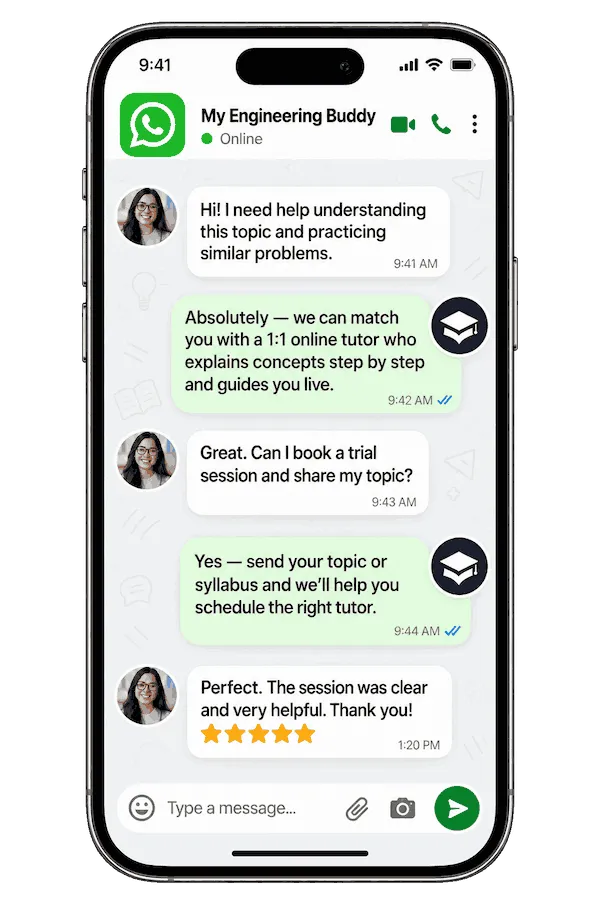
Unlike platforms where you fill out a form and wait, MEB responds in under a minute, 24/7. Tutor match takes under an hour. The $1 trial means you test before you commit. Everything runs over WhatsApp — no logins, no intake forms.
Pricing Guide
Surface modeling tutoring starts at $20/hr for standard coursework and project support. Sessions covering advanced CATIA GSD, Siemens NX Class A surfacing, or specialist automotive surface workflows run $40–$100/hr depending on tutor background and project complexity.
Rate factors: software level, surface complexity, timeline pressure, and tutor availability. Slots fill fast in portfolio submission periods — particularly March–April and October–November when design school deadlines cluster.
For students targeting roles at automotive OEMs, aerospace firms, or top industrial design consultancies, MEB can match you with tutors who have direct professional surfacing backgrounds — share your specific goal and MEB will match the tier to your ambition.
Start with the $1 trial — 30 minutes, no registration, no commitment. WhatsApp MEB for a quick quote.
FAQ
Is surface modeling hard?
It’s genuinely difficult — not because the software is complicated, but because clean surface quality requires understanding curvature geometry that isn’t intuitive. Most students need guided practice with live feedback on their actual models before the logic clicks.
How many sessions does it take to get competent at surface modeling?
Most students see clear improvement in surface quality within 6–10 sessions. Reaching consistent G2 continuity across multi-patch models typically takes 15–20 hours of focused 1:1 work, depending on starting level and software.
Can you help with surface modeling projects and portfolio work?
MEB tutoring is guided learning — we explain the geometry logic, the continuity strategy, and the construction approach. You build the model and submit it yourself. See our Academic Integrity policy and Why MEB page for full details on what we help with and what we don’t.
Will the tutor match my exact software and version?
Yes. Tell MEB which software you’re using — CATIA V5/V6, Rhino 3D, SOLIDWORKS, Siemens NX, Fusion 360, or another tool — and the tutor matched to you will have direct experience with that platform. Version matters; share it when you WhatsApp.
What happens in the first session?
The tutor runs a diagnostic — either reviewing a model file you share or watching you build a basic surface from scratch. They identify exactly where your geometry logic breaks down and build the first session around fixing that specific problem.
Is online surface modeling tutoring as effective as in-person?
For CAD-based subjects, online is often better. Screen sharing lets the tutor see your exact model, run annotation directly on your geometry, and use a digital pen-pad to demonstrate adjustments in real time — things a physical whiteboard can’t do.
Can I get surface modeling help late at night or on weekends?
MEB operates 24/7. WhatsApp response averages under a minute regardless of time zone. Tutors are available across US, UK, Gulf, and Australian time zones — including evenings and weekends when portfolio deadlines tend to hit.
What’s the difference between Class A surfacing and standard surface modeling?
Class A surfacing requires G2 or G3 continuity across every patch, with no perceptible highlight breaks under zebra or reflection analysis. It’s the standard for automotive exterior panels and high-end consumer products. Standard surface modeling may tolerate G1 continuity. Your tutor will clarify which standard your course or employer requires.
What if I don’t get on with my assigned tutor?
Tell MEB after the first session. A replacement is arranged within 24 hours at no extra cost. The $1 trial is specifically designed so you can assess fit before committing to a regular schedule.
Do you support Rhino 3D SubD-to-NURBS workflows specifically?
Yes. SubD-to-NURBS conversion in Rhino 3D — including controlling the output quality, managing edge creases, and cleaning up the resulting NURBS patches — is a common focus area. MEB has tutors with direct Rhino 3D experience covering this workflow in detail.
How do I get started?
WhatsApp MEB, share your software, current model or project brief, and your deadline. MEB matches you with a verified surface modeling tutor — usually within the hour. Your first session is the $1 trial: 30 minutes live or one geometry problem explained in full. Three steps: WhatsApp → matched → start trial.
Can you help with CAM preparation after the surface model is complete?
Yes. Once your surface model is ready, MEB tutors can help you prepare it for CAE analysis or machining — including checking watertightness, thickening surfaces to solids, and reviewing geometry for downstream manufacturing use.
Trust & Quality at My Engineering Buddy
Every MEB surface modeling tutor goes through subject-specific screening — not a general CAD test. Candidates must demonstrate live surfacing skill in the tools they claim, pass a demo session evaluation, and maintain a feedback rating above threshold to stay active on the platform. Rated 4.8/5 across 40,000+ verified reviews on Google. MEB has served 52,000+ students since 2008 across the US, UK, Canada, Australia, Gulf, and Europe.
MEB tutoring is guided learning — you understand the work, then submit it yourself. For full details on what we help with and what we don’t, read our Academic Integrity policy and Why MEB.
MEB covers 2,800+ subjects — from surface modeling and computer graphics to engineering drawing and machine design. The platform was built specifically for advanced technical subjects where generic tutoring platforms fall short. Surface modeling is one of the areas where that specialist depth makes the clearest difference. See our tutoring methodology for how sessions are structured across technical subjects.
A common pattern our tutors observe is that students who struggle with surface modeling have often been taught to use the commands — but not why a particular surface construction method produces better curvature than another. Fixing that gap is where most of the real progress happens.
Explore Related Subjects
Students studying surface modeling often also need support in:
At MEB, we’ve found that students who pair surface modeling work with structured sessions on engineering drawing or technical drawing catch up faster — because reading and producing geometry documentation reinforces the spatial thinking that surface quality depends on.
Next Steps
Getting started takes less than a minute.
- Share your software, exam board or course name, and your hardest current problem
- Share your availability and time zone
- MEB matches you with a verified surface modeling tutor — usually within 24 hours, often within the hour
- First session starts with a diagnostic so every minute is used on what actually matters
Before your first session, have ready:
- Your software version and any course outline or project brief
- A model file you’ve been working on, or a homework problem you got stuck on
- Your deadline or submission date — the tutor handles the plan from there
Visit www.myengineeringbuddy.com for more on how MEB works.
WhatsApp to get started or email [email protected].
Reviewed by Subject Expert
This page has been carefully reviewed and validated by our subject expert to ensure accuracy and relevance.




