~1 min
Average Reply Time
~1 hour
To Be Matched With A Tutor
30 Min Trial
75% Find Their Tutor On The 1st Trial
$20-35+/hr
Premium Yet Affordable Learning
Hire The Best Communication Systems Tutor




Most students don’t fail Communication Systems because the subject is impossible. They fail because nobody caught the gap in their Fourier analysis or AM/FM modulation understanding — until the exam did.
Communication Systems Tutor Online
Communication Systems is the study of transmitting information across channels using modulation, encoding, and signal processing techniques. It underpins wireless, optical, and digital networks, equipping students to analyse bandwidth, noise, and data integrity in real-world communication architectures.
MEB provides 1:1 online tutoring and homework help in 2800+ advanced subjects, including a full range of Electrical Engineering subjects. If you’ve been searching for a Communication Systems tutor near me, MEB matches you with a verified expert — usually within an hour — and the first session starts with a diagnostic so nothing is wasted. Most students see measurable progress within 3–5 focused sessions.
- 1:1 online sessions tailored to your exact course or syllabus
- Expert-verified tutors with subject-specific depth in modulation, coding, and signal analysis
- Flexible time zones — US, UK, Canada, Australia, Gulf
- Structured learning plan built after a diagnostic session
- Ethical homework and assignment guidance — you understand the work before you submit it
52,000+ students across the US, UK, Canada, Australia, and the Gulf have used MEB since 2008 — including students in Electrical Engineering subjects like Communication Systems, Digital Communications, and Signals and Systems.
Source: My Engineering Buddy, 2008–2025.
How Much Does a Communication Systems Tutor Cost?
Rates run $20–$40/hr for most undergraduate and postgraduate levels. Highly specialised topics — OFDM system design, advanced channel coding, or graduate research support — can reach up to $100/hr. You can test MEB with a $1 trial before committing to anything.
| Level / Need | Typical Rate | What’s Included |
|---|---|---|
| Standard (most undergrad levels) | $20–$35/hr | 1:1 sessions, homework guidance |
| Advanced / Graduate Specialist | $35–$100/hr | Expert tutor, niche depth, research support |
| $1 Trial | $1 flat | 30 min live session or one full homework question explained |
Tutor availability tightens significantly in the weeks before final exams. Book early if your deadline is approaching.
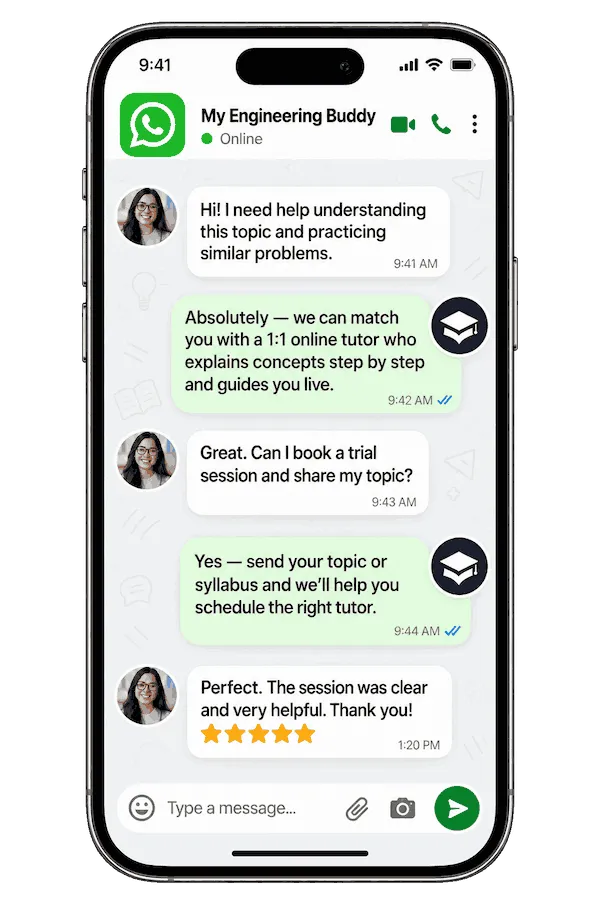
WhatsApp MEB for a quick quote — average response time under 1 minute.
Who This Communication Systems Tutoring Is For
Communication Systems sits at the intersection of mathematics, signal theory, and applied electronics. It trips up strong students. The gap between lecture notes and exam questions is wider here than in most engineering subjects.
- Undergraduate EE students struggling with AM, FM, and digital modulation schemes
- Graduate students working through channel capacity, MIMO, or spread spectrum techniques
- Students retaking after a failed first attempt who need targeted gap-filling, not a full course replay
- Students with a university conditional offer depending on this grade
- Students 4–6 weeks from finals with significant gaps in noise analysis or probability of error derivations
- Parents watching a confident engineering student’s grades drop as the course difficulty jumps in second year
MEB tutors have worked with students at MIT, Caltech, Imperial College London, the University of Toronto, ETH Zürich, UNSW Sydney, and Delft University of Technology — all as private students, not institutional partnerships.
Start with the $1 trial — 30 minutes of live diagnosis that shows exactly where the gaps are.
1:1 Tutoring vs Self-Study vs AI vs YouTube vs Online Courses
Self-study works if you already understand the structure — most Communication Systems students don’t know what they don’t know until a problem collapses. AI tools give fast answers but can’t follow your specific derivation and spot where your phasor diagram went wrong. YouTube covers AM demodulation clearly at introductory level; it stops when you’re stuck on BER curves for BPSK versus QPSK in an AWGN channel. Online courses move at a fixed pace with no room for the three topics that are specifically blocking your progress. A 1:1 Communication Systems tutor online corrects errors in real time, works from your actual past papers, and adjusts every session to what you haven’t mastered yet.
Outcomes: What You’ll Be Able To Do in Communication Systems
After focused 1:1 sessions, students consistently report clear gains in specific technical areas. You’ll be able to analyse AM and FM signals, derive bandwidth requirements, and sketch spectra without hesitation. Apply Shannon’s channel capacity theorem to real system constraints. Model noise performance and calculate probability of error for BPSK, QPSK, and QAM schemes. Explain and design basic source and channel coding structures, including Hamming codes. Present matched filter design rationale in written assignments with accurate justification — not just formula recall.
Based on feedback from 40,000+ sessions collected by MEB from 2022 to 2025, 58% of students improved by one full grade after approximately 20 hours of 1:1 tutoring in subjects like Communication Systems. A further 23% achieved at least a half-grade improvement.
Source: MEB session feedback data, 2022–2025.
Supporting a student through Communication Systems? MEB works directly with parents to set up sessions, track progress, and keep coursework on schedule. WhatsApp MEB — average response time is under a minute, 24/7.
What We Cover in Communication Systems (Syllabus / Topics)

Analog Communication Systems
- Amplitude modulation (AM): DSB-SC, SSB, VSB — derivations and spectra
- Frequency modulation (FM) and phase modulation (PM): Carson’s rule, bandwidth
- Envelope detection, coherent detection, and superheterodyne receivers
- Noise in AM and FM systems: SNR analysis and figure-of-merit comparisons
- Phase-locked loops (PLLs): operation, acquisition, and tracking
- Angle modulation applications in broadcast and VHF systems
Core texts: Haykin & Moher Communication Systems (5th ed.), Lathi & Ding Modern Digital and Analog Communication Systems.
Digital Communication Systems
- Sampling theorem, quantisation, and PCM encoding
- Baseband pulse transmission: Nyquist criterion, ISI, raised-cosine filtering
- Digital modulation: BPSK, QPSK, QAM, FSK — constellation diagrams and BER
- Matched filter receiver and correlator receiver derivations
- OFDM principles, cyclic prefix, and multicarrier systems
- Spread spectrum: DSSS, FHSS, and CDMA fundamentals
- Channel capacity: Shannon’s theorem, bandwidth-efficiency tradeoffs
Core texts: Proakis & Salehi Digital Communications (5th ed.), Sklar Digital Communications: Fundamentals and Applications.
Channel Coding and Information Theory
- Entropy, mutual information, and channel capacity derivations
- Source coding: Huffman coding, run-length encoding
- Error detection and correction: Hamming codes, cyclic codes, convolutional codes
- Turbo codes and LDPC: principles and decoding concepts
- MIMO channel modelling and spatial multiplexing gain
Core texts: Cover & Thomas Elements of Information Theory, Lin & Costello Error Control Coding.
Students consistently tell us that the moment Communication Systems clicks is when they stop treating modulation and coding as separate topics and start seeing every system as a chain — source, encoder, modulator, channel, demodulator, decoder. Sessions are built around making that chain visible early.
What a Typical Communication Systems Session Looks Like
The tutor opens by checking the previous session’s topic — usually probability of error for a specific modulation scheme or a Fourier transform derivation the student flagged. They then pull up the student’s most recent assignment or past paper question on screen. Working through QPSK BER derivation together, the tutor writes each step on a digital pen-pad while the student follows and annotates their own copy. When an error appears — typically a sign error in the noise variance term — the tutor catches it immediately and explains why it propagates through the whole answer. The student reworks the step independently. Session closes with two unseen problems set for independent practice: one on matched filter output SNR, one on bandwidth calculation for a given FM index. Next topic — channel coding — is confirmed before the call ends.
How MEB Tutors Help You with Communication Systems (The Learning Loop)
Diagnose: In the first session, the tutor identifies the exact breakdown point. For most Communication Systems students, it sits in one of three places — probability theory applied to noise, the relationship between time-domain and frequency-domain representations, or the transition from analog to digital modulation concepts.
Explain: The tutor works through live examples on a digital pen-pad — not slides, not a textbook scan. You watch the derivation build step by step. Signals and Systems foundations are revisited where needed, because analog communication problems collapse without them.
Practice: You attempt the next problem with the tutor present. Not after the session. During it. This is where most errors surface — and where they get fixed before they become exam habits.
Feedback: The tutor explains exactly where marks were lost and why — not just the correct answer. Understanding why a matched filter derivation fails at a particular step is worth more than ten correct answers copied from solutions.
Plan: After each session, the tutor notes the next topic, sets specific practice problems, and flags what to bring to the following session. Progress through the syllabus is tracked explicitly.
Sessions run over Google Meet. The tutor uses a digital pen-pad or iPad with Apple Pencil. Before the first session, share your course syllabus or module outline, one recent homework problem you couldn’t complete, and your exam date. The first session covers diagnostic questions and the first content gap. Start with the $1 trial — 30 minutes of live tutoring that also serves as your first diagnostic.
At MEB, we’ve found that students who struggle with digital modulation almost always have the same root issue: they never properly connected Fourier analysis to spectral bandwidth. Fix that one link and BPSK, QPSK, and QAM stop feeling like three separate topics to memorise.
Tutor Match Criteria (How We Pick Your Tutor)
Not every strong engineer can teach Communication Systems at exam level. MEB matches on four criteria.
Subject depth: The tutor must have demonstrated knowledge at the level requested — second-year undergrad, final year, or graduate. A tutor covering OFDM and MIMO must have worked with those topics in coursework or professional practice, not just lectured from a textbook.
Tools: Every tutor uses Google Meet with a digital pen-pad or iPad plus Apple Pencil. Screen-sharing a static PDF is not how Communication Systems derivations are taught here.
Time zone: Matched to your region — US, UK, Gulf, Canada, or Australia — so sessions fit your schedule without compromise.
Goals: Whether you need exam score improvement, help with digital signal processing coursework, or conceptual depth for research, the tutor is selected for your specific objective — not assigned at random.
Unlike platforms where you fill out a form and wait, MEB responds in under a minute, 24/7. Tutor match takes under an hour. The $1 trial means you test before you commit. Everything runs over WhatsApp — no logins, no intake forms.
Study Plans (Pick One That Matches Your Goal)
After the diagnostic, the tutor builds the sequence. Three common patterns: a catch-up plan for students with 1–3 weeks before an exam, targeting the highest-yield topics first — modulation schemes, noise analysis, BER calculations; a structured 4–8 week exam prep plan working through the full syllabus with past papers at each checkpoint; or weekly support aligned to your semester schedule, keeping pace with lectures and clearing homework blocks before they compound. The tutor decides the order — you bring the deadline and the syllabus.
Pricing Guide
Most Communication Systems sessions run $20–$40/hr. Graduate-level work — MIMO channel modelling, advanced coding theory, research-adjacent topics — typically falls in the $50–$100/hr range. Rate factors include topic complexity, level, timeline urgency, and tutor availability.
For students targeting competitive graduate programmes or roles in telecommunications engineering, tutors with industry backgrounds in RF, wireless, or signal processing are available at higher rates — share your specific goal and MEB matches the tier to your ambition.
Availability in peak exam periods is limited. Start with the $1 trial — 30 minutes, no registration, no commitment. WhatsApp MEB for a quick quote.
A common pattern our tutors observe is that students underestimate how much the probability and statistics background matters in Communication Systems. Two sessions spent solidifying that foundation save five sessions of confusion later when BER derivations won’t resolve.
FAQ
Is Communication Systems hard?
It’s genuinely demanding. The course combines Fourier analysis, probability theory, and signal processing — often in the same problem. Students who struggled with Signals and Systems find it harder. Targeted 1:1 sessions address the specific gaps rather than repeating the whole course.
How many sessions are needed?
Students covering specific exam gaps typically need 6–12 sessions. Those building from a weak foundation — or preparing over a full semester — benefit from 20+ hours. The diagnostic after the first session gives a clearer estimate based on your actual starting point.
Can you help with homework and assignments?
Yes. MEB tutoring is guided learning — you understand the work, then submit it yourself. The tutor explains the method, works through a similar example, and checks your reasoning. See our Academic Integrity policy and Why MEB page for full details on what we help with and what we don’t.
Will the tutor match my exact syllabus or exam board?
Yes. Share your course outline, university, and exam board before the first session. Tutors are matched to your specific content — whether that’s Haykin-based analog comms, Proakis digital modulation, or a graduate-level information theory module.
What happens in the first session?
The tutor runs a short diagnostic — a few targeted questions across modulation, noise analysis, and signal representation. This identifies exactly where to start. Most of the first session is already productive content work, not just assessment.
Is online tutoring as effective as in-person?
For Communication Systems specifically, online works well. Derivations on a shared digital pen-pad are clearer than a physical whiteboard viewed from across a desk. Screen annotation, instant replay of written steps, and session recordings all add to the experience.
Can I get Communication Systems help at midnight or on weekends?
Yes. MEB operates 24/7 across time zones. Students in the Gulf, Australia, and the US West Coast regularly schedule late-night or weekend sessions. WhatsApp MEB at any hour — average response is under a minute.
What if I don’t get along with my assigned tutor?
Request a switch. No explanation required, no penalty. MEB re-matches you within hours. The $1 trial exists partly for this reason — you evaluate the tutor before any larger commitment.
What’s the difference between analog and digital Communication Systems, and do your tutors cover both?
Analog comms covers AM, FM, and PM modulation with continuous signals. Digital comms covers PCM, BPSK, QPSK, OFDM, and coding schemes. Most university courses cover both sequentially. MEB tutors cover the full scope — see the syllabus section above for the complete topic list.
How do I find a Communication Systems tutor in my city?
You don’t need to. MEB sessions run fully online over Google Meet, matching you to the right tutor by subject depth and time zone — not geography. Students in London, Toronto, Dubai, and Sydney all access the same tutor pool.
Why do so many students lose marks on BER and noise analysis questions specifically?
These questions require connecting probability distributions to physical channel behaviour — a step most lectures skip too quickly. Tutors work through BER derivations for BPSK and QPSK from first principles until the connection is solid, not just formula-substitutable.
How do I get started?
Start with the $1 trial — 30 minutes of live 1:1 tutoring or one homework question explained in full. Three steps: WhatsApp MEB, get matched with a verified tutor within the hour, begin your trial session. No registration required.
Trust & Quality at My Engineering Buddy
Every MEB tutor goes through subject-specific screening before taking a session. That means a live demo evaluation, degree verification, and review of their ability to explain Communication Systems concepts — not just solve problems. Rated 4.8/5 across 40,000+ verified reviews on Google. Tutors covering graduate-level topics such as MIMO, turbo coding, or information theory are evaluated at that level specifically. Ongoing session feedback filters out tutors who score poorly on explanation quality, regardless of their academic credentials.
MEB tutoring is guided learning — you understand the work, then submit it yourself. For full details on what we help with and what we don’t, read our Academic Integrity policy and Why MEB.
MEB has served 52,000+ students across the US, UK, Canada, Australia, the Gulf, and Europe since 2008 — covering 2,800+ subjects. Within Electrical Engineering, that includes students working on wireless communication systems, telecommunications theory, and optical communications alongside core Communication Systems modules. The MEB tutoring methodology is built around the diagnostic-first, feedback-loop approach that consistently produces measurable grade improvement.
Explore Related Subjects
Students studying Communication Systems often also need support in:
- Analog Signal Processing
- Microwave Engineering
- Satellite Communications
- Radar Systems
- Embedded Systems
- Network Theory
- Electromagnetic Field Theory
Next Steps
Before your first session, have ready: your exam board and syllabus or course outline, a recent past paper attempt or homework question you couldn’t finish, and your exam or deadline date. The tutor handles the rest.
- Share your exam board, hardest topic, and current timeline
- Share your availability and time zone
- MEB matches you with a verified Communication Systems tutor — usually within 24 hours
Try your first session for $1 — 30 minutes of live 1:1 tutoring or one homework question explained in full. No registration. No commitment. WhatsApp MEB now and get matched within the hour.
Visit www.myengineeringbuddy.com for more on how MEB works.
WhatsApp to get started or email [email protected].
Reviewed by Subject Expert
This page has been carefully reviewed and validated by our subject expert to ensure accuracy and relevance.