

Contact MEB Today To Get The Best
Industrial and Environmental microbiology Tutoring Online
Email: [email protected]



~1 min
Average Reply Time
~1 hour
To Be Matched With A Tutor
30 Min Trial
75% Find Their Tutor On The 1st Trial
$20-35+/hr
Premium Yet Affordable Learning
Hire The Best Industrial and Environmental microbiology Tutor

Failing to connect microbial metabolism to real-world bioremediation? A targeted tutor fixes that gap faster than re-reading the chapter twice.
Industrial and Environmental Microbiology Tutor Online
Industrial and environmental microbiology is the study of microorganisms in industrial processes and natural ecosystems — covering fermentation, bioremediation, wastewater treatment, and microbial ecology — equipping students to apply microbial science in biotechnology and environmental management.
MEB offers 1:1 online tutoring and homework help in 2,800+ advanced subjects, including environmental science and its specialist branches. If you’ve searched for an industrial and environmental microbiology tutor near me and want someone who knows the difference between activated sludge and trickling filter systems, you’re in the right place. Our tutors are matched to your exact course, module, and level — and sessions start with a diagnostic so no time is wasted.
- 1:1 online sessions tailored to your university module or syllabus
- Expert-verified tutors with subject-specific knowledge in microbial ecology, fermentation, and bioremediation
- Flexible time zones — US, UK, Canada, Australia, Gulf
- Structured learning plan built after a diagnostic session
- Ethical homework and assignment guidance — you understand the work, then submit it yourself
52,000+ students across the US, UK, Canada, Australia, and the Gulf have used MEB since 2008 — including students in Environmental Science subjects like industrial and environmental microbiology, environmental biotechnology, and environmental pollution.
Source: My Engineering Buddy, 2008–2025.
How Much Does an Industrial and Environmental Microbiology Tutor Cost?
Most students pay $20–$40/hr for 1:1 online tutoring. Graduate-level or highly specialised topics — such as advanced bioreactor design or environmental genomics — can run up to $100/hr. The $1 trial gives you 30 minutes of live tutoring or one homework question explained in full before you commit to anything.
| Level / Need | Typical Rate | What’s Included |
|---|---|---|
| Standard (most undergrad levels) | $20–$35/hr | 1:1 sessions, homework guidance |
| Advanced / Graduate / Specialist | $35–$100/hr | Expert tutor, niche depth, research support |
| $1 Trial | $1 flat | 30 min live session or 1 homework question |
Tutor availability tightens around semester-end exam periods and lab report deadlines — book early if your schedule is tight.
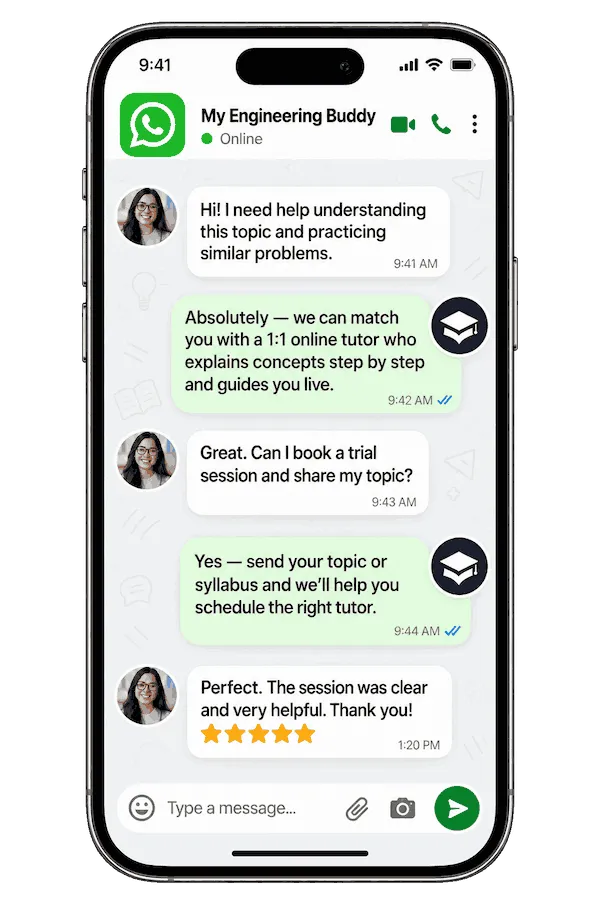
WhatsApp MEB for a quick quote — average response time under 1 minute.
Who This Industrial and Environmental Microbiology Tutoring Is For
This tutoring is built for students who need more than a lecture replay. Whether you’re stuck on how nitrogen-fixing bacteria interact with soil chemistry, or you can’t get your head around BOD calculations in wastewater treatment, a 1:1 tutor moves at your pace and addresses your exact confusion.
- Undergraduate students in biology, environmental science, or biotechnology programmes at universities like MIT, UC Davis, Imperial College London, University of Toronto, University of Melbourne, and ETH Zurich
- Graduate students working on environmental microbiology modules within Masters or PhD programmes
- Students retaking after a failed first attempt — needing targeted work on specific failed topics
- Students with a university conditional offer depending on this grade
- Students 4–6 weeks from an exam with significant gaps still to close in topics like microbial genetics or bioreactor kinetics
- Students needing ethical homework and assignment guidance — MEB explains the method, you do the work
1:1 Tutoring vs Self-Study vs AI vs YouTube vs Online Courses
Self-study works if you’re disciplined, but microbial ecology has enough interconnected systems that isolated reading often creates false confidence. AI tools give fast definitions of terms like quorum sensing or phytoremediation but can’t spot where your reasoning breaks down in a specific problem. YouTube is useful for visualising the activated sludge process — it stops cold when you’re stuck on your own data set. Online courses move at a fixed pace with no adaptation. 1:1 tutoring with MEB is calibrated to your exact course materials, corrects errors in real time, and connects industrial fermentation principles to the environmental applications your exam actually tests.
Outcomes: What You’ll Be Able To Do in Industrial and Environmental Microbiology
After targeted sessions, students are able to explain the role of specific microbial consortia in bioremediation of petroleum-contaminated soils, analyze BOD and COD data to evaluate wastewater treatment efficiency, apply Monod kinetics to model microbial growth in bioreactor systems, solve problems on nitrogen and carbon cycling in natural ecosystems, and present the mechanisms behind industrial fermentation — from inoculum preparation through to downstream processing. These aren’t abstract outcomes. They map directly to the exam questions and lab reports your course sets.
Based on feedback from 40,000+ sessions collected by MEB from 2022 to 2025, 58% of students improved by one full grade after approximately 20 hours of 1:1 tutoring in subjects like industrial and environmental microbiology. A further 23% achieved at least a half-grade improvement.
Source: MEB session feedback data, 2022–2025.
At MEB, we’ve found that students who struggle with industrial microbiology topics — especially bioreactor design and fermentation kinetics — often do so because no one has connected the underlying biochemistry to the engineering application. One session bridging those two angles changes everything.
What We Cover in Industrial and Environmental Microbiology (Syllabus / Topics)

Track 1: Industrial Microbiology and Fermentation
- Microbial growth kinetics — Monod equation, batch vs continuous culture
- Bioreactor design: stirred tank, airlift, and packed-bed configurations
- Industrial fermentation: antibiotics, enzymes, amino acids, and organic acids
- Inoculum development and scale-up strategies
- Downstream processing: cell harvesting, product recovery, and purification
- Quality control in industrial microbiology settings
- Case studies: penicillin production, citric acid fermentation, and bioethanol
Core texts for this track include Stanbury, Whitaker & Hall’s Principles of Fermentation Technology and Glazer & Nikaido’s Microbial Biotechnology.
Track 2: Environmental Microbiology and Bioremediation
- Microbial ecology: community structure, diversity indices, and sampling methods
- Biogeochemical cycling — nitrogen, carbon, sulphur, and phosphorus
- Bioremediation mechanisms: biodegradation of hydrocarbons, heavy metal sequestration, phytoremediation support
- Wastewater treatment: activated sludge, trickling filters, anaerobic digestion
- BOD, COD, and TSS calculations and interpretation
- Microbial indicators of water quality: coliforms, enterococci, and emerging pathogens
- Metagenomics and molecular tools for environmental microbial profiling
Recommended texts: Maier, Pepper & Gerba’s Environmental Microbiology and Atlas & Bartha’s Microbial Ecology.
Track 3: Applied and Emerging Topics
- Microbial fuel cells and bioelectrochemical systems
- Synthetic biology applications in industrial and environmental contexts
- Biosensors for environmental monitoring
- Antibiotic resistance in environmental reservoirs
- Regulatory frameworks for microbial releases into the environment
- Climate change impacts on microbial community dynamics — links to climate change tutoring
Useful references include Rittmann & McCarty’s Environmental Biotechnology: Principles and Applications and current review articles via EMBO Journal.
Students who get 1:1 environmental biotechnology tutoring alongside industrial microbiology consistently report faster progress on bioreactor and bioremediation crossover topics — the two subjects reinforce each other directly.
Source: My Engineering Buddy tutor team observations, 2022–2025.
What a Typical Industrial and Environmental Microbiology Session Looks Like
The tutor opens by checking the previous topic — say, microbial growth kinetics from last session — and asking you to talk through the Monod equation before moving on. From there, you and the tutor work through a specific problem: perhaps calculating dilution rate in a chemostat or interpreting a BOD removal curve from a wastewater treatment scenario. The tutor uses a digital pen-pad to annotate diagrams and work through calculations live on screen. You replicate the method or explain your reasoning back — whichever exposes the gap faster. The session closes with a concrete practice question set around anaerobic digestion or bioremediation kinetics, and the next topic is agreed before you log off.
Students consistently tell us that the moment they stop copying a method and start explaining it back — even imperfectly — is when industrial microbiology stops feeling like a pile of disconnected facts and starts working as a system. That’s what the tutor is there to trigger.
How MEB Tutors Help You with Industrial and Environmental Microbiology (The Learning Loop)
Diagnose: In the first session, the tutor identifies where your understanding actually breaks down — not just where you feel uncertain. For industrial microbiology students, this is often the connection between microbial physiology and engineering design, or the maths behind kinetic models.
Explain: The tutor works through problems live, using a digital pen-pad to build diagrams of bioreactor configurations, draw microbial growth curves, or annotate a wastewater flow diagram step by step.
Practice: You attempt problems with the tutor present — not after the session. This is where the real learning happens. Getting something wrong in front of an expert is faster than getting it wrong alone.
Feedback: The tutor corrects errors at the step level — explaining exactly where your reasoning diverged and why that loses marks in an exam or lab report context.
Plan: After each session, the tutor sets the next topic in sequence. Progress is tracked so you’re never repeating ground you’ve already covered.
Sessions run on Google Meet. The tutor uses a digital pen-pad or iPad with Apple Pencil. Before your first session, share your course outline or module guide, a recent assignment or exam paper you struggled with, and your submission or exam date. The first session covers a full diagnostic, then moves directly into the highest-priority topic. Whether you need a quick catch-up before an exam, structured revision over 4–8 weeks, or ongoing weekly support through the semester, the tutor maps the session plan after that first diagnostic.
Start with the $1 trial — 30 minutes of live tutoring that also serves as your first diagnostic.
Try your first session for $1 — 30 minutes of live 1:1 tutoring or one homework question explained in full. No registration. No commitment. WhatsApp MEB now and get matched within the hour.
Tutor Match Criteria (How We Pick Your Tutor)
Every match is made against four criteria.
Subject depth: The tutor must have direct knowledge of your specific module — whether that’s wastewater engineering, industrial fermentation, environmental genomics, or microbial ecology at undergraduate or graduate level.
Tools: All tutors use Google Meet with a digital pen-pad or iPad and Apple Pencil — essential for working through diagrams and calculations live.
Time zone: Matched to your region — US, UK, Gulf, Canada, or Australia — so sessions don’t require either party to be awake at 3am.
Goals: Whether you’re targeting a specific exam score, trying to close a gap in conceptual understanding, or working through a lab report backlog, the tutor is briefed on your actual aim before session one.
Unlike platforms where you fill out a form and wait, MEB responds in under a minute, 24/7. Tutor match takes under an hour. The $1 trial means you test before you commit. Everything runs over WhatsApp — no logins, no intake forms.
Study Plans (Pick One That Matches Your Goal)
The tutor builds your exact sequence after the diagnostic, but most industrial and environmental microbiology students fall into one of three plans: a catch-up plan for students 1–3 weeks from a deadline with specific topic gaps to close; a structured exam prep plan running 4–8 weeks through core topics in sequence; or ongoing weekly support aligned to your semester schedule and coursework submission dates. Tell MEB your timeline and the tutor does the rest.
Pricing Guide
Standard rates run $20–$40/hr for most undergraduate modules. Graduate-level industrial microbiology — particularly topics involving bioreactor modelling, metagenomics, or environmental systems analysis — can reach $100/hr depending on tutor specialisation and timeline urgency.
Rate factors: your level, the complexity of the specific topic, how quickly you need to start, and tutor availability in your time zone.
Availability tightens at semester end. If your exam or submission is within three weeks, book sooner rather than later.
For students targeting competitive graduate programmes or research positions, tutors with active research or professional environmental consultancy backgrounds are available at higher rates — share your specific goal and MEB will match the tier to your ambition.
Start with the $1 trial — 30 minutes, no registration, no commitment. WhatsApp MEB for a quick quote.
FAQ
Is industrial and environmental microbiology hard?
It’s demanding because it bridges pure microbiology with engineering and ecological systems. Students typically struggle most with bioreactor kinetics, BOD calculations, and understanding how biogeochemical cycles interact. A tutor who knows exactly where those gaps appear makes the difference.
How many sessions do I need?
Students with a specific gap — one failing topic, one assignment — often see results in 3–5 sessions. Those starting 6–8 weeks before exams with multiple weak areas typically need 15–20 hours of 1:1 work. The tutor advises after the diagnostic.
Can you help with homework and assignments?
Yes — MEB tutoring is guided learning. You understand the work, then submit it yourself. We explain methods, walk through problems, and help you reason through your own answers. See our Academic Integrity policy and Why MEB page for full details on what we help with and what we don’t.
Will the tutor match my exact syllabus or exam board?
Yes. Share your course outline, module guide, or university code when you contact MEB. Tutors are matched to your specific syllabus — whether that’s a US research university module, a UK undergraduate programme, or a graduate environmental engineering course.
What happens in the first session?
The tutor runs a short diagnostic — asking you to explain a concept or work through a problem — to find exactly where understanding breaks down. From there, the session moves directly into your highest-priority topic. No wasted time on things you already know.
Is online tutoring as effective as in-person?
For microbiology and environmental science topics, yes — the digital pen-pad replicates whiteboard work precisely. Students in the US, UK, Canada, and Gulf consistently report the same depth of explanation online as they’d expect face to face, without the commute.
Can I get help at short notice — including late at night?
MEB operates 24/7 via WhatsApp. If you message at midnight before a morning submission, you’ll get a response in under a minute. Tutor matching typically takes under an hour, even outside standard business hours.
What if I don’t get on with my assigned tutor?
Tell MEB and they’ll rematch you — usually within hours. The $1 trial exists precisely so you test the fit before committing to a session block. No awkward conversation required; just message MEB directly.
How do I find an industrial and environmental microbiology tutor in my city?
You don’t need one locally. MEB sessions run entirely online via Google Meet, matched to your time zone. Students across the US, UK, Canada, Australia, and Gulf access the same expert tutors regardless of location.
What’s the difference between industrial microbiology and environmental microbiology — do I need a tutor for both?
Industrial microbiology focuses on using microbes in production processes — fermentation, enzyme manufacture, biofuels. Environmental microbiology covers microbial roles in ecosystems and pollution remediation. Most university modules combine both. One tutor covers the full scope — you don’t need separate sessions.
Can a tutor help with lab report writing and data interpretation?
Yes. Tutors regularly help students interpret experimental data — BOD curves, microbial growth plots, bioremediation efficiency tables — and structure lab reports clearly. MEB explains the reasoning; you write and submit the report yourself.
How do I get started?
Start with the $1 trial — 30 minutes of live tutoring or one homework question explained in full. Three steps: WhatsApp MEB, get matched with a verified industrial and environmental microbiology tutor, and start your trial session. No forms, no waiting.
Trust & Quality at My Engineering Buddy
Every MEB tutor goes through subject-specific screening: a live demo evaluation, degree and qualification check, and review of their session feedback history. Tutors covering industrial and environmental microbiology are assessed on their ability to explain bioreactor design, wastewater treatment calculations, and microbial ecology concepts clearly — not just on their academic credentials. Rated 4.8/5 across 40,000+ verified reviews on Google.
MEB tutoring is guided learning — you understand the work, then submit it yourself. For full details on what we help with and what we don’t, read our Academic Integrity policy and Why MEB.
MEB has served 52,000+ students across the US, UK, Canada, Australia, Gulf, and Europe since 2008, across 2,800+ subjects. In Environmental Science specifically — including industrial and environmental microbiology, environmental pollution tutoring, and natural resource management help — MEB tutors carry both academic and applied field experience. You can review our full tutoring methodology to see how sessions are structured from diagnostic through to exam readiness.
Need sustainability tutoring or geostatistics help alongside your microbiology module? MEB covers the full Environmental Science spectrum — one platform, matched tutors, same $1 trial entry point.
Source: My Engineering Buddy, 2008–2025.
A common pattern our tutors observe is that students arrive having memorised definitions of bioremediation or quorum sensing but can’t apply them to a scenario question. That gap between knowing a term and using it under exam conditions is exactly what 1:1 sessions are designed to close.
Explore Related Subjects
Students studying industrial and environmental microbiology often also need support in:
Next Steps
When you contact MEB, have these ready:
- Your course outline, module guide, or exam syllabus
- A recent homework, lab report, or past paper you struggled with
- Your exam date or submission deadline
Share your availability and time zone. MEB matches you with a verified industrial and environmental microbiology tutor — usually within 24 hours. The first session starts with a diagnostic so every minute is used well.
Visit www.myengineeringbuddy.com for more on how MEB works.
WhatsApp to get started or email [email protected].
Reviewed by Subject Expert
This page has been carefully reviewed and validated by our subject expert to ensure accuracy and relevance.




