




~1 min
Average Reply Time
~1 hour
To Be Matched With A Tutor
30 Min Trial
75% Find Their Tutor On The 1st Trial
$20-35+/hr
Premium Yet Affordable Learning
Most students who struggle with HSC Music 1 don’t lack talent — they’re missing structured feedback on aural skills, composition, and musicology before it’s too late.
HSC Music 1 Tutor Online
HSC Music 1 is a Higher School Certificate course offered by NESA in New South Wales, Australia. It develops students’ skills in performance, composition, aural training, and musicology across diverse musical styles and contexts.
If you’ve searched for a HSC Music 1 tutor near me, MEB connects you with a 1:1 online HSC Music 1 tutor who knows the NESA syllabus — aural skills, viva voce, composition portfolios, and musicology essays — and builds sessions around your exact gaps. Part of MEB’s broader HSC tutoring programme covering 2,800+ subjects since 2008. One focused session can shift what three weeks of solo practice doesn’t.
- 1:1 online sessions mapped directly to the NESA HSC Music 1 syllabus
- Expert-verified tutors with performance, composition, and musicology backgrounds
- Flexible time zones — US, UK, Canada, Australia, Gulf
- Structured learning plan built after a diagnostic session
- Ethical assignment guidance — you understand the work, then submit it yourself
52,000+ students across the US, UK, Canada, Australia, and the Gulf have used MEB since 2008 — including students in HSC subjects like HSC Music 1, HSC Music 2, and HSC Music Extension.
Source: My Engineering Buddy, 2008–2025.
How Much Does a HSC Music 1 Tutor Cost?
Most HSC Music 1 tutoring sessions run $20–$40/hr. Specialist tutors with conservatoire or AMEB examining backgrounds may sit higher. The $1 trial gets you 30 minutes of live 1:1 tutoring — or a full explanation of one piece of work you’re stuck on — before you commit to anything.
| Level / Need | Typical Rate | What’s Included |
|---|---|---|
| Standard (most HSC levels) | $20–$35/hr | 1:1 sessions, aural and musicology guidance |
| Advanced / Specialist | $35–$70/hr | Expert tutor, composition portfolio depth |
| $1 Trial | $1 flat | 30 min live session or 1 homework question |
Availability tightens sharply in Terms 3 and 4 when HSC Music 1 performance and submission deadlines stack up. Book early if you’re within eight weeks of any assessment.
WhatsApp MEB for a quick quote — average response time under 1 minute.
Who This HSC Music 1 Tutoring Is For
HSC Music 1 has moving parts that catch students off guard — aural dictation, a composition portfolio, a viva voce, and musicology essays, all assessed separately. Most students are reasonably competent at one component and quietly behind in at least two others. This is for students who want to close that gap before it costs them marks.
- Students whose aural skills aren’t matching their performance standard
- Students with a composition portfolio deadline approaching and no clear structure yet
- Students 4–6 weeks from their HSC exam with significant musicology gaps still to close
- Students retaking after a failed first attempt at a music unit
- Parents watching a child’s confidence drop alongside their marks in a subject they genuinely love
- Students aiming for Band 6 and needing tutor-level feedback on their musicology essays, not just self-marking
MEB has worked with students preparing for conservatoire auditions at institutions like the Sydney Conservatorium of Music, the Queensland Conservatorium, and the Victorian College of the Arts — alongside students simply needing to pass cleanly and move on.
1:1 Tutoring vs Self-Study vs AI vs YouTube vs Online Courses
Self-study works if you’re disciplined — but HSC Music 1 aural training without live feedback is almost always slower than it needs to be. AI tools explain music theory fast but can’t hear your dictation attempt or tell you where your harmonic analysis broke down. YouTube is excellent for concept overviews but stops when you need your specific composition annotated. Online courses are structured but fixed-pace with no adjustment for your exam board’s weighting. 1:1 HSC Music 1 tutoring with MEB is live, calibrated to NESA’s exact syllabus, and corrects errors in the moment — including the ones you didn’t know you were making.
Outcomes: What You’ll Be Able To Do in HSC Music 1
After consistent 1:1 HSC Music 1 tutoring, students can analyze harmonic structure and melodic devices across the mandatory core topics with confidence, write musicology essays that address the “concepts of music” framework NESA markers look for, and apply composition techniques that demonstrate stylistic awareness in their portfolio. Students also develop the ability to explain their compositional choices clearly in a viva voce — a component many lose marks on simply because they can’t articulate what they did and why. The goal isn’t just passing. It’s performing at the level your musicianship actually deserves.
At MEB, we’ve found that HSC Music 1 students often know more than their marks suggest. The gap is usually in how they’re applying the concepts of music — duration, pitch, dynamics, texture — to analysis tasks. Once a tutor shows them the exact framework NESA markers use, the jump in essay scores is fast and consistent.
Based on feedback from 40,000+ sessions collected by MEB from 2022 to 2025, 58% of students improved by one full grade after approximately 20 hours of 1:1 tutoring in subjects like HSC Music 1. A further 23% achieved at least a half-grade improvement.
Source: MEB session feedback data, 2022–2025.
Supporting a student through HSC Music 1? MEB works directly with parents to set up sessions, track progress, and keep coursework on schedule. WhatsApp MEB — average response time is under a minute, 24/7.
What We Cover in HSC Music 1 (Syllabus / Topics)
Aural Skills and Listening
- Melodic and rhythmic dictation — identifying pitch and duration from audio excerpts
- Harmonic recognition — cadences, chord progressions, and tonal centres
- Identifying the concepts of music: duration, pitch, dynamics, tone colour, texture, structure
- Comparative listening across different musical styles and historical periods
- Score reading and annotation against recorded excerpts
- Exam technique for the HSC Aural Skills paper — timing, notation speed, checking
Useful reference: NESA’s HSC Music 1 syllabus document; The Complete Musician by Steven Laitz is widely used for aural theory depth.
Composition and Portfolio
- Composing in a variety of styles with attention to NESA’s mandatory core topics
- Structuring a composition portfolio — number of pieces, duration requirements, presentation
- Using musical concepts deliberately and annotating choices for the viva voce
- Stylistic techniques: imitation, ostinato, sequence, call and response across genres
- Score notation or lead sheet preparation, depending on style
- Viva voce preparation — how to discuss compositional decisions clearly and specifically
Tutors reference Music in Theory and Practice by Benward and Saker alongside NESA’s own composition marking guidelines.
Musicology and Performance
- Musicology essay structure — addressing the prescribed topic using specific musical evidence
- Applying the concepts of music framework to written analysis
- Mandatory core topics: Music of the 20th Century, Music of the last 25 years, Australian Music, Jazz, Rock, and related elective topics
- Performance preparation — selecting and presenting a programme of appropriate difficulty
- Understanding how performance is assessed: preparation, technique, musicality, and communication
- Past paper practice for the written exam and musicology section
Students also work with the Library of Congress’s digitised historical music collections for musicology research across 20th-century and Australian music topics.

What a Typical HSC Music 1 Session Looks Like
The tutor opens by checking the previous session’s task — usually a short aural dictation or a draft composition annotation. From there, the session moves into the area of most immediate need: if aural is the focus, the tutor plays excerpts and the student attempts identification of pitch, rhythm, and harmonic function in real time, with the tutor correcting on the spot using a digital pen-pad to mark up the score. If the session is composition-focused, student and tutor work through a draft bar-by-bar, discussing stylistic choices and refining annotations for the viva voce. Every session closes with a specific task — two aural exercises, one revised composition paragraph, or one musicology essay plan — and the next session’s topic is agreed before the call ends.
How MEB Tutors Help You with HSC Music 1 (The Learning Loop)
Diagnose: In the first session, the tutor identifies which of the four assessment components — aural, composition, musicology, performance — needs the most attention relative to your timeline and current mark band.
Explain: The tutor works through live examples on screen — annotating a score, demonstrating a harmonic progression, or mapping an essay structure — using a digital pen-pad so every step is visible and replicable.
Practice: You attempt the task with the tutor present: a dictation passage, a composition extract, an essay introduction. This is where the real learning happens — not watching, but doing under guided conditions.
Feedback: The tutor corrects step-by-step — not just marking wrong, but showing exactly where the analysis broke down, which musical concept was misapplied, or why a composition choice wouldn’t score in the current marking criteria.
Plan: Each session ends with a clear next step and a topic progression mapped to your exam or submission date. Accountability is built in — the tutor checks the previous task at the start of every session.
Sessions run on Google Meet. Tutors use a digital pen-pad or iPad with Apple Pencil for score annotation and live demonstration. Before your first session, share your current syllabus topic, any recent assessment feedback you’ve received, and your exam or portfolio deadline. The first session doubles as your diagnostic. Start with the $1 trial — 30 minutes of live tutoring that also serves as your first diagnostic.
Students consistently tell us that the viva voce is the component they feel least prepared for — not because they can’t compose, but because no one has asked them to explain their decisions out loud before. A few targeted sessions on this alone can recover marks that the composition itself already earned.
MEB tutors cover the full HSC Music 1 assessment structure — aural skills, composition portfolio, viva voce, musicology essays, and performance — matched to NESA’s current marking criteria and your specific exam date.
Source: My Engineering Buddy, 2008–2025.
Tutor Match Criteria (How We Pick Your Tutor)
Not every music tutor is the right fit for HSC Music 1. Here’s what MEB looks for.
Subject depth: Tutors hold degrees in music performance, composition, or music education — and have direct experience teaching or examining within the NESA HSC framework.
Tools: Every tutor works via Google Meet with a digital pen-pad or iPad and Apple Pencil. Score annotation, harmonic analysis, and composition feedback happen live on screen — not in a chat box.
Time zone: Matched to your region — Australia, US, UK, Gulf, Canada — so session times are realistic, not 2am compromises.
Goals: Whether you’re chasing Band 6, closing a gap before the written exam, or refining your composition portfolio, the tutor match is made against your specific objective, not a generic profile.
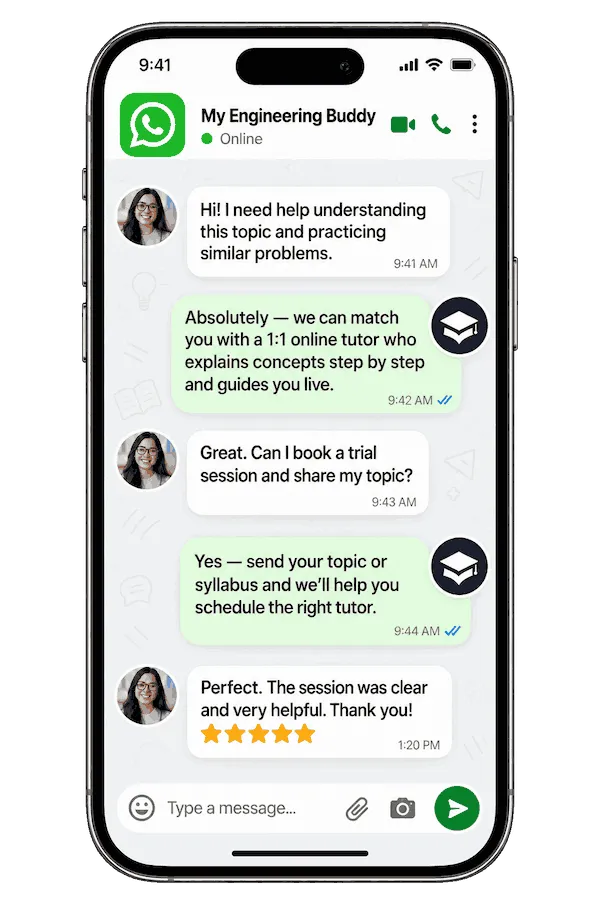
Unlike platforms where you fill out a form and wait, MEB responds in under a minute, 24/7. Tutor match takes under an hour. The $1 trial means you test before you commit. Everything runs over WhatsApp — no logins, no intake forms.
Study Plans (Pick One That Matches Your Goal)
Catch-up (1–3 weeks): for students with an aural exam or submission deadline close and clear gaps to close fast. Exam prep (4–8 weeks): structured revision covering all four assessment components in sequence, with past paper practice built into the final two weeks. Weekly support: ongoing, aligned to term dates and assessment calendars for students who want consistent progress across the full HSC year. The tutor maps the specific session sequence after the first diagnostic.
Pricing Guide
HSC Music 1 tutoring starts at $20/hr for standard syllabus support. Specialist tutors with AMEB examining or conservatoire teaching backgrounds are available at higher rates — typically $50–$100/hr — for students targeting Band 6 or preparing for auditions alongside their HSC.
Rate factors include: year level, which components need the most work, how close the exam or submission deadline is, and tutor availability during peak periods.
For students targeting entry to institutions like the Sydney Conservatorium of Music or the Queensland Conservatorium, tutors with professional performance and examining backgrounds are available at higher rates — share your goal and MEB will match the right tier.
Start with the $1 trial — 30 minutes, no registration, no commitment. WhatsApp MEB for a quick quote.
FAQ
Is HSC Music 1 hard?
It’s demanding because it assesses four distinct skills simultaneously — aural, composition, musicology, and performance. Students who play well often underestimate the written and aural components. The gap between musical ability and HSC mark is usually closed with targeted, structured practice rather than more general music study.
How many sessions are needed?
Most students see clear improvement in their weakest component within 6–8 sessions. A full Band improvement typically takes 15–20 sessions spread across 8–10 weeks. Students with a single component to fix — like musicology essays — often need fewer. The tutor sets a realistic estimate after the diagnostic.
Can you help with homework and assignments?
Yes. MEB tutoring is guided learning — you understand the work, then submit it yourself. This covers musicology essay drafts, composition portfolio annotations, and aural practice tasks. See our Academic Integrity policy and Why MEB page for full details on what we help with and what we don’t.
Will the tutor match my exact syllabus or exam board?
Yes. MEB tutors work specifically to the NESA HSC Music 1 syllabus — including the mandatory core topics, elective areas, and the current marking criteria for each assessment component. You won’t get generic music theory tutoring that misses the exam’s actual structure.
What happens in the first session?
The tutor runs a short diagnostic — usually a brief aural task, a quick composition or analysis question, and a conversation about which components you find hardest. From that, they map the session plan. You leave the first session knowing exactly where your time should go.
Is online tutoring as effective as in-person?
For HSC Music 1, yes — and in some ways better. Tutors can share scores, annotate in real time, and play audio excerpts directly in the session. Aural training, composition feedback, and essay structure work all translate cleanly to an online format with a digital pen-pad and shared screen.
Can I get HSC Music 1 help at short notice — even close to my exam?
Yes. MEB operates 24/7 and can typically match a tutor within an hour of your first WhatsApp. Students often start in the final two weeks before their HSC written exam. Availability tightens in Terms 3 and 4, so earlier contact gives you more tutor options.
What if I don’t connect with my assigned tutor?
Tell MEB via WhatsApp. A replacement is arranged without fuss. The $1 trial is designed for exactly this — you find out in the first session whether the tutor’s style suits you, before spending anything significant.
What’s the difference between HSC Music 1 and HSC Music 2, and can I get help with both?
HSC Music 1 is the broader course — accessible to a wider range of musicians and assessed across four components. HSC Music 2 is more demanding, with a heavier performance focus and higher technical expectations. MEB tutors cover both. Students moving between the two often start with HSC Music 2 tutoring support partway through the year.
How does the viva voce work, and how do tutors help with it?
The viva voce is a short oral examination where you discuss your composition choices. Many students lose marks here because they can’t articulate what they did technically. MEB tutors run mock viva voces — asking you real questions about your portfolio and coaching you to answer with specific musical vocabulary and evidence.
How do I get started?
Start with the $1 trial — 30 minutes of live 1:1 HSC Music 1 tutoring or a full explanation of one piece of work you’re stuck on. Three steps: WhatsApp MEB, get matched to a verified tutor (usually within the hour), then start your trial session.
Trust & Quality at My Engineering Buddy
Every MEB tutor goes through subject-specific screening — not a general interview. For HSC Music 1, that means verifying music qualifications, checking for direct experience with the NESA syllabus, and running a live demo evaluation before any tutor works with a student. Ongoing session feedback keeps standards in place after onboarding. Rated 4.8/5 across 40,000+ verified reviews on Google.
MEB tutoring is guided learning — you understand the work, then submit it yourself. For full details on what we help with and what we don’t, read our Academic Integrity policy and Why MEB.
MEB has served 52,000+ students across the US, UK, Canada, Australia, Gulf, and Europe since 2008 — across 2,800+ subjects. Within the HSC programme, that includes students working on HSC Visual Arts tutoring, HSC Dance help, and HSC English Advanced tutoring — all assessed creative and analytical subjects with similar written and portfolio demands to Music 1. See our tutoring methodology for how sessions are structured across subjects.
Explore Related Subjects
Students studying HSC Music 1 often also need support in:
- HSC Music Extension
- HSC English Standard
- HSC Modern History
- HSC Ancient History
- HSC Society and Culture
- HSC Personal Development
Next Steps
Before your first session, have ready: your NESA HSC Music 1 syllabus (or your school’s course outline), a recent assessment task or piece of work you struggled with — an aural test, a composition draft, or a musicology essay — and your exam or submission deadline. The tutor handles the rest.
- Share your hardest component, current timeline, and any recent assessment feedback
- Share your availability and time zone
- MEB matches you with a verified HSC Music 1 tutor — usually within an hour
The first session starts with a diagnostic so every minute is used well. Visit www.myengineeringbuddy.com for more on how MEB works.
WhatsApp to get started or email [email protected].
Try your first session for $1 — 30 minutes of live 1:1 tutoring or one homework question explained in full. No registration. No commitment. WhatsApp MEB now and get matched within the hour.
18 years. 52,000+ students. 4.8/5 on Google. MEB’s HSC Music 1 tutors are matched by syllabus, component, and timeline — not assigned by availability alone.
Source: My Engineering Buddy, 2008–2025.
Reviewed by Subject Expert
This page has been carefully reviewed and validated by our subject expert to ensure accuracy and relevance.




