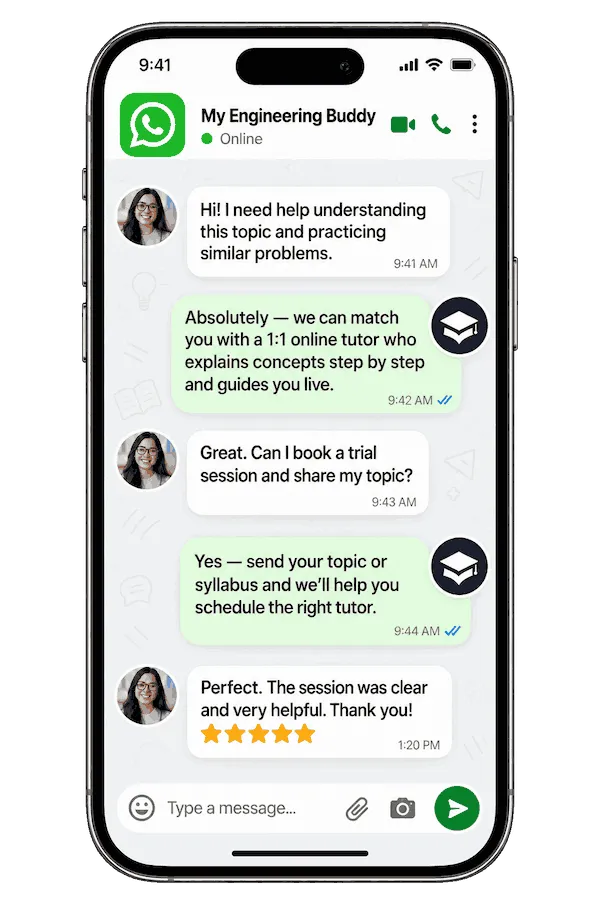
~1 min
Average Reply Time
~1 hour
To Be Matched With A Tutor
30 Min Trial
75% Find Their Tutor On The 1st Trial
$20-35+/hr
Premium Yet Affordable Learning
Most students who fail family law don’t misread the statute — they misread which jurisdiction’s rules apply and when.
Family Law Tutor Online
Family law is the branch of civil law governing marriage, divorce, child custody, adoption, domestic partnerships, and property division upon relationship breakdown — equipping students to apply statutory frameworks and case law within specific jurisdictions.
MEB provides 1:1 online tutoring and homework help in 2,800+ advanced subjects — including law and its specialist branches. If you’ve searched for a family law tutor near me and found generalists who barely distinguish equitable distribution from community property, MEB matches you with tutors who know the specific module, exam board, and jurisdiction you’re studying. One tutor, your syllabus, your timeline.
- 1:1 online sessions tailored to your exact course or syllabus
- Expert-verified tutors with family law subject knowledge at undergraduate, LLB, and graduate levels
- Flexible time zones — sessions available across the US, UK, Canada, Australia, and the Gulf
- Structured learning plan built after a diagnostic in your first session
- Ethical homework and assignment guidance — you understand the work, then submit it yourself
52,000+ students across the US, UK, Canada, Australia, and the Gulf have used MEB since 2008 — including students in Law subjects like Family Law, Constitutional Law, and Criminal Law.
Source: My Engineering Buddy, 2008–2025.
How Much Does a Family Law Tutor Cost?
Most family law tutoring sessions at MEB run $20–$40/hr depending on level and topic complexity. Graduate seminars, bar prep, and highly niche jurisdictional modules can reach $100/hr. Not sure where you fit? Start with the $1 trial and MEB will quote you from there.
| Level / Need | Typical Rate | What’s Included |
|---|---|---|
| Undergraduate / LLB (most levels) | $20–$35/hr | 1:1 sessions, assignment guidance, case analysis |
| Graduate / LLM / Specialist | $35–$70/hr | Expert tutor, jurisdictional depth, research support |
| $1 Trial | $1 flat | 30 min live session or one full homework question explained |
Tutor availability tightens significantly during exam term and dissertation submission windows. Book early if your deadline is within four weeks.
WhatsApp MEB for a quick quote — average response time under 1 minute.
Who This Family Law Tutoring Is For
Family law attracts students from LLB programmes, graduate law schools, paralegal courses, and social work degrees — and the range of difficulty varies enormously by institution and jurisdiction. If any of the following sounds like you, MEB can help.
- LLB or JD students struggling to distinguish procedural from substantive family law principles
- LLM students specialising in child law, divorce law, or cross-border custody disputes
- Students retaking a failed family law module with a resit deadline approaching
- Students with a conditional offer from a law school that depends on passing this unit
- Paralegals and social work students needing applied family law knowledge for practice
- Parents watching a child’s confidence and marks drop in their first law year
Students at institutions including Harvard Law, NYU School of Law, King’s College London, the University of Melbourne, McGill, and Utrecht have used MEB tutoring support during demanding family law modules. Need a online family law tutor who knows your exact syllabus? That’s the starting point for every MEB match.
Try the $1 trial — 30 minutes live or one question explained in full, no registration required.
1:1 Tutoring vs Self-Study vs AI vs YouTube vs Online Courses
Self-study works if you’re disciplined — but family law’s competing jurisdictional frameworks make self-diagnosis of gaps genuinely hard. AI tools give fast answers but can’t tell you why your analysis of a specific custody case lost marks. YouTube is solid for overview lectures and stops completely when you’re applying MFPA 1984 to a complex set of facts. Online courses move at a fixed pace with no room for your specific question. 1:1 tutoring with MEB puts a family law specialist in the session with you — working through your actual problem, correcting the reasoning, not just the conclusion.
Outcomes: What You’ll Be Able To Do in Family Law
After working with an MEB family law tutor, you’ll be able to analyze the grounds for divorce under your jurisdiction’s statute and apply them to a problem question without mixing up fault-based and no-fault regimes. You’ll explain the welfare principle in child custody determinations and apply it to competing parental claims. You’ll write a structured problem answer that correctly identifies which financial remedy principles apply — maintenance, property adjustment, or pension sharing — and why. You’ll present arguments on the enforceability of pre-nuptial agreements with reference to leading cases like Radmacher v Granatino in English law. And you’ll apply cross-jurisdictional conflict of laws rules to international family disputes without losing track of which court has competence.
Supporting a student through Family Law? MEB works directly with parents to set up sessions, track progress, and keep coursework on schedule. WhatsApp MEB — average response time is under a minute, 24/7.
Based on feedback from 40,000+ sessions collected by MEB from 2022 to 2025, 58% of students improved by one full grade after approximately 20 hours of 1:1 tutoring in subjects like Family Law. A further 23% achieved at least a half-grade improvement.
Source: MEB session feedback data, 2022–2025.
What We Cover in Family Law (Syllabus / Topics)

Track 1: Marriage, Civil Partnership, and Relationship Breakdown
- Formation and validity of marriage and civil partnerships
- Nullity — void and voidable marriages, grounds and bars
- Divorce law — no-fault divorce regimes (Divorce, Dissolution and Separation Act 2020), fault-based systems in other jurisdictions
- Judicial separation — when and why it applies
- Separation agreements and their enforceability
- Pre-nuptial and post-nuptial agreements — leading cases and legislative trends
- Cohabitation rights — common law myth vs legal reality
Key texts: Herring, Family Law (Pearson); Cretney’s Family Law (Sweet & Maxwell); Gillmore & Glennon, Hayes & Williams’ Family Law.
Track 2: Children — Custody, Welfare, and Public Law
- The paramountcy principle and the welfare checklist under Children Act 1989 (or equivalent)
- Parental responsibility — who holds it and how it’s acquired or lost
- Child arrangements orders, prohibited steps, and specific issue orders
- International child abduction — Hague Convention 1980
- Adoption law — domestic and intercountry frameworks
- Public law proceedings — care orders, supervision orders, threshold criteria
- Surrogacy — legal parenthood and current reform debates
Key texts: Herring, Family Law; Fortin, Children’s Rights and the Developing Law; Lowe & Douglas, Bromley’s Family Law (Oxford University Press).
Track 3: Financial Remedies and Property on Relationship Breakdown
- Section 25 Matrimonial Causes Act 1973 — the discretionary factors
- Property adjustment orders, lump sum orders, periodical payments
- Pension sharing and earmarking
- White v White and the sharing principle — needs, compensation, sharing
- TOLATA 1996 — property disputes for unmarried couples
- Constructive and resulting trusts in family property disputes
- Enforcement of financial orders across jurisdictions
Key texts: Hitchings, Miles & Sloan, Liability Family Law; Masson, Bailey-Harris & Probert, Cretney: Principles of Family Law; Brookings Institution research on family asset division trends.
At MEB, we’ve found that family law students lose the most marks not on the law itself, but on how they structure a problem answer — applying the right test, in the right order, to the right set of facts. That’s the first thing a good tutor fixes.
What a Typical Family Law Session Looks Like
The tutor opens by checking your previous topic — say, the welfare checklist from Children Act 1989 — and asks you to walk through how you applied it in the practice problem set last time. You’ll work through a new problem question together on screen: a divorce petition involving disputed financial remedies and a child arrangements dispute. The tutor uses a digital pen-pad to annotate the facts, map the relevant statute, and show where your analysis drifted from the leading case authority. You then attempt the next section of the problem while the tutor watches your reasoning in real time, stepping in when you conflate maintenance with property adjustment orders. The session closes with one targeted practice task — a structured skeleton argument on the pension-sharing issue — and a note of next week’s topic: TOLATA claims by cohabiting couples.
How MEB Tutors Help You with Family Law (The Learning Loop)
Diagnose: In the first session, the tutor asks you to talk through a recent problem question or essay. They identify whether your difficulty is with statutory interpretation, case application, problem-answer structure, or jurisdictional confusion — these are four very different problems that need four different fixes.
Explain: The tutor works through a live example using a digital pen-pad — annotating a set of facts, mapping statute to fact, and demonstrating how courts reason through competing welfare or financial considerations. You watch the analysis being built, not just the conclusion.
Practice: You attempt the next problem while the tutor is present. No waiting 48 hours for feedback. Errors get caught while the reasoning is still visible.
Feedback: The tutor shows you, step by step, exactly where marks were lost — wrong test applied, missing authority, weak application of the welfare checklist. You understand not just what was wrong but why the examiner would penalise it.
Plan: Before the session ends, the tutor maps the next two or three topics — what to revise, which cases to consolidate, and whether you need more time on private or public law. Each session feeds the next.
Sessions run on Google Meet with a digital pen-pad or iPad and Apple Pencil for annotation. Before your first session, bring your module handbook or syllabus, a problem question you’ve attempted, and your exam or submission date. The first session doubles as your diagnostic — no separate intake form needed. Start with the $1 trial — 30 minutes of live tutoring that also serves as your first diagnostic.
Students consistently tell us that the shift in family law comes when they stop memorising cases and start understanding the reasoning pattern courts use — then problem answers write themselves more quickly.
Source: MEB tutor observation, 2022–2025.
Try your first session for $1 — 30 minutes of live 1:1 tutoring or one homework question explained in full. No registration. No commitment. WhatsApp MEB now and get matched within the hour.
Tutor Match Criteria (How We Pick Your Tutor)
MEB doesn’t assign the first available tutor. The match is built around four criteria.
Subject depth: The tutor must have studied or taught family law at the level you need — LLB, LLM, or professional. A tutor who knows contract law well is not the right match for a child law seminar.
Tools: Every tutor works on Google Meet with a digital pen-pad or iPad and Apple Pencil — standard across all family law sessions for annotation, case mapping, and statute walkthroughs.
Time zone: Matched to your region. Morning in Sydney, evening in Toronto, late night in Dubai — the tutor’s schedule fits yours.
Goals: Whether you need to pass a resit, hit a first-class grade, or master a specific area like human rights law intersections with child law, the tutor is briefed on your actual objective before the first session.
Unlike platforms where you fill out a form and wait, MEB responds in under a minute, 24/7. Tutor match takes under an hour. The $1 trial means you test before you commit. Everything runs over WhatsApp — no logins, no intake forms.
Study Plans (Pick One That Matches Your Goal)
After the diagnostic, your tutor builds a session sequence specific to your timeline. A catch-up plan over one to three weeks targets the highest-yield topics before a resit — typically the welfare checklist, financial remedy discretion, and problem-answer structure. An exam prep plan over four to eight weeks works through the full syllabus with timed problem questions and essay plans under exam conditions. Weekly support through the semester keeps you ahead of seminar readings, coursework deadlines, and case consolidation. The tutor builds the specific sequence — you just need to show up with your question.
Pricing Guide
Family law tutoring starts at $20/hr for most undergraduate LLB modules. Graduate LLM work, bar prep, and specialist jurisdictional modules — including US state-specific family codes or EU cross-border family regulation — run $35–$100/hr depending on tutor background and topic depth.
Rate factors: your level, how niche the topic is, your deadline, and tutor availability. A student needing intensive support three weeks before an LLM dissertation submission will pay more than a first-year student with a full semester ahead.
For students targeting top law schools, judicial clerkships, or family law practice at firms like Withers, Mishcon de Reya, or major US family law boutiques, tutors with professional legal practice backgrounds are available at higher rates — share your specific goal and MEB will match the tier to your ambition.
Start with the $1 trial — 30 minutes, no registration, no commitment. WhatsApp MEB for a quick quote.
A common pattern our tutors observe is that students who struggle with financial remedies have the same underlying problem — they haven’t internalised the Section 25 factors as a checklist, so they apply them inconsistently under exam pressure. Two sessions on that alone changes the answer structure.
FAQ
Is family law hard?
It’s conceptually demanding because outcomes are discretionary, not formulaic. Courts balance competing factors, and examiners expect you to apply that balancing — not just recite the statute. Students who struggle usually need help with problem-answer structure more than the law itself.
How many sessions are needed?
Most students see a clear shift in their problem-answer quality within five to eight sessions. A full module revision typically takes twelve to twenty hours. Your tutor will map this after the first diagnostic based on your exam date and current level.
Can you help with homework and assignments?
Yes. MEB tutoring is guided learning — you understand the work, then submit it yourself. The tutor works through the legal analysis with you, not for you. See our Academic Integrity policy and Why MEB page for full details on what we help with and what we don’t.
Will the tutor match my exact syllabus or exam board?
Yes. Before matching, MEB asks for your institution, module code if available, and exam board or jurisdiction. An LLB student studying English family law gets a different tutor from an LLM student focused on US or EU cross-border family regulation.
What happens in the first session?
The tutor asks you to walk through a recent problem or essay. From that, they identify your specific gaps — wrong test applied, weak case application, or structural errors. The rest of the session tackles the highest-priority issue immediately.
Is online tutoring as effective as in-person?
For law subjects, yes — often more so. The tutor annotates statutes and case facts on screen in real time. You can share your written answer directly. There’s no travel time and the session can be scheduled around your deadlines, not a fixed location.
Can I get family law help at midnight?
Yes. MEB operates across time zones — tutors are available in the US, UK, Gulf, and Australia. WhatsApp MEB at any hour and you’ll typically have a response within minutes. Sessions can be booked for the same night in many cases.
What if I don’t like my assigned tutor?
Tell MEB via WhatsApp and a new match is arranged — usually within an hour. No paperwork, no dispute process. The $1 trial exists partly for this reason: you test the tutor before committing to a full session package.
What’s the difference between English family law and US family law — and does MEB cover both?
English family law is largely statute-based under the Children Act 1989 and Matrimonial Causes Act 1973, with discretionary financial remedies. US family law is state-specific — community property vs equitable distribution states differ significantly. MEB covers both, with tutors matched to your specific jurisdiction.
How do I prepare for a family law problem question in an exam?
Identify the legal issue, apply the correct test in the correct order, cite the leading authority, and reach a reasoned conclusion. Most marks are lost on steps two and three. MEB tutors drill this structure using past exam questions specific to your module and institution.
Do you offer help with family law dissertations and research essays?
Yes. MEB tutors support LLB and LLM dissertation students with legal research strategy, argument structure, and critical analysis of case law and academic literature. The student writes and submits — the tutor guides the analytical framework and identifies gaps in the argument.
How do I get started?
WhatsApp MEB, share your module or exam details, and you’re matched with a verified family law tutor — usually within 24 hours. First session starts with the $1 trial: 30 minutes live or one question explained in full. Three steps: WhatsApp → matched → start trial.
Trust & Quality at My Engineering Buddy
Every MEB tutor is screened before their first session — subject knowledge test, live demo evaluation, and ongoing feedback review from students. Family law tutors hold law degrees (LLB, LLM, JD, or equivalent) and most have professional legal practice experience. Rated 4.8/5 across 40,000+ verified reviews on Google. Tutors who consistently receive below-standard feedback don’t continue on the platform — quality isn’t set at onboarding, it’s tracked continuously. For family law specifically, we verify that the tutor has worked with the relevant jurisdiction’s statute and case law, not just general legal knowledge.
MEB tutoring is guided learning — you understand the work, then submit it yourself. For full details on what we help with and what we don’t, read our Academic Integrity policy and Why MEB.
MEB has served 52,000+ students across the US, UK, Canada, Australia, the Gulf, and Europe since 2008 — covering 2,800+ subjects. In the Law category, that includes civil law tutoring, tort law help, and property law tutoring, alongside family law. See our tutoring methodology for how sessions are structured across all subjects.
Our experience across thousands of sessions shows that law students improve fastest when they stop treating every subject as separate memorisation tasks and start seeing the shared analytical framework beneath them — family law is one of the clearest examples of this.
Source: MEB tutor observation, 2022–2025.
Students consistently tell us that once they understand how courts reason — not just what courts decided — family law stops feeling like a memory test and starts feeling like an argument to be made. That’s the point of the first session.
Explore Related Subjects
Students studying Family Law often also need support in:
- Administrative Law
- Civil Procedure
- Immigration Law
- Private International Law (Conflict of Laws)
- Jurisprudence
- Legal Theory
- Procedural Law
Next Steps
Before your first session, have ready: your exam board and syllabus (or course outline), a recent past paper attempt or problem question you struggled with, and your exam or submission deadline. The tutor handles the rest.
- Share your module, jurisdiction, and the topics giving you the most trouble
- Share your availability and time zone
- MEB matches you with a verified family law tutor — usually within 24 hours
First session starts with a diagnostic so every minute is used well. Visit www.myengineeringbuddy.com for more on how MEB works.
WhatsApp to get started or email [email protected].
Reviewed by Subject Expert
This page has been carefully reviewed and validated by our subject expert to ensure accuracy and relevance.