




~1 min
Average Reply Time
~1 hour
To Be Matched With A Tutor
30 Min Trial
75% Find Their Tutor On The 1st Trial
$20-35+/hr
Premium Yet Affordable Learning
Most students who struggle with Labour laws don’t lack intelligence — they lack a tutor who can separate the doctrine from the policy debate and show them exactly which framework applies to which fact pattern.
Labour Laws Tutor Online
Labour laws govern the legal relationship between employers, employees, and trade unions — covering employment contracts, wages, working conditions, collective bargaining, and dispute resolution across national and international regulatory frameworks.
Finding a reliable labour laws tutor near me is harder than it sounds. The subject spans statutory interpretation, case law, ILO conventions, and jurisdiction-specific codes — and most general tutors don’t go deep enough. MEB provides 1:1 online law tutoring and homework help across 2,800+ advanced subjects, including Labour laws, with tutors who know the specific course, exam board, or jurisdiction you’re working in. One session won’t fix everything, but it will show you exactly where the gaps are.
- 1:1 online sessions tailored to your exact syllabus, jurisdiction, or exam board
- Expert-verified tutors with law degrees, HR, or employment law backgrounds
- Flexible time zones — US, UK, Canada, Australia, Gulf, Europe
- Structured learning plan built after a diagnostic session
- Ethical homework and assignment guidance — you understand the work, then submit it yourself
52,000+ students across the US, UK, Canada, Australia, and the Gulf have used MEB since 2008 — including students in Law subjects like Labour laws, Employment Law, Constitutional Law, and Business Law.
Source: My Engineering Buddy, 2008–2025.
How Much Does a Labour Laws Tutor Cost?
Most students pay $20–$40/hr for Labour laws tutoring. Graduate-level and jurisdiction-specific modules (e.g. US Federal labor law, EU employment directives, UK Employment Tribunal practice) may run up to $100/hr depending on tutor expertise. The $1 trial gets you 30 minutes of live 1:1 tutoring or a full explanation of one assignment question — no registration needed.
| Level / Need | Typical Rate | What’s Included |
|---|---|---|
| Undergraduate (most levels) | $20–$35/hr | 1:1 sessions, homework guidance |
| Graduate / Specialist | $35–$100/hr | Expert tutor, jurisdiction depth |
| $1 Trial | $1 flat | 30 min live session or 1 assignment question |
Tutor availability tightens significantly during end-of-semester submission windows. Book ahead if you’re 3–4 weeks from a deadline.
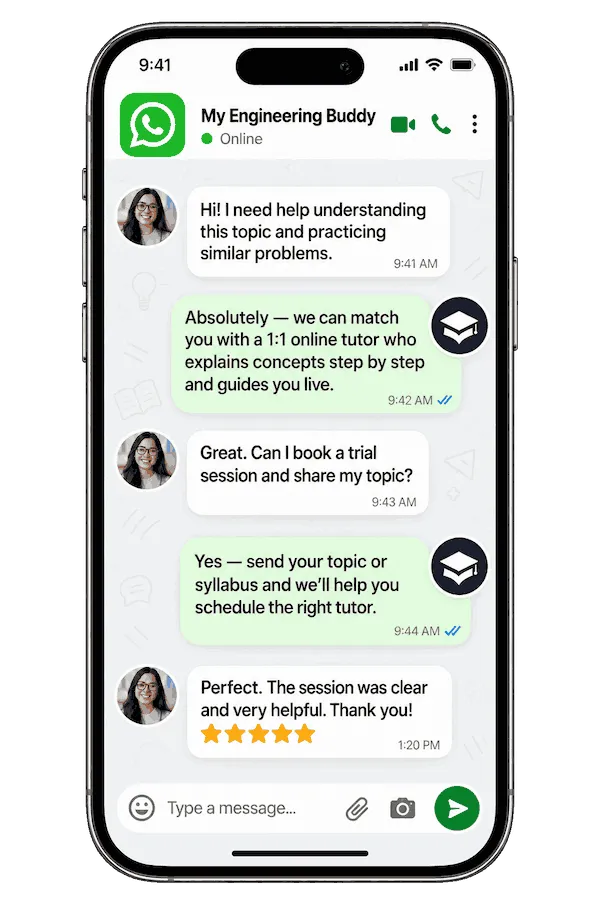
WhatsApp MEB for a quick quote — average response time under 1 minute.
Who This Labour Laws Tutoring Is For
Labour laws attracts students from law, business, HR management, and public policy — but the workload catches most of them off guard. The combination of statutory text, case law application, and policy context is genuinely difficult to hold together without guidance.
- Undergraduate law students covering employment statutes and collective bargaining modules
- MBA and HR management students needing employment law grounding for their programmes
- Students retaking after a failed first attempt at a labour law examination
- Students with a conditional university offer depending on this module’s grade
- Graduate students writing dissertations on trade union law, wage regulation, or workplace discrimination
- Students 4–6 weeks from finals with real gaps in unfair dismissal, redundancy, or ILO framework content
Students come from universities across the US, UK, Canada, and Australia — including programmes at institutions like Georgetown, King’s College London, McGill, Melbourne Law School, and NYU. If your course touches administrative law, human rights law, or tort law alongside labour law, MEB tutors can work across all of them.
1:1 Tutoring vs Self-Study vs AI vs YouTube vs Online Courses
Self-study works if you’re disciplined — but Labour laws requires you to connect statute, case law, and jurisdiction-specific context, and most students can’t see their own gaps. AI tools give fast definitions but can’t apply the right legal test to your specific fact pattern. YouTube handles overviews, not problem questions. Online courses move at a fixed pace that ignores what you specifically don’t understand. With 1:1 MEB tutoring, a labour law specialist works through your actual question, your actual exam board, and your actual confusion — in real time, correcting errors before they embed.
Outcomes: What You’ll Be Able To Do in Labour Laws
After working with an MEB labour laws tutor, students consistently report being able to apply the correct legal test to unfair dismissal and redundancy scenarios, analyse collective bargaining agreements under both national legislation and ILO conventions, explain the distinction between employee and independent contractor status across different jurisdictions, write structured problem-question answers that identify the right statute and relevant case law, and present coherent arguments on wage regulation and workplace discrimination in exam conditions. These aren’t abstract skills — they’re the exact capabilities that separate a pass from a merit on most labour law assessments.
Based on feedback from 40,000+ sessions collected by MEB from 2022 to 2025, 58% of students improved by one full grade after approximately 20 hours of 1:1 tutoring in subjects like Labour laws. A further 23% achieved at least a half-grade improvement.
Source: MEB session feedback data, 2022–2025.
At MEB, we’ve found that labour law students often arrive knowing the cases but not knowing how to apply them. The shift from recognition to application — seeing which test fits which fact pattern — usually happens within the first two or three sessions. That’s where the grade difference lives.
What We Cover in Labour Laws (Syllabus / Topics)

Employment Rights and Individual Labour Law
- Formation and terms of employment contracts
- Employee vs independent contractor classification
- Unfair dismissal: statutory tests, procedural requirements, remedies
- Redundancy law: selection criteria, consultation obligations, pay entitlements
- Discrimination in the workplace: protected characteristics, direct and indirect discrimination
- Wage regulation: minimum wage law, equal pay, unlawful deductions
- Working time regulations and rest period entitlements
Key texts: Deakin & Morris, Labour Law (Hart Publishing); Painter & Holmes, Cases and Materials on Employment Law.
Collective Labour Law and Trade Unions
- Trade union recognition: statutory procedures and voluntary agreements
- Collective bargaining: legal status, scope, enforceability of collective agreements
- Industrial action: lawful strikes, secondary action, picketing rules
- Freedom of association under ILO Conventions 87 and 98
- Works councils and employee representation in EU and comparative contexts
- Dispute resolution: conciliation, arbitration, Employment Tribunal procedure
Key texts: Ewing, Hendy & Jones, A Guide to the Trade Union Act 2016; Davies & Freedland, Kahn-Freund’s Labour and the Law.
International and Comparative Labour Law
- ILO core labour standards and their domestic implementation
- EU employment directives: Working Time, Transfer of Undertakings (TUPE), collective redundancies
- Comparative approaches: US NLRA, German co-determination, Canadian labour codes
- Gig economy and platform work regulation across jurisdictions
- Cross-border employment and applicable law questions
Key texts: Blanpain, Comparative Labour Law and Industrial Relations in Industrialized Market Economies; ILO publications on international labour standards.
The gig economy has made jurisdiction-specific labour law more contested than it has been in decades. Students who understand both the ILO framework and domestic statutory schemes are the ones equipped to analyse cases like Uber BV v Aslam — and that’s exactly the level of depth MEB tutors work at.
Source: My Engineering Buddy, tutoring methodology overview.
What a Typical Labour Laws Session Looks Like
The tutor opens by checking the previous topic — often unfair dismissal procedure or the statutory definition of a trade dispute. From there, the session moves into the specific problem: the student might be working through a fact pattern involving constructive dismissal, and the tutor walks through the legal test on screen using a digital pen-pad, annotating the Employment Rights Act sections in real time. The student then replicates the analysis for a parallel scenario — out loud, or in writing, while the tutor watches. Errors get caught immediately. The session closes with a concrete practice task: two further problem questions using the same statutory framework, with the next topic — collective bargaining enforceability — noted for the following session.
How MEB Tutors Help You with Labour Laws (The Learning Loop)
Diagnose: In the first session, the tutor identifies exactly which areas are unclear — whether that’s the statutory definition of dismissal, the correct employment status test, or how to structure a legal problem answer. Most students arrive thinking they have a general gap. Usually it’s more specific than that.
Explain: The tutor works through real problems on screen. Digital pen-pad annotation means statute sections, case holdings, and legal tests get broken down visually — not just described. Students who’ve read the same passage ten times often understand it in one session this way.
Practice: The student attempts a problem question or statutory application exercise with the tutor present. No moving on until the student can reproduce the reasoning independently.
Feedback: Error correction is step-by-step and specific — not “this is wrong” but “you’ve applied the Burchell test correctly but skipped the procedural fairness stage, which is worth marks.” That precision is what changes grades.
Plan: Next session topic is agreed. If exams are close, the tutor maps a sequence across the remaining weeks — which cases, which statutes, which exam-technique issues to address in order.
Sessions run on Google Meet. Tutors use a digital pen-pad or iPad with Apple Pencil. Before the first session, share your syllabus or module outline, a recent assignment or past paper question you struggled with, and your exam or submission date. The first session covers your biggest gap and sets the plan. Start with the $1 trial — 30 minutes of live tutoring that doubles as your first diagnostic.
Students consistently tell us that seeing a legal test broken down step-by-step on screen — annotated in real time rather than described verbally — is what makes the difference. Reading a case is not the same as knowing how to use it. MEB sessions focus on use.
Tutor Match Criteria (How We Pick Your Tutor)
Match quality is the reason this works. Here’s what the criteria look like for Labour laws specifically.
Subject depth: Tutors hold law degrees or postgraduate qualifications in employment law, HR law, or related fields — and are matched to your exact level: undergraduate module, LLM, HR certification, or professional development.
Jurisdiction fit: A student studying UK employment law needs a different tutor than one working through US NLRA doctrine or Canadian labour codes. MEB matches on jurisdiction, not just subject name.
Tools: All tutors use Google Meet with digital pen-pad or iPad + Apple Pencil for annotation — essential for working through statutory text and problem questions in real time.
Time zone: Matched to your region — US, UK, Gulf, Canada, Australia.
Goals: Whether your priority is exam technique, dissertation support, legal research skills, or understanding a specific module, the tutor is matched to that goal — not assigned generically.
Unlike platforms where you fill out a form and wait, MEB responds in under a minute, 24/7. Tutor match takes under an hour. The $1 trial means you test before you commit. Everything runs over WhatsApp — no logins, no intake forms.
Pricing Guide
Labour laws tutoring runs $20–$40/hr for most undergraduate and taught postgraduate levels. Niche modules — Employment Tribunal advocacy, cross-border employment law, advanced ILO framework — can reach $100/hr for tutors with professional practice backgrounds. Rate depends on level, topic complexity, timeline, and tutor availability.
For students targeting top LLM programmes, Bar qualifications, or HR professional certifications, tutors with actual employment law practice experience are available at higher rates — share your specific goal and MEB matches the tier to your target.
Availability tightens hard in April–May and November–December when law exam seasons overlap. Don’t wait until the week before.
Start with the $1 trial — 30 minutes, no registration, no commitment. WhatsApp MEB for a quick quote.
Labour laws sits at the intersection of statute, case law, and policy — which is exactly why students with strong general law ability still find it harder than expected. The subject rewards students who can move between all three registers fluently. That’s what MEB tutoring builds.
Source: My Engineering Buddy, tutoring methodology overview.
FAQ
Is Labour laws hard?
Yes — it combines statutory interpretation, case law application, and jurisdiction-specific policy in ways most students underestimate. The difficulty isn’t memorising cases; it’s knowing which legal test applies and how to structure an answer that uses both statute and precedent correctly.
How many sessions are needed?
Students with one or two specific gaps often see improvement in 3–5 sessions. Students preparing across a full module or revising for finals typically work over 10–20 sessions. The tutor maps a realistic plan after the first diagnostic.
Can you help with homework and assignments?
Yes. MEB tutoring is guided learning — you understand the work, then submit it yourself. See our Academic Integrity policy and Why MEB page for full details on what we help with and what we don’t.
Will the tutor match my exact syllabus or exam board?
Yes. Labour laws is taught very differently across jurisdictions and institutions. MEB matches on your specific course outline, jurisdiction (UK, US, EU, Canadian, Australian), and exam or assessment format — not just the subject name.
What happens in the first session?
The tutor reviews your syllabus or recent assignment, identifies the clearest gaps, and works through one or two specific problems with you. By the end, you’ll have a targeted plan for remaining sessions and a concrete practice task to complete before the next one.
Is online tutoring as effective as in-person?
For a text-heavy subject like Labour laws, yes — often more so. Digital pen-pad annotation of statutory text and case holdings on screen is more precise than a whiteboard. Students in the UK, US, and Gulf report no meaningful difference in learning quality versus face-to-face.
Can I get Labour laws help at midnight or on weekends?
Yes. MEB operates across time zones 24/7. Students in the Gulf, Australia, and North America regularly book sessions outside standard business hours. WhatsApp MEB and you’ll typically hear back within a minute regardless of time.
What if I don’t like my assigned tutor?
Tell MEB on WhatsApp immediately. A replacement tutor is matched — usually within a few hours. The $1 trial exists precisely so you can check the fit before committing to a full schedule.
Do I need to know which jurisdiction applies before I contact MEB?
No. Many students aren’t sure whether their course focuses on UK employment law, US federal labour law, EU directives, or comparative frameworks. Share your module outline and MEB identifies the right tutor match from there.
How does Labour laws differ from Employment Law as a separate subject?
Labour laws typically encompasses both individual employment rights and collective labour law — trade unions, industrial action, collective bargaining. Employment Law modules often focus more narrowly on the individual contract. Some programmes use the terms interchangeably. MEB tutors clarify which areas your specific course covers in the first session.
What is the ILO and why does it matter for my Labour laws course?
The International Labour Organization sets international labour standards through conventions and recommendations. Many Labour laws courses require students to understand how ILO Conventions 87 and 98 interact with domestic legislation. If your syllabus includes comparative or international content, an MEB tutor covers ILO framework alongside your national code.
How do I get started?
Start with the $1 trial — 30 minutes of live 1:1 tutoring or one assignment question fully explained. Three steps: WhatsApp MEB, get matched with a labour law tutor within the hour, and begin your trial session. No registration, no commitment required.
Trust & Quality at My Engineering Buddy
Every MEB tutor goes through subject-specific vetting — not a generic onboarding process. For Labour laws, that means verified law qualifications, demonstrated knowledge of the relevant jurisdiction and exam format, and a live demo evaluation before they take sessions. Tutors are reviewed after every session, and feedback that falls below standard triggers immediate review. Rated 4.8/5 across 40,000+ verified reviews on Google.
MEB tutoring is guided learning — you understand the work, then submit it yourself. For full details on what we help with and what we don’t, read our Academic Integrity policy and Why MEB.
MEB has served 52,000+ students across the US, UK, Canada, Australia, the Gulf, and Europe since 2008 — across 2,800+ subjects. In Law, that includes employment law tutoring, civil law help, and jurisprudence tutoring. Students who need support in adjacent areas alongside Labour laws regularly work with the same tutor across multiple modules. See our tutoring methodology for how MEB structures sessions and tutor assignments.
Try your first session for $1 — 30 minutes of live 1:1 tutoring or one homework question explained in full. No registration. No commitment. WhatsApp MEB now and get matched within the hour.
Explore Related Subjects
Students studying Labour laws often also need support in:
- Intellectual Property Law
- International Law (Public & Comparative)
- Economic and Commercial Law
- Family Law
- Immigration Law
- Criminal Law
- Procedural Law
Next Steps
Getting started takes less than five minutes. When you WhatsApp MEB, have the following ready:
- Your course outline or module syllabus (or exam board and level)
- A recent assignment, past paper question, or topic you’re stuck on
- Your exam date, submission deadline, or how many weeks you have left
MEB matches you with a verified labour laws tutor — usually within 24 hours, often within the hour. The first session opens with a diagnostic so every minute is used on the right topic. Share your time zone and availability and MEB handles the scheduling.
Visit www.myengineeringbuddy.com for more on how MEB works.
WhatsApp to get started or email [email protected].
Reviewed by Subject Expert
This page has been carefully reviewed and validated by our subject expert to ensure accuracy and relevance.




