~1 min
Average Reply Time
~1 hour
To Be Matched With A Tutor
30 Min Trial
75% Find Their Tutor On The 1st Trial
$20-35+/hr
Premium Yet Affordable Learning
Spelling rules tripped up your last assignment? An online orthography tutor fixes that — fast, and from $20/hr.
Orthography Tutor Online
Orthography is the study of the writing system of a language — its spelling conventions, letter-sound correspondences, punctuation rules, and script norms — equipping students to analyse and apply written language standards accurately.
MEB connects you with a qualified orthography tutor near me — found online, matched to your exact course level and linguistic framework. Whether you’re working through English spelling systems, analysing grapheme-phoneme correspondences, or studying script variation across languages, our linguistics tutoring team has the depth to help. Sessions run live, 1:1, over Google Meet. One outcome you can expect: measurable improvement in your ability to analyse and apply orthographic rules, without vague promises.
- 1:1 online sessions tailored to your exact course or syllabus
- Expert-vetted tutors with linguistics degrees and subject-specific knowledge
- Flexible scheduling across US, UK, Canada, Australia, and Gulf time zones
- Structured learning plan built after a diagnostic session
- Ethical academic guidance — you understand the work before you submit
52,000+ students across the US, UK, Canada, Australia, and the Gulf have used MEB since 2008 — including students in Linguistics subjects like Orthography, Phonology, and Morphology.
Source: My Engineering Buddy, 2008–2025.
How Much Does an Orthography Tutor Cost?
Rates start at $20–$40/hr for most undergraduate and postgraduate levels. Niche or advanced work runs up to $100/hr. You can start with the $1 trial — 30 minutes of live 1:1 tutoring or one homework question explained in full.
| Level / Need | Typical Rate | What’s Included |
|---|---|---|
| Standard (most levels) | $20–$35/hr | 1:1 sessions, homework guidance |
| Advanced / Specialist | $35–$70/hr | Expert tutor, niche depth |
| Graduate / Research level | Up to $100/hr | PhD-qualified tutors, thesis-level analysis |
| $1 Trial | $1 flat | 30 min live session or 1 homework question |
Tutor availability tightens during semester peaks and essay submission windows — book early if you have a firm deadline.
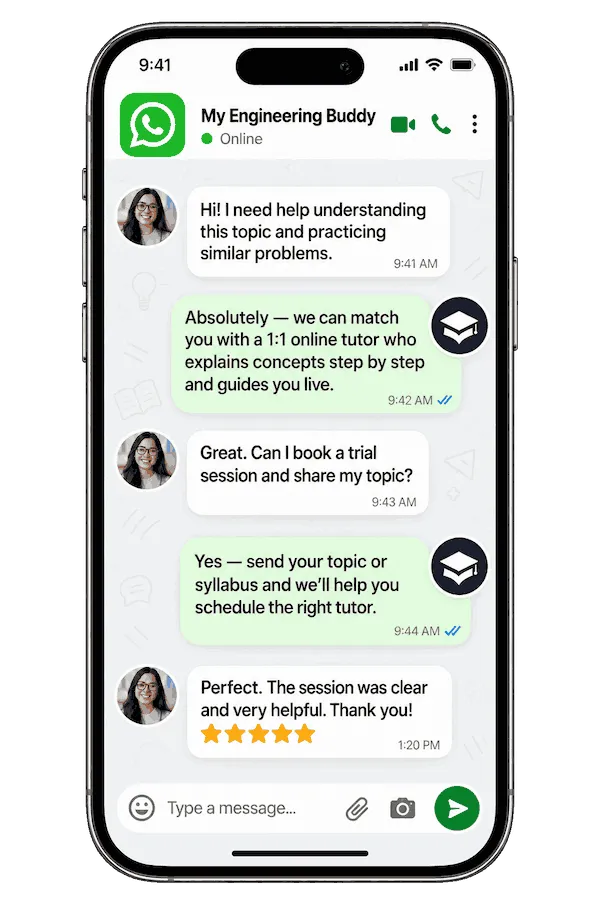
WhatsApp MEB for a quick quote — average response time under 1 minute.
Who This Orthography Tutoring Is For
Orthography sits inside linguistics programmes but causes disproportionate trouble. Students who are strong on grammar often stumble on the systematic analysis of spelling — especially when working across multiple languages or scripts.
- Undergraduates in English language, linguistics, or education programmes struggling with orthographic analysis coursework
- Graduate students writing theses on writing systems, literacy acquisition, or cross-linguistic spelling patterns
- Students retaking after a failed first attempt at a linguistics module with an orthography component
- Education students preparing to teach literacy who need to understand phonics and grapheme-phoneme mapping at a deeper level
- Students with a university conditional offer depending on passing a linguistics or language sciences module this term
- Researchers comparing orthographic depth across languages such as English, French, German, or Arabic
Students from institutions including Harvard, Oxford, University of Toronto, University of Edinburgh, UCLA, and the University of Melbourne have all worked with MEB tutors on linguistics-related coursework.
1:1 Tutoring vs Self-Study vs AI vs YouTube vs Online Courses
Self-study works if your textbook is clear and your feedback loop is tight — most orthography students find neither is true. AI tools explain definitions quickly but can’t diagnose why you keep misapplying the syllabic structure rules or confusing shallow and deep orthographies. YouTube covers introductory overviews; it stops short when you’re analysing the orthographic depth hypothesis in Finnish versus English. Online courses follow a fixed pace with no room to slow down on the parts that are actually hard for you. With MEB, a 1:1 online orthography tutor works through your exact assignment, live — spotting the error in your analysis and correcting it before it costs you marks.
Outcomes: What You’ll Be Able To Do in Orthography
After working with an MEB orthography tutor, you’ll be able to analyse grapheme-phoneme correspondence rules across English and other alphabetic systems with confidence. You’ll apply the orthographic depth hypothesis to compare transparent orthographies like Spanish or Finnish against deep systems like English or French. You’ll explain why English spelling appears irregular — and demonstrate where the system is actually consistent. You’ll write structured analyses of writing systems for assessed coursework and present script comparisons across logographic, syllabic, and alphabetic traditions with precision.
Based on feedback from 40,000+ sessions collected by MEB from 2022 to 2025, 58% of students improved by one full grade after approximately 20 hours of 1:1 tutoring in subjects like Orthography. A further 23% achieved at least a half-grade improvement.
Source: MEB session feedback data, 2022–2025.
Try your first session for $1 — 30 minutes of live 1:1 tutoring or one homework question explained in full. No registration. No commitment. WhatsApp MEB now and get matched within the hour.
What We Cover in Orthography (Syllabus / Topics)

Writing Systems and Script Typology
- Alphabetic, syllabic, and logographic writing systems — definitions and examples
- The development of Latin, Greek, Cyrillic, and Arabic scripts
- Featural systems and abjads — how consonant-dominant orthographies work
- Script reform and standardisation: historical and modern case studies
- Cross-linguistic script comparison with attention to directionality and character inventory
- Orthographic typology frameworks used in current linguistics research
Core texts for this track include Coulmas’s The Writing Systems of the World and Sampson’s Writing Systems: A Linguistic Introduction.
Grapheme-Phoneme Correspondence and Orthographic Depth
- Phoneme-grapheme mapping rules in English — regular and irregular patterns
- The orthographic depth hypothesis: shallow vs deep orthographies
- Reading acquisition differences across orthographic systems (English, German, Italian, Finnish)
- Silent letters, digraphs, and trigraphs — systematic analysis
- Spelling rules: doubling consonants, silent-e patterns, vowel teams
- Morphological consistency in English spelling: why sign and signal share a grapheme
- Cross-linguistic transfer in bilingual literacy
Recommended reading: Venezky’s The American Way of Spelling and Treiman’s research on English spelling development — widely cited in undergraduate linguistics syllabi.
Historical and Comparative Orthography
- History of English spelling: Old English, Middle English, and the Great Vowel Shift
- Spelling standardisation and the role of the printing press
- Spelling reform debates — English, German, French, and Norwegian cases
- Comparative orthography: English versus Romance language spelling systems
- Dialect spelling and non-standard orthographic conventions in sociolinguistics
- Digital orthography: text messaging, social media, and evolving norms
Key texts include Crystal’s Spell It Out: The Singular Story of English Spelling and Upward and Davidson’s The History of English Spelling.
What a Typical Orthography Session Looks Like
The tutor opens by checking how you got on with the grapheme-phoneme mapping exercise from the previous session — specifically, whether you correctly categorised the irregular correspondences in the English vowel system. From there, you and the tutor work through your current assignment on the screen together: for example, annotating a passage to identify orthographic depth markers or explaining why certain spelling patterns persist despite phonological change. The tutor uses a digital pen-pad to mark up the text live, then hands control back — you replicate the analysis on a new example while the tutor watches for the exact point where your reasoning breaks down. The session closes with a focused practice task, usually two or three unseen words or a short passage to classify before the next meeting.
How MEB Tutors Help You with Orthography (The Learning Loop)
Diagnose: In the first session, the tutor identifies exactly where your orthographic analysis breaks down — whether that’s misapplying the depth hypothesis, confusing grapheme and phoneme counts, or struggling with historical spelling change explanations.
Explain: The tutor works through live examples using a digital pen-pad on Google Meet — annotating actual words from your coursework, marking correspondences, and tracing the morphological logic behind apparently irregular spellings.
Practice: You attempt the next set of examples while the tutor is present. No working ahead and checking answers later — the correction happens in the moment, before the wrong approach becomes habit.
Feedback: The tutor explains why each error occurred — not just what the right answer is. If you lost marks on an essay, the tutor traces which analytical step was missing and how to fix it in the next draft.
Plan: Each session ends with a clear next topic and a practice task tied to your actual assignment or exam date. The plan shifts as your gaps close.
All sessions run on Google Meet with a digital pen-pad or iPad and Apple Pencil for annotation. Before your first session, share your course outline, a recent assignment you struggled with, and your submission or exam date. The first session runs as a diagnostic — every minute goes toward understanding your specific gaps. Start with the $1 trial — 30 minutes of live tutoring that also serves as your first diagnostic.
At MEB, we’ve found that orthography students often know the rule but can’t apply it to an unseen word under exam conditions. The gap isn’t knowledge — it’s pattern recognition, and that only closes through repeated practice with immediate feedback, not re-reading the textbook chapter.
Tutor Match Criteria (How We Pick Your Tutor)
Match quality determines whether the sessions actually work. MEB matches on four criteria.
Subject depth: The tutor holds a linguistics degree at or above your course level, with specific experience in orthographic analysis, writing systems, or phonics — not just general language teaching.
Tools: Every tutor works on Google Meet with a digital pen-pad or iPad and Apple Pencil. Written annotation of orthographic examples is central to how the subject is taught.
Time zone: Matched to your region — US, UK, Gulf, Canada, or Australia. Evening and weekend slots available.
Goals: Whether you need to pass a specific module, improve your essay-level analysis, or build the conceptual depth needed for a linguistics dissertation, the tutor is selected for that outcome — not assigned randomly from a pool.
Unlike platforms where you fill out a form and wait, MEB responds in under a minute, 24/7. Tutor match takes under an hour. The $1 trial means you test before you commit. Everything runs over WhatsApp — no logins, no intake forms.
Study Plans (Pick One That Matches Your Goal)
The tutor builds your specific session sequence after the diagnostic, but most orthography students fall into one of three patterns. Catch-up (1–3 weeks): targeted work on the topics causing the most damage to your assignment marks, fast. Exam prep (4–8 weeks): structured revision across all orthographic topics on your syllabus, with past-paper analysis built in. Weekly support: ongoing sessions tied to your semester deadlines, so coursework is never left to the last 48 hours. Share your deadline when you message MEB and the tutor maps the plan from there.
Pricing Guide
Most orthography tutoring sessions run at $20–$40/hr. Graduate-level work — dissertation support, cross-linguistic script analysis at a research level — goes up to $100/hr. Rate depends on the level of the course, topic complexity, your timeline, and tutor availability.
For students targeting postgraduate linguistics programmes at institutions like UCL, Edinburgh, Georgetown, or the University of Amsterdam, tutors with academic research backgrounds in writing systems and literacy are available at higher rates — share your specific goal and MEB will match the tier to your ambition.
Availability tightens at semester end and during assessment windows. Start with the $1 trial — 30 minutes, no registration, no commitment. WhatsApp MEB for a quick quote.
Students consistently tell us that the first session feels different from anything they’ve tried before — not because it’s a lecture, but because the tutor is watching them work in real time and correcting the exact mistake, not a hypothetical version of it.
FAQ
Is orthography hard?
It depends on your background. If you’re coming from a phonology or phonetics course, the grapheme-phoneme framework will feel familiar. If you’re new to linguistic analysis, the systematic logic behind English spelling can take several sessions to click into place. It’s learnable — with the right approach.
How many sessions are needed?
Most students see a clear improvement in their orthographic analysis after 6–10 hours of 1:1 work. Students covering the full writing systems curriculum over a semester typically continue for 15–20 hours. The diagnostic session clarifies what’s realistic for your specific gaps and timeline.
Can you help with homework and assignments?
Yes. MEB tutoring is guided learning — you understand the work, then submit it yourself. The tutor explains the orthographic concepts, walks through the analytical method, and checks your reasoning. See our Academic Integrity policy and Why MEB page for full details on what we help with and what we don’t.
Will the tutor match my exact syllabus or exam board?
Yes. Share your course outline, module handbook, or reading list when you message MEB. The tutor is matched to your specific programme — whether that’s an English language A Level, a university linguistics module, or a graduate course in literacy and writing systems.
What happens in the first session?
The tutor runs a diagnostic — asking you to work through an orthographic analysis task live. This identifies where your reasoning is solid and where it breaks down. The session plan for subsequent meetings is built from that, not from a generic syllabus template.
Is online tutoring as effective as in-person?
For orthography, yes — and in some ways better. The digital pen-pad annotation on Google Meet lets the tutor mark up words, syllable boundaries, and grapheme boundaries directly on screen. Students report it’s clearer than whiteboard sessions in person, particularly for detailed phoneme-grapheme mapping work.
Can I get orthography help at midnight or on weekends?
Yes. MEB operates across multiple time zones and tutors are available evenings, weekends, and late nights depending on your region. WhatsApp MEB at any hour — the average response time is under a minute. Sessions are booked directly around your schedule.
What if my orthography tutor isn’t the right fit?
Tell MEB. Tutor rematch is straightforward — no lengthy process, no forms. The $1 trial exists partly for this reason: you test the match before committing to a full rate. If the fit isn’t right after the trial, MEB reassigns quickly.
Do you cover orthography in languages other than English?
Yes. MEB tutors cover orthographic analysis in French, German, Spanish, Arabic, and other languages with documented writing systems. Cross-linguistic comparison coursework — such as comparing orthographic depth across English and Finnish — is a common request. Share the specific languages in your coursework when you message.
What is the difference between orthography and phonology, and does MEB cover both?
Orthography studies the written system — spelling rules, graphemes, and script conventions. Phonology tutoring focuses on sound systems and phonological rules. They overlap in grapheme-phoneme correspondence work. MEB covers both individually and together for students whose coursework spans both areas.
How do I get started?
Start with the $1 trial — 30 minutes of live 1:1 tutoring or one homework question explained in full. Three steps: WhatsApp MEB, get matched with an orthography tutor within the hour, and begin your trial session. No registration, no upfront commitment beyond $1.
Is orthography relevant if I want to teach reading or work in speech-language pathology?
Directly, yes. Orthographic knowledge underpins phonics instruction, literacy intervention, and dyslexia assessment. Students training as teachers or speech-language therapists at institutions including the University of Toronto, UCL, and the University of Sydney regularly use MEB for orthography support tied to their professional placement requirements.
Trust & Quality at My Engineering Buddy
Every MEB tutor goes through subject-specific screening — a live demo session evaluated by senior staff, verification of degree credentials, and ongoing review based on student feedback. Rated 4.8/5 across 40,000+ verified reviews on Google. Tutors teaching orthography hold linguistics degrees at postgraduate level or above and are vetted specifically for their knowledge of writing systems, grapheme-phoneme correspondence, and cross-linguistic analysis — not just general language competence.
MEB tutoring is guided learning — you understand the work, then submit it yourself. For full details on what we help with and what we don’t, read our Academic Integrity policy and Why MEB.
MEB has served 52,000+ students in 2,800+ subjects across the US, UK, Canada, Australia, the Gulf, and Europe since 2008. Linguistics is one of our strongest subject families — students come to us for Phonetics tutoring, Pragmatics help, and Semantics tutoring alongside orthography, often in the same semester. The tutoring methodology we use — diagnostic first, then structured 1:1 progression — is documented at our tutoring methodology page.
A common pattern our tutors observe is that students who struggle with orthography have never been shown the internal logic of the spelling system — they were taught to memorise, not to analyse. One session spent on the morphological consistency principle changes how they see the entire subject.
Explore Related Subjects
Students studying Orthography often also need support in:
- Applied Linguistics
- Bilingualism
- Computational Linguistics
- Discourse Analysis
- Historical Linguistics
- Psycholinguistics
- Sociolinguistics
- Syntax
Next Steps
When you message MEB, share your exam board or course outline, the component you’re finding hardest, and how much time you have before your deadline. Include your time zone and availability.
MEB matches you with a verified orthography tutor — usually within 24 hours, often faster. The first session runs as a diagnostic so every minute goes toward closing the right gaps.
Before your first session, have ready:
- Your course syllabus or module handbook
- A recent assignment or homework question you struggled with
- Your exam or submission date
The tutor handles the rest. Visit www.myengineeringbuddy.com for more on how MEB works.
WhatsApp to get started or email [email protected].
Reviewed by Subject Expert
This page has been carefully reviewed and validated by our subject expert to ensure accuracy and relevance.