




~1 min
Average Reply Time
~1 hour
To Be Matched With A Tutor
30 Min Trial
75% Find Their Tutor On The 1st Trial
$20-35+/hr
Premium Yet Affordable Learning
Most students who struggle with Pragmatics don’t lack intelligence — they lack a tutor who can show them exactly where their analysis of meaning breaks down.
Pragmatics Tutor Online
Pragmatics is the study of how context shapes meaning in language use — covering speech acts, implicature, deixis, and conversational principles. It equips students to analyse what speakers mean beyond the literal words used.
If you’re searching for a Pragmatics tutor near me, MEB connects you with a verified linguistics tutor who knows your exact syllabus — whether that’s an undergraduate linguistics module, a graduate seminar, or an applied language programme. Sessions are live, 1:1, and built around your specific gaps. You walk away understanding the material, not just copying an answer.
- 1:1 online sessions tailored to your course syllabus and exam board
- Expert verified tutors with subject-specific linguistics backgrounds
- Flexible time zones — US, UK, Canada, Australia, Gulf
- Structured learning plan built after a diagnostic session
- Ethical academic guidance — you understand before you submit
52,000+ students across the US, UK, Canada, Australia, and the Gulf have used MEB since 2008 — including students in Linguistics subjects like Pragmatics, Semantics, and Discourse Analysis.
Source: My Engineering Buddy, 2008–2025.
How Much Does a Pragmatics Tutor Cost?
Most Pragmatics sessions run $20–$40/hr. Graduate-level or specialist applied linguistics tutoring can reach $100/hr. Not sure where you fall? Start with the $1 trial — 30 minutes of live 1:1 tutoring or one homework question explained in full.
| Level / Need | Typical Rate | What’s Included |
|---|---|---|
| Standard (most undergrad levels) | $20–$35/hr | 1:1 sessions, homework guidance |
| Advanced / Graduate-level | $35–$70/hr | Expert tutor, niche depth, research support |
| $1 Trial | $1 flat | 30 min live session or 1 homework question |
Availability tightens during end-of-semester submission windows. If you have a deadline approaching, reach out early.
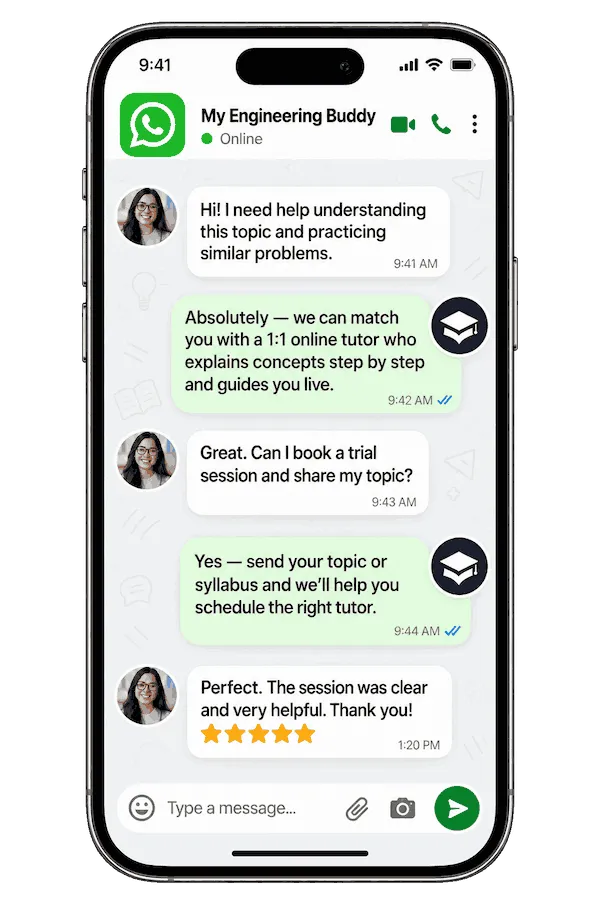
WhatsApp MEB for a quick quote — average response time under 1 minute.
Who This Pragmatics Tutoring Is For
Pragmatics sits at an awkward intersection — it draws on philosophy of language, cognitive science, and linguistics all at once. Students often do fine on grammar and phonology, then hit a wall when meaning becomes context-dependent. This tutoring is for anyone who has hit that wall.
- Undergraduate linguistics students struggling with Gricean maxims, speech act theory, or relevance theory
- Graduate students writing dissertations involving conversation analysis or cross-cultural pragmatics
- Students with a university conditional offer depending on this grade
- TESOL and applied linguistics students who need pragmatics for their teaching certification coursework
- Students returning after a failed first attempt at a pragmatics module
- Parents watching a child’s confidence drop alongside their grades in a linguistics programme
MEB has worked with students at universities including UCLA, University of Edinburgh, University of Toronto, Macquarie University, Utrecht University, and the American University of Sharjah — as well as students progressing toward postgraduate linguistics programmes at institutions like UCL and Georgetown.
1:1 Tutoring vs Self-Study vs AI vs YouTube vs Online Courses
Self-study works if you’re disciplined, but pragmatics analysis requires feedback — you won’t know your implicature reasoning is circular until someone points it out. AI tools give fast definitions but can’t catch the flaw in your speech act categorisation live. YouTube covers Grice’s maxims in broad strokes and stops there. Online courses move at a fixed pace regardless of whether you’ve actually understood relevance theory. With a 1:1 Pragmatics tutor online from MEB, sessions adapt in real time — your tutor identifies the exact point where your analysis of context breaks down and corrects it before it becomes a habit.
Outcomes: What You’ll Be Able To Do in Pragmatics
After consistent 1:1 sessions, you’ll be able to analyse speech acts — direct, indirect, and failed — using Austin and Searle’s frameworks with precision. You’ll apply Grice’s Cooperative Principle and the four maxims to real conversational data without second-guessing yourself. You’ll explain implicature, presupposition, and deixis in essay answers that go beyond surface definitions. You’ll present cross-cultural pragmatic variation with supporting evidence rather than vague generalisations.
Supporting a student through Pragmatics? MEB works directly with parents to set up sessions, track progress, and keep coursework on schedule. WhatsApp MEB — average response time is under a minute, 24/7.
Based on feedback from 40,000+ sessions collected by MEB from 2022 to 2025, 58% of students improved by one full grade after approximately 20 hours of 1:1 tutoring in subjects like Pragmatics. A further 23% achieved at least a half-grade improvement.
Source: MEB session feedback data, 2022–2025.
What We Cover in Pragmatics (Syllabus / Topics)

Core Pragmatic Theory
- Speech act theory — Austin’s performatives, Searle’s taxonomy of illocutionary acts
- Grice’s Cooperative Principle and the four conversational maxims
- Relevance Theory (Sperber and Wilson) — cognitive effects and processing effort
- Conversational implicature — scalar, particularised, and generalised
- Presupposition and entailment — how background assumptions operate in discourse
- Deixis — person, place, time, and discourse deixis with real data examples
Key texts: Yule’s Pragmatics (Oxford Introductions to Language Study); Levinson’s Pragmatics (Cambridge Textbooks in Linguistics); Sperber and Wilson’s Relevance.
Discourse and Interaction
- Conversation analysis — turn-taking, adjacency pairs, repair sequences
- Politeness theory — Brown and Levinson’s face-threatening acts and strategies
- Discourse markers and their pragmatic functions
- Indirect speech acts and how context disambiguates them
- Interactional pragmatics — how meaning is co-constructed across turns
- Discourse analysis connections — how pragmatics and text analysis overlap
Key texts: Yule’s The Study of Language; Thomas’s Meaning in Interaction; Cutting’s Pragmatics and Discourse.
Applied and Cross-Cultural Pragmatics
- Cross-cultural and interlanguage pragmatics — how pragmatic norms vary across languages
- Pragmatic failure — types, causes, and how to identify them in learner data
- Pragmatics in second language acquisition and TESOL contexts
- Research methods in pragmatics — discourse completion tasks, role plays, corpus data
- Connections to applied linguistics tutoring and language teaching methodology
Key texts: Blum-Kulka, House and Kasper’s Cross-Cultural Pragmatics; Bardovi-Harlig’s work on interlanguage pragmatics; Kasper and Rose’s Pragmatic Development in a Second Language.
At MEB, we’ve found that Pragmatics clicks fastest when students stop treating it as abstract theory and start applying it to actual transcripts — even short ones. A two-minute conversation excerpt reveals more about speech act sequencing than reading three textbook chapters alone.
What a Typical Pragmatics Session Looks Like
The session opens with a quick check on the previous topic — usually implicature or a speech act taxonomy question the student found slippery. The tutor pulls up a short conversation transcript on screen and walks through it line by line, asking the student to identify illocutionary force, flouted maxims, or presuppositions as they appear. When the student’s reasoning stalls — say, confusing indirect speech acts with politeness strategies — the tutor pauses, draws the distinction on a digital pen-pad, and asks the student to re-apply it to the same data. The session closes with a specific excerpt or past-paper question set for independent practice, and the next topic — usually deixis or cross-cultural pragmatic failure — is noted for next time.
How MEB Tutors Help You with Pragmatics (The Learning Loop)
Diagnose: In the first session, the tutor identifies where the breakdown actually is — whether you’re confusing implicature with entailment, misapplying maxim violation categories, or writing essay answers that describe rather than analyse. Most students arrive thinking the problem is broader than it is.
Explain: The tutor works through live examples using a digital pen-pad — annotating real conversational data, marking up speech act sequences, and showing the reasoning step by step. No slides. No passive listening.
Practice: You attempt the next example while the tutor watches. This is where the real work happens. Errors surface immediately instead of at marking time.
Feedback: The tutor steps through your reasoning error by error — not just the wrong answer, but the exact point where the logic broke. For essay-based pragmatics work, that means line-level annotation on your argument structure.
Plan: Each session ends with a specific task and a clear next topic. Progress is tracked across sessions. If you’re six weeks from submission, the tutor maps backwards from your deadline.
Sessions run on Google Meet. The tutor uses a digital pen-pad or iPad with Apple Pencil for live annotation. Before your first session, have your course outline or module guide ready, a recent essay or assignment you struggled with, and your submission or exam date. The first session covers diagnosis and builds the session plan from there. Whether you need a quick catch-up before an essay deadline, structured revision over four to eight weeks, or ongoing weekly support through the semester, the tutor maps the sequence after the diagnostic.
Start with the $1 trial — 30 minutes of live tutoring that also serves as your first diagnostic.
Try your first session for $1 — 30 minutes of live 1:1 tutoring or one homework question explained in full. No registration. No commitment. WhatsApp MEB now and get matched within the hour.
Tutor Match Criteria (How We Pick Your Tutor)
Not every linguistics graduate can teach pragmatics well. MEB matches on four criteria.
Subject depth: Tutors hold postgraduate degrees in linguistics, applied linguistics, or language science — with demonstrable coursework or research in pragmatic theory, not just general language study.
Tools: Every tutor uses Google Meet with a digital pen-pad or iPad and Apple Pencil. Live annotation on transcripts and essay drafts is non-negotiable.
Time zone: Matched to your region — US, UK, Gulf, Canada, or Australia — so sessions don’t require a 6am alarm.
Goals: Whether your target is a specific essay grade, a solid pass in a pragmatics module, or research support for a dissertation on interlanguage pragmatics, the match accounts for that from the start.
Unlike platforms where you fill out a form and wait, MEB responds in under a minute, 24/7. Tutor match takes under an hour. The $1 trial means you test before you commit. Everything runs over WhatsApp — no logins, no intake forms.
Study Plans (Pick One That Matches Your Goal)
After the diagnostic, your tutor builds the session sequence. Catch-up (one to three weeks): for students behind on a specific topic — implicature, deixis, or speech act analysis — before an essay submission. Exam prep (four to eight weeks): structured revision through the full pragmatics syllabus with past-paper practice and timed answer technique. Weekly support: ongoing sessions aligned to your module schedule, with homework guidance built in as each topic arrives. The tutor sets the specific sequence; you bring your current work.
Pricing Guide
Pragmatics tutoring starts at $20/hr for standard undergraduate modules. Graduate-level and dissertation-support sessions — particularly for cross-cultural pragmatics or interlanguage pragmatics research — run $40–$100/hr depending on the tutor’s research background and your timeline.
Rate factors include your level, the complexity of the topics, how close your deadline is, and tutor availability. Spots fill fast during end-of-semester periods at US and UK universities.
For students targeting competitive postgraduate programmes in linguistics at institutions like UCL, Georgetown, or Edinburgh, tutors with active research backgrounds in pragmatics are available at higher rates — share your specific goal and MEB will match the tier to your ambition.
Start with the $1 trial — 30 minutes, no registration, no commitment. WhatsApp MEB for a quick quote.
MEB has covered Linguistics subjects — including Sociolinguistics, Psycholinguistics, and Pragmatics — for students across four continents since 2008. The subject breadth is 2,800+ and growing.
Source: My Engineering Buddy, 2008–2025.
FAQ
Is Pragmatics hard?
It’s conceptually demanding rather than technically complex. The challenge is that meaning becomes context-dependent — there’s no formula. Students who struggle usually need more practice applying theory to real data, not more reading. That’s exactly what 1:1 sessions fix.
How many sessions are needed?
Most students see clear improvement in three to five sessions. Closing a significant gap across a full pragmatics syllabus — speech acts, implicature, deixis, politeness — typically takes ten to fifteen sessions over four to six weeks. The first diagnostic sets the exact plan.
Can you help with homework and assignments?
Yes. MEB tutoring is guided learning — you understand the work, then submit it yourself. If you’re stuck on an essay question about Gricean maxims or a data analysis task, the tutor explains the approach and reasoning. See our Academic Integrity policy and Why MEB page for full details on what we help with and what we don’t.
Will the tutor match my exact syllabus or exam board?
Yes. Before matching, MEB asks for your course outline, module code, or exam board. Tutors are matched to your specific syllabus — whether that’s a UK undergraduate module, a North American graduate course, or an applied linguistics programme in the Gulf.
What happens in the first session?
The tutor runs a short diagnostic — usually a transcript analysis or a past essay question — to identify where your reasoning breaks down. From there, the session plan is set. No time is wasted on topics you already understand. The $1 trial covers this first diagnostic session in full.
Is online tutoring as effective as in-person?
For Pragmatics, yes — and arguably better. Transcript analysis, essay annotation, and worked examples on a shared screen with a digital pen-pad replicate exactly what a face-to-face whiteboard session does. Most MEB students never request in-person alternatives after the first session.
What’s the difference between Pragmatics and Semantics — and can you help with both?
Semantics covers literal, context-independent meaning — what words and sentences mean in isolation. Pragmatics covers what speakers mean in context — including implicature, speech acts, and presupposition. Many students need both. MEB tutors cover Semantics tutoring alongside Pragmatics within the same session block if needed.
How do Grice’s maxims actually appear in assessments — and what do markers want?
Most pragmatics assessments want evidence of application, not recitation. Naming the maxim is worth little; showing precisely how a speaker flouts it and what implicature results is what earns marks. Tutors walk through past-paper examples and annotate real transcripts so you see what a top-band answer looks like versus a mid-band one.
Can I get Pragmatics help at midnight?
Yes. MEB operates 24/7 across time zones. WhatsApp MEB at any hour — average response time is under one minute. Tutors are available across US, UK, Gulf, and Australian time zones, so a midnight message in Toronto or Dubai gets a fast reply.
Do you offer group Pragmatics sessions?
MEB’s model is strictly 1:1. Group sessions dilute the diagnostic precision that makes pragmatics tutoring work — you can’t catch one student’s specific implicature reasoning error in a group of five. Every session is built around your data, your essay, your gaps.
How do I get started?
Three steps: WhatsApp MEB with your course details and current challenge — matched to a verified Pragmatics tutor usually within the hour — then start the $1 trial: 30 minutes of live tutoring or one assignment question explained in full. No registration required.
Can a Pragmatics tutor help with dissertation or thesis chapters on interlanguage pragmatics?
Yes. MEB has tutors with postgraduate research backgrounds in interlanguage and cross-cultural pragmatics. Support covers research design, data analysis using discourse completion tasks or role-play corpora, and chapter-level feedback on argument structure and theory application. Share your specific chapter focus when you WhatsApp.
Trust & Quality at My Engineering Buddy
Every MEB tutor completes a multi-stage screening process — subject knowledge assessment, a live demo session evaluated by a senior tutor, and ongoing feedback review from students. Pragmatics tutors hold postgraduate degrees in linguistics or related fields and demonstrate specific competency in the areas they teach. Rated 4.8/5 across 40,000+ verified reviews on Google.
MEB tutoring is guided learning — you understand the work, then submit it yourself. For full details on what we help with and what we don’t, read our Academic Integrity policy and Why MEB.
MEB has served 52,000+ students across the US, UK, Canada, Australia, the Gulf, and Europe since 2008 — across 2,800+ subjects. In Linguistics, that includes Pragmatics, Computational Linguistics tutoring, and Phonology help, among many others. For more on how tutors are selected and sessions are structured, see our tutoring methodology.
Students consistently tell us that the biggest shift in Pragmatics comes not from reading more theory, but from having someone interrupt their reasoning mid-analysis and show exactly where the logic slipped. That’s what 1:1 sessions are built for.
Explore Related Subjects
Students studying Pragmatics often also need support in:
Next Steps
Ready to get started? Here’s what to do:
- Share your module code, course level, and hardest topic — implicature, speech acts, or something else
- Share your time zone and availability — sessions run across US, UK, Gulf, Canada, and Australian hours
- MEB matches you with a verified Pragmatics tutor, usually within 24 hours
- First session starts with a diagnostic so every minute is used well
Before your first session, have ready:
- Your syllabus or module guide (or a course outline from your university)
- A recent essay, past-paper attempt, or homework question you struggled with
- Your submission or exam deadline date — the tutor builds the plan from there
Visit www.myengineeringbuddy.com for more on how MEB works.
WhatsApp to get started or email [email protected].
Reviewed by Subject Expert
This page has been carefully reviewed and validated by our subject expert to ensure accuracy and relevance.




