




~1 min
Average Reply Time
~1 hour
To Be Matched With A Tutor
30 Min Trial
75% Find Their Tutor On The 1st Trial
$20-35+/hr
Premium Yet Affordable Learning
Most students don’t fail Psycholinguistics because the subject is too hard. They fail because nobody has ever explained how language processing actually works — step by step, in real time, in their own course material.
Psycholinguistics Tutor Online
Psycholinguistics is the scientific study of how the human mind acquires, processes, produces, and represents language, drawing on cognitive psychology and linguistic theory to explain reading, speech, and comprehension.
MEB offers 1:1 online tutoring and academic guidance in 2,800+ advanced subjects, including Linguistics and its specialist branches. If you’ve searched for a Psycholinguistics tutor near me and found mostly generalists, MEB is different — tutors are matched to your exact course, university level, and the specific models or frameworks your syllabus uses. One session can shift a student from confused to genuinely capable.
- 1:1 online sessions tailored to your course outline and reading list
- Expert-verified tutors with graduate-level knowledge in Psycholinguistics
- Flexible time zones — US, UK, Canada, Australia, Gulf
- Structured learning plan built after a diagnostic session
- Ethical academic guidance — you understand the work, then submit it yourself
52,000+ students across the US, UK, Canada, Australia, and the Gulf have used MEB since 2008 — including students in Linguistics subjects like Psycholinguistics, Applied Linguistics, and Discourse Analysis.
Source: My Engineering Buddy, 2008–2025.
How Much Does a Psycholinguistics Tutor Cost?
Most Psycholinguistics tutoring sessions run $20–$40/hr depending on level and topic complexity. Graduate and research-level support can reach up to $100/hr. Not sure yet? Start with the $1 trial — 30 minutes of live 1:1 tutoring, no registration required.
| Level / Need | Typical Rate | What’s Included |
|---|---|---|
| Undergraduate (introductory) | $20–$35/hr | 1:1 sessions, assignment guidance |
| Advanced / Graduate | $35–$70/hr | Expert tutor, thesis and research support |
| $1 Trial | $1 flat | 30 min live session or 1 homework question explained |
Tutor availability tightens sharply around end-of-semester submission windows. Book early if you have a deadline coming up.
WhatsApp MEB for a quick quote — average response time under 1 minute.
Who This Psycholinguistics Tutoring Is For
This is for students who need more than a textbook definition of priming or a lecture slide on the TRACE model. It’s for anyone who has read the chapter twice and still can’t explain why it matters for their essay or exam answer.
- Undergraduates in Linguistics, Cognitive Science, Psychology, or Speech Pathology taking a Psycholinguistics module
- Graduate students working on theses involving language acquisition, bilingual processing, or reading disorders
- Students retaking after a failed first attempt who need the foundational models explained differently
- Students with a university conditional offer depending on this grade — you can’t afford a second miss
- Researchers needing help interpreting experimental data from eye-tracking, ERP, or reaction-time studies
- Students at universities including Stanford, UCL, Edinburgh, McGill, Melbourne, Amsterdam, and Toronto who need tutor support outside office hours
The $1 trial is a low-risk way to test whether MEB’s approach fits your level before committing to regular sessions.
1:1 Tutoring vs Self-Study vs AI vs YouTube vs Online Courses
Self-study works if you’re disciplined — but Psycholinguistics requires you to apply competing theoretical models, and a textbook won’t tell you which one your marker prefers. AI tools give fast definitions of garden-path sentences or the cohort model, but they can’t spot where your argument breaks down or why your experiment design has a confound. YouTube covers the basics of language acquisition reasonably well but stops when you need to critique a specific study design. Online courses are structured but fixed-pace — they don’t adjust when you’re stuck on sentence parsing versus semantic integration. 1:1 tutoring with MEB is live, adapted to your exact reading list, and corrects your reasoning in the moment — not after you’ve already submitted.
Outcomes: What You’ll Be Able To Do in Psycholinguistics
After focused 1:1 sessions, you’ll be able to explain and apply the core processing models — including the cohort model, TRACE, and interactive activation — with enough precision to use them in exam answers and essays. You’ll analyze experimental evidence from reaction-time and eye-tracking studies without misreading the methodology. You’ll write clearly about language acquisition debates, including nativist versus usage-based accounts, at the level your course requires. You’ll apply knowledge of reading disorders such as surface and phonological dyslexia to clinical and educational scenarios. You’ll present arguments about bilingual lexical access that hold up under the kind of critical scrutiny a graduate marker expects.
Based on feedback from 40,000+ sessions collected by MEB from 2022 to 2025, 58% of students improved by one full grade after approximately 20 hours of 1:1 tutoring in subjects like Psycholinguistics. A further 23% achieved at least a half-grade improvement.
Source: MEB session feedback data, 2022–2025.
Try your first session for $1 — 30 minutes of live 1:1 tutoring or one homework question explained in full. No registration. No commitment. WhatsApp MEB now and get matched within the hour.
What We Cover in Psycholinguistics (Syllabus / Topics)

Language Processing and Comprehension
- Lexical access: the cohort model, TRACE model, and interactive activation
- Sentence parsing: garden-path sentences, syntax-first versus constraint-based models
- Semantic integration and context effects in real-time comprehension
- Discourse processing: anaphora resolution, inference, and coherence building
- Eye-tracking and self-paced reading paradigms — how to read and report the data
- Priming: semantic, syntactic, and structural priming evidence and what it tells us
Core texts include Harley’s The Psychology of Language, Traxler’s Introduction to Psycholinguistics, and Seidenberg’s Language at the Speed of Sight.
Language Acquisition
- First language acquisition: stages, milestones, and theoretical accounts
- Nativist approaches: Universal Grammar, poverty of the stimulus argument
- Usage-based and constructivist accounts: Tomasello and emergentist models
- Critical period hypothesis: evidence from feral children, late signers, and L2 research
- Bilingual acquisition: simultaneous versus sequential, code-switching, and the bilingual advantage debate
- Developmental language disorders: specific language impairment versus delay
Key readings include Pinker’s The Language Instinct, Tomasello’s Constructing a Language, and Bialystok’s work on bilingualism and executive function.
Reading, Disorders, and Neurolinguistics
- The dual-route model of reading: lexical versus sublexical pathways
- Surface dyslexia, phonological dyslexia, and deep dyslexia — case study evidence
- Aphasia: Broca’s, Wernicke’s, and the classical neurolinguistic model
- Neuroimaging in language research: what fMRI and ERP data can and cannot tell us
- Language and the brain: left lateralisation, the arcuate fasciculus, and hemispheric specialisation
Recommended texts include Coltheart’s dual-route research, Gazzaniga’s The Cognitive Neurosciences, and Patterson & Lambon Ralph on acquired dyslexias.
At MEB, we’ve found that Psycholinguistics students often hit a wall not on the models themselves, but on knowing which model applies to which type of evidence. That’s the gap the tutor works on first — before touching essay structure or exam technique.
What a Typical Psycholinguistics Session Looks Like
The tutor opens by checking the previous topic — say, where you got stuck on the cohort model and why TRACE handles spoken word recognition differently. From there, the student and tutor work through the specific problem on screen: it might be a past essay question asking you to evaluate competing accounts of sentence parsing, or a methods section you need to critique for a research methods assignment. The tutor uses a digital pen-pad to annotate models visually — drawing activation cascades or parsing trees in real time while you ask questions. You then reconstruct the explanation in your own words, and the tutor corrects any slip in reasoning before it embeds. The session closes with one concrete practice task — write a paragraph answering a specific question about priming evidence — and the next topic is logged so nothing gets left behind.
How MEB Tutors Help You with Psycholinguistics (The Learning Loop)
Diagnose: In the first session, the tutor asks you to explain one model in your own words — usually whichever one you find least clear. Within ten minutes, they know exactly which concepts are shaky and whether the problem is theoretical understanding, academic writing, or experiment interpretation.
Explain: The tutor works through the concept live, using a digital pen-pad to draw what the model predicts and what the evidence shows. For Psycholinguistics, that might mean animating a cohort activation sequence or mapping Broca’s area against a specific aphasia case.
Practice: You attempt the next problem — answering an exam-style question or evaluating a study — with the tutor watching. No Googling the answer. The point is to catch the gap while it’s visible.
Feedback: The tutor marks your reasoning step by step, not just the conclusion. In Psycholinguistics, a correct answer built on confused reasoning will lose marks at master’s level. The tutor shows you exactly where and why.
Plan: Each session ends with a note of the next topic, what you need to read before the next session, and where you are against your deadline. No vague “keep practicing.”
Sessions run over Google Meet with a shared digital workspace. Before your first session, have your course outline, a reading list, and one piece of work you struggled with — an essay, a problem set, or a past exam question. Start with the $1 trial — 30 minutes of live tutoring that also serves as your first diagnostic. Whether you need a two-week catch-up before an end-of-term exam or ongoing weekly support through a full semester, the tutor maps the session plan after that first session.
MEB has delivered 1:1 tutoring across Phonology, Semantics, Psycholinguistics, and related Linguistics fields to students across four continents since 2008 — with verified reviews on Google from students in the US, UK, Canada, and Australia.
Source: My Engineering Buddy, 2008–2025.
Tutor Match Criteria (How We Pick Your Tutor)
MEB doesn’t assign the first available tutor. The match is based on four things.
Subject depth: The tutor must have graduate-level training in Psycholinguistics or a closely adjacent field — Cognitive Science, Speech and Language Therapy, or Experimental Linguistics. General language tutors are not matched to this subject.
Tools: Every tutor works on Google Meet with a digital pen-pad or iPad and Apple Pencil. Real-time annotation is not optional for a subject this model-heavy.
Time zone: Matched to your region — US, UK, Gulf, Canada, or Australia. No awkward scheduling across twelve time zones.
Goals: Whether you need to pass an end-of-year exam, improve an essay grade, or get support interpreting experimental data for a thesis, the tutor is briefed on your specific goal before session one.
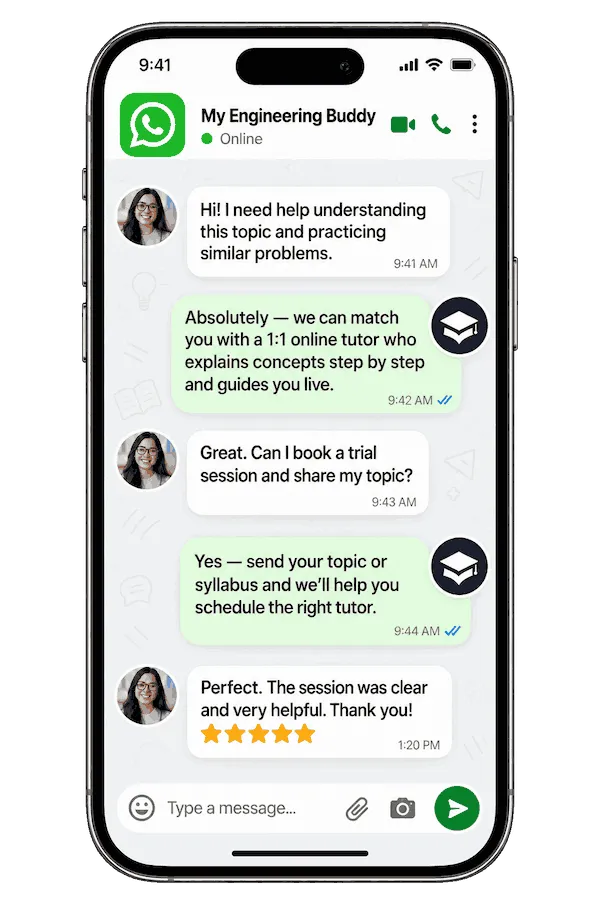
Unlike platforms where you fill out a form and wait, MEB responds in under a minute, 24/7. Tutor match takes under an hour. The $1 trial means you test before you commit. Everything runs over WhatsApp — no logins, no intake forms.
Pricing Guide
Psycholinguistics tutoring runs $20–$40/hr for most undergraduate levels. Graduate, research-level, and thesis support reaches up to $100/hr. Rate factors include topic complexity (computational models and neurolinguistic methods cost more), your timeline, and tutor availability at your required hours.
Availability tightens sharply during end-of-semester and dissertation submission periods — especially in the US spring semester and UK Easter revision window. Don’t leave it to the last two weeks.
For students targeting graduate programmes at research-intensive universities, tutors with active research backgrounds in experimental Psycholinguistics or cognitive neuroscience are available at higher rates. Share your specific goal and MEB will match the tier to what you actually need.
Start with the $1 trial — 30 minutes, no registration, no commitment. WhatsApp MEB for a quick quote.
Students consistently tell us that the first session tells them more about their actual gaps than a full semester of lectures. That’s not a criticism of the lectures — it’s what one-to-one does that fifty-person seminars can’t.
FAQ
Is Psycholinguistics hard?
It’s conceptually demanding rather than technically difficult. The challenge is holding multiple competing theoretical models in mind and knowing which one the evidence supports. Students who struggle most are usually trying to memorise models rather than understand what each one predicts and why.
How many sessions are needed?
Most students working on a specific exam or essay module need 6–12 sessions. Students with broader gaps — or supporting a full dissertation — typically need 15–25 sessions. The tutor sets a realistic sequence after the first diagnostic so you’re not guessing.
Can you help with homework and assignments?
Yes. MEB tutoring is guided learning — you understand the work, then submit it yourself. Tutors explain the relevant models, walk through the evidence, and help you build the argument. See our Academic Integrity policy and Why MEB page for full details on what we help with and what we don’t.
Will the tutor match my exact syllabus or exam board?
Yes. Before matching, MEB asks for your course outline or module descriptor. Psycholinguistics varies significantly between universities — some emphasise computational models, others focus on clinical applications or developmental acquisition. The tutor is briefed on your specific course before session one.
What happens in the first session?
The tutor asks you to explain a concept in your own words to locate the actual gap. From there, the session covers one or two topics in depth — no rushing through five chapters. You leave with a concrete task and a clear plan for the next session.
Is online tutoring as effective as in-person?
For a model-heavy subject like Psycholinguistics, the digital pen-pad on Google Meet is often better than a whiteboard — the tutor can annotate processing diagrams, parsing trees, and neural pathway maps in real time, and you can screenshot everything for later review.
Can I get Psycholinguistics help at midnight or on weekends?
Yes. MEB operates 24/7 across time zones. Students in the Gulf, Australia, and the US West Coast routinely book late-evening or weekend sessions. WhatsApp MEB at any hour and you’ll get a response within minutes.
What if I don’t like my assigned tutor?
WhatsApp MEB and request a rematch — no explanation required. MEB keeps a pool of tutors in each subject precisely so this isn’t a problem. Most rematches happen within a few hours.
Do you offer group Psycholinguistics sessions?
No. Every session is 1:1. Group sessions reduce the tutor’s ability to pinpoint your specific gaps, which is the core of what MEB does. If you and a classmate both need help, you each get your own tutor.
What’s the difference between Psycholinguistics and other Linguistics subfields — does the tutor know both?
Psycholinguistics focuses specifically on mental processing and cognition, while fields like Sociolinguistics or Pragmatics address social or communicative function. MEB tutors are matched by specialism, so your tutor knows the processing literature — not just general Linguistics.
Does MEB cover the experimental methods used in Psycholinguistics research?
Yes. Reaction-time paradigms, eye-tracking data interpretation, ERP components, and priming methodology are all within scope. Many graduate students specifically need help understanding and writing about the methods sections of key papers on their reading list.
How do I get started?
WhatsApp MEB, share your course level and topic, and MEB matches you with a verified Psycholinguistics tutor — usually within the hour. The first session is the $1 trial: 30 minutes of live tutoring or one homework question explained in full. Three steps: WhatsApp → matched → start trial.
Trust & Quality at My Engineering Buddy
Every MEB tutor goes through subject-specific screening before their first session. That means a live demo evaluation — not just a CV review — followed by ongoing session feedback review. Tutors covering Psycholinguistics hold graduate degrees in Linguistics, Cognitive Science, Psychology, or related fields, and many have research or clinical backgrounds. Rated 4.8/5 across 40,000+ verified reviews on Google.
MEB tutoring is guided learning — you understand the work, then submit it yourself. For full details on what we help with and what we don’t, read our Academic Integrity policy and Why MEB.
MEB has served 52,000+ students across the US, UK, Canada, Australia, Gulf, and Europe in 2,800+ subjects since 2008. Within Linguistics, that includes students needing Computational Linguistics tutoring, Syntax help, and support with Morphology alongside Psycholinguistics. If you’re working across multiple Linguistics modules, MEB can match you with tutors in each. See our tutoring methodology for how the session structure works.
MEB’s approach to Phonetics tutoring, Historical Linguistics help, and Psycholinguistics is the same: one tutor, one student, one course outline — no generic lesson plans.
Source: My Engineering Buddy, 2008–2025.
Explore Related Subjects
Students studying Psycholinguistics often also need support in:
Next Steps
When you WhatsApp MEB, share your exam board or university course name, the topic or module giving you the most trouble, and your exam or submission date. Share your time zone and when you’re free each week. MEB matches you with a verified Psycholinguistics tutor — usually within 24 hours, often within the hour.
Before your first session, have ready:
- Your course outline or module descriptor and reading list
- A recent essay, past paper attempt, or homework question you struggled with
- Your exam date or assignment deadline
The tutor handles everything from there. Visit www.myengineeringbuddy.com for more on how MEB works.
WhatsApp to get started or email [email protected].
Reviewed by Subject Expert
This page has been carefully reviewed and validated by our subject expert to ensure accuracy and relevance.




