




~1 min
Average Reply Time
~1 hour
To Be Matched With A Tutor
30 Min Trial
75% Find Their Tutor On The 1st Trial
$20-35+/hr
Premium Yet Affordable Learning
Most students don’t fail literary criticism because they can’t read. They fail because nobody ever showed them how to argue about what they’ve read — clearly, rigorously, and under exam conditions.
Literary Criticism Tutor Online
Literary criticism is the systematic analysis, interpretation, and evaluation of literary texts using established theoretical frameworks — such as formalism, Marxism, feminism, or poststructuralism — to construct evidence-based arguments about meaning, form, and context.
If you’re searching for a literary criticism tutor near me, MEB gives you something better: a 1:1 online literary criticism tutor matched to your exact course, institution, and essay deadlines within hours. We cover undergraduate modules, graduate seminars, A Level English Literature, IB Language and Literature, and independent research projects across Literature and its sub-disciplines. One well-placed session can turn a muddled argument into a clear, theoretically grounded essay.
- 1:1 online sessions tailored to your specific syllabus or course module
- Expert-verified tutors with advanced degrees in literary studies and criticism
- Flexible time zones — US, UK, Canada, Australia, Gulf
- Structured learning plan built after a diagnostic session
- Ethical academic guidance — you understand the argument before you write it
52,000+ students across the US, UK, Canada, Australia, and the Gulf have used MEB since 2008 — including students in Literature subjects like literary criticism, comparative literature, and literary analysis.
Source: My Engineering Buddy, 2008–2025.
How Much Does a Literary Criticism Tutor Cost?
Most literary criticism tutoring sessions run $20–$40/hr depending on level and complexity. Graduate and doctoral-level theory work can reach $70–$100/hr. The $1 trial gets you 30 minutes of live 1:1 tutoring or a full explanation of one essay question — no registration required.
| Level / Need | Typical Rate | What’s Included |
|---|---|---|
| Undergraduate (most levels) | $20–$35/hr | 1:1 sessions, essay planning, homework guidance |
| Graduate / Advanced Theory | $35–$100/hr | Expert tutor, critical theory depth, dissertation support |
| $1 Trial | $1 flat | 30 min live session or 1 essay question explained in full |
Tutor availability tightens around semester deadlines and finals periods. Book early if your essay submission is within three weeks.
WhatsApp MEB for a quick quote — average response time under 1 minute.
Who This Literary Criticism Tutoring Is For
Literary criticism sits at the intersection of reading and argumentation. Students struggle not because the texts are too hard, but because the leap from “I read the novel” to “I can write a theoretically coherent argument about it” is wider than most courses acknowledge.
- Undergraduates in English, Comparative Literature, or Humanities facing their first theory-heavy essay module
- A Level and IB students who can summarise a text but lose marks on analytical depth
- Students who failed or underperformed on a first essay submission and need to rebuild their approach before the next deadline
- Graduate students applying critical frameworks — Derrida, Foucault, Butler — to a dissertation chapter for the first time
- Students with a university conditional offer that depends on their A Level English Literature grade
- Parents watching a child’s confidence drop alongside their English essay marks
MEB has worked with students at institutions including Harvard, Yale, Oxford, Cambridge, Toronto, the University of Melbourne, NYU, and King’s College London. The $1 trial is a low-risk way to find out whether the approach is right for you.
At MEB, we’ve found that students who struggle with literary criticism almost always have the same gap: they’re reporting what a text says rather than arguing what it means. One session focused on that single shift — from summary to analysis — consistently changes how students approach every essay that follows.
1:1 Tutoring vs Self-Study vs AI vs YouTube vs Online Courses
Self-study works if you’re disciplined, but literary criticism demands feedback on your actual arguments — not just more reading. AI tools can explain what deconstruction means; they can’t tell you why your Derrida application doesn’t hold up in paragraph three. YouTube covers theory overviews well but stops the moment you’re stuck on a specific passage or essay prompt. Online courses give you structure at a fixed pace with no adjustment for your particular text or exam board. 1:1 tutoring with MEB is live, calibrated to your exact module and critical framework, and corrects the specific errors in your essay reasoning in real time — which is where literary criticism marks are actually won or lost.
Outcomes: What You’ll Be Able To Do in Literary Criticism
After working with an online literary criticism tutor at MEB, students can apply theoretical frameworks — from New Criticism to postcolonial theory — to unseen texts with precision. You’ll write arguments that move beyond plot summary: analyzing how form, language, and ideology intersect in a specific passage. You’ll explain why a Marxist reading of a Victorian novel produces different interpretive conclusions than a feminist one. You’ll present a coherent close reading that holds up to academic scrutiny, and apply concepts like the male gaze, hegemony, or différance without misusing them. These are not generic skills — they are the precise competencies that separate a strong first-class essay from a solid 2:1.
“Based on feedback from 40,000+ sessions collected by MEB from 2022 to 2025, 58% of students improved by one full grade after approximately 20 hours of 1:1 tutoring in subjects like literary criticism. A further 23% achieved at least a half-grade improvement.”
Source: MEB session feedback data, 2022–2025.
Try your first session for $1 — 30 minutes of live 1:1 tutoring or one homework question explained in full. No registration. No commitment. WhatsApp MEB now and get matched within the hour.
What We Cover in Literary Criticism (Syllabus / Topics)

Critical Theory and Theoretical Frameworks
- Formalism and New Criticism: close reading, ambiguity, irony, tension
- Structuralism and semiotics: sign systems, narrative grammar, Lévi-Strauss
- Poststructuralism: Derrida’s différance and deconstruction, Foucault on discourse and power
- Psychoanalytic criticism: Freud, Lacan, the unconscious in narrative
- Feminist and gender criticism: Woolf, de Beauvoir, Butler’s performativity
- Marxist and materialist criticism: ideology, base and superstructure, Gramsci’s hegemony
- Postcolonial criticism: Said’s Orientalism, Bhabha’s hybridity, Spivak’s subaltern
Core texts include Jonathan Culler’s Literary Theory: A Very Short Introduction, Terry Eagleton’s Literary Theory: An Introduction, and Vincent Leitch’s The Norton Anthology of Theory and Criticism.
Essay Writing and Argumentative Method
- Constructing a thesis that makes a debatable, theoretically grounded claim
- Close reading technique: quotation selection, integration, and analysis
- Structuring an essay argument: claim, evidence, warrant, counterargument
- Applying a theoretical framework consistently without forcing it onto the text
- Writing the introduction and conclusion without restating rather than arguing
- Citation and academic referencing conventions (MLA, Chicago, MHRA)
Recommended resources include The Chicago Manual of Style, MLA Handbook (9th ed.), and Joseph Gibaldi’s MLA Handbook for Writers of Research Papers.
Text-Specific and Period-Specific Criticism
- Reading Victorian fiction through class, empire, and gender lenses
- Modernist texts: stream of consciousness, unreliable narrators, fragmentation
- Renaissance and early modern drama: historicism, power, and language
- Contemporary fiction: trauma theory, diaspora, memory and identity
- Poetry criticism: prosody, speaker, imagery, and the limits of intentionality
- Getting help with postcolonial literature readings and theoretical application
Tutors draw on texts including M.H. Abrams’ A Glossary of Literary Terms, Lois Tyson’s Critical Theory Today, and Bertens’ Literary Theory: The Basics.
What a Typical Literary Criticism Session Looks Like
The tutor opens by checking the previous session’s focus — say, how you applied Foucauldian discourse theory to a passage from Jane Eyre. You share a draft paragraph or an essay question you’re working on. The tutor reads it on screen, marks the points where your argument slips into summary or where the theoretical link is underdeveloped, and then works through a corrected version with you using a digital pen-pad — showing exactly how the sentence structure and evidentiary logic need to change. You rewrite a section in real time while the tutor watches. The session closes with a specific revision task: rework two body paragraphs applying one framework consistently, and note the next theoretical concept to tackle. Nothing is left vague.
How MEB Tutors Help You with Literary Criticism (The Learning Loop)
Diagnose: In the first session, your tutor identifies whether your core issue is framework knowledge, essay structure, close reading technique, or all three. Most students have one dominant gap — the diagnostic makes it visible fast.
Explain: The tutor works through a model argument on screen using a digital pen-pad, showing how a theoretical concept connects to a specific textual moment — not in the abstract, but in the passage you’re actually writing about.
Practice: You attempt a paragraph or close reading in the session while the tutor watches. This is where most students discover habits they didn’t know they had — defaulting to plot summary, misapplying a framework, or burying the thesis.
Feedback: The tutor goes through your attempt line by line, explaining exactly where the argument weakens and why that would cost you marks. Not “this needs more analysis” — specific, actionable correction.
Plan: Each session ends with a clear next step: which text, which framework, which essay component to work on next. Progress is tracked across sessions so nothing is revisited without reason.
Sessions run over Google Meet with a digital pen-pad or iPad and Apple Pencil for annotation. Before your first session, have your essay prompt, the relevant text, and any previous tutor or lecturer feedback ready. Start with the $1 trial — 30 minutes of live tutoring that also serves as your first diagnostic. Whether you need a quick catch-up before a submission deadline, structured revision over four to eight weeks, or ongoing weekly support through the semester, the tutor maps the session plan after that first diagnostic.
Students consistently tell us that the biggest shift in literary criticism tutoring happens not when they learn a new theory, but when they finally understand how to use the theory they already know to build a real argument — not just reference one.
Source: My Engineering Buddy tutor observations, 2008–2025.
Tutor Match Criteria (How We Pick Your Tutor)
Not every English literature graduate can teach literary criticism at the level a struggling second-year undergraduate or a graduate student needs. MEB matches on specifics.
Subject depth: tutors hold postgraduate degrees in English, Comparative Literature, or related fields, with demonstrable familiarity with the theoretical frameworks on your syllabus — not just general English teaching experience.
Tools: all tutors use Google Meet with a digital pen-pad or iPad and Apple Pencil for live annotation of your essay drafts and textual passages.
Time zone: matched to your region — US, UK, Gulf, Canada, or Australia — so sessions happen at hours that don’t wreck your sleep schedule.
Goals: whether you need to pass one essay, improve systematically across a module, or work through a dissertation chapter, the match reflects that specific aim — not a generic “English tutor” assignment.
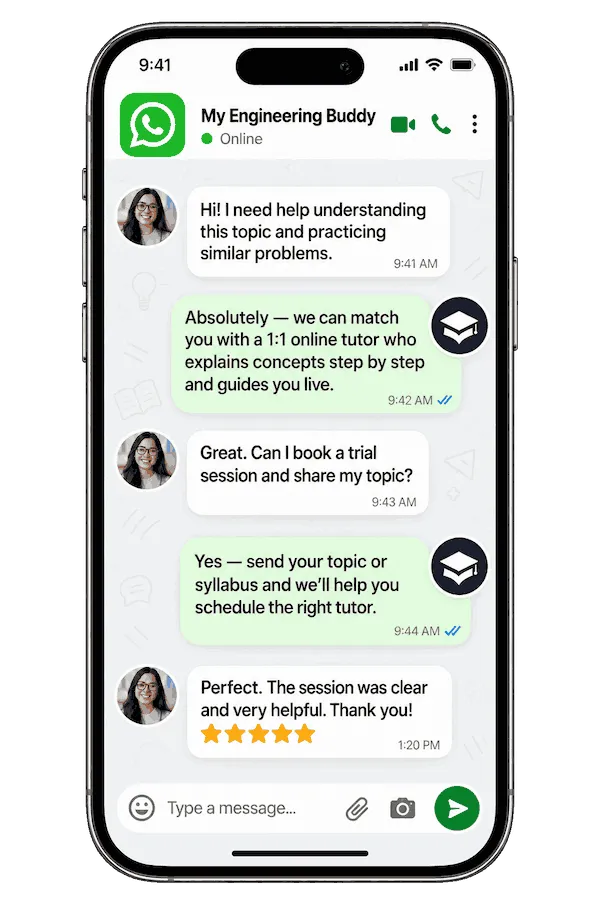
Unlike platforms where you fill out a form and wait, MEB responds in under a minute, 24/7. Tutor match takes under an hour. The $1 trial means you test before you commit. Everything runs over WhatsApp — no logins, no intake forms.
Pricing Guide
Literary criticism tutoring starts at $20/hr for undergraduate-level support and rises to $70–$100/hr for graduate theory, dissertation work, or highly specialised critical frameworks. Rate factors include your level, the complexity of the theory involved, your timeline, and tutor availability.
Tutor availability shrinks in the four weeks before semester essay deadlines. If you’re working toward a specific submission date, book now rather than the week before.
For students targeting top-ranked programmes in literary studies, humanities PhD positions, or competitive MFA courses, tutors with active research and publication backgrounds are available at higher rates — share your specific goal and MEB will match the tier to your ambition.
Start with the $1 trial — 30 minutes, no registration, no commitment. WhatsApp MEB for a quick quote.
FAQ
Is literary criticism hard?
It’s demanding because it requires two skills at once: understanding complex theory and applying it to specific texts under argument. Most students find one easier than the other. A tutor identifies which is the actual bottleneck and addresses that directly.
How many sessions are needed to improve?
Students with a single essay deadline often see measurable improvement in 3–5 sessions. Systematic improvement across a full module typically takes 10–20 sessions. MEB outcome data shows 58% of students improve by a full grade after roughly 20 hours of 1:1 tutoring.
Can you help with homework and assignments?
MEB tutoring is guided learning — you understand the argument, then write the essay yourself. Tutors help you plan your thesis, work through your close reading, and identify where your reasoning breaks down. See our Academic Integrity policy and Why MEB page for full details on what we help with and what we don’t.
Will the tutor match my exact syllabus or exam board?
Yes. When you contact MEB, share your institution, module name, and the theoretical frameworks or set texts involved. The tutor matched to you will have specific familiarity with that material — not a generic English literature background.
What happens in the first session?
The tutor runs a diagnostic: you share an essay question or a recent piece of written work, and the tutor identifies your core gap — framework knowledge, close reading, essay structure, or argument construction. The session plan follows from that, not from a generic template.
Is online tutoring as effective as in-person for literary criticism?
For essay-based subjects, online is often more effective. Screen sharing lets the tutor annotate your draft in real time. Google Meet with a digital pen-pad replicates the experience of working through a passage together — with the added advantage of a written record you can review later.
Which critical theory frameworks does MEB cover?
MEB tutors cover the full range: New Criticism, structuralism, poststructuralism, deconstruction, psychoanalytic criticism, feminist and gender theory, Marxist criticism, postcolonial theory, ecocriticism, and narratology. If your syllabus includes a framework not listed here, ask — the match will confirm coverage before the first session.
Can I get literary criticism help at short notice — even the night before a deadline?
MEB operates 24/7. Average response time on WhatsApp is under a minute. Tutor matching typically takes under an hour. Late-night or early-morning sessions are available across most time zones. Contact MEB as soon as you know you need help — don’t wait until the morning of the deadline.
What if I disagree with my assigned tutor’s reading of a text?
Literary criticism is inherently interpretive. A good tutor doesn’t impose one reading — they help you build the strongest possible case for yours. If the tutor fit isn’t right for any reason, MEB will rematch you. That’s part of what the $1 trial is for.
Do you offer help with British literature essays specifically, or only general literary criticism?
Both. MEB tutors work on text-specific and period-specific criticism — Victorian, Modernist, Renaissance, contemporary — as well as general critical theory applicable across any literary tradition. Specify your texts and time period when you contact MEB.
How do I get started?
Three steps: WhatsApp MEB → share your module, essay prompt, and deadline → get matched with a verified literary criticism tutor, usually within an hour. The $1 trial covers your first 30 minutes of live tutoring or one full essay question explained. No registration, no commitment.
Can MEB help with a dissertation chapter applying a specific critical framework?
Yes. Dissertation-level support is one of MEB’s strongest areas for literary criticism. Tutors help you select and justify your theoretical framework, apply it consistently across your chapter, and align your argument with the scholarly conversation in your field. Share your chapter draft and supervisor feedback when you contact MEB.
Trust & Quality at My Engineering Buddy
Every MEB tutor goes through a subject-specific screening process: academic credentials verified, a live demo session evaluated, and ongoing session feedback reviewed. Tutors working in literary criticism hold postgraduate degrees — most at MA or PhD level — in English, Comparative Literature, or related disciplines. Rated 4.8/5 across 40,000+ verified reviews on Google. MEB has served 52,000+ students since 2008, across the US, UK, Canada, Australia, Gulf, and Europe.
MEB tutoring is guided learning — you understand the work, then submit it yourself. For full details on what we help with and what we don’t, read our Academic Integrity policy and Why MEB.
MEB covers 2,800+ advanced subjects. The Literature category includes subjects like postmodern literature tutoring, world literature help, and poetry tutoring — with the same tutor-matching rigour applied across all of them. If your programme spans multiple literary sub-disciplines, MEB can coordinate tutor coverage across all of them.
Students consistently tell us that what separates MEB from other services isn’t the speed of matching — it’s that the tutor actually knows the specific text, the specific framework, and the specific thing the student is getting wrong. That level of match takes effort. We’ve built systems for it over 18 years.
MEB has been running since 2008. The tutoring methodology — diagnostic first, structured loop, progress tracked — is documented and applied consistently. Read more about how it works at our tutoring methodology page.
Source: My Engineering Buddy, 2008–2025.
Explore Related Subjects
Students studying literary criticism often also need support in:
Next Steps
Before your first session, have ready: your exam board and syllabus or course outline, a recent essay attempt or a homework question you struggled with, and your submission or exam date. The tutor handles the rest.
- Share your module name, the critical framework involved, and your current deadline
- Share your availability and time zone
- MEB matches you with a verified literary criticism tutor — usually within 24 hours
The first session opens with a diagnostic so every minute is used on the gap that actually matters.
Visit www.myengineeringbuddy.com for more on how MEB works.
WhatsApp to get started or email [email protected].
Reviewed by Subject Expert
This page has been carefully reviewed and validated by our subject expert to ensure accuracy and relevance.




