Hire Verified & Experienced
Orthopedic Surgery Tutors
Email: [email protected]
4.8/5 40K+ session ratings collected on the MEB platform



Hire The Best Orthopedic Surgery Tutor
Top Tutors, Top Grades. Without The Stress!
Most students don’t fail Orthopedic Surgery because the subject is impossible — they fail because nobody corrected their biomechanics reasoning in week three.
Orthopedic Surgery Tutor Online
Orthopedic Surgery is the medical specialty focused on diagnosing, treating, and rehabilitating disorders of the musculoskeletal system — bones, joints, ligaments, tendons, and muscles — equipping students to manage trauma, degenerative disease, and congenital conditions through surgical and non-surgical means.
MEB connects you with a verified Orthopedic Surgery tutor online who knows your exact curriculum — whether you’re working through a medical school module, a residency prep programme, or a graduate-level course in Medicine. If you’ve been searching for an Orthopedic Surgery tutor near me and coming up empty, 1:1 online sessions with MEB give you the same depth — without the scheduling constraints. Your tutor adapts to your gaps, not the other way around.
- 1:1 online sessions tailored to your exact course and syllabus
- Expert verified tutors with clinical and academic Orthopedic Surgery backgrounds
- Flexible time zones — US, UK, Canada, Australia, Gulf
- Structured learning plan built after a diagnostic session
- Ethical homework and assignment guidance — you understand the work before you submit
52,000+ students across the US, UK, Canada, Australia, and the Gulf have used MEB since 2008 — including students in Medicine subjects like Orthopedic Surgery, General Surgery, and Gross Anatomy.
Source: My Engineering Buddy, 2008–2025.
How Much Does an Orthopedic Surgery Tutor Cost?
Most Orthopedic Surgery tutoring sessions run $20–$40/hr. Graduate-level and residency-prep sessions with specialist tutors can reach $100/hr. The $1 trial gets you 30 minutes of live 1:1 tutoring or a full explanation of one homework question — no registration needed.
| Level / Need | Typical Rate | What’s Included |
|---|---|---|
| Undergraduate / Medical School | $20–$40/hr | 1:1 sessions, homework guidance |
| Graduate / Residency Prep | $40–$100/hr | Expert tutor, clinical depth, case review |
| $1 Trial | $1 flat | 30 min live session or 1 homework question |
Availability tightens during clinical rotation exam periods and USMLE prep windows. Book early if you’re within six weeks of a major assessment.
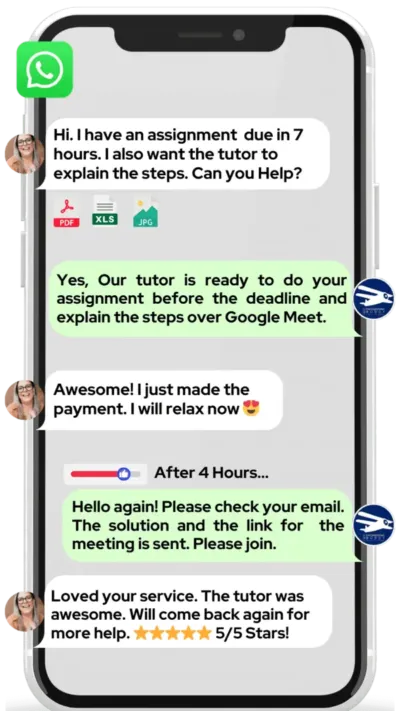
WhatsApp MEB for a quick quote — average response time under 1 minute.
Who This Orthopedic Surgery Tutoring Is For
This isn’t a course for students who are curious about bones. It’s for people with a real deadline, a specific gap, and a need to close it fast.
- Medical students working through musculoskeletal modules in years 2–4
- Students retaking after a failed first attempt at a clinical sciences exam
- Students with a university conditional offer depending on this grade
- Graduate students writing research papers on fracture biomechanics or joint replacement outcomes
- Students preparing for USMLE Step 1 or Step 2 musculoskeletal question blocks
- Students 4–6 weeks from an exam with significant gaps still to close — especially in surgical approaches, implant selection, and post-operative complications
MEB has worked with students at institutions including Johns Hopkins, University of Toronto, Imperial College London, University of Melbourne, King Saud University, and Harvard Medical School. The $1 trial is a fast way to check the fit before committing.
1:1 Tutoring vs Self-Study vs AI vs YouTube vs Online Courses
Self-study works if you’re disciplined — but Orthopedic Surgery has too many clinical edge cases to learn from notes alone. AI tools give fast definitions; they can’t quiz you on surgical decision trees or tell you why your reasoning on a tibial fracture classification is off. YouTube covers surgical overviews well, but stops when you need to work through a specific case. Online courses move at a fixed pace with no correction. 1:1 tutoring with MEB is live, calibrated to your exact module, and corrects your clinical reasoning in real time — which is the skill examiners actually test.
Outcomes: What You’ll Be Able To Do in Orthopedic Surgery
After working with an MEB Orthopedic Surgery tutor, you’ll be able to apply fracture classification systems — including AO/OTA and Salter-Harris — accurately in both written exams and clinical viva settings. You’ll analyze imaging findings on plain X-ray and MRI to differentiate diagnoses like ACL rupture versus meniscal tear. You’ll explain the biomechanical rationale behind implant selection for total hip and knee arthroplasty. You’ll present post-operative complication management plans — DVT prophylaxis, wound dehiscence, periprosthetic infection — using evidence-based protocols. You’ll solve USMLE-style musculoskeletal questions with the systematic approach that earns marks.
Based on feedback from 40,000+ sessions collected by MEB from 2022 to 2025, 58% of students improved by one full grade after approximately 20 hours of 1:1 tutoring in subjects like Orthopedic Surgery. A further 23% achieved at least a half-grade improvement.
Source: MEB session feedback data, 2022–2025.
At MEB, we’ve found that Orthopedic Surgery students who struggle most are usually solid on anatomy but shaky on surgical decision-making. The gap isn’t knowledge — it’s knowing when and why to operate, and how to justify it in writing. That’s what sessions focus on.
What We Cover in Orthopedic Surgery (Syllabus / Topics)

Track 1: Musculoskeletal Anatomy and Biomechanics
- Skeletal anatomy: long bones, short bones, growth plates, and cancellous vs cortical structure
- Joint anatomy: synovial joints, cartilage types, ligament and tendon function
- Biomechanics of load-bearing and stress distribution in femur, tibia, and spine
- Gait analysis: normal and pathological — antalgic, Trendelenburg, steppage
- Neurovascular supply to major regions: brachial plexus, femoral and sciatic nerve paths
- Compartment anatomy and clinical significance in crush injuries
Recommended references: Gray’s Anatomy for Students (Drake et al.), Netter’s Orthopaedics (Netter), Basic Orthopaedic Biomechanics (Mow & Huiskes).
Track 2: Fracture Management and Trauma Surgery
- Fracture classification: AO/OTA system, Salter-Harris physeal fractures, Garden hip fractures
- Principles of fracture healing: primary vs secondary, callus formation, delayed union
- Conservative vs operative management: casting, traction, ORIF, intramedullary nailing
- Soft tissue injury classification: Gustilo-Anderson open fracture grading
- Compartment syndrome: recognition, fasciotomy indications, timing
- Polytrauma management and damage control orthopaedics
- Paediatric fracture patterns and growth plate considerations
Recommended references: Rockwood and Green’s Fractures in Adults, Apley and Solomon’s System of Orthopaedics and Trauma, OKU: Orthopaedic Knowledge Update (AAOS).
Track 3: Elective Orthopaedics and Surgical Decision-Making
- Osteoarthritis: pathophysiology, grading (Kellgren-Lawrence), non-operative vs surgical thresholds
- Total hip and knee arthroplasty: implant types, surgical approaches, cemented vs uncemented
- Spine surgery: disc herniation, spinal stenosis, deformity correction (scoliosis, spondylolisthesis)
- Sports medicine: ACL reconstruction techniques, meniscal repair vs meniscectomy, rotator cuff surgery
- Oncological orthopaedics: primary bone tumours, limb-salvage principles, pathological fracture management
- Post-operative complications: VTE prophylaxis protocols, periprosthetic joint infection, revision surgery indications
Recommended references: Miller’s Review of Orthopaedics (Miller), Campbell’s Operative Orthopaedics, Clinical Orthopaedics and Related Research (journal — for case-based reading).
What a Typical Orthopedic Surgery Session Looks Like
The tutor opens by checking the previous topic — say, the Gustilo-Anderson classification from last session — and asks you to recall the criteria for Grade IIIC. If you hesitate, that’s the starting point. From there, you and the tutor work through a clinical vignette on screen: a 34-year-old with an open tibial fracture, dropping neurovascular status, and a two-hour transfer window. The tutor writes the decision pathway on a digital pen-pad while you narrate your reasoning aloud. When your thinking drifts — choosing ORIF before vascular repair — the tutor stops you and asks why. You rework it. By the end of the session, you’ve worked through three cases covering fracture management, compartment syndrome recognition, and post-operative complication documentation. The tutor sets a practice task: classify five X-ray cases using the AO system before next session, with written justifications.
How MEB Tutors Help You with Orthopedic Surgery (The Learning Loop)
Diagnose: In the first session, the tutor identifies where your reasoning breaks down — not just what you don’t know, but how you approach clinical decisions. Most Orthopedic Surgery students have anatomy solid; the gap is usually surgical indication logic or complication sequencing.
Explain: The tutor works through live cases on a digital pen-pad — drawing fracture patterns, annotating X-rays on screen, walking through AO classification in real time. Explanation is always linked to a specific case, never abstract.
Practice: You attempt the next case with the tutor watching. You narrate. You make decisions. You commit to answers before the tutor responds — this mirrors the pressure of a viva or OSCE station.
Feedback: The tutor identifies where marks would be lost and explains why — not just “wrong” but “you skipped neurovascular assessment before fixation, which costs you the whole question in a clinical exam.”
Plan: At the end of every session, the tutor logs what was covered, what remains weak, and what the next session will prioritise. If you’re eight weeks out from OSCEs, the sequence is mapped explicitly.
Sessions run over Google Meet with a digital pen-pad or iPad and Apple Pencil for annotating imaging and drawing diagrams. Before your first session, have ready: your module guide or course syllabus, any past paper or mock exam you’ve attempted, and your exam date. Start with the $1 trial — 30 minutes of live tutoring that also serves as your first diagnostic.
Students consistently tell us that the moment things click in Orthopedic Surgery isn’t when they memorise a classification — it’s when they understand why that classification changes the surgical plan. That shift, from recall to reasoning, is what MEB sessions are built around.
Tutor Match Criteria (How We Pick Your Tutor)
Not every tutor with a medical degree is right for Orthopedic Surgery.
Subject depth: Tutors are matched on specific sub-fields — trauma surgery, arthroplasty, sports medicine, or spine — not just general medicine. If you’re preparing for a musculoskeletal OSCE, you get someone who has taught or practiced exactly that.
Tools: Every tutor works on Google Meet with a digital pen-pad or iPad and Apple Pencil — essential for annotating X-rays and drawing surgical approaches live.
Time zone: Matched to your region — US, UK, Gulf, Canada, or Australia — so sessions don’t run at 2am unless you want them to.
Goals: Whether you’re targeting exam scores, building surgical reasoning for clinical placements, or working through pathophysiology assignment help alongside your orthopaedics module, the tutor fit reflects your actual objective.
Unlike platforms where you fill out a form and wait, MEB responds in under a minute, 24/7. Tutor match takes under an hour. The $1 trial means you test before you commit. Everything runs over WhatsApp — no logins, no intake forms.
Study Plans (Pick One That Matches Your Goal)
The tutor builds the exact sequence after your first diagnostic session, but most students fit one of three patterns. Catch-up (1–3 weeks): heavy focus on highest-yield topics — fracture classification, surgical indications, complication management — with daily practice cases. Exam prep (4–8 weeks): structured revision through all tracks, timed OSCE and viva practice, past paper analysis. Weekly support: ongoing, aligned to your semester’s clinical rotation schedule and coursework deadlines, picking up each new module as it starts.
Pricing Guide
Orthopedic Surgery tutoring starts at $20–$40/hr for most undergraduate and medical school levels. Graduate, residency-prep, and research-support sessions with specialist tutors run up to $100/hr. Rate factors include: level, sub-topic complexity, urgency, and tutor availability.
For students targeting competitive residency programmes or orthopaedic surgery fellowship applications, tutors with clinical practice and research backgrounds are available at higher rates — share your specific goal and MEB will match the right tier.
Availability tightens sharply during USMLE exam windows and clinical rotation assessment periods. Book early.
Start with the $1 trial — 30 minutes, no registration, no commitment. WhatsApp MEB for a quick quote.
MEB has been operating since 2008 — 18 years serving medical students, graduate researchers, and clinical professionals across 2,800+ subjects. That’s not a claim. That’s the track record you’re paying for.
Source: My Engineering Buddy, 2008–2025.
Try your first session for $1 — 30 minutes of live 1:1 tutoring or one homework question explained in full. No registration. No commitment. WhatsApp MEB now and get matched within the hour.
FAQ
Is Orthopedic Surgery hard to study?
It’s one of the most demanding clinical specialties to learn — heavy on anatomy, biomechanics, surgical technique, and evidence-based decision-making simultaneously. Most students find fracture classification and implant selection the steepest parts. Consistent 1:1 practice with clinical case review makes the difference.
How many tutoring sessions will I need?
Students with a 4–8 week timeline typically need 8–16 sessions. Those closing a specific gap before an OSCE or written paper may need 3–6 targeted sessions. The first diagnostic session gives the tutor enough to build a realistic plan for your exact situation.
Can you help with homework and assignments?
MEB tutoring is guided learning — you understand the work, then submit it yourself. Tutors work through the reasoning with you on case studies, clinical vignettes, and written assignments. See our Academic Integrity policy and Why MEB page for full details on what we help with and what we don’t.
Will the tutor match my exact syllabus or exam board?
Yes. MEB tutors are matched to your specific course — whether that’s a medical school module, a USMLE musculoskeletal block, or a graduate surgical sciences programme. Share your syllabus or course guide on WhatsApp and MEB selects accordingly.
What happens in the first session?
The tutor runs a diagnostic — working through a clinical case or past paper question with you to identify exactly where your reasoning breaks down. By the end of the first session, you have a topic priority list and a session plan built around your exam date.
Is online tutoring as effective as in-person for Orthopedic Surgery?
For theory, clinical reasoning, case analysis, and OSCE prep — yes. The tutor annotates imaging and draws surgical diagrams live on a digital pen-pad. The only thing online sessions can’t replicate is physical examination technique, which requires a clinical setting.
Can I get Orthopedic Surgery help at midnight or on weekends?
MEB tutors operate across multiple time zones — US, UK, Gulf, Australia. Midnight availability depends on your region and tutor match. WhatsApp MEB with your time zone and preferred hours; most students are matched to a suitable tutor within 24 hours.
What if I don’t like my assigned tutor?
Tell MEB on WhatsApp. No forms, no waiting periods. MEB re-matches you within the hour. The $1 trial is specifically designed so you test the fit before any financial commitment. If the first session doesn’t feel right, say so immediately.
Do you cover USMLE Step 1 and Step 2 musculoskeletal topics specifically?
Yes. USMLE musculoskeletal questions appear across both Step 1 and Step 2 CK. Tutors focus on high-yield fracture patterns, orthopaedic emergencies, and clinical decision-making vignettes that mirror the exam format — not a broad overview of the specialty.
What’s the difference between studying Orthopedic Surgery for a written exam versus an OSCE?
Written exams test classification systems, pathophysiology, and evidence recall. OSCEs test clinical reasoning, history-taking structure, and examination findings under time pressure. MEB tutors prepare for both — and adapt the session format to whichever is your immediate priority.
Can you help with a research paper or dissertation in Orthopedic Surgery?
Yes. MEB supports graduate students with literature review structure, biomechanics methodology, surgical outcomes analysis, and academic writing for orthopaedic research. Get clinical research support alongside your orthopaedics work if your paper involves trial design or data interpretation.
How do I get started?
Start with the $1 trial — 30 minutes of live 1:1 tutoring or one full explanation of a homework question. Three steps: WhatsApp MEB, get matched to a verified Orthopedic Surgery tutor within the hour, then start your trial session. No registration required.
Trust & Quality at My Engineering Buddy
Every MEB tutor goes through subject-specific vetting — not a general screening. For Orthopedic Surgery, that means verified academic credentials in surgical sciences or clinical medicine, a live demo session evaluated against our teaching standards, and ongoing review based on student feedback. Rated 4.8/5 across 40,000+ verified reviews on Google. MEB has been running since 2008 — that’s 18 years of refining what works in 1:1 medical tutoring. Get surgery tutoring from the same verified pool.
MEB tutoring is guided learning — you understand the work, then submit it yourself. For full details on what we help with and what we don’t, read our Academic Integrity policy and Why MEB.
MEB serves students across the US, UK, Canada, Australia, the Gulf, and Europe in 2,800+ subjects since 2008. In Medicine, that includes Orthopedic Surgery, internal medicine tutoring, neurology tutoring, and dozens of adjacent clinical specialties. If you need physical therapy and physiotherapy help alongside your orthopaedics work, MEB covers that too.
The Nobel Prize in Medicine has repeatedly recognised musculoskeletal and surgical research — from joint replacement biomechanics to bone healing mechanisms. The science behind Orthopedic Surgery is as rigorous as any in medicine.
Source: Nobel Prize — Medicine.
Explore Related Subjects
Students studying Orthopedic Surgery often also need support in:
- Anesthesiology
- Radiology
- MRI (Magnetic Resonance Imaging)
- Medical Ethics
- Hematology
- Pediatrics
- Gerontology
Next Steps
Getting started is straightforward. Share your exam board or course outline, the topics giving you the most trouble, and your exam or deadline date. Add your time zone and availability. MEB matches you with a verified Orthopedic Surgery tutor — usually within 24 hours.
Before your first session, have ready:
- Your module guide, course syllabus, or exam specification
- A recent past paper attempt, case study, or homework question you struggled with
- Your exam date or coursework deadline
The tutor handles the rest — including the diagnostic that makes every minute count from session one.
Visit www.myengineeringbuddy.com for more on how MEB works.
WhatsApp to get started or email [email protected].
52,000+ Happy Students From Various Universities



How Much For Private 1:1 Tutoring & Hw Help?
Private 1:1 Tutoring and HW help Cost $20 – 35 per hour* on average.
Reviewed by Subject Expert
This page has been carefully reviewed and validated by our subject expert to ensure accuracy and relevance.