




~1 min
Average Reply Time
~1 hour
To Be Matched With A Tutor
30 Min Trial
75% Find Their Tutor On The 1st Trial
$20-35+/hr
Premium Yet Affordable Learning
Hire The Best MCAT Tutor



Your MCAT score isn’t moving — and your med school application deadline isn’t waiting.
MCAT Tutor Online
The MCAT (Medical College Admission Test) is a standardised exam administered by the AAMC, required for admission to medical schools across the US and Canada. It tests biological sciences, biochemistry, psychology, sociology, and critical analysis across four scored sections on a 472–528 scale.
MEB connects you with a 1:1 MCAT tutor online who knows the exam cold — section by section, passage type by passage type. If you’ve been searching for an MCAT tutor near me, online delivery means you get a better-matched expert regardless of your city, time zone, or country. Our test preparation tutoring covers over 2,800 subjects, and MCAT is one of the most requested. Sessions are built around your diagnostic, your weak sections, and your target score date — not a fixed syllabus everyone follows at the same pace.
- 1:1 online sessions mapped to your current score and target score
- Expert-vetted tutors with demonstrated MCAT section knowledge
- Flexible scheduling across US, UK, Canada, Australia, and Gulf time zones
- Structured plan built after a first-session diagnostic
- Ethical homework and passage-based guidance — you understand before you submit
52,000+ students across the US, UK, Canada, Australia, and the Gulf have used MEB since 2008 — including students in test preparation subjects like MCAT, USMLE, GAMSAT, and BMAT.
Source: My Engineering Buddy, 2008–2025.
How Much Does an MCAT Tutor Cost?
MCAT tutoring at MEB runs $20–$40/hr for most students. Tutors with advanced research or clinical backgrounds who specialise in high-score MCAT prep are available up to $100/hr. The $1 trial gets you 30 minutes of live tutoring — no registration, no commitment.
Spots fill quickly in the 8–12 weeks before the MCAT test window opens. Don’t wait until two months out to book a diagnostic.
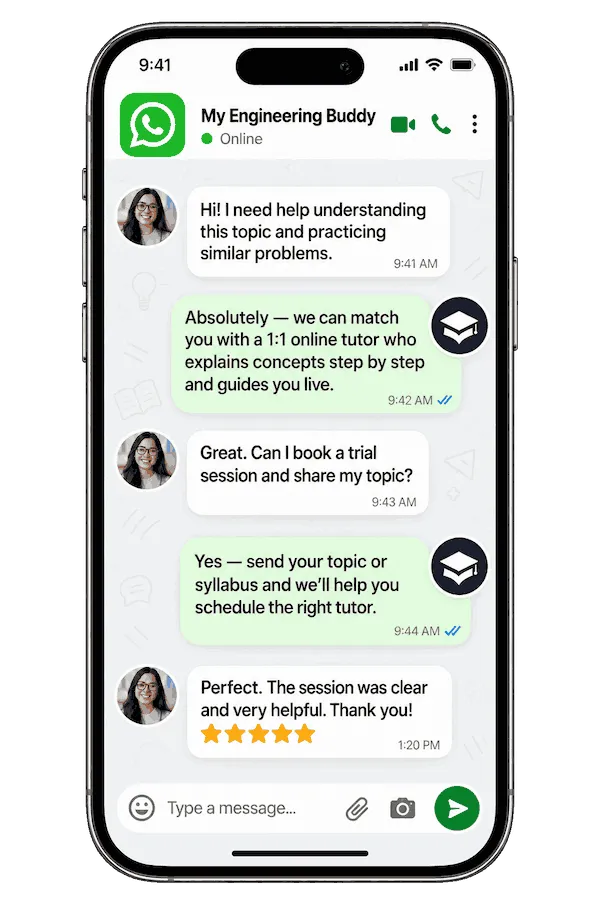
WhatsApp MEB for a quick quote — average response time under 1 minute.
Who This MCAT Tutoring Is For
Most students who contact MEB for MCAT help fall into one of two categories: they’ve sat the exam once and need a higher score, or they’re preparing for the first time with a hard deadline and real gaps in at least two sections. Both are fixable with the right approach.
- Students retaking after a first attempt that didn’t hit their target score
- Students with a conditional medical school offer depending on this result
- Pre-med students 6–12 weeks out with clear weak sections still to close
- Students strong in sciences but struggling with CARS or the psychology/sociology section
- Students who’ve used prep books and practice tests but can’t diagnose why scores have plateaued
- Parents supporting a pre-med student whose confidence has dropped alongside their practice scores
Students from institutions including Harvard, Johns Hopkins, University of Michigan, UCLA, University of Toronto, and King’s College London have used MEB when standard prep wasn’t moving the needle.
1:1 Tutoring vs Self-Study vs AI vs YouTube vs Online Courses
Self-study works if you’re disciplined and already know what’s wrong — most MCAT retakers aren’t in that position. AI tools give fast explanations but can’t watch you misread a CARS passage in real time and correct the pattern. YouTube covers concepts well but stops when you’re stuck on a specific amino acid question in a biochemistry passage. Online courses are structured but run at a fixed pace — they don’t slow down for your weakest section. A 1:1 MCAT tutor from MEB works live with your actual practice test errors, adjusts when your CARS reading strategy breaks down mid-session, and holds you to a prep timeline tied to your real test date.
Outcomes: What You’ll Be Able To Do After MCAT Tutoring
After consistent 1:1 MCAT sessions, students can analyze multi-paragraph CARS passages under timed conditions without losing central argument tracking. They can apply enzyme kinetics, molecular genetics, and amino acid chemistry to passage-based questions rather than just recalling definitions. Students learn to model psychological and sociological scenarios using the frameworks the MCAT actually tests — Freud, Vygotsky, social stratification — not general knowledge. They can explain their reasoning on a full-length practice exam, section by section, and identify exactly which question type is costing them points. Confidence in the testing room comes from having done that diagnostic work out loud, under a tutor who caught the errors before test day.
Supporting a student through MCAT? MEB works directly with parents to set up sessions, track progress, and keep the prep schedule on track. WhatsApp MEB — average response time is under a minute, 24/7.
Based on feedback from 40,000+ sessions collected by MEB from 2022 to 2025, 58% of students improved their MCAT score by 5–10 points after approximately 20 hours of 1:1 tutoring. A further 21% reported measurable improvement of 3–5 points.
Source: MEB session feedback data, 2022–2025.
At MEB, we’ve found that MCAT students who plateau on practice tests are almost always making the same two or three passage-reading errors on repeat. Identifying those errors in a live session — not from a score report — is what breaks the plateau. Twenty hours of targeted 1:1 work does more than 200 hours of untargeted self-study.
What We Cover in MCAT Tutoring (Syllabus / Topics)

The MCAT is administered by the AAMC and scored on a 472–528 scale across four sections. Each section is scored 118–132. The median score for matriculating medical students at US allopathic schools is approximately 511–512. MEB tutors cover all four sections with equal depth.
| Section | Full Name | Score Range | Time |
|---|---|---|---|
| C/P | Chemical & Physical Foundations of Biological Systems | 118–132 | 95 min |
| CARS | Critical Analysis and Reasoning Skills | 118–132 | 90 min |
| B/B | Biological & Biochemical Foundations of Living Systems | 118–132 | 95 min |
| P/S | Psychological, Social & Biological Foundations of Behavior | 118–132 | 95 min |
Chemical & Physical Foundations (C/P)
- General chemistry: equilibrium, thermodynamics, electrochemistry
- Organic chemistry: reaction mechanisms, stereochemistry, spectroscopy
- Physics: circuits, fluids, optics, sound, electrostatics
- Biochemistry: enzyme kinetics, metabolic pathways, protein structure
- Passage-based problem solving under timed conditions
- Connecting lab data to conceptual frameworks tested in C/P questions
Recommended texts: Kaplan MCAT Complete 7-Book Subject Review, Princeton Review MCAT Subject Review Complete Box Set, AAMC Official Prep materials.
Critical Analysis and Reasoning Skills (CARS)
- Identifying central argument vs supporting detail in dense humanities passages
- Inference and application questions — going beyond what the text states
- Author tone, perspective, and rhetorical purpose questions
- Timed passage strategy: active reading vs skim-first approaches
- Eliminating answer traps — “true but out of scope” errors
- Building reading speed without sacrificing comprehension accuracy
Recommended texts: The Princeton Review CARS Workout, Jack Westin CARS Passages (daily practice).
Biological & Biochemical Foundations (B/B) and P/S
- Molecular biology: DNA replication, transcription, translation, gene regulation
- Physiology: cardiovascular, respiratory, renal, endocrine, immune systems
- Genetics: Mendelian inheritance, Hardy-Weinberg, population genetics
- Psychology: sensation/perception, learning theory, memory, cognition, motivation
- Sociology: identity, social stratification, healthcare disparities, institutions
- Psychological theories testable on MCAT: Freud, Erikson, Piaget, Vygotsky, Bandura
- Research methods and statistics as applied to behavioral science passages
Recommended texts: Kaplan MCAT Behavioral Sciences Review, Next Step/Blueprint Full-Length Tests, AAMC Official Practice Exams.
What a Typical MCAT Session Looks Like
The tutor opens by reviewing the practice passage or question set you attempted since the last session — often a CARS passage or a C/P discrete question block. You walk through your reasoning aloud. The tutor listens for the exact moment the logic breaks down: whether you’re misreading the passage structure, applying the wrong acid-base rule, or confusing Piaget with Vygotsky under time pressure. From there, you work through two or three targeted problems together on screen — the tutor annotates using a digital pen-pad, you replicate the reasoning step by step. The session closes with a specific practice task: three timed CARS passages before next session, or a B/B question set focused on kidney physiology. Next topic is logged so no session starts cold.
How MEB Tutors Help You with MCAT (The Learning Loop)
Diagnose: In the first session, the tutor identifies your section-by-section score breakdown, the question types costing you the most points, and whether your prep timeline is realistic given your target score. This isn’t a quiz — it’s a structured conversation with evidence from your practice materials.
Explain: The tutor works through problems live using a digital pen-pad. You see the reasoning as it happens — not a finished solution. For CARS, that means annotating the passage structure in real time. For B/B, it means building the metabolic pathway from first principles rather than memorising a table.
Practice: You attempt the next question or passage independently while the tutor observes. The goal is to catch errors before they become habits. This is different from doing a practice test alone and reviewing answers afterwards — the feedback is immediate.
Feedback: Step-by-step correction. The tutor explains not just the right answer but why your reasoning produced the wrong one — and which of the AAMC’s tested reasoning skills you need to engage instead.
Plan: At the end of each session, a specific topic progression is agreed for the next two weeks. Whether it’s getting through all 30 AAMC CARS passages under timed conditions or mastering enzyme kinetics before moving into metabolic biochemistry, the sequence is set — not improvised.
Sessions run on Google Meet. Tutors use a digital pen-pad or iPad with Apple Pencil. Before your first session, share your most recent full-length practice test score, the sections where you’re losing the most points, and your target test date. The $1 trial — 30 minutes live — also works as your first diagnostic so no time is wasted.
Try your first session for $1 — 30 minutes of live 1:1 tutoring or one homework question explained in full. No registration. No commitment. WhatsApp MEB now and get matched within the hour.
Tutor Match Criteria (How We Pick Your MCAT Tutor)
Not every science tutor can teach MCAT effectively. The exam requires section-specific expertise, not just subject knowledge.
Subject depth: Tutors demonstrate competency in the specific MCAT sections they cover — C/P, CARS, B/B, or P/S — not just general biology or chemistry. Section specialists are matched where depth matters most.
Tools: All MCAT tutors use Google Meet with digital pen-pad or iPad and Apple Pencil. Passage annotation, diagram work, and biochemistry pathway mapping all require a writing tool — not just screen sharing.
Time zone: Matched to your region — US, UK, Canada, Australia, or Gulf. Pre-dawn and late-night sessions are available for students around clinical rotations or work schedules.
Goals: A student targeting 515+ for a top-10 MD programme needs a different tutor profile than a student aiming for 506 to clear a conditional offer. MEB matches by stated goal, not just subject name.
Unlike platforms where you fill out a form and wait days for a reply, MEB responds in under a minute, 24/7. Tutor match takes under an hour. The $1 trial means you test the fit before committing to a package. Everything runs over WhatsApp — no logins, no intake portals.
Study Plans (Pick One That Matches Your MCAT Goal)
The right prep structure depends on how far out your test date is. A student 10 weeks out has different options than one who tests in three weeks. For a short-window catch-up (1–3 weeks), the tutor focuses exclusively on your two weakest sections and high-yield question types. Exam prep over 4–8 weeks allows a full section rotation with timed full-length review built in. Ongoing weekly support works for students who want consistent MCAT improvement alongside pre-med coursework and MCAT homework guidance throughout the semester. The tutor maps the specific sequence after the diagnostic — no pre-packaged plan is applied without knowing your current score and target date.
Pricing Guide
MCAT tutoring at MEB starts at $20–$40/hr for most levels and section combinations. Tutors with medical school admissions advisory experience or 99th-percentile MCAT backgrounds are available at higher rates — up to $100/hr for specialised, high-score prep.
Rate factors: the section you need (CARS-only vs full exam), your timeline, and tutor availability. Availability tightens significantly in January–March and again in June–August, which are peak MCAT test windows.
For students targeting top-10 MD programmes or international medical schools with competitive score cut-offs, tutors with research or clinical backgrounds are available at higher tiers — share your target programme and MEB will match accordingly.
Start with the $1 trial — 30 minutes, no registration, no commitment. WhatsApp MEB for a quick quote.
Students consistently tell us that the biggest mistake in MCAT prep is spending the final four weeks doing more practice tests rather than fixing the two or three error patterns the tests have already revealed. A tutor’s job in those final weeks isn’t to add content — it’s to close the gap between what you know and what you’re demonstrating under exam conditions.
FAQ
Is the MCAT hard?
Yes — the MCAT tests seven years of undergraduate science plus critical reading and behavioral science, all in passage-based format under strict time limits. The median score for matriculating MD students is around 511–512 out of 528. Most students need structured prep, not just more reading time.
How many sessions are needed to improve my MCAT score?
It depends on your starting score and target. Students aiming for a 5–7 point improvement typically need 15–25 hours of 1:1 work alongside independent practice. Students targeting a 10-point jump from a previous sitting usually need a full structured cycle of 30–40 hours.
Can you help with MCAT homework and assignments?
MEB tutoring is guided learning — you work through the material, understand the reasoning, and apply it yourself. Tutors help you analyze practice passages, identify where your reasoning breaks down, and build the skills to answer correctly under pressure. See our Academic Integrity policy and Why MEB page for full details on what we help with and what we don’t.
Will the tutor match my exact MCAT sections and target score?
Yes. When you contact MEB, share your most recent full-length score, the sections causing the most point loss, and your target score. The tutor is matched to your specific profile — not assigned generically. Section specialists are available for CARS, C/P, B/B, and P/S.
What happens in the first MCAT session?
The tutor reviews your practice test data, identifies your highest-priority weak areas, and runs a short live diagnostic — often a CARS passage or a targeted C/P or B/B question set. By the end of the first session, you have a session plan for the next two to four weeks.
Is online MCAT tutoring as effective as in-person?
For the MCAT specifically, online delivery has a practical advantage: you can be matched to a tutor who specialises in your exact weak section, regardless of location. The digital pen-pad format also mirrors how passage annotation actually works in prep — which is useful practice in itself.
Can I get MCAT tutoring help late at night or on weekends?
Yes. MEB operates 24/7. Many pre-med students balance lab work, clinical volunteering, and coursework — sessions are available in early morning, evening, and weekend slots across US, UK, Canada, Australia, and Gulf time zones.
What if my MCAT score has plateaued on practice tests?
Score plateaus almost always mean you’re repeating the same reasoning errors without catching them. A tutor watches your reasoning live — not just your answers — and identifies the specific pattern. Most students who plateau break through within 8–12 hours of targeted 1:1 work on those error patterns.
Do you offer MCAT tutoring for specific sections only — like CARS?
Yes. Many students come to MEB strong in the sciences but struggling specifically in CARS — or the reverse. You can book section-specific tutoring for any combination of CARS, C/P, B/B, or P/S without committing to full-exam prep. The tutor is matched to the section you need.
How is the MCAT scored, and what score do I actually need?
The MCAT is scored 472–528, with each of the four sections scored 118–132. Score requirements vary by school — most US MD programmes look for 510+, and top-10 schools typically see matriculants averaging 517–520. The tutor will benchmark your prep to your specific target programmes.
How do I get started with an MCAT tutor?
Three steps: WhatsApp MEB with your current score, target score, and test date. MEB matches you with a verified tutor — usually within an hour. Your first session starts with the $1 trial — 30 minutes live, which also functions as your diagnostic. No forms, no delay.
Trust & Quality at My Engineering Buddy
Every MEB tutor goes through subject-specific vetting — not a generic screening call. For MCAT tutors, that means demonstrating section-level knowledge, working through live passage questions, and passing a teaching evaluation before being matched to any student. Rated 4.8/5 across 40,000+ verified reviews on Google. Tutors hold degrees in life sciences, biochemistry, psychology, or related fields — and many have supported students through the full medical school admissions pipeline. Ongoing session feedback is reviewed to maintain quality across the platform.
MEB tutoring is guided learning — you understand the work, then submit it yourself. For full details on what we help with and what we don’t, read our Academic Integrity policy and Why MEB.
MEB has served 52,000+ students across the US, UK, Canada, Australia, the Gulf, and Europe in 2,800+ subjects since 2008. Test preparation — including USMLE Step 1 tutoring, DAT tutoring, and GRE tutoring — is one of our most active subject areas. If you’re preparing for a health professions admission exam, you’re in the right place. Read more about how our sessions are structured at our tutoring methodology page.
A common pattern our tutors observe is this: students who score 504–507 on full-lengths often know the content well enough to score 512+. The gap is almost never content — it’s question interpretation, time allocation by section, and catching the one trap answer type that keeps recurring. That’s exactly what 1:1 sessions address directly.
Explore Related Subjects
Students preparing for MCAT often also need support in:
Next Steps
Before your first session, have ready: your most recent full-length MCAT practice test score (section breakdown if possible), the question types or passages you’re consistently losing points on, and your confirmed or target test date. The tutor handles the rest from there.
- Share your target score, current score, and timeline over WhatsApp
- Share your time zone and weekly availability
- MEB matches you with a verified MCAT tutor — usually within an hour
The first session starts with a diagnostic so every minute counts from day one. Visit www.myengineeringbuddy.com for more on how MEB works.
WhatsApp to get started or email [email protected].
Reviewed by Subject Expert
This page has been carefully reviewed and validated by our subject expert to ensure accuracy and relevance.




