




~1 min
Average Reply Time
~1 hour
To Be Matched With A Tutor
30 Min Trial
75% Find Their Tutor On The 1st Trial
$20-35+/hr
Premium Yet Affordable Learning
Most USMLE Step 3 failures come down to one thing: knowing the science but freezing on clinical decision-making under time pressure.
USMLE Step 3 Tutor Online
USMLE Step 3 is the third and final licensing examination of the United States Medical Licensing Examination series, administered by the NBME and FSMB, assessing whether a physician can apply medical knowledge to unsupervised patient management.
MEB provides 1:1 online USMLE Step 3 tutoring and homework help across 2,800+ advanced subjects. If you’ve been searching for a USMLE Step 3 tutor near me and landing on generic platforms, MEB is different — tutors are matched to your specific exam stage, your weakest content areas, and your available weeks before test day. No guarantees, but targeted preparation makes a measurable difference.
MEB works with physicians in residency across the US, Canada, Australia, UK, and the Gulf — people who passed Steps 1 and 2 but stalled here. Test preparation tutoring at MEB is built around your timeline, not a fixed syllabus.
- 1:1 online sessions built around your weakest CCS cases and biostatistics gaps
- Expert-verified tutors with clinical and exam-specific backgrounds
- Flexible time zones — US, UK, Canada, Australia, Gulf
- Structured session plan built after a diagnostic in your first hour
- Ethical homework and assignment guidance — you understand the reasoning, then apply it yourself
52,000+ students across the US, UK, Canada, Australia, and the Gulf have used MEB since 2008 — including physicians preparing for USMLE licensing exams, USMLE Step 3, USMLE Step 1, and USMLE Step 2 CK.
Source: My Engineering Buddy, 2008–2025.
How Much Does a USMLE Step 3 Tutor Cost?
Most USMLE Step 3 sessions run $40–$100/hr depending on the tutor’s clinical background and your timeline. Start with the $1 trial — 30 minutes of live 1:1 tutoring or one question explained in full — before committing to a package.
| Level / Need | Typical Rate | What’s Included |
|---|---|---|
| Standard USMLE Step 3 prep | $40–$70/hr | 1:1 sessions, CCS case walkthroughs, biostatistics |
| Advanced / specialist support | $70–$100/hr | Clinical reasoning, high-yield integrated case review |
| $1 Trial | $1 flat | 30 min live session or one full question explanation |
Tutor availability tightens in the weeks before peak Step 3 testing windows. Book early if your test date is within six weeks.
WhatsApp MEB for a quick quote — average response time under 1 minute.
Who This USMLE Step 3 Tutoring Is For
Step 3 is not just more Step 2 content. It tests clinical management decisions — ordering the right workup, adjusting treatment, recognising when to refer. Most candidates who struggle are not weak on facts; they’re weak on the decision logic that the exam rewards.
- Physicians in residency preparing for their first Step 3 attempt
- Physicians retaking after a failed first attempt — the most common profile MEB sees
- IMGs preparing to complete USMLE licensing before starting a US residency programme
- Candidates 4–8 weeks out with CCS or biostatistics still unresolved
- Residents at programmes including those at hospitals affiliated with Harvard Medical School, Johns Hopkins, UCSF, Mayo Clinic, and Cleveland Clinic, where board completion timelines are closely monitored
- Students who need guided review of practice CCS cases and Foundations of Independent Practice (FIP) questions
The $1 trial gives you 30 minutes with a matched tutor before you spend anything further.
1:1 Tutoring vs Self-Study vs AI vs YouTube vs Online Courses
Self-study works if you’re disciplined and already near the pass mark — but most repeat takers have tried it. AI tools explain concepts quickly but cannot walk through a CCS case with you in real time or catch the specific reasoning error you keep making. YouTube covers high-yield content at a surface level and stops when you hit a nuanced clinical scenario. Online courses like Amboss or UWorld are structured but move at a fixed pace with no live correction. 1:1 tutoring with MEB is different: a tutor watches you work through a CCS case, stops you at the wrong click, and explains the decision tree before you cement the wrong habit. For USMLE Step 3 specifically, that live correction loop is what separates a pass from another retake.
Outcomes: What You’ll Be Able To Do in USMLE Step 3
After structured 1:1 sessions, you’ll be able to apply clinical reasoning frameworks to Foundations of Independent Practice (FIP) questions without second-guessing your differential. You’ll analyze ambiguous patient management scenarios and select the single best next step with confidence. Solve biostatistics and epidemiology questions — the category most Step 3 candidates underestimate — using a reliable, repeatable method. Explain your CCS case management sequence clearly, including when to advance time versus order further workup. Apply evidence-based treatment thresholds across internal medicine, emergency, and ambulatory care settings that appear across Day 1 and Day 2 of the exam.
Based on feedback from 40,000+ sessions collected by MEB from 2022 to 2025, students improved their USMLE Step 3 score by a meaningful margin after approximately 20 hours of 1:1 tutoring — with the most consistent gains in CCS performance and biostatistics accuracy, areas that respond well to targeted coaching. Students report measurable score improvement compared to self-directed review alone.
Source: MEB session feedback data, 2022–2025.
At MEB, we’ve found that Step 3 candidates who struggle with CCS almost always share the same blind spot: they know what the diagnosis is, but they misread what the exam is actually asking them to do next. That distinction is teachable — and usually clicks within a few focused sessions.
What We Cover in USMLE Step 3 (Syllabus / Topics)

Foundations of Independent Practice (FIP) — Day 1
- Internal medicine: acute presentations, chronic disease management, diagnostic reasoning
- Emergency scenarios: stabilisation priorities, triage decision-making
- Biostatistics and epidemiology: sensitivity/specificity, NNT, study design interpretation
- Preventive medicine and population health screening guidelines
- Pharmacology and drug safety: interactions, contraindications, monitoring parameters
- Psychiatry: diagnostic criteria, inpatient vs outpatient management decisions
Core references: First Aid for the USMLE Step 3, Master the Boards Step 3 (Conrad Fischer).
Advanced Clinical Medicine (ACM) — Day 2 with CCS
- Computer-based Case Simulations (CCS): ordering workup, initiating treatment, advancing time
- Ambulatory and preventive care cases
- Surgical and obstetric management decisions
- Paediatrics: well-child care, developmental milestones, acute illness management
- Ethics and legal issues in clinical practice: informed consent, capacity, disclosure
- High-acuity cases: ICU management, sepsis, respiratory failure
Core references: UWorld Step 3 Qbank, Amboss Step 3 question bank, NBME practice forms.
Biostatistics, Epidemiology & Evidence-Based Medicine
- Study design: RCT, cohort, case-control, cross-sectional — interpreting results
- Screening and diagnostic test statistics: PPV, NPV, LR+, LR−
- Relative risk, odds ratio, absolute risk reduction
- Confidence intervals, p-values, and when results are clinically vs statistically significant
- Applying published guidelines to individual patient scenarios
Core references: Biostatistics for the USMLE Step 3 review chapters; NBME sample questions with explanations.
| Exam Component | Format | Approx. Weighting |
|---|---|---|
| Day 1 — FIP MCQs | 232 multiple-choice questions | ~60% of total exam |
| Day 2 — ACM MCQs | 180 multiple-choice questions | Part of Day 2 total |
| Day 2 — CCS Cases | 13 interactive patient simulations | Significant separate scoring |
Students consistently tell us that the CCS component feels like a different exam entirely from the MCQ sections. It is. A tutor who can run live CCS case practice with you — stopping at decision points, explaining time-advance logic — is worth more here than any qbank alone.
What a Typical USMLE Step 3 Session Looks Like
The tutor opens by checking your last CCS case attempt — specifically where you advanced time, what you ordered first, and whether you closed the case correctly. You then work through two or three FIP-style clinical scenarios together. The tutor shares their screen, annotates the clinical vignette using a digital pen-pad, and walks through the decision logic step by step. You replicate the reasoning on your next question while the tutor watches. If your biostatistics is the priority that session, you work through NNT and screening calculations until the method is automatic. The session closes with a specific practice task — a timed CCS case or a 20-question Qbank block — and the next session topic is agreed before you disconnect.
How MEB Tutors Help You with USMLE Step 3 (The Learning Loop)
Diagnose: In the first session, your tutor identifies exactly where your clinical reasoning breaks down — whether it’s the initial workup order, the treatment threshold, or the CCS time-advance logic. Not a general assessment. Specific errors, specific patterns.
Explain: Your tutor works through a live patient case on screen, annotating the vignette with a digital pen-pad, talking through each decision branch as it appears. You see the reasoning, not just the answer.
Practice: You attempt the next case while the tutor watches. No looking away, no skipping the hard parts. The tutor is present for every click in CCS and every answer selection in FIP blocks.
Feedback: Every error gets corrected at the step it happened — not at the end. You find out why a management choice loses marks, not just that it does. That specificity is what prevents the same mistake in the next block.
Plan: Each session ends with a written task and a topic for next time. The tutor tracks your progress across sessions and adjusts the sequence if a content area needs more time than originally allocated.
Sessions run on Google Meet. Your tutor uses a digital pen-pad or iPad with Apple Pencil to annotate cases in real time. Before your first session, send MEB your most recent practice exam score, the content categories you found hardest, and your test date. Start with the $1 trial — 30 minutes of live tutoring that also serves as your first diagnostic.
Whether you need a three-week intensive before a booked test date, a full 8-week structured revision plan, or weekly support through your residency schedule, the tutor maps the session sequence after the first diagnostic.
Tutor Match Criteria (How We Pick Your Tutor)
Every USMLE Step 3 tutor is matched on four criteria.
Subject depth: Tutors must demonstrate familiarity with the current USMLE Step 3 content outline, CCS mechanics, and the specific content categories — FIP, ACM, and biostatistics. Background in clinical medicine or medical education is required.
Tools: Google Meet with a digital pen-pad or iPad and Apple Pencil for real-time case annotation. No static slide decks.
Time zone: Matched to your region — US, UK, Gulf, Canada, or Australia. Late-night sessions are available for residents with unpredictable schedules.
Goals: Matched to your specific aim — first-time pass, retake recovery, CCS-focused, or biostatistics-intensive. One profile does not fit all Step 3 candidates.
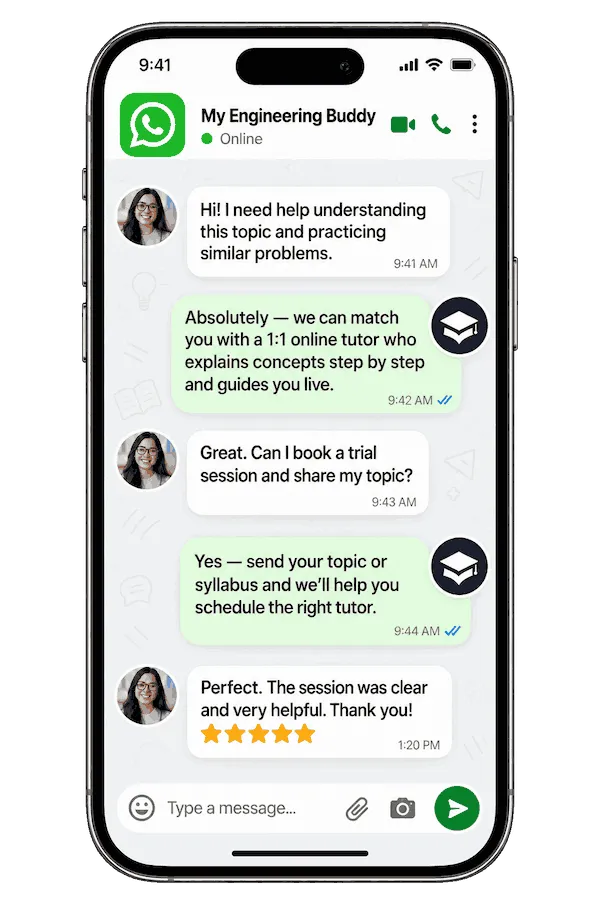
Unlike platforms where you fill out a form and wait, MEB responds in under a minute, 24/7. Tutor match takes under an hour. The $1 trial means you test before you commit. Everything runs over WhatsApp — no logins, no intake forms.
Study Plans (Pick One That Matches Your Goal)
For a 3-week intensive, the tutor prioritises CCS mechanics and your highest-yield weak content areas with daily practice tasks between sessions. For an 8-week structured plan, sessions cover FIP content systematically, with CCS practice introduced from week 4 and timed full-block simulations in weeks 6–8. For weekly ongoing support during residency, sessions are scheduled around your on-call rota and focus on whichever content category most recently surfaced in your Qbank review. The tutor builds the specific sequence after the first diagnostic session.
Pricing Guide
USMLE Step 3 tutoring runs $40–$70/hr for standard preparation, and up to $100/hr for tutors with direct clinical examination experience or specialist intensive packages. Rate factors include your timeline, the depth of CCS support needed, and tutor availability.
For candidates targeting a first-time pass in a compressed window, tutors with professional clinical backgrounds and medical education experience are available at higher rates — share your test date and current practice score and MEB will match the right tier.
Tutor availability drops sharply in the four weeks before peak Step 3 windows. Book early.
Start with the $1 trial — 30 minutes, no registration, no commitment. WhatsApp MEB for a quick quote.
Try your first session for $1 — 30 minutes of live 1:1 tutoring or one homework question explained in full. No registration. No commitment. WhatsApp MEB now and get matched within the hour.
FAQ
Is USMLE Step 3 hard?
Step 3 pass rates are generally above 90% for US medical graduates but lower for IMGs and retakers. The difficulty is less about content volume and more about clinical decision-making speed across 412 questions and 13 CCS cases over two days. Preparation quality matters more than raw study hours.
How many sessions do I need?
Most candidates see meaningful progress in 8–15 sessions. A 3-week intensive typically runs 10–12 focused hours. Candidates targeting a retake after a close fail often need fewer sessions than they expect — the gap is usually specific and correctable.
Can you help with homework and assignments?
MEB tutoring is guided learning — you understand the work, then submit it yourself. See our Academic Integrity policy and Why MEB page for full details on what we help with and what we don’t.
Will the tutor match my exact exam stage and content gaps?
Yes. Before your first session, you share your current practice exam score, your weakest content categories, and your test date. The tutor builds around that — not a generic Step 3 curriculum. CCS-focused, biostatistics-intensive, or full-coverage plans are all available.
What happens in the first session?
The tutor runs a short diagnostic — typically a mixed FIP block and one CCS walkthrough. This identifies your specific error patterns. The rest of the session begins addressing the highest-priority gap immediately. You do not spend the first session on orientation.
Is online tutoring as effective as in-person for Step 3?
For USMLE Step 3 specifically, online delivery has an advantage: the exam itself is computer-based. Practising on screen, navigating CCS on a shared digital workspace, and reviewing annotated vignettes digitally mirrors the actual test environment more closely than a whiteboard session.
What is the difference between CCS and the MCQ sections of Step 3?
CCS cases are interactive patient simulations where you order tests, treatments, and advance simulated time — there is no list of answer choices. MCQ sections present fixed options. Many candidates score well on MCQs but lose ground on CCS because the management logic and interface require separate, specific practice.
How do I pass USMLE Step 3 on a residency schedule with limited study time?
Most residents prepare in 6–12 week windows around call schedules. MEB tutors are available late evenings and weekends. The first diagnostic session identifies your highest-yield gaps so every hour is spent on what actually moves your score, not blanket re-review.
Can MEB help with the USMLE Step 3 biostatistics and epidemiology section specifically?
Yes — and this is one of the most common requests MEB receives for Step 3. Biostatistics questions are high-yield and systematically learnable. A focused session of 2–3 hours on study design, screening statistics, and clinical significance covers most of what the exam tests in this area.
Do you offer group USMLE Step 3 sessions?
MEB specialises in 1:1 online sessions only. Group formats do not allow the tutor to identify and correct individual error patterns in CCS cases — which is the main reason candidates fail. The 1:1 model is the product, not a pricing tier.
How do I get started?
Three steps: WhatsApp MEB, share your test date and current practice score, and get matched with a tutor — usually within an hour. Your first session is the $1 trial: 30 minutes of live tutoring or one full question explained. No registration required.
Can I get USMLE Step 3 help at short notice before a booked test date?
Yes, but availability is tighter with less lead time. MEB operates 24/7 and can match a tutor within hours in most cases. WhatsApp MEB with your test date and we’ll confirm availability immediately. Intensive 5-day and 10-day packages are available for urgent timelines.
Trust & Quality at My Engineering Buddy
Every USMLE Step 3 tutor on MEB goes through subject-specific screening: clinical or medical education background, live demo evaluation, and ongoing session feedback review. Tutors are not generalists assigned to medical content — they are matched specifically to Step 3’s content outline, CCS mechanics, and biostatistics scope. Rated 4.8/5 across 40,000+ verified reviews on Google.
MEB tutoring is guided learning — you understand the work, then submit it yourself. For full details on what we help with and what we don’t, read our Academic Integrity policy and Why MEB.
MEB has served 52,000+ students across the US, UK, Canada, Australia, the Gulf, and Europe in 2,800+ subjects since 2008. In the test preparation and medical licensing space, that includes candidates sitting USMLE Step 3, the MCAT, and MRCP UK. Subject-specific tutor vetting is the standard across every subject on the platform — not just medical licensing. See our tutoring methodology for how that works in practice.
MEB has been matching students with subject-specific tutors since 2008. In medical licensing preparation alone, that means thousands of sessions across USMLE Step 3, clinical case reasoning, and biostatistics — the exact areas where 1:1 live correction changes outcomes.
Source: My Engineering Buddy, 2008–2025.
A common pattern our tutors observe is that candidates who retake Step 3 have often done substantial self-study but have never had anyone watch them work through a CCS case live. That gap — the absence of real-time correction — is usually the entire problem. It’s fixable.
Explore Related Subjects
Students studying USMLE Step 3 often also need support in:
Next Steps
Before your first session, have ready: your current practice exam score and the content categories you struggled with most, your test date, and any specific CCS cases or Qbank blocks you have already attempted. The tutor handles the rest.
- Share your exam stage, hardest component, and available weeks before your test date
- Share your time zone and preferred session times (late evenings and weekends available)
- MEB matches you with a verified USMLE Step 3 tutor — usually within an hour
Your first session opens with a diagnostic so every minute counts from the start. Visit www.myengineeringbuddy.com for more on how MEB works.
WhatsApp to get started or email [email protected].
Reviewed by Subject Expert
This page has been carefully reviewed and validated by our subject expert to ensure accuracy and relevance.




