




~1 min
Average Reply Time
~1 hour
To Be Matched With A Tutor
30 Min Trial
75% Find Their Tutor On The 1st Trial
$20-35+/hr
Premium Yet Affordable Learning
Most students don’t fail Archaeology because they lack ability — they fail because excavation reports, stratigraphic analysis, and theoretical frameworks pile up faster than any lecture can handle.
Archaeology Tutor Online
Archaeology is the scientific study of human history through the excavation and analysis of material remains — including artefacts, structures, and landscapes. It equips students to apply fieldwork methods, interpret chronological sequences, and evaluate theories of human behaviour across cultures.
If you’re searching for an Archaeology tutor near me, MEB connects you with verified specialists for 1:1 online sessions — whether you’re working through Social Science coursework at undergraduate level, tackling a dissertation chapter, or rebuilding confidence after a poor first attempt. Our tutors work directly with your syllabus and your gaps, not a generic curriculum. One session is often enough to untangle a concept you’ve spent weeks rereading.
- 1:1 online sessions tailored to your specific course and syllabus
- Expert-verified tutors with subject-specific academic backgrounds
- Flexible time zones — US, UK, Canada, Australia, Gulf
- Structured learning plan built after a diagnostic session
- Ethical academic guidance — you understand before you submit
52,000+ students across the US, UK, Canada, Australia, and the Gulf have used MEB since 2008 — including students in Social Science subjects like Archaeology, Anthropology, and Forensic Anthropology.
Source: My Engineering Buddy, 2008–2025.
How Much Does an Archaeology Tutor Cost?
Most Archaeology tutoring sessions run $20–$40 per hour. Advanced topics — zooarchaeology, digital survey methods, dissertation supervision — can reach up to $100/hr depending on tutor specialisation. The $1 trial gives you 30 minutes of live 1:1 tutoring or a full explanation of one homework question before you commit to anything.
| Level / Need | Typical Rate | What’s Included |
|---|---|---|
| Standard (undergraduate) | $20–$35/hr | 1:1 sessions, homework guidance |
| Advanced / Specialist | $35–$70/hr | Expert tutor, niche field depth |
| $1 Trial | $1 flat | 30 min live session or 1 homework question |
Tutor availability tightens significantly during submission and exam periods. WhatsApp MEB for a quick quote — average response time under 1 minute.
Who This Archaeology Tutoring Is For
Archaeology draws students from across disciplines — history, anthropology, geography, and the natural sciences all feed into it. The content is demanding, the essay conventions are specific, and the theoretical debates shift fast.
- Undergraduates struggling with stratigraphic analysis or radiocarbon dating interpretation
- Students with a university conditional offer depending on this grade
- Students 4–6 weeks from a submission with significant gaps still to close
- Graduate students working through dissertations on landscape survey or material culture
- Students retaking after a failed first attempt at a unit or module
- Parents watching a child’s confidence drop alongside their grades in an archaeology or ancient history programme
Students at institutions including Durham, Edinburgh, UCL, Boston University, Sydney, and the University of Toronto have used MEB for Anthropology tutoring and archaeology-adjacent coursework at all levels.
At MEB, we’ve found that Archaeology students often know more than they think — but struggle to translate that knowledge into structured written argument. The first session usually focuses on exactly that gap: turning understanding into marks.
1:1 Tutoring vs Self-Study vs AI vs YouTube vs Online Courses
Self-study works if you’re disciplined, but there’s no one to tell you when your stratigraphic interpretation is wrong. AI tools explain concepts fast but can’t diagnose why your essay on processual vs post-processual theory keeps losing marks. YouTube covers site formation basics well — it stops when you need feedback on your own excavation report. Online courses are structured but fixed-pace, with no adjustment for your specific submission deadline. 1:1 tutoring with MEB is live, matched to your exact module and assignment brief, and corrects your specific errors in real time.
Outcomes: What You’ll Be Able To Do in Archaeology
After working with an MEB Archaeology tutor, students consistently report sharper analytical skills and better marks. You’ll be able to analyze stratigraphic sequences and explain site formation processes without second-guessing your reasoning. You’ll apply dating methods — including relative and absolute chronology — accurately in written work. You’ll evaluate competing theoretical frameworks such as cultural-historical, processual, and post-processual approaches with enough precision to build a genuine argument. You’ll write structured archaeological reports that meet the conventions your institution expects. And you’ll present material culture evidence in a way that connects artefact analysis to broader historical interpretation.
Based on feedback from 40,000+ sessions collected by MEB from 2022 to 2025, 58% of students improved by one full grade after approximately 20 hours of 1:1 tutoring in subjects like Archaeology. A further 23% achieved at least a half-grade improvement.
Source: MEB session feedback data, 2022–2025.
Supporting a student through Archaeology? MEB works directly with parents to set up sessions, track progress, and keep coursework on schedule. WhatsApp MEB — average response time is under a minute, 24/7.
Try your first session for $1 — 30 minutes of live 1:1 tutoring or one homework question explained in full. No registration. No commitment. WhatsApp MEB now and get matched within the hour.
What We Cover in Archaeology (Syllabus / Topics)

Track 1: Fieldwork Methods and Site Analysis
- Excavation strategies: grid, open-area, and test pit approaches
- Stratigraphic recording and the Harris Matrix
- Surface survey methods including geophysical prospection and remote sensing
- Artefact recovery, cleaning, and cataloguing protocols
- Environmental sampling — pollen, seeds, faunal remains
- Site formation processes and post-depositional transformation
- Fieldwork report writing conventions
Core texts for this track include Renfrew and Bahn’s Archaeology: Theories, Methods and Practice and Barker’s Techniques of Archaeological Excavation.
Track 2: Dating Methods and Chronology
- Relative dating: typology, seriation, stratigraphy
- Absolute dating: radiocarbon (AMS and conventional), dendrochronology, thermoluminescence
- Interpreting calibrated radiocarbon dates and Bayesian modelling basics
- DNA and isotope analysis in archaeological contexts
- Numismatics and documentary cross-dating
- Common errors in chronological interpretation and how to avoid them
Useful references include Taylor and Bar-Yosef’s Radiocarbon Dating and Bayliss et al. on Bayesian chronological modelling in archaeological practice.
Track 3: Archaeological Theory and Interpretation
- Culture-historical archaeology and its legacy
- Processual (New) Archaeology: systems theory and the scientific method
- Post-processual approaches: agency, identity, phenomenology
- Cognitive and symbolic archaeology
- Landscape archaeology and spatial analysis using GIS
- Ethics of excavation: indigenous heritage, repatriation, and cultural property law
- Writing theoretical frameworks for essays and dissertations
Key reading includes Trigger’s A History of Archaeological Thought and Hodder’s Reading the Past — two texts that underpin most theory assessment at undergraduate and postgraduate level.
What a Typical Archaeology Session Looks Like
The tutor opens by checking where you left off — usually a specific concept like Harris Matrix recording or the distinction between processual and post-processual interpretation. From there, the session moves into your actual work: an essay draft you can’t structure, a dating exercise you’re unsure about, or a set of stratigraphic diagrams you need to interpret for a lab report. The tutor uses a digital pen-pad to annotate diagrams and walk through reasoning step by step. You explain your logic back — this is where real gaps surface. By the end, you have a clear practice task: revise one section of the essay using a specific argument structure, or apply a dating technique to a set of given site data. The next topic is noted before you close the session, so there’s no dead time at the start of the following one.
How MEB Tutors Help You with Archaeology (The Learning Loop)
Diagnose: In the first session, the tutor identifies exactly where your reasoning breaks down — whether that’s confusing relative and absolute chronology, misapplying a theoretical framework in an essay, or not knowing how to structure an excavation report. You don’t start with chapter one; you start with your actual problem.
Explain: The tutor works through the concept live, using a digital pen-pad to annotate diagrams, draw stratigraphic profiles, or model an essay argument paragraph by paragraph. You see the reasoning built from scratch, not just the answer.
Practice: You attempt the next problem or draft section yourself — while the tutor is still there. This is the step most self-study approaches skip entirely.
Feedback: The tutor corrects errors in real time, explaining not just what’s wrong but why it loses marks in an Archaeology assessment context. A wrong interpretation of site formation processes costs different marks than a structural essay problem — the feedback reflects that.
Plan: Before the session ends, the tutor sets a specific task and maps the next topic. Students working toward a submission deadline get a session sequence that covers the remaining gaps in order of priority.
Sessions run over Google Meet. The tutor uses a digital pen-pad or iPad with Apple Pencil for diagram annotation and written work. Before your first session, share your module outline, a recent piece of marked work, and your submission or exam date. That first session then serves as a full diagnostic. Start with the $1 trial — 30 minutes of live tutoring that also serves as your first diagnostic.
Students consistently tell us that the moment an Archaeology tutor annotates a stratigraphic diagram in real time — showing exactly how to read the sequence — is the point the subject finally clicks. That’s the difference 1:1 makes.
Source: My Engineering Buddy, student feedback aggregated 2022–2025.
Tutor Match Criteria (How We Pick Your Tutor)
Not every archaeology graduate can tutor effectively at every level. MEB matches on four criteria.
Subject depth: The tutor’s background must match your specific area — prehistoric archaeology, classical, historical, or environmental — and your assessment type, whether that’s essay-based, lab report, or dissertation.
Tools: Every tutor works on Google Meet with a digital pen-pad or iPad and Apple Pencil. Diagram annotation is non-negotiable for a subject that relies heavily on visual site data.
Time zone: Tutors are matched to your region — US, UK, Gulf, Canada, or Australia — so sessions run at hours that work for your schedule, not the tutor’s convenience.
Goals: A student chasing a first-class essay mark needs a different tutor profile than a student rebuilding foundational knowledge before resits. MEB matches on both.
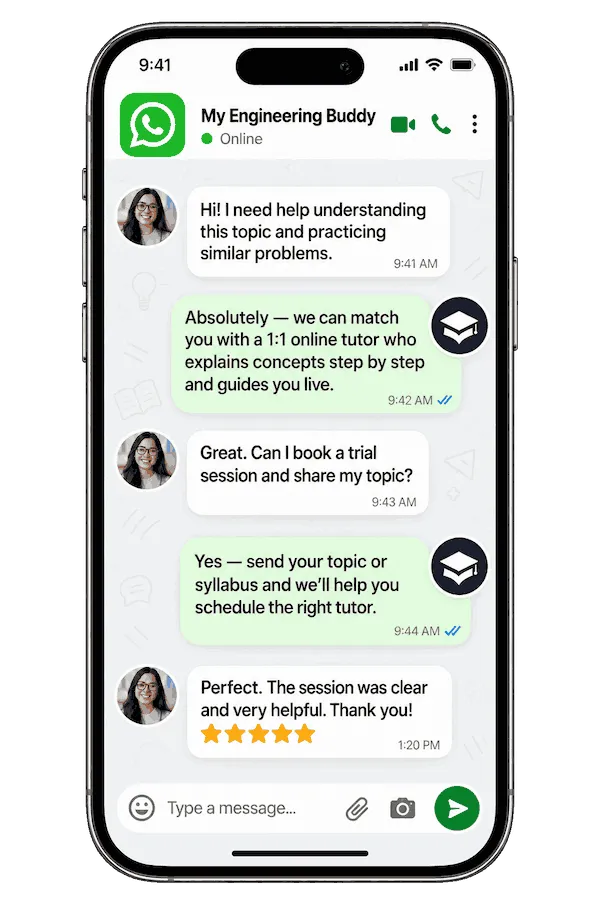
Unlike platforms where you fill out a form and wait days, MEB responds in under a minute, 24/7. Tutor match takes under an hour. The $1 trial means you test before you commit. Everything runs over WhatsApp — no logins, no intake forms.
Study Plans (Pick One That Matches Your Goal)
After the diagnostic session, the tutor builds a specific sequence. The three most common structures: a catch-up plan (1–3 weeks, for students with a submission in days and clear gaps to close), an exam or essay prep plan (4–8 weeks, structured around a specific deadline with tracked progress), or weekly support through the semester, aligned to your module schedule and upcoming assessment dates. No two plans look the same — the tutor builds it around your syllabus, not a template.
Pricing Guide
Archaeology tutoring starts at $20/hr for standard undergraduate modules. Graduate-level dissertation supervision and specialist sub-fields — zooarchaeology, archaeobotany, digital heritage — can reach $100/hr depending on the tutor’s research background. Rate factors include your level, the complexity of the topic, your deadline, and tutor availability.
For students targeting top postgraduate programmes in archaeology or heritage studies, tutors with active research or professional fieldwork backgrounds are available at higher rates — share your specific goal and MEB will match the tier to your ambition.
Tutor availability drops fast during peak submission periods. Start with the $1 trial — 30 minutes, no registration, no commitment. WhatsApp MEB for a quick quote.
Students consistently tell us that the hardest part of Archaeology isn’t the content — it’s not knowing how to turn a pile of evidence into a coherent argument. At MEB, that’s often the first thing we fix. One session on essay structure can shift an entire grade band.
FAQ
Is Archaeology hard?
It’s demanding in specific ways. The combination of scientific dating methods, theoretical debate, and formal report writing catches many students off guard. Students who struggle most are usually missing either the analytical framework or the essay conventions — both are fixable with targeted 1:1 help.
How many sessions are needed?
Most students with a specific gap — one essay type, one dating method, one theoretical debate — see clear improvement in 3–5 sessions. Students working through a full module or dissertation chapter typically need 10–20 hours spread over 4–8 weeks.
Can you help with practice exercises?
Yes. MEB tutoring is guided learning — you understand the work, then submit it yourself. See our Academic Integrity policy and Why MEB page for full details on what we help with and what we don’t. Tutors explain the method; you produce the work.
Will the tutor match my exact syllabus or exam board?
Yes. Before matching, MEB asks for your institution, module code or course name, and assessment type. The tutor is selected based on familiarity with that specific syllabus — not just the general subject area.
What happens in the first session?
The first session is a diagnostic. The tutor reviews a piece of your recent work or asks targeted questions to locate your gaps precisely. From that, a session plan is built. You don’t waste time on content you already know.
Is online tutoring as effective as in-person?
For Archaeology, yes — particularly for theory, essay work, and dating method explanation. Diagram annotation via digital pen-pad on Google Meet replicates whiteboard teaching well. Fieldwork skills are the one area that requires physical presence, which falls outside tutoring scope regardless.
Can I get Archaeology help at midnight or over a weekend?
Yes. MEB operates 24/7 via WhatsApp. If you have a submission due Monday and a crisis Saturday night, message MEB — response time averages under a minute. Tutor availability varies, but urgent requests are prioritised.
What if I don’t connect well with my assigned tutor?
Request a change via WhatsApp. MEB reassigns without a fee or waiting period. The $1 trial exists precisely so you can test the match before committing to a longer session block.
How do processual and post-processual archaeology differ, and does my tutor know both?
Processual archaeology treats culture as a system, applying scientific methods to explain behaviour. Post-processual approaches focus on meaning, agency, and identity. Both appear in undergraduate and postgraduate assessments regularly. MEB tutors covering theory are familiar with both and can help you apply them in essays or exam answers accurately.
Do you support students working with GIS or digital survey data in archaeology?
Yes. Tutors with digital humanities and landscape archaeology backgrounds can support GIS-based assignments, spatial analysis write-ups, and remote sensing interpretation. Share your specific software and assessment brief when you first contact MEB so the right tutor is assigned from the start.
How do I get started?
Start with the $1 trial: 30 minutes of live tutoring or one homework question explained in full. Three steps — WhatsApp MEB, get matched within the hour, begin your trial session. No forms, no registration required.
Trust & Quality at My Engineering Buddy
Every MEB tutor is screened before they take a session. Screening includes subject knowledge verification, a live demo session evaluated against MEB’s teaching criteria, and ongoing review based on student feedback. Tutors hold relevant degrees and, for advanced subjects, active research or professional field experience. Rated 4.8/5 across 40,000+ verified reviews on Google. For Sociology tutoring and adjacent humanities subjects, the same rigour applies — no tutor reaches a student without passing the full process.
MEB tutoring is guided learning — you understand the work, then submit it yourself. For full details on what we help with and what we don’t, read our Academic Integrity policy and Why MEB.
MEB has served 52,000+ students across the US, UK, Canada, Australia, the Gulf, and Europe in 2,800+ subjects since 2008. Within Social Science, the platform covers Archaeology alongside Geography tutoring, Political Science tutoring, and dozens of related disciplines — all under the same tutor vetting and session quality standards.
Explore Related Subjects
Students studying Archaeology often also need support in:
- Biological Anthropology
- Classical Sociological Theory
- Demography
- Development Studies
- Ethnolinguistics
- Global Studies
- Native American Studies
Next Steps
When you contact MEB, have these ready:
- Your course name, institution, and module outline or syllabus
- A recent piece of marked work or a homework question you’re stuck on
- Your exam date, submission deadline, and available time zones
MEB matches you with a verified Archaeology tutor — usually within 24 hours, often faster. The first session starts with a diagnostic so every minute is used on your actual gaps, not generic content.
Visit www.myengineeringbuddy.com for more on how MEB works.
WhatsApp to get started or email [email protected].
Reviewed by Subject Expert
This page has been carefully reviewed and validated by our subject expert to ensure accuracy and relevance.




