




~1 min
Average Reply Time
~1 hour
To Be Matched With A Tutor
1 Trial
75% Find Their Tutor On The 1st Trial
$1
Your First 30 Minutes
Hire The Best C# Programming Tutor
Top Tutors, Top Grades. Without The Stress!



Related Subjects
C# won’t debug itself — and neither will a YouTube video at 2 a.m. If your assignments are piling up and the compiler errors aren’t making sense, you need a tutor who knows the language cold.
C# Programming Tutor Online
C# (C-Sharp) is a statically typed, object-oriented programming language developed by Microsoft and used within the .NET framework. It equips developers to build desktop applications, web APIs, game logic in Unity, and enterprise-level software systems.
MEB offers 1:1 online tutoring and homework help in 2,800+ advanced subjects, including C# Programming. Whether you’re searching for a C# Programming tutor near me or need someone who understands your exact university module, MEB matches you with a verified expert — usually within the hour. Our tutors cover everything from basic syntax to advanced design patterns, and they work at your pace, not a fixed course schedule. Students who start with the $1 trial consistently say it clarified more in 30 minutes than a week of lecture slides. As part of our broader computer programming tutoring offering, C# support is available across all time zones.
- 1:1 online sessions tailored to your specific university module or course syllabus
- Expert-verified tutors with hands-on C# and .NET development experience
- Flexible scheduling across US, UK, Canada, Australia, and Gulf time zones
- Structured learning plan built after a diagnostic in your first session
- Ethical homework and assignment guidance — you understand the code, then submit it yourself
52,000+ students across the US, UK, Canada, Australia, and the Gulf have used MEB since 2008 — including students in Computer Programming subjects like C# Programming, Java tutoring, and C++ programming help.
Source: My Engineering Buddy, 2008–2025.
How Much Does a C# Programming Tutor Cost?
Most C# Programming sessions run $20–$40/hr. Graduate-level or highly specialised .NET architecture work can reach up to $100/hr. The $1 trial gives you 30 minutes of live 1:1 tutoring or a full explanation of one homework question — no registration required.
| Level / Need | Typical Rate | What’s Included |
|---|---|---|
| Standard (undergraduate) | $20–$35/hr | 1:1 sessions, homework guidance |
| Advanced / Specialist (.NET, Unity, architecture) | $35–$100/hr | Expert tutor, niche depth |
| $1 Trial | $1 flat | 30 min live session or 1 homework question |
Tutor availability tightens significantly during semester finals and project submission windows. Book early if you have a hard deadline.
WhatsApp MEB for a quick quote — average response time under 1 minute.
Who This C# Programming Tutoring Is For
C# sits at an awkward middle ground — more structured than Python, less bare-metal than C++. Students often hit a wall at object-oriented principles, LINQ, or async programming and don’t know where the actual gap is. MEB tutoring is built for exactly that situation.
- Undergraduate CS and software engineering students whose C# module is moving faster than the lectures explain
- Students retaking after a failed first attempt in a programming fundamentals or OOP course
- Students with a university conditional offer depending on their final programming grade
- Graduate students using C# for research tools, data pipelines, or thesis software components
- Working developers (at MIT, Carnegie Mellon, Georgia Tech, Imperial College London, University of Waterloo, University of Melbourne, or TU Delft) upskilling into .NET or Unity game development
- Parents watching a child’s confidence drop as assignment complexity increases mid-semester
- Students who need guided homework help to understand the code before submission
1:1 Tutoring vs Self-Study vs AI vs YouTube vs Online Courses
Self-study works if you’re disciplined, but C# error messages don’t explain themselves. AI tools give fast answers — they can’t see where your logic breaks down live. YouTube is fine for concept overviews, useless when you’re stuck on a specific null reference exception at midnight. Online courses move at a fixed pace and don’t adapt when you’re behind. 1:1 tutoring with MEB is calibrated to your exact C# module, corrects misconceptions in the moment, and doesn’t move on until the concept sticks.
Outcomes: What You’ll Be Able To Do in C# Programming
After working with an MEB tutor, students can write clean, well-structured C# classes using proper encapsulation and inheritance. They can apply LINQ queries to collections, handle exceptions without crashing applications, and work confidently with async/await patterns in real .NET projects. Students also learn to explain their code design decisions in vivas and coursework write-ups — not just get it running. The difference shows in assessed lab submissions, code reviews, and final project presentations.
Based on feedback from 40,000+ sessions collected by MEB from 2022 to 2025, 58% of students improved by one full grade after approximately 20 hours of 1:1 tutoring in subjects like C# Programming. A further 23% achieved at least a half-grade improvement.
Source: MEB session feedback data, 2022–2025.
At MEB, we’ve found that C# students who struggle the most aren’t missing effort — they’re missing a clear mental model of how objects, methods, and memory actually interact. Fix that model early, and the rest of the language clicks surprisingly fast.
What We Cover in C# Programming (Syllabus / Topics)

Core C# Language Fundamentals
- Data types, variables, operators, and control flow (if/else, switch, loops)
- Methods, parameters, return types, and method overloading
- Arrays, lists, dictionaries, and collection iteration
- String manipulation and formatting
- Exception handling with try/catch/finally blocks
- File I/O and basic stream operations
Recommended texts: C# 12 and .NET 8 — Modern Cross-Platform Development by Mark J. Price; Head First C# by Andrew Stellman and Jennifer Greene.
Object-Oriented Programming in C#
- Classes, objects, constructors, and destructors
- Encapsulation, inheritance, and polymorphism
- Abstract classes and interfaces
- Static vs instance members
- Generics and type constraints
- Design patterns: Singleton, Factory, Repository, and Observer in C# context
Recommended texts: Pro C# 10 with .NET 6 by Andrew Troelsen and Phil Japikse; Design Patterns in C# by Vaskaran Sarcar.
Advanced C# and .NET Development
- LINQ: query syntax vs method syntax, deferred execution, and lambda expressions
- Async programming with async/await and Task Parallel Library
- Delegates, events, and Func/Action/Predicate types
- ASP.NET Core: building REST APIs and MVC web applications
- Entity Framework Core: database-first and code-first approaches
- Unit testing with xUnit or NUnit; dependency injection fundamentals
- Unity scripting basics for game logic in C# (MonoBehaviour lifecycle)
Recommended texts: CLR via C# by Jeffrey Richter; ASP.NET Core in Action by Andrew Lock.
Students consistently tell us that the jump from writing C# code that runs to writing C# code that’s actually structured well is where the real difficulty is. That gap between “it works” and “it’s correct” is exactly where tutor feedback earns its value.
Platforms, Tools & Textbooks We Support
C# development depends heavily on the tools you’re working in. MEB tutors are comfortable across the full Microsoft and cross-platform .NET ecosystem and can guide you directly in your own environment.
- Visual Studio 2022 (Community, Professional, Enterprise)
- Visual Studio Code with C# Dev Kit extension
- .NET 6 / .NET 8 SDK and CLI tooling
- Unity Editor (2022 LTS and 2023) for game development assignments
- GitHub and Git for version control and assignment submission
- NuGet package manager
- SQL Server and SQLite with Entity Framework Core
- xUnit, NUnit, and MSTest for unit testing frameworks
MIT OpenCourseWare’s Introduction to Computer Science is a useful foundational reference for students new to programming concepts before moving into C#-specific coursework.
What a Typical C# Programming Session Looks Like
The tutor opens by checking the previous topic — say, whether the student’s interface implementation from last time compiled cleanly and why one method was returning null. From there, the session moves to the current sticking point: maybe async/await is producing deadlocks, or the Entity Framework query isn’t returning the expected records. The tutor writes on a digital pen-pad, stepping through the logic line by line, then hands the problem back and watches the student reproduce the fix. Explanations cover not just what to change but why the original code behaved the way it did. The session closes with a specific task — implement a repository pattern for one data model — and the next topic is flagged before logging off.
How MEB Tutors Help You with C# Programming (The Learning Loop)
Diagnose: In the first session, the tutor asks you to write or walk through a piece of your own code. Within minutes they can see whether the gap is syntax, logic structure, OOP concepts, or something more specific like misunderstanding the C# memory model or nullable reference types.
Explain: The tutor works through a live example on a digital pen-pad — not slides, not pre-recorded video. You watch the solution build in real time. They name the exact concept, show a broken version first, then fix it and explain the difference.
Practice: You attempt a similar problem while the tutor watches. This is where most progress happens. Errors surface immediately, not three days later when you’re marking your own work.
Feedback: Every mistake gets a specific correction with a reason. Not “this is wrong” — but “this returns null here because the method signature doesn’t handle the case where the list is empty.” That’s the kind of feedback that changes how you write code going forward.
Plan: Each session ends with a clear next topic and a concrete practice task. The tutor tracks what’s been covered and what still needs work, so sessions don’t drift or repeat ground unnecessarily.
Sessions run over Google Meet with screen sharing. The tutor uses a digital pen-pad or iPad with Apple Pencil for annotations. Before your first session, send over your assignment brief, the specific error or concept you’re stuck on, and your deadline. The first session is partly diagnostic — the tutor uses it to calibrate the pace and sequence for everything that follows. Start with the $1 trial — 30 minutes of live tutoring that also serves as your first diagnostic.
MEB tutors have supported students working in Visual Studio, Unity, and ASP.NET Core environments — from first-year OOP assignments to graduate-level API architecture — since 2008, across 18 years of live 1:1 C# Programming tutoring.
Source: My Engineering Buddy, 2008–2025.
Tutor Match Criteria (How We Pick Your Tutor)
Not every C# tutor is a fit for every student. MEB matches on four criteria.
Subject depth: The tutor must have worked in C# at the level you need — undergraduate OOP, ASP.NET Core API development, Unity scripting, or graduate software architecture. A tutor who knows the language well but has never built an EF Core data layer won’t be assigned to a student who needs exactly that.
Tools: Every tutor uses Google Meet with screen sharing and a digital pen-pad or iPad with Apple Pencil. No exceptions — this is how live annotation and code walkthrough works.
Time zone: Matched to your region. US East, UK, Gulf, Canada, and Australia are all covered with tutors who keep reasonable local hours.
Goals: Whether you need to pass a specific module, build a portfolio project, understand async programming deeply, or hit a target grade — the tutor match reflects that specific aim.
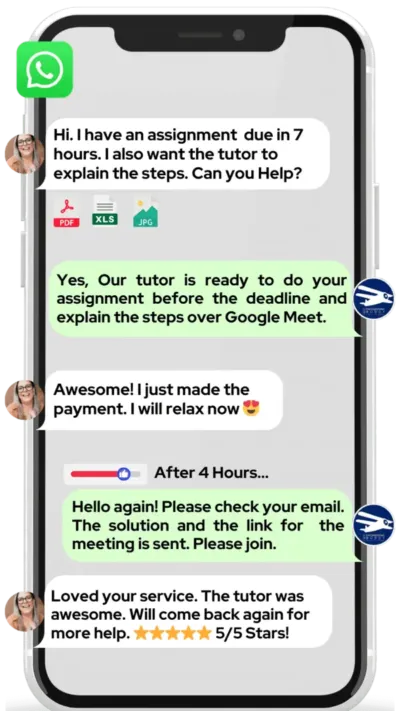
Unlike platforms where you fill out a form and wait days, MEB responds in under a minute, 24/7. Tutor match takes under an hour. The $1 trial means you test before you commit. Everything runs over WhatsApp — no logins, no intake forms.
Study Plans (Pick One That Matches Your Goal)
After the first diagnostic session, the tutor builds a specific sequence. Most students choose one of three paths: a short catch-up over 1–3 weeks to close one targeted gap before a submission deadline; a structured exam or project-prep plan over 4–8 weeks aligned to a specific assessment date; or ongoing weekly sessions through the semester, paced to coursework deadlines as they appear. The tutor adjusts as the course progresses — no rigid plan survives contact with a sudden change in assignment scope.
Pricing Guide
C# Programming tutoring starts at $20/hr for standard undergraduate work. Specialist areas — ASP.NET Core architecture, Unity game systems, graduate-level software design — can run up to $100/hr depending on the tutor’s depth and the complexity of the topic.
Rate factors: your course level, how niche the topic is, how close your deadline is, and tutor availability at your preferred times. Availability tightens hard during semester finals — if you have a fixed submission date, book before it becomes urgent.
For students targeting roles at top software companies or pursuing graduate research that requires production-quality C# work, tutors with professional industry backgrounds are available at higher rates — share your specific goal and MEB will match the tier to what you’re actually trying to achieve.
Start with the $1 trial — 30 minutes, no registration, no commitment. WhatsApp MEB for a quick quote.
FAQ
Is C# Programming hard to learn?
C# is harder than Python but more approachable than C++. The syntax is strict, OOP concepts require genuine understanding, and async programming trips up most students at first. With structured 1:1 guidance, the learning curve shortens noticeably.
How many sessions are typically needed?
Most students see real progress after 4–6 sessions. Closing a gap in one topic — like LINQ or generics — often takes 2–3 focused sessions. A full semester of support typically means weekly sessions throughout the course, adjusted to assignment deadlines.
Can you help with C# homework and assignments?
Yes. MEB tutoring is guided learning — you understand the code, then submit it yourself. Tutors explain the logic, walk through the approach, and help you identify where your own implementation goes wrong. See our Academic Integrity policy and Why MEB page for full details on what we help with and what we don’t.
Will the tutor match my exact university module or syllabus?
Yes. When you contact MEB, share your course outline or assignment brief. The tutor is matched specifically to your module — not assigned generically. If your course uses Entity Framework or Unity, the tutor will have direct experience with those tools.
What happens in the first session?
The tutor runs a short diagnostic — usually asking you to walk through code you’ve written or explain a concept in your own words. This takes 10–15 minutes and shapes the entire plan. The rest of the session addresses the most urgent gap immediately.
Is online C# tutoring as effective as in-person?
For programming, online is often better. Screen sharing lets the tutor see your exact code and environment. The digital pen-pad works directly over the shared screen. There’s no travel, no fixed location, and sessions can happen the same day you get stuck.
What’s the difference between C# and C++, and can MEB help with both?
C# runs on the .NET runtime with managed memory; C++ is compiled to machine code with manual memory management. They share syntax ancestry but serve different use cases. MEB has specialist tutors for both — you won’t be assigned a C++ tutor for a C# module. Get C++ programming help separately if you need it.
Can MEB help with Unity game development using C#?
Yes. Unity scripting is a significant part of what MEB C# tutors cover. This includes MonoBehaviour lifecycle methods, coroutines, collision detection logic, scriptable objects, and structuring game systems cleanly. Students working on game development coursework or personal portfolio projects are covered. MEB also supports students needing Python tutoring for data or AI components alongside their Unity work.
Can I get C# help late at night or on weekends?
Yes. MEB operates 24/7. WhatsApp response time averages under a minute regardless of the hour. Tutors are available across time zones, so a session at 11 p.m. in Toronto or 1 a.m. in Dubai is entirely feasible — not an exception.
Do you offer group C# Programming sessions?
No. All MEB sessions are 1:1. Group sessions dilute the diagnostic value — a tutor working with one student can identify and fix the exact error pattern in real time. That precision disappears in a group format.
Should I learn C# or Java first, and can MEB help me decide?
Both are strongly typed OOP languages with similar concepts. C# is dominant in .NET, Unity, and Windows enterprise; Java is standard in Android and large-scale backend systems. Your tutor can assess your course goals and advise. MEB also provides Java tutoring for students navigating both tracks.
How do I get started with MEB?
Start with the $1 trial — 30 minutes of live tutoring or one homework question explained in full. Three steps: WhatsApp MEB, get matched with a verified C# tutor (usually within the hour), then start your trial session.
Trust & Quality at My Engineering Buddy
Every MEB tutor goes through subject-specific screening before taking a session. This includes a live demo evaluation, verification of their academic or professional background in C# and .NET development, and ongoing review based on student session feedback. MEB doesn’t assign tutors by availability alone — the match is based on your exact module, the tools you’re using, and your stated goal. Rated 4.8/5 across 40,000+ verified reviews on Google, MEB has served 52,000+ students since 2008.
MEB tutoring is guided learning — you understand the work, then submit it yourself. For full details on what we help with and what we don’t, read our Academic Integrity policy and Why MEB.
MEB has been running since 2008 and covers 2,800+ subjects across the US, UK, Canada, Australia, the Gulf, and Europe. Computer Programming is one of MEB’s strongest categories — with dedicated tutors for JavaScript help, SQL tutoring, and Swift programming tutoring alongside C#. The tutor network spans industry practitioners and academics — not just people who passed the course themselves. See our tutoring methodology for how sessions are structured and how progress is tracked.
MEB has matched students with C# Programming tutors for university modules, final-year projects, and professional upskilling across 40+ countries. The platform runs over WhatsApp — no intake forms, no waiting lists, no account setup required before your first session.
Source: My Engineering Buddy, 2008–2025.
A common pattern our tutors observe is that students who’ve spent hours on Stack Overflow trying to fix one bug often have a deeper conceptual gap underneath it. The bug is a symptom. One session that finds the real issue saves ten hours of trial and error.
Explore Related Subjects
Students studying C# Programming often also need support in:
Next Steps
Getting started takes under two minutes. When you WhatsApp MEB, share your exam board or course name, the topic or assignment you’re stuck on, and your deadline or upcoming assessment date. Also share your time zone and preferred session times — MEB matches you with a verified tutor, typically within 24 hours, and often within the hour.
Before your first session, have ready:
- Your course outline or assignment brief
- A recent piece of code or homework you struggled with
- Your submission or exam deadline date
The tutor handles the rest — the first session starts with a diagnostic so every minute of your time is used on what actually matters.
Visit www.myengineeringbuddy.com for more on how MEB works.
WhatsApp to get started or email [email protected].
52,000+ Happy Students From Various Universities






Reviewed by Subject Expert
This page has been carefully reviewed and validated by our subject expert to ensure accuracy and relevance.
