

Hire Verified & Experienced
Digital Communications Tutors
Email: [email protected]
4.8/5 40K+ session ratings collected on the MEB platform



Hire The Best Digital Communications Tutor
Top Tutors, Top Grades. Without The Stress!
Most students hit a wall at modulation schemes or channel coding — and a textbook reread doesn’t fix it.
Digital Communications Tutor Online
Digital Communications is an undergraduate and graduate engineering course covering the transmission of information using digital signals — including modulation techniques, source and channel coding, error correction, and spectral efficiency across wired and wireless channels.
MEB provides 1:1 online Electrical Engineering tutoring and homework help across 2,800+ advanced subjects, including Digital Communications. If you’ve searched for a Digital Communications tutor near me, the tutor comes to you — live, online, and matched to your exact course and syllabus. Students working consistently with MEB typically close two or three major topic gaps before their next exam sitting.
- 1:1 online sessions tailored to your course syllabus and exam board
- Expert verified tutors with hands-on knowledge of signal processing and communications theory
- Flexible time zones — US, UK, Canada, Australia, Gulf
- Structured learning plan built after a diagnostic session
- Ethical homework and assignment guidance — you understand the work before you submit
52,000+ students across the US, UK, Canada, Australia, and the Gulf have used MEB since 2008 — including students in Electrical Engineering subjects like Digital Communications, Analog Communication, and Signals and Systems.
Source: My Engineering Buddy, 2008–2025.
How Much Does a Digital Communications Tutor Cost?
Rates run $20–$40/hr for most undergraduate levels. Graduate and specialist sessions go up to $100/hr depending on depth and tutor background. Not sure if it’s worth it? Start with the $1 trial — 30 minutes of live tutoring or one assignment question explained in full, no registration required.
| Level / Need | Typical Rate | What’s Included |
|---|---|---|
| Standard (most undergrad levels) | $20–$35/hr | 1:1 sessions, homework guidance |
| Advanced / Graduate / Specialist | $35–$100/hr | Expert tutor, graduate-depth topics |
| $1 Trial | $1 flat | 30 min live session or 1 homework question |
Tutor availability tightens significantly during end-of-semester exam periods. Book early if you’re working toward a fixed deadline.
WhatsApp MEB for a quick quote — average response time under 1 minute.
Who This Digital Communications Tutoring Is For
Digital Communications sits at the intersection of mathematics, signal theory, and systems engineering. It’s abstract, cumulative, and unforgiving if you miss a foundational concept early. These are the students MEB works with most often.
- Undergraduates in Electrical Engineering, Electronics, or Telecommunications who are stuck on modulation, BER analysis, or channel coding theorems
- Graduate students needing to strengthen their foundations before a qualifying exam or thesis defense
- Students with a university conditional offer depending on this grade
- Students 4–6 weeks from a final exam with significant gaps still to close
- Students whose coursework or lab assignment deadline is approaching and the derivations aren’t clicking
- Parents watching a child’s confidence drop alongside their grades in a course they can’t help with directly
MEB tutors have supported students at institutions including MIT, Georgia Tech, University of Toronto, Imperial College London, TU Delft, ETH Zurich, University of Melbourne, and King Abdullah University of Science and Technology.
1:1 Tutoring vs Self-Study vs AI vs YouTube vs Online Courses
Self-study works if you’re disciplined and already understand the foundations — but Digital Communications has layers where a single misread derivation sends you in the wrong direction for weeks. AI tools give fast definitions but can’t diagnose whether your confusion is in the probability model, the Fourier transform step, or the SNR interpretation. YouTube covers QAM and OFDM well at an overview level, then stalls when you’re halfway through a specific problem set. Online courses move at a fixed pace with no adjustment for where you’re actually stuck. 1:1 tutoring with MEB is live, calibrated to your exact course and problem sheet, and corrects errors in the moment — which matters in a subject where one wrong assumption compounds across every topic that follows.
Outcomes: What You’ll Be Able To Do in Digital Communications
After consistent 1:1 sessions, students routinely report that the course stops feeling like disconnected formulas. You’ll be able to analyze the bit error rate performance of BPSK, QPSK, and QAM under AWGN and fading channel conditions. You’ll be able to apply Shannon’s channel capacity theorem to real system constraints and explain the tradeoffs between bandwidth and power. You’ll be able to design and evaluate source coding and channel coding schemes — including Huffman coding, convolutional codes, and turbo codes — and explain why one outperforms another for a given channel. You’ll be able to model a digital communications link end-to-end, from source to receiver, and identify where performance degrades. You’ll be able to present your reasoning clearly in derivation-heavy exam questions, not just arrive at the right number.
Try your first session for $1 — 30 minutes of live 1:1 tutoring or one homework question explained in full. No registration. No commitment. WhatsApp MEB now and get matched within the hour.
Based on feedback from 40,000+ sessions collected by MEB from 2022 to 2025, 58% of students improved by one full grade after approximately 20 hours of 1:1 tutoring in subjects like Digital Communications. A further 23% achieved at least a half-grade improvement.
Source: MEB session feedback data, 2022–2025.
What We Cover in Digital Communications (Syllabus / Topics)

Track 1: Signals, Modulation, and Demodulation
- Baseband vs passband signal representation
- Amplitude, frequency, and phase modulation (AM, FM, PM)
- Digital modulation: ASK, FSK, PSK, DPSK, QAM
- Constellation diagrams and signal space analysis
- Coherent and non-coherent detection
- OFDM — subcarrier structure, cyclic prefix, guard intervals
- Matched filter receiver design and optimal detection
Key texts: Proakis & Salehi Digital Communications (5th ed.), Haykin & Moher Communication Systems (4th ed.).
Track 2: Source Coding, Channel Coding, and Error Control
- Information theory fundamentals: entropy, mutual information
- Shannon’s source coding theorem and channel capacity
- Huffman coding and arithmetic coding
- Linear block codes: Hamming, Reed-Solomon
- Convolutional codes and the Viterbi algorithm
- Turbo codes and LDPC codes — principles and performance
- ARQ, HARQ, and retransmission strategies
Key texts: Lin & Costello Error Control Coding (2nd ed.), Blahut Principles and Practice of Information Theory.
Track 3: Channel Models, Noise, and System Performance
- AWGN channel — noise power spectral density, SNR, Eb/N0
- Bit error rate (BER) derivations for BPSK, QPSK, M-QAM
- Multipath fading: Rayleigh, Rician, frequency-selective vs flat fading
- Diversity techniques: time, frequency, spatial (MIMO overview)
- Spread spectrum: DSSS, FHSS, CDMA principles
- Synchronisation: carrier recovery, timing recovery, phase-locked loops
- Wireless communication link budget analysis
Key texts: Goldsmith Wireless Communications, Sklar Digital Communications: Fundamentals and Applications (2nd ed.).
What a Typical Digital Communications Session Looks Like
The tutor opens by checking where you left off — usually BER derivation or a coding scheme that didn’t fully land last time. You share your screen or problem sheet, and the tutor works through the specific question with you using a digital pen-pad, annotating each step: setting up the signal model, applying the noise distribution, carrying the integral through to the final probability expression. You then attempt the next problem yourself while the tutor watches. When you stall — typically at the point where the Q-function substitution happens or where the generator polynomial needs to be applied — the tutor steps in, names the exact error, and has you redo that step. Session ends with one or two practice problems set for before the next session, and the tutor notes which topic comes next: usually multipath channel modelling or diversity combining, depending on your syllabus order. You leave knowing exactly what to review and why.
How MEB Tutors Help You with Digital Communications (The Learning Loop)
Diagnose: In the first session, the tutor asks you to work through a short problem — typically a BER calculation or a Huffman coding exercise — and identifies exactly where your reasoning breaks down. Is it the probability framework, the Fourier domain representation, or the algebraic manipulation? That determines the session plan.
Explain: The tutor works through solved examples on a shared digital canvas — not slides, not a static PDF. Each derivation is written live, step-by-step, with the reasoning spoken aloud. For Digital Communications, this matters most when you’re tracking a proof from signal space geometry all the way to a closed-form BER expression.
Practice: You attempt the next problem while the tutor observes. No interruptions until you reach a decision point. This is deliberate — the goal is to surface where your understanding actually breaks, not where you think it breaks.
At MEB, we’ve found that Digital Communications students who struggle most have usually memorised the formulas but never worked through a full derivation under exam conditions. The tutor’s job is to walk you through that process until it’s second nature — not to hand you the answer.
Feedback: After you attempt each problem, the tutor goes through every error — not just the final answer, but each step where marks would be lost in an exam. Students consistently tell us this is the part that changes how they approach exam questions. Knowing why a step was wrong is the only thing that stops you repeating it.
Plan: The session ends with a clear next topic, two or three practice problems, and a note on what to bring to the next session. For Digital Communications, the sequence typically moves from modulation and detection through coding theory and into channel modelling — but the tutor adjusts based on your syllabus order and exam date.
All sessions run on Google Meet. The tutor uses a digital pen-pad or iPad with Apple Pencil for live annotation. Before your first session, share your course outline or syllabus, a recent problem set you struggled with, and your exam date. Start with the $1 trial — 30 minutes of live tutoring that also serves as your first diagnostic.
A common pattern our tutors observe is that students who struggle with Digital Communications are often solid at circuit analysis but haven’t yet built intuition for probabilistic signal models. That’s the gap the first two sessions are designed to close.
Source: MEB tutor observation, 2008–2025.
Tutor Match Criteria (How We Pick Your Tutor)
Not every engineer who knows Digital Communications can teach it well. MEB’s matching process filters on four things.
Subject depth: Tutors are assessed on the specific topics in your syllabus — modulation schemes, coding theory, channel models. A tutor covering graduate-level MIMO or OFDM system design is different from one covering introductory ASK/FSK at second-year undergraduate level. MEB matches to your level, not just your subject name.
Tools: Every tutor works on Google Meet with a digital pen-pad or iPad and Apple Pencil. Live annotation is non-negotiable for a subject that runs on derivations.
Time zone: Matched to your region — US, UK, Gulf, Canada, or Australia. No 3am sessions unless you want them.
Goals: Whether you need to pass a final exam, close gaps before a qualifying exam, or get structured support through a semester of homework, the tutor is briefed on that before session one.
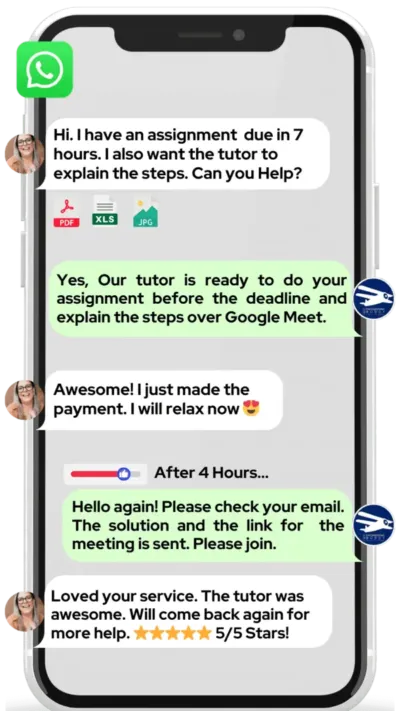
Unlike platforms where you fill out a form and wait, MEB responds in under a minute, 24/7. Tutor match takes under an hour. The $1 trial means you test before you commit. Everything runs over WhatsApp — no logins, no intake forms.
Study Plans (Pick One That Matches Your Goal)
After the first diagnostic session, your tutor maps a specific sequence based on your exam date and current gaps. Three plans cover most situations: a catch-up plan (1–3 weeks) for students who are significantly behind and need to prioritise the highest-yield topics before an exam; an exam prep plan (4–8 weeks) covering the full syllabus in a structured sequence with past paper practice built in; and weekly support for students tracking alongside semester coursework and lab deadlines. The tutor adjusts the plan after every two or three sessions based on what’s landed and what hasn’t.
Pricing Guide
Most Digital Communications sessions run $20–$40/hr. Graduate-level work — MIMO capacity analysis, turbo decoding, advanced channel estimation — sits at the higher end or up to $100/hr depending on the tutor’s background and the depth required. Rate factors include your level, the complexity of topics, how tight your deadline is, and tutor availability.
For students targeting graduate programmes at research-intensive universities or roles in communications engineering at firms working on 5G and beyond, tutors with industry or research backgrounds in wireless systems are available at higher rates — share your specific goal and MEB will match the tier to your ambition.
Availability tightens at end-of-semester. If you have a fixed exam date, book before the last four weeks.
Start with the $1 trial — 30 minutes, no registration, no commitment. WhatsApp MEB for a quick quote.
Students consistently tell us that the first session is the one where they realise how much of Digital Communications they thought they understood but actually couldn’t reproduce under exam conditions. That gap — between recognition and recall — is exactly what the diagnostic is designed to find.
FAQ
Is Digital Communications hard?
Yes, for most students. It combines probability theory, Fourier analysis, and systems thinking in ways that aren’t intuitive at first. The students who find it manageable are usually the ones who got solid help early rather than waiting until the week before the exam.
How many sessions are needed?
Most students close their main topic gaps in 8–12 sessions. Students starting from a significant deficit — or targeting strong performance in a graduate course — typically need 15–20 hours over 6–8 weeks. The tutor gives a clearer estimate after the diagnostic.
Can you help with homework and assignments?
Yes. MEB tutoring is guided learning — you understand the work, then submit it yourself. See our Academic Integrity policy and Why MEB page for full details on what we help with and what we don’t.
Will the tutor match my exact syllabus or exam board?
Yes. Before matching, MEB asks for your course outline, university, and current topic. Tutors are matched to your specific syllabus — not just the subject name. Share your course material before the first session and the tutor reviews it in advance.
What happens in the first session?
The tutor runs a short diagnostic — usually a problem from your recent coursework or a past exam question. This identifies exactly where your understanding breaks down. The rest of the session and the plan that follows are built around what that reveals.
Is online tutoring as effective as in-person?
For Digital Communications, yes. The digital pen-pad replicates the whiteboard experience. Students in the US, UK, and Gulf working with MEB online report outcomes equivalent to in-person sessions — with the added benefit of session recordings they can review before exams.
What’s the difference between Digital Communications and Analog Communication — do I need both?
They’re sequential courses at most universities. Analog Communication tutoring covers AM/FM systems and continuous signal transmission. Digital Communications builds on that with discrete signal models, coding, and modern channel theory. If you’re shaky on analog foundations, the tutor will flag it early.
My university uses MATLAB for Digital Communications simulations — can you help with that?
Yes. Many Digital Communications courses require MATLAB-based simulation of BER curves, channel models, or coding schemes. MEB tutors can walk through your simulation code, explain what the output means, and help you connect the numerical results to the underlying theory.
Can I get Digital Communications help at midnight?
Yes. MEB operates 24/7 across time zones. Message via WhatsApp at any hour — average response time is under one minute. Tutors are available across US, UK, Gulf, and Australian time zones, so late-night help before a morning submission is a standard request, not an exception.
What if I don’t understand my tutor’s explanation style?
Say so — immediately, or after the session. MEB will rematch you within hours, no questions asked. The $1 trial exists precisely so you can test compatibility before committing to a longer engagement. Tutor fit matters more than tutor credentials alone.
How do I get started?
Three steps: WhatsApp MEB, share your course details and exam date, and start the $1 trial — 30 minutes of live Digital Communications tutoring or one homework question explained in full. You’re matched and in a session within the hour.
Does Digital Communications tutoring cover 5G and modern wireless standards?
Yes, where your syllabus includes them. Topics like OFDM, MIMO, massive antenna systems, and link budget analysis for LTE and 5G NR appear in advanced undergraduate and graduate Digital Communications courses. Confirm your course topics when you message MEB and the tutor match will reflect them. See IEEE Xplore for published standards and technical depth if you’re doing research alongside your coursework.
Trust & Quality at My Engineering Buddy
Every MEB tutor goes through subject-specific screening before taking a session. That means a live demo evaluation, a review of their academic and professional background, and ongoing monitoring through session feedback. Tutors covering Digital Communications hold degrees in Electrical Engineering, Communications Engineering, or a closely related field — and many have research or industry experience in signal processing, wireless systems, or semiconductor-layer communications. Rated 4.8/5 across 40,000+ verified reviews on Google.
MEB tutoring is guided learning — you understand the work, then submit it yourself. For full details on what we help with and what we don’t, read our Academic Integrity policy and Why MEB.
MEB has served 52,000+ students across the US, UK, Canada, Australia, the Gulf, and Europe since 2008, covering 2,800+ subjects. Within Electrical Engineering, that includes Digital Communications, Digital Signal Processing tutoring, Communication Systems help, and Telecommunications tutoring. See our tutoring methodology for how sessions are structured and how tutors are held to account across every subject.
Our experience across thousands of sessions shows that the students who improve fastest in Digital Communications are not the ones who study more hours — they’re the ones who get corrective feedback faster. That’s the only variable MEB controls directly.
Source: MEB tutor feedback review, 2022–2025.
A common pattern our tutors observe is that students who have already failed a Digital Communications exam once tend to re-sit with the same gaps — because they revised the same notes rather than doing new problem-solving under timed conditions. The second attempt needs a different approach, not more of the same.
Explore Related Subjects
Students studying Digital Communications often also need support in:
- Digital Electronics
- Digital Circuit
- Satellite Communications
- Optical Communications
- Microwave Engineering
- Radar Systems
- Embedded Systems
- FPGA Design
Next Steps
Getting started takes about two minutes.
- Share your exam board or university course name, your hardest topic right now, and how many weeks you have
- Share your time zone and weekly availability
- MEB matches you with a verified Digital Communications tutor — usually within 24 hours, often within the hour
- First session starts with a diagnostic so every minute is used on what actually matters
Before your first session, have ready: your course outline or syllabus, a recent problem set or assignment you struggled with, and your exam or submission deadline. The tutor handles the rest.
Visit www.myengineeringbuddy.com for more on how MEB works.
WhatsApp to get started or email [email protected].
52,000+ Happy Students From Various Universities






How Much For Private 1:1 Tutoring & Hw Help?
Private 1:1 Tutoring and HW help Cost $20 – 35 per hour* on average.
Reviewed by Subject Expert
This page has been carefully reviewed and validated by our subject expert to ensure accuracy and relevance.
