




~1 min
Average Reply Time
~1 hour
To Be Matched With A Tutor
30 Min Trial
75% Find Their Tutor On The 1st Trial
$20-35+/hr
Premium Yet Affordable Learning
Most IGCSE Art & Design students lose marks not because their work is weak — but because their portfolio lacks direction and their sketchbook doesn’t show enough development.
IGCSE Art & Design (0400) Tutor Online
IGCSE Art & Design (0400) is a Cambridge International qualification assessing students in visual art and design practice. It develops skills in observation, creative exploration, and personal response through a portfolio and externally set assignment.
Finding a reliable IGCSE Art & Design (0400) tutor near me is harder than it sounds — most tutors know either art theory or exam technique, rarely both. MEB connects you with tutors who know the Cambridge 0400 syllabus in detail: Component 1 portfolio requirements, the externally set assignment (Component 2), annotation expectations, and what examiners actually reward. Whether you’re working on Drawing, Photography, Graphic Communication, or Textile Design, your tutor adapts to your chosen area. As part of the broader Cambridge IGCSE programme, 0400 demands both creative output and structured, documented development — and that’s exactly what 1:1 tutoring is built to support.
- 1:1 online sessions aligned to the Cambridge 0400 syllabus and your chosen area of study
- Tutors with subject-specific knowledge of portfolio development and examiner expectations
- Flexible time zones — US, UK, Canada, Australia, Gulf
- Structured learning plan built after a diagnostic session
- Ethical academic guidance — you understand the work, then submit it yourself
52,000+ students across the US, UK, Canada, Australia, and the Gulf have used MEB since 2008 — including students in Cambridge IGCSE subjects like IGCSE Art & Design (0400), IGCSE Drama, and IGCSE Music.
Source: My Engineering Buddy, 2008–2025.
How Much Does an IGCSE Art & Design (0400) Tutor Cost?
Sessions start at $20–$40/hr for most IGCSE levels. Specialist tutors with strong portfolios or examiner backgrounds may run higher. Before committing to a package, you can try the $1 trial — 30 minutes of live tutoring or one full portfolio question explained in detail.
| Level / Need | Typical Rate | What’s Included |
|---|---|---|
| Standard IGCSE (0400) | $20–$35/hr | 1:1 sessions, portfolio and sketchbook guidance |
| Advanced / Specialist | $35–$70/hr | Expert tutor, examiner-level feedback, niche area depth |
| $1 Trial | $1 flat | 30 min live session or one full portfolio question explained |
Tutor availability tightens significantly in the weeks before Cambridge submission deadlines. Book early if your Component 1 portfolio deadline is approaching.
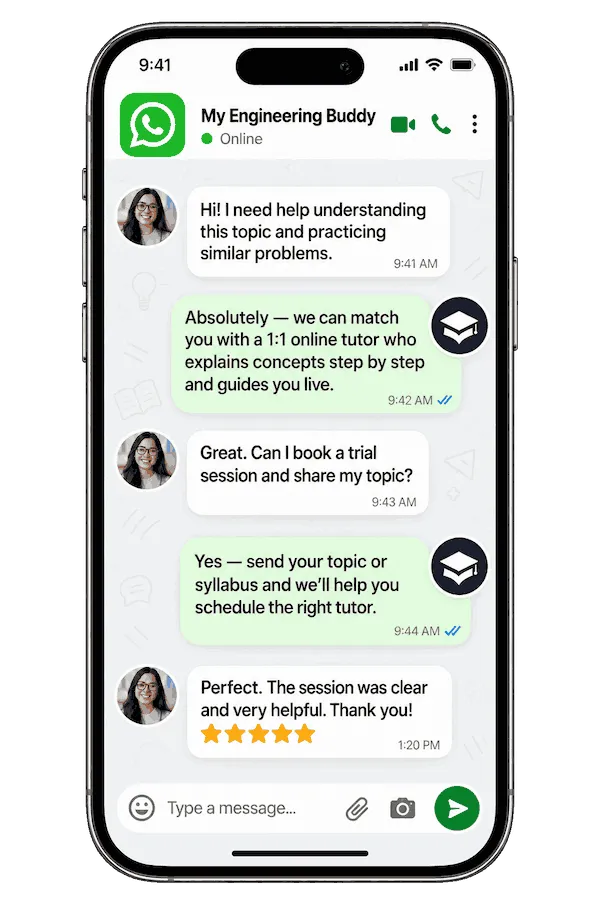
WhatsApp MEB for a quick quote — average response time under 1 minute.
Who This IGCSE Art & Design (0400) Tutoring Is For
This is for students who know they can produce strong work but aren’t sure how to translate that into marks. It’s also for students whose sketchbook development feels thin, or whose annotation reads more like captions than critical reflection.
- Students with a coursework or portfolio submission deadline approaching fast
- Students whose Component 1 portfolio lacks a clear creative journey
- Students unsure how to annotate their work to meet Cambridge examiner expectations
- Students choosing between Drawing, Photography, Graphic Communication, or Textile Design and needing guidance on which area suits them
- Parents watching a student’s confidence drop when their sketchbook gets returned unmarked or with sparse feedback
- Students in the US, UK, Canada, Australia, and the Gulf sitting Cambridge IGCSE — including those at schools offering IGCSE Drama tutoring or IGCSE Music support who also take Art & Design
Students progress to art foundation programmes, A Level Fine Art, IB Visual Arts, and design degrees at institutions including Central Saint Martins, RISD, Parsons School of Design, and the Glasgow School of Art.
1:1 Tutoring vs Self-Study vs AI vs YouTube vs Online Courses
Self-study works if you’re self-directed, but IGCSE Art & Design rewards documented development — and most students can’t audit their own sketchbook objectively. AI tools can suggest ideas but can’t look at your actual work and tell you what the examiner will think. YouTube covers general drawing techniques; it stops the moment your specific portfolio problem starts. Online courses are fixed-pace and built for generic outcomes — not your Cambridge submission date. 1:1 tutoring with MEB is live, responsive to your actual sketchbook and portfolio, and aligned to the Cambridge 0400 mark scheme from the first session.
Outcomes: What You’ll Be Able To Do in IGCSE Art & Design (0400)
After focused 1:1 sessions, students can present a Component 1 portfolio that shows a clear, evidenced creative journey from initial research through to final outcome. You’ll be able to annotate your work with genuine critical reflection — not just descriptions of what you did. You’ll apply observational drawing, media exploration, and contextual study in a way that maps directly to Cambridge assessment objectives. Students also learn to approach the Component 2 externally set assignment with a structured preparatory period, selecting and developing one starting point effectively rather than attempting all of them. You’ll present resolved, finished outcomes that hold together as a body of work — not a collection of unconnected experiments.
Supporting a student through IGCSE Art & Design (0400)? MEB works directly with parents to set up sessions, track portfolio progress, and keep submission timelines on schedule. WhatsApp MEB — average response time is under a minute, 24/7.
Based on feedback from 40,000+ sessions collected by MEB from 2022 to 2025, 58% of students improved by one full grade after approximately 20 hours of 1:1 tutoring in subjects like IGCSE Art & Design (0400). A further 23% achieved at least a half-grade improvement.
Source: MEB session feedback data, 2022–2025.
What We Cover in IGCSE Art & Design (0400) (Syllabus / Topics)
Cambridge IGCSE Art & Design (0400) is assessed across two components. The table below shows the structure:
| Component | Description | Weighting |
|---|---|---|
| Component 1: Portfolio | Internally assessed coursework — sketchbooks, development work, final piece(s) | 60% |
| Component 2: Externally Set Assignment | Cambridge-issued paper with starting points; 15 hours of supervised time | 40% |
Track 1: Portfolio Development (Component 1)
- Choosing and sustaining a personal creative theme or concept
- Research and contextual study — artists, designers, movements relevant to your theme
- Observational drawing and primary source work
- Media exploration: recording experiments with different materials and techniques
- Sketchbook presentation — layout, annotation, visual sequencing
- Development of ideas from research to resolved final outcome
- Critical annotation: how to write about your own work in a way examiners reward
Recommended references: Cambridge IGCSE Art & Design (0400) syllabus document; The Complete Guide to Life Drawing by Gottfried Bammes for observational drawing development.
Track 2: Externally Set Assignment (Component 2)
- Understanding the Cambridge assignment paper and its starting point options
- Selecting one starting point and justifying the choice
- Preparatory period: research, exploration, and development before the supervised session
- Time management during the 15-hour supervised period
- Producing a resolved outcome that responds clearly to the chosen starting point
- Presentation and mounting of final work for external moderation
Recommended references: Cambridge International specimen papers for 0400; Drawing on the Right Side of the Brain by Betty Edwards as a practical skill-building resource.
Track 3: Area of Study — Graphic Communication and Design Technology
- Visual communication principles: layout, typography, and image relationship
- Design briefs and problem-solving through visual means
- Digital and hand-produced design work within the portfolio
- Understanding design movements and their influence on contemporary work
- Connecting design history to your own visual choices
Students taking related subjects often also benefit from IGCSE Design Technology tutoring alongside their Art & Design work. Recommended text: Graphic Design: The New Basics by Ellen Lupton and Jennifer Cole Phillips.

What a Typical IGCSE Art & Design (0400) Session Looks Like
The tutor opens by checking what you worked on since the last session — specifically whether you’ve added development pages to your sketchbook or advanced your contextual research. From there, you work through an area that’s holding the portfolio back. That might be annotating a mixed-media experiment you completed but haven’t written about, or working out how to visually sequence pages so the creative journey reads clearly. The tutor uses a digital pen-pad to mark up your scanned sketchbook pages directly, pointing to specific areas and showing you what stronger annotation would look like. You rewrite or redevelop one section during the session so you leave with something done, not just discussed. The session closes with a specific task — three new development pages, one artist study, or a refined final composition — and a note on what the next session will tackle.
How MEB Tutors Help You with IGCSE Art & Design (0400) (The Learning Loop)
Diagnose: In the first session, the tutor reviews your current portfolio or sketchbook, identifies which assessment objectives are weakly evidenced, and maps the gap between where you are and what the Cambridge mark scheme rewards at your target grade.
Explain: The tutor works through a live example — showing what a well-developed page looks like versus a thin one, or demonstrating how to write annotation that goes beyond description into genuine reflection. All of this happens on screen with a digital pen-pad.
Practice: You work on your own sketchbook or portfolio task during the session, with the tutor present. Not watching — actively responding as you go, asking questions that push your thinking.
Feedback: When a page or piece is done, the tutor marks it against the Cambridge assessment criteria — pointing out exactly where marks are gained and where they’re lost. No vague encouragement. Specific, criterion-referenced feedback.
Plan: Every session ends with a clear task list: what to produce before next time, which artist to research, which component to develop. Progress is tracked session to session so nothing drifts.
Sessions run over Google Meet. The tutor uses a digital pen-pad or iPad with Apple Pencil to annotate your work directly on screen. Before your first session, scan or photograph your current sketchbook pages and share them via WhatsApp so the tutor arrives prepared. Start with the $1 trial — 30 minutes of live tutoring that also serves as your first diagnostic.
At MEB, we’ve found that IGCSE Art & Design students who struggle most are often producing genuinely strong work — they just haven’t been shown how to document their process in a way Cambridge examiners can follow and reward.
Tutor Match Criteria (How We Pick Your Tutor)
Not every art tutor knows Cambridge 0400 specifically. MEB matches on four criteria.
Subject depth: Tutors are matched to your chosen area of study — Drawing, Photography, Graphic Communication, or Textile Design — and to the Cambridge 0400 syllabus specifically, not just general art instruction.
Tools: Every tutor works with Google Meet and a digital pen-pad or iPad with Apple Pencil — essential for marking up portfolio and sketchbook pages live.
Time zone: Matched to your region — US, UK, Gulf, Canada, Australia — so sessions run at a sensible hour without compromise on tutor quality.
Goals: Whether you need Component 1 portfolio rescue, Component 2 exam preparation, or steady weekly support through the academic year, the tutor is matched to your specific situation.
Unlike platforms where you fill out a form and wait, MEB responds in under a minute, 24/7. Tutor match takes under an hour. The $1 trial means you test before you commit. Everything runs over WhatsApp — no logins, no intake forms.
Study Plans (Pick One That Matches Your Goal)
If your Component 1 submission is in three weeks, the tutor focuses entirely on portfolio completion — what to cut, what to develop, how to present. For students earlier in the course, a four-to-eight-week structured plan covers contextual research, development work, and annotation in sequence. Ongoing weekly support works best for students who want consistent feedback through the full academic year. The tutor maps the exact sequence after the first diagnostic session — no generic plan applied to every student.
Pricing Guide
IGCSE Art & Design (0400) tutoring runs $20–$40/hr for most students. Tutors with professional design or fine art backgrounds, or those with direct Cambridge examining experience, are available at higher rates — up to $100/hr for the most specialist profiles.
Rate factors include your current portfolio stage, the component you’re focusing on, how close your submission deadline is, and tutor availability. For students targeting art foundation programmes at institutions like Central Saint Martins or Chelsea College of Arts, tutors with professional fine art or design portfolios are available at higher rates — share your specific goal and MEB will match the tier to your ambition.
Availability narrows in the six weeks before Cambridge submission windows. Start with the $1 trial — 30 minutes, no registration, no commitment. WhatsApp MEB for a quick quote.
Students consistently tell us that the biggest barrier isn’t ability — it’s not knowing what the examiner is actually looking for in a sketchbook. One session clarifying that shifts everything.
FAQ
Is IGCSE Art & Design (0400) hard?
It’s demanding in a specific way. The work itself isn’t graded on technical perfection — Cambridge rewards documented creative development. Students who struggle are usually those who make good final pieces but don’t show enough process, research, and reflection in their sketchbooks.
How many sessions are needed?
Students with a submission in under four weeks typically need six to ten focused sessions. Students working across a full academic year benefit from weekly sessions aligned to portfolio milestones. The tutor confirms a realistic plan after the first diagnostic.
Can you help with practice exercises?
MEB tutoring is guided learning — you understand the work, then submit it yourself. That applies to portfolio development, sketchbook tasks, and annotation. See our Academic Integrity policy and Why MEB page for full details on what we help with and what we don’t.
Will the tutor match my exact syllabus or exam board?
Yes. Tutors are matched specifically to Cambridge IGCSE 0400 — not to a generic art curriculum. They know the assessment objectives, the moderation process for Component 1, and the structure of the Component 2 assignment paper.
What happens in the first session?
The tutor reviews your current sketchbook and portfolio, identifies the weakest areas against the Cambridge mark scheme, and sets a clear task list. You leave with a specific plan — not just a conversation about what could be better.
Is online tutoring as effective as in-person for Art & Design?
For portfolio and sketchbook work, yes — provided the tutor uses a digital pen-pad to annotate your scanned pages directly. MEB tutors all use this setup. The review-and-feedback loop works at least as well as sitting across a table, and often better because everything is recorded and reviewable.
What’s the difference between IGCSE Art & Design (0400) and IGCSE Art & Design 9-1 (0989)?
Both are Cambridge qualifications covering the same subject. The 9-1 version uses a different grading scale and is primarily offered in the UK. The 0400 syllabus uses the standard A*–G Cambridge grade scale and is the more widely used version internationally, including in the Gulf, Canada, and Australia.
How does the Component 2 supervised time work, and can a tutor help with it?
Component 2 involves 15 hours of supervised work completed under school conditions — tutors cannot be present during those hours. Where tutors genuinely help is in the preparatory period: researching your chosen starting point, developing ideas in your sketchbook, and planning your approach before the supervised sessions begin.
Can I get IGCSE Art & Design help at short notice — even late at night?
Yes. MEB operates across time zones and responds via WhatsApp in under a minute on average. If your portfolio deadline is tomorrow morning, message now — MEB will confirm tutor availability immediately and get a session booked the same day.
What if I don’t get on with my assigned tutor?
Tell MEB via WhatsApp. Tutor changes happen quickly — usually within a few hours. The $1 trial exists precisely so you can test the match before paying for a full package. No one is locked in.
How do I get started?
Three steps: WhatsApp MEB with your exam board, current portfolio stage, and submission date. MEB matches you with a verified IGCSE Art & Design (0400) tutor — usually within the hour. Your first session is the $1 trial: 30 minutes live or one full question explained.
A common pattern our tutors observe is that IGCSE Art & Design students annotate their sketchbooks the night before submission — after the creative decisions are already made. That’s too late. Annotation should grow alongside the work, not explain it after the fact.
Trust & Quality at My Engineering Buddy
Every MEB tutor goes through a screening process that includes a subject-knowledge check, a live demo session evaluation, and ongoing review based on student feedback. Tutors are matched to specific Cambridge syllabuses — not just broad subject areas. Rated 4.8/5 across 40,000+ verified reviews on Google. For IGCSE Art & Design specifically, tutors hold fine art, design, or art education backgrounds and are familiar with Cambridge moderation standards and portfolio assessment criteria.
MEB tutoring is guided learning — you understand the work, then submit it yourself. For full details on what we help with and what we don’t, read our Academic Integrity policy and Why MEB.
MEB has been running since 2008 and serves students in Cambridge IGCSE subjects across the US, UK, Canada, Australia, the Gulf, and Europe — across 2,800+ subjects. Beyond Art & Design, students in this subject cohort often also need support in IGCSE Design Technology 9-1 tutoring and IGCSE Drama 9-1 help. MEB covers all of them, with tutors matched to the specific syllabus version.
MEB has operated since 2008. In Cambridge IGCSE Art & Design and related creative subjects, tutors are matched to your specific area — not assigned by availability alone. That distinction shows up in results.
Source: My Engineering Buddy, 2008–2025.
Explore Related Subjects
Students studying IGCSE Art & Design (0400) often also need support in:
- IGCSE Art & Design 9-1 (0989)
- IGCSE Global Perspectives (0457)
- IGCSE English Literature in English (0475)
- IGCSE Food & Nutrition (0648)
- IGCSE Physical Education
- IGCSE World Literature
Next Steps
Share your Cambridge 0400 submission date, which component you’re working on, and what your sketchbook looks like right now. MEB matches you with a verified tutor — usually within 24 hours.
Before your first session, have ready:
- Your Cambridge 0400 syllabus and your school’s internal deadline for Component 1
- Scanned or photographed pages from your current sketchbook or portfolio
- Your exam or submission date, and any teacher feedback you’ve received
The tutor handles the rest — diagnostic first, plan second, work starts immediately.
Try your first session for $1 — 30 minutes of live 1:1 tutoring or one homework question explained in full. No registration. No commitment. WhatsApp MEB now and get matched within the hour.
Visit www.myengineeringbuddy.com for more on how MEB works. Or email [email protected] — whichever is easier. WhatsApp to get started or email [email protected].
Reviewed by Subject Expert
This page has been carefully reviewed and validated by our subject expert to ensure accuracy and relevance.




