

Contact MEB Today To Get The Best
Optometry Admission Test (OAT) Tutoring Online
Email: [email protected]



~1 min
Average Reply Time
~1 hour
To Be Matched With A Tutor
30 Min Trial
75% Find Their Tutor On The 1st Trial
$20-35+/hr
Premium Yet Affordable Learning
Hire The Best Optometry Admission Test (OAT) Tutor

Most OAT candidates underestimate the Biology and General Chemistry sections — and run out of time in Quantitative Reasoning. Here’s how to fix that before test day.
OAT Tutor Online
The Optometry Admission Test (OAT) is a standardised admissions exam administered by the Association of Schools and Colleges of Optometry (ASCO), assessing applicants across six science and reasoning sections required for entry into Doctor of Optometry programmes.
If you’re searching for an OAT tutor near me, MEB offers 1:1 online OAT tutoring and academic guidance across all six sections of the exam. Our test preparation tutors work with students in the US, Canada, Australia, the Gulf, and the UK — matched to your current score, your weakest sections, and your application deadline. No generic prep course. No fixed pace. Just a tutor who knows exactly where the OAT catches candidates off guard.
- 1:1 online sessions tailored to your OAT section scores and target programme
- Expert-verified tutors with subject-specific knowledge in science and quantitative reasoning
- Flexible time zones — US, Canada, UK, Australia, Gulf
- Structured learning plan built after a diagnostic session
- Ethical guidance on practice questions and assignments — you understand before you submit
52,000+ students across the US, UK, Canada, Australia, and the Gulf have used MEB since 2008 — including students in test preparation subjects like the OAT, the Dental Admission Test (DAT), and the MCAT.
Source: My Engineering Buddy, 2008–2025.
How Much Does an OAT Tutor Cost?
OAT tutoring at MEB starts at $20–$40/hr for most sections. Graduate-level science depth or intensive last-minute prep can run higher. You can start with the $1 trial — 30 minutes of live 1:1 tutoring or one full question explained — before committing to anything.
Spots fill quickly in the months before major application cycles. If you’re within 8 weeks of your target test date, book early.
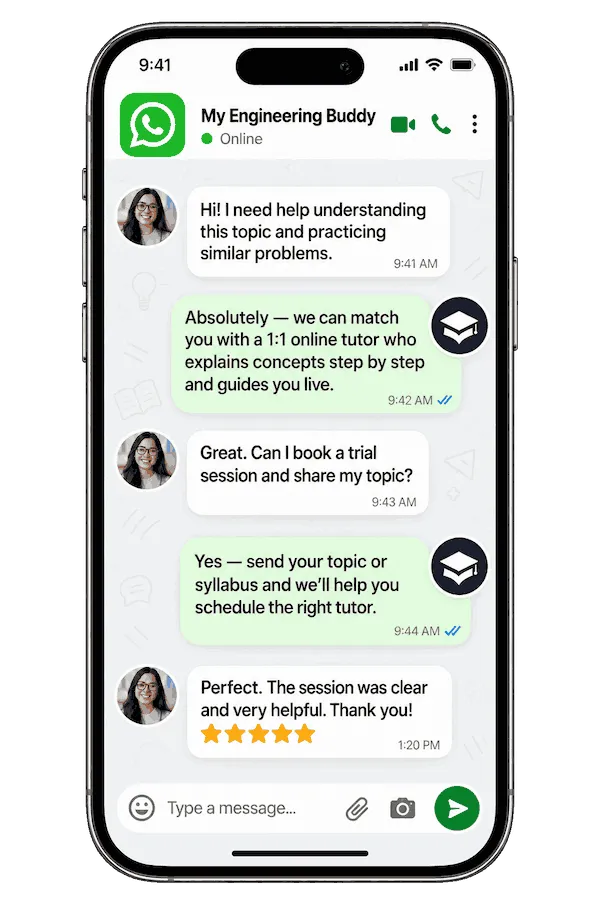
WhatsApp MEB for a quick quote — average response time under 1 minute.
Who This OAT Tutoring Is For
This is for pre-optometry students preparing for their first OAT attempt, and for candidates retaking after a score that didn’t meet programme cut-offs. It’s also for students who’ve been self-studying for weeks and still can’t break through in a specific section.
- Students retaking after a failed first attempt or a score below their target programme’s cut-off
- Pre-optometry students 4–8 weeks from their scheduled OAT date with gaps still to close
- Students scoring well in Biology but struggling with Organic Chemistry or Physics
- Students who run out of time consistently in Quantitative Reasoning or Reading Comprehension
- Parents supporting a student through the optometry school application process
- Students targeting competitive programmes at schools like the University of California Berkeley, Ohio State, University of Houston, or University of Waterloo
The $1 trial is a good place to start if you’re not sure which section needs the most work.
1:1 Tutoring vs Self-Study vs AI vs YouTube vs Online Courses
Self-study works if you’re disciplined, but the OAT punishes gaps you don’t know you have. AI tools can explain a concept quickly but can’t watch you work through a passage and tell you why you keep losing time. YouTube is good for watching someone solve a reaction — it stops when you’re stuck on your own version of that problem. Online prep courses give you structure but move at their pace, not yours. With 1:1 OAT tutoring at MEB, the tutor sees your error pattern in real time, adjusts the session mid-stream, and focuses on the exact section costing you points.
Outcomes: What You’ll Be Able To Do in OAT
After consistent 1:1 OAT tutoring, you’ll be able to solve multi-step General Chemistry problems — including electrochemistry and acid-base equilibria — without second-guessing your method. You’ll apply biological concepts across cell biology, genetics, and ecology with the precision the exam demands. You’ll analyse organic reaction mechanisms under timed conditions. You’ll work through Physics optics problems, which are unusually prominent on the OAT compared to other admissions exams. You’ll read dense scientific passages and extract answers efficiently without rereading entire sections. Confidence in Quantitative Reasoning follows from drilling the specific question formats the OAT uses.
Based on feedback from 40,000+ sessions collected by MEB from 2022 to 2025, 58% of students improved their OAT score by 30–50 points (on the 200–400 scaled score range) after approximately 20 hours of 1:1 tutoring.
Source: MEB session feedback data, 2022–2025.
At MEB, we’ve found that OAT candidates who struggle with time management in Reading Comprehension are almost always trying to read every passage fully before answering. One session on active reading strategy — skimming for structure, then reading around the question — cuts average section time by several minutes.
What We Cover in OAT (Syllabus / Topics)

The OAT is scored on a 200–400 scale per section, with a separate Total Science score and an Academic Average. The table below shows the six test sections and their structure.
| OAT Section | Number of Questions | Time Allowed |
|---|---|---|
| Survey of the Natural Sciences (Biology, Gen Chem, Org Chem) | 100 questions | 90 minutes |
| Physics | 40 questions | 50 minutes |
| Reading Comprehension | 50 questions | 50 minutes |
| Quantitative Reasoning | 40 questions | 45 minutes |
Track 1: Survey of the Natural Sciences
- Biology: cell biology, genetics, evolution, diversity of life, ecology, physiology
- General Chemistry: atomic structure, stoichiometry, equilibrium, thermodynamics, electrochemistry
- Organic Chemistry: reaction mechanisms, functional groups, stereochemistry, lab techniques
- High-yield topic identification and elimination strategies
- Cross-topic connections tested in multi-concept questions
Recommended references: Campbell Biology (Urry et al.), Chemistry: The Central Science (Brown et al.), Organic Chemistry (Klein) — standard pre-optometry undergraduate editions.
Track 2: Physics and Quantitative Reasoning
- Optics: reflection, refraction, lenses, mirrors — especially prominent on the OAT versus other health professions exams
- Mechanics, waves, electricity, and modern physics
- Quantitative Reasoning: algebra, probability, statistics, trigonometry, applied maths
- Calculator policy: a basic on-screen calculator is provided for QR only
- Timed drill practice — OAT QR requires speed, not just accuracy
Recommended references: College Physics (Serway & Vuille), OAT Prep Plus (Kaplan) for practice sets.
Track 3: Reading Comprehension
- Three scientific passages per section — dense, technical content
- Question types: main idea, detail, inference, tone, vocabulary in context
- Active reading strategies: passage mapping, question-first approaches
- Time management: 50 questions in 50 minutes leaves no room for full rereads
- Practice with optometry and health sciences source material
Recommended references: OAT Prep Plus (Kaplan), official Association of Schools and Colleges of Optometry practice materials via the ASCO OAT portal.
Students consistently tell us that the OAT Physics section surprises them — not because it’s harder than MCAT Physics in breadth, but because optics questions appear at a frequency most general prep materials don’t reflect. We build that in from the first diagnostic.
What a Typical OAT Session Looks Like
The tutor opens by checking the previous session’s practice set — typically a block of General Chemistry equilibrium problems or an Organic Chemistry mechanism sequence. Any errors get worked through on a digital pen-pad before moving forward. The student then attempts new problems on screen — often a timed QR drill or a Physics optics question set — while the tutor observes reasoning in real time. If the student hesitates at a particular step, the tutor pauses, asks them to explain their logic, and corrects at exactly that point rather than at the end. The session closes with a specific task: three Biology past-style questions on genetics, for example, or one Reading Comprehension passage under timed conditions. The next session topic is confirmed before the student logs off. Sessions run on Google Meet with screen sharing throughout.
How MEB Tutors Help You with OAT (The Learning Loop)
Diagnose: In the first session, the tutor identifies which OAT sections are costing the most points and whether the issue is content knowledge, test strategy, or pacing. A student who scores 300 in Biology but 260 in Physics needs a completely different session plan than one who’s balanced but slow across all sections.
Explain: The tutor works through representative problems live — drawing reaction mechanisms on a digital pen-pad, annotating optics diagrams, or walking through a multi-step stoichiometry calculation step by step. Nothing is summarised from memory. Everything is shown.
Practice: The student attempts the next problem type with the tutor present. This is where errors actually surface — not in review, but in the attempt. The tutor sees where the student stalls.
Feedback: Every error gets a specific explanation: why that answer was wrong, what the correct reasoning path looks like, and what trap the question was designed to set. General feedback doesn’t help on the OAT. Precise feedback does.
Plan: At the end of each session, the tutor sets a clear target for independent practice — specific question types, a timed section drill, or a set of Biology flashcards on a named topic. Progress is reviewed at the start of the next session without fail.
Sessions run on Google Meet. Tutors use a digital pen-pad or iPad with Apple Pencil for live working. Before your first session, share your most recent OAT practice score breakdown, any score reports from a previous attempt, and your target test date. Start with the $1 trial — 30 minutes of live tutoring that also serves as your first diagnostic. Whether you need an intensive 3-week push before your exam or steady weekly support through your prep semester, the tutor maps the session plan after that first diagnostic.
Tutor Match Criteria (How We Pick Your Tutor)
Not every science tutor knows the OAT. MEB matches you based on four criteria.
Subject depth: Your tutor has covered the specific OAT syllabus — not just general biology or chemistry. They know which optics topics appear, which organic mechanisms are tested, and where QR question formats differ from standard maths.
Tools: Every OAT tutor uses Google Meet with screen share and a digital pen-pad or iPad with Apple Pencil — essential for working through mechanisms and diagrams live.
Time zone: Matched to your region. US, Canada, UK, Gulf, and Australia students all get tutors available during reasonable local hours.
Goals: Whether you’re targeting a 320 Academic Average for a competitive programme or just need to clear the minimum cut-off for a specific school, the tutor match reflects that.
Unlike platforms where you fill out a form and wait days, MEB responds in under a minute, 24/7. Tutor match takes under an hour. The $1 trial means you test before you commit. Everything runs over WhatsApp — no logins, no intake forms.
Study Plans (Pick One That Matches Your Goal)
After the first diagnostic session, your tutor builds a session sequence based on your timeline. A 1–3 week catch-up plan focuses hard on your lowest-scoring sections and high-yield Biology and Chemistry content. A 4–8 week exam prep plan covers all six OAT sections systematically, with full timed practice sets in the final two weeks. Ongoing weekly support works alongside your undergraduate coursework, keeping your science knowledge current through your pre-optometry programme. The tutor decides the sequence — you show up with your practice scores and your questions.
Pricing Guide
Most OAT tutoring sessions run $20–$40/hr. Students targeting highly competitive programmes, or needing intensive multi-section prep in a short window, can access tutors with deeper research or professional backgrounds at rates up to $100/hr.
Rate factors include: which OAT sections need coverage, how close your exam date is, and tutor availability in your time zone during peak application season.
For students targeting top optometry programmes at schools like UC Berkeley School of Optometry, Ohio State College of Optometry, or the University of Waterloo School of Optometry, tutors with relevant professional and academic backgrounds are available at higher rates — share your specific score target and application timeline and MEB will match accordingly.
Start with the $1 trial — 30 minutes, no registration, no commitment. WhatsApp MEB for a quick quote.
OAT tutoring from $20/hr. First session from $1. No forms, no waiting — WhatsApp MEB and get matched within the hour. Sessions run on Google Meet, 24/7, across all time zones.
Source: My Engineering Buddy, 2025.
Try your first session for $1 — 30 minutes of live 1:1 tutoring or one homework question explained in full. No registration. No commitment.
WhatsApp MEB now
and get matched within the hour.
FAQ
Is the OAT hard?
It’s demanding. The Natural Sciences section covers Biology, General Chemistry, and Organic Chemistry in 90 minutes. Physics has a strong optics focus most students don’t expect. Quantitative Reasoning requires speed as much as accuracy. The difficulty is manageable with the right prep structure.
How many sessions are needed?
It depends on your current practice scores and your target. Most students see meaningful improvement in 10–20 hours of 1:1 work. Students with significant gaps in Organic Chemistry or Physics typically need closer to 20 hours to reach competitive scores.
Can you help with homework and assignments?
MEB tutoring is guided learning — you understand the work, then submit it yourself. See our Academic Integrity policy and Why MEB page for full details on what we help with and what we don’t.
Will the tutor match my exact OAT syllabus and exam format?
Yes. The OAT has a fixed format administered by ASCO. Your tutor works specifically with the OAT’s section structure, question types, and scoring scale — not a generalised science curriculum. Section-specific strategies are built into every session.
What happens in the first session?
The tutor reviews your practice score breakdown, identifies your weakest sections, and works through a sample question set to assess your reasoning approach. The session plan for subsequent sessions is set before you finish. Nothing generic.
Is online OAT tutoring as effective as in-person?
For the OAT, yes — arguably more so. Screen sharing lets the tutor see exactly what you’re doing in real time. The digital pen-pad handles mechanism drawing and diagram annotation. Students in remote areas or with limited local options access the same quality of prep as those in major cities.
Can I get OAT help at short notice — including late at night?
MEB operates 24/7. WhatsApp response time is under one minute on average. If you have an OAT date in two weeks and need sessions starting immediately, message MEB now — tutors in compatible time zones are matched within the hour.
What if I don’t click with my assigned tutor?
Tell MEB. A tutor change is straightforward and fast — typically resolved within the same day. The $1 trial exists precisely so you can assess fit before investing in a full session block.
How does the OAT differ from the DAT — and can MEB help with both?
The OAT and DAT tutoring overlap significantly in Natural Sciences content, but the OAT replaces the DAT’s Perceptual Ability section with Physics. Students switching between the two benefit from targeted coverage of Physics optics — the area that most differentiates OAT prep from DAT prep.
What OAT score do I need to get into optometry school?
Most accredited programmes look for an Academic Average of 300 or above, with competitive schools expecting 320+. Some programmes also set minimum section scores. Your tutor will build your prep around your target programme’s actual published averages where available.
How do I get started?
WhatsApp MEB, share your current practice scores and test date, and get matched with an OAT tutor — usually within the hour. The first session is the $1 trial: 30 minutes live or one full question explained. Three steps: WhatsApp → matched → start trial.
Trust & Quality at My Engineering Buddy
Every MEB tutor goes through subject-specific vetting — not a general interview. For OAT, that means demonstrated knowledge of the exam’s six sections, familiarity with ASCO’s format and scoring, and a live demo evaluation before any student sessions are assigned. Tutors hold relevant undergraduate and postgraduate degrees in biology, chemistry, physics, or optometry-adjacent fields. Ongoing session feedback from students drives continuous tutor review. Rated 4.8/5 across 40,000+ verified reviews on Google.
MEB tutoring is guided learning — you understand the work, then submit it yourself. For full details on what we help with and what we don’t, read our Academic Integrity policy and Why MEB.
MEB has served 52,000+ students in 2,800+ subjects since 2008, across the US, UK, Canada, Australia, the Gulf, and Europe. Within test preparation, that includes dedicated support for OAT tutoring, USMLE preparation, and GAMSAT tutoring — as well as the full range of health professions admissions exams. Every session is built around the student’s actual syllabus, score report, and timeline. Learn more about how sessions are structured on our tutoring methodology page.
MEB has been running since 2008. 52,000+ students. 4.8/5 on Google. The OAT is one of over 2,800 subjects covered — and it’s one where section-specific prep genuinely moves the score.
Source: My Engineering Buddy, 2008–2025.
A common pattern our tutors observe is that OAT candidates who score well in Biology but poorly in Physics have often never studied optics at a university level. That single gap — lenses, mirrors, refraction — can cost 20–30 points in a section that’s already tight on time.
Explore Related Subjects
Students studying the OAT often also need support in:
- OAT Biology
- OAT General Chemistry
- OAT Organic Chemistry
- OAT Physics
- OAT Quantitative Reasoning
- OAT Reading Comprehension
- HESI
- IMAT
Next Steps
Before your first session, have ready: your most recent OAT practice score breakdown by section, any score report from a previous attempt, and your confirmed or target test date. The tutor handles the rest.
- Share your weakest OAT section and your application deadline
- Share your availability and time zone
- MEB matches you with a verified OAT tutor — usually within the hour
The first session starts with a diagnostic so every minute is used well. Visit www.myengineeringbuddy.com for more on how MEB works.
WhatsApp to get started or email [email protected].
Reviewed by Subject Expert
This page has been carefully reviewed and validated by our subject expert to ensure accuracy and relevance.




