




~1 min
Average Reply Time
~1 hour
To Be Matched With A Tutor
30 Min Trial
75% Find Their Tutor On The 1st Trial
$20-35+/hr
Premium Yet Affordable Learning
Hire The Best Sustainable architecture Tutor


Your sustainable architecture studio reviews are in two weeks. You’ve got passive systems, embodied carbon, and LEED credits still to untangle.
Sustainable Architecture Tutor Online
Sustainable architecture is the design and construction of buildings that minimise environmental impact through energy efficiency, low-carbon materials, and passive climate strategies — equipping students to integrate green building standards into professional architectural practice.
Finding a sustainable architecture tutor near me online means access to a specialist who actually knows LEED, BREEAM, passive house principles, and embodied carbon analysis — not someone who teaches general design. MEB connects you with a 1:1 architecture tutor who has worked within or taught sustainable design frameworks at university level. One session can shift a semester’s worth of confusion.
- 1:1 online sessions tailored to your course syllabus and studio brief
- Expert verified tutors with subject-specific sustainable design knowledge
- Flexible time zones — US, UK, Canada, Australia, Gulf
- Structured learning plan built after a diagnostic session
- Ethical homework and assignment guidance — you understand before you submit
52,000+ students across the US, UK, Canada, Australia, and the Gulf have used MEB since 2008 — across 2,800+ subjects, from AP Calculus to A Level Music Technology to Data Science.
Source: My Engineering Buddy, 2008–2025.
How Much Does a Sustainable Architecture Tutor Cost?
Most sustainable architecture tutoring sessions run $20–$40/hr. Graduate-level work covering environmental simulation tools or dissertation support can reach $70–$100/hr depending on tutor background and topic complexity. There is also a $1 trial — 30 minutes of live tutoring or one full homework question explained in detail.
| Level / Need | Typical Rate | What’s Included |
|---|---|---|
| Undergraduate (most levels) | $20–$40/hr | 1:1 sessions, assignment guidance |
| Graduate / Specialist Topics | $40–$100/hr | Expert tutor, niche depth, dissertation support |
| $1 Trial | $1 flat | 30 min live session or 1 homework question explained |
Tutor availability tightens sharply during end-of-semester reviews and thesis submission periods. Book early if your deadline is within four weeks.
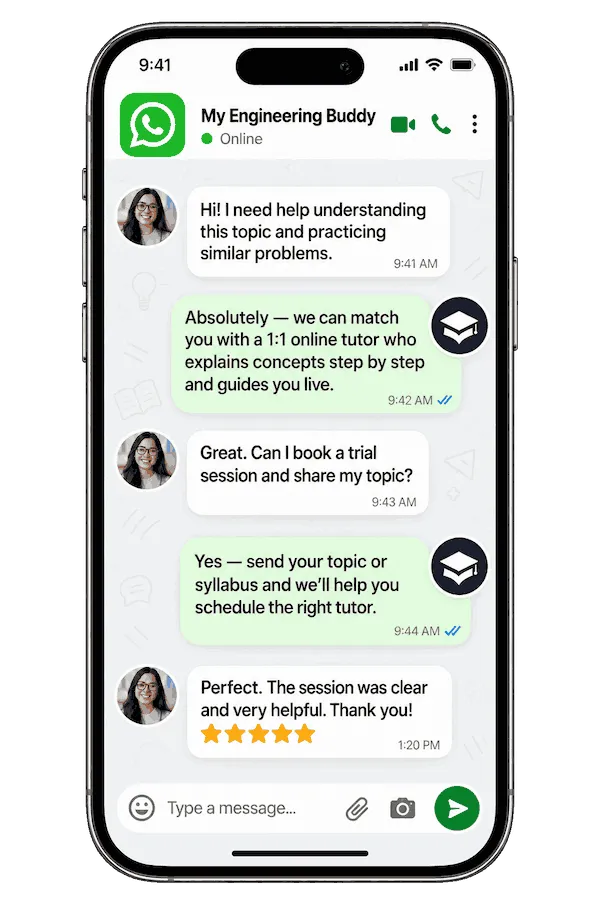
WhatsApp MEB for a quick quote — average response time under 1 minute.
Who This Sustainable Architecture Tutoring Is For
This service is for students working through one of the most technically layered areas of architectural education — where passive design, material science, and environmental policy all land on the same studio desk. It suits undergraduate and graduate students alike, as well as early-career architects preparing professional submissions.
- Undergraduate architecture students struggling to connect passive design theory with live studio projects
- Graduate students tackling energy modelling, lifecycle assessment, or LEED/BREEAM certification modules
- Students with a university conditional offer depending on passing a sustainable design unit this semester
- Architecture students with a coursework or NEA submission deadline approaching and significant gaps still to close
- Students preparing architectural thesis research centred on low-carbon or net-zero building strategies
- Students at institutions including MIT, TU Delft, UCL Bartlett, University of Toronto, and the University of Melbourne who need specialist guidance beyond what studio crits provide
1:1 Tutoring vs Self-Study vs AI Tools
Self-study works for reading around passive solar principles or reviewing LEED credit categories, but without feedback you can rehearse the same misconceptions about thermal mass or embodied carbon for weeks without realising it. AI tools can define a U-value or explain the basics of a solar heat gain coefficient in seconds, but they cannot look at your actual building section, identify why your passive ventilation strategy won’t work for that orientation, or walk you through fixing it in real time. That kind of live, annotated problem-solving — specific to your project brief, your climate zone, your tutor’s pen on your section drawing — is exactly what sustainable architecture demands. MEB delivers that online, with the flexibility of any time zone and a structured feedback loop calibrated to your exact course.
Outcomes: What You’ll Be Able To Do in Sustainable Architecture
After targeted sessions, you will be able to apply passive cooling and heating strategies to a given site and orientation with clear reasoning. You will analyse a building’s embodied carbon across its material lifecycle and present that data in a format your tutors and examiners expect. You will model daylighting performance using tools relevant to your programme. You will explain LEED or BREEAM credit structures accurately in written submissions. You will solve energy load calculations without reverting to guesswork and present your environmental design decisions with the kind of confidence that holds up in a studio crit.
Supporting a student through sustainable architecture? MEB works directly with parents to set up sessions, track progress, and keep coursework on schedule. WhatsApp MEB — average response time is under a minute, 24/7.
Based on feedback from 40,000+ sessions collected by MEB from 2022 to 2025, 58% of students improved by one full grade after approximately 20 hours of 1:1 tutoring in a single subject. A further 23% achieved at least a half-grade improvement.
Source: MEB session feedback data, 2022–2025.
What We Cover in Sustainable Architecture (Syllabus / Topics)

Passive Design and Environmental Systems
- Solar geometry, sun path diagrams, and shading calculations
- Passive heating and cooling strategies by climate zone
- Natural ventilation principles — stack effect, cross-ventilation, wind pressure
- Thermal mass, insulation values, and U-value calculations
- Daylighting design — daylight factor, glare control, window-to-wall ratios
- Acoustic performance in sustainable building design
- Moisture and condensation control in building envelopes
Key references: Sun, Wind & Light by Mark DeKay and G.Z. Brown; A Green Vitruvius by the European Commission; Environmental Science in Building by Randall McMullan.
Green Building Standards and Certification
- LEED v4 credit categories and documentation requirements
- BREEAM assessment methodology and evidence requirements
- WELL Building Standard basics and overlap with LEED
- Passive House (Passivhaus) principles and PHPP fundamentals
- Net-zero carbon definitions and measurement frameworks
- Energy Performance Certificates (EPC) and building regulations compliance
- Life cycle assessment (LCA) and embodied carbon reporting
Key references: LEED Reference Guide for Building Design and Construction (USGBC); Passivhaus Designer’s Guide by Jessica Grove-Smith; The Embodied Carbon Primer (RIBA).
Materials, Technology, and Building Science
- Low-carbon and bio-based materials — timber, hemp, recycled content
- Structural systems suited to sustainable construction — CLT, mass timber
- Building integrated photovoltaics and renewable energy systems
- Water efficiency and greywater recycling systems
- Smart building technologies and energy management systems
- Construction waste reduction strategies and circular economy principles
Key references: Building Construction Illustrated by Francis Ching and Cassandra Adams; Mechanical and Electrical Services for Buildings by Brian Cotterell and Johan Dadabhoy; Materials for a Healthy, Ecological and Sustainable Built Environment edited by Ulrike Plank.
What a Typical Sustainable Architecture Session Looks Like
The tutor opens by checking what you covered last time — say, passive solar gain calculations or thermal bridging in a wall section. From there, you share your screen or upload your drawings directly. The tutor works through a specific problem with you on a digital pen-pad — annotating your section to show where heat loss is occurring or marking up your LEED credit checklist to identify what documentation is still missing. You replicate the reasoning yourself, not just watch it happen. By the end of the session, you have a practice task — recalculate the heating load for a revised envelope, or draft the energy narrative for your design report — and the next topic is already mapped.
How MEB Tutors Help You with Sustainable Architecture (The Learning Loop)
Diagnose: In the first session, the tutor identifies exactly where the gap is. It might be U-value calculations, a misunderstanding of how BREEAM credits stack, or confusion about which passive strategy suits your climate zone. This shapes every session that follows.
Explain: The tutor works through live problems using a digital pen-pad — annotating building sections, marking up energy diagrams, walking through LCA spreadsheets line by line. No recorded lectures. No slides from a generic course.
Practice: You attempt the problem with the tutor present — modelling a passive cooling strategy for your brief, recalculating embodied carbon for an alternative material, or drafting a LEED credit narrative. The tutor watches and listens.
Feedback: Errors get corrected step by step, with an explanation of why the mark or the argument fails. Not just “that’s wrong” — but where the reasoning broke and how to fix it before your submission or crit.
Plan: Each session ends with a clear next topic, a practice task, and a note of where you are in the broader arc — whether that is exam prep, studio review prep, or thesis progress.
Sessions run over Google Meet. The tutor uses a digital pen-pad or iPad with Apple Pencil to annotate your drawings and diagrams in real time. Before your first session, share your course outline or studio brief, any work you have already submitted or attempted, and your deadline date. The first session doubles as your diagnostic. Whether you need a quick catch-up before a studio review, structured revision over four to eight weeks, or ongoing weekly support through the semester, the tutor maps the session plan after that first conversation.
Start with the $1 trial — 30 minutes of live tutoring that also serves as your first diagnostic.
At MEB, we’ve found that students who arrive at a sustainable architecture session with a specific drawing, calculation, or brief to work through make dramatically faster progress than those who come with a general topic. Come with your actual work — that’s what the session is built around.
Tutor Match Criteria (How We Pick Your Tutor)
Not every architecture tutor knows passive house standards. Not every sustainability lecturer has taught LEED documentation to a student under exam pressure. MEB matches on specifics.
Subject depth: Tutors are matched to your exact level — undergraduate studio, graduate environmental systems module, or professional certification prep — with demonstrated knowledge of the relevant framework, whether LEED, BREEAM, or Passivhaus.
Tools: All sessions use Google Meet with a digital pen-pad or iPad and Apple Pencil for live annotation of drawings, sections, and energy diagrams. No whiteboard-and-talk.
Time zone: Tutors are available across New York, Los Angeles, Chicago, London, Dubai, Toronto, Sydney, and Melbourne — evenings and weekends included.
Learning style: Calibrated from the first session. Some students need slow worked examples; others need to be pushed through a crit simulation.
Communication: Clear English, adjusted to the student’s level. No assumption that you already know the vocabulary.
Goals: Exam scores, assignment completion, studio confidence, thesis structure, or conceptual depth — the tutor is briefed on your specific target before session one.
Unlike platforms where you fill out a form and wait, MEB responds in under a minute, 24/7. Tutor match takes under an hour. The $1 trial means you test before you commit. Everything runs over WhatsApp — no logins, no intake forms.
Study Plans (Pick One That Matches Your Goal)
After the first diagnostic session, your tutor builds a sequence around your actual timeline. Catch-up plans run one to three weeks and focus on closing the most critical gaps before a studio review or submission. Exam prep plans run four to eight weeks and work through all testable topics in order of difficulty and exam weighting. Weekly ongoing support aligns sessions to your studio schedule, coursework deadlines, and thesis milestones — so nothing gets left to the last week.
Pricing Guide
Undergraduate sustainable architecture tutoring starts at $20/hr and runs to $40/hr for most topics. Graduate-level support — covering energy simulation, embodied carbon analysis, or thesis methodology — ranges from $40 to $100/hr depending on tutor specialisation and turnaround requirements.
Rate factors include your current level, the complexity of the topic (passive design principles differ significantly from full LCA methodology), your timeline, and tutor availability. Availability drops sharply in the weeks before end-of-semester reviews and thesis submission deadlines.
For students targeting architecture schools with strong sustainability programmes — at institutions such as ETH Zurich, the AA School, or UC Berkeley — tutors with professional green building consultancy or research backgrounds are available at higher rates. Share your specific goal and MEB will match the tier to your ambition.
Start with the $1 trial — 30 minutes, no registration, no commitment. WhatsApp MEB for a quick quote.
Students consistently tell us that the first session — even just 30 minutes — reframes what they thought was a broad knowledge gap as two or three very specific misunderstandings. That is almost always fixable in a handful of sessions if you start early enough.
FAQ
Is sustainable architecture hard?
It combines design judgment with technical calculation — passive solar geometry, energy loads, material lifecycle data — which trips up many students. The concepts are learnable with the right guided approach, but trying to self-study across all three areas simultaneously without feedback rarely works.
How many sessions will I need?
Students with a single assignment gap often need two to four sessions. Those covering a full sustainable design module from scratch typically need eight to fifteen sessions over a semester. Your tutor maps the plan after the first diagnostic.
Can you help with homework and assignments?
Yes — MEB explains the concepts and works through the method with you. You understand the work and submit it yourself. For full details, read our Academic Integrity policy and Why MEB.
Will the tutor match my exact syllabus or exam board?
Yes. Share your course outline, studio brief, or university module descriptor before the first session. The tutor is matched specifically to your programme — whether it is a LEED-focused graduate module, a Passivhaus unit, or an undergraduate environmental systems course.
What happens in the first session?
The tutor runs a diagnostic — reviewing your submitted work, asking targeted questions, and identifying exactly where understanding breaks down. The remainder of the session addresses the most pressing gap. Every session after that builds on this map.
Is online tutoring as effective as in-person?
For sustainable architecture, yes. The tutor annotates your actual drawings and calculations in real time over a digital pen-pad. Students report that this level of specific, visual feedback on their own work is more useful than a generic in-person session with a tutor who hasn’t seen the brief.
Can I get sustainable architecture help at midnight or on weekends?
Yes. MEB operates 24/7 across all major time zones. Students in the Gulf, Australia, and North America regularly book late-evening or weekend sessions. WhatsApp MEB at any hour — average response time is under a minute.
What if I don’t like my assigned tutor?
Tell MEB. A replacement is arranged immediately, usually within the same day. The $1 trial is specifically designed so you test the match before committing to a full package. No awkward cancellation process.
Do you offer help with LEED or BREEAM exam preparation specifically?
Yes. Tutors familiar with LEED Green Associate, LEED AP, and BREEAM assessor exam structures are available. Share which credential and which section you are focused on — the tutor prepares accordingly, covering credit categories, documentation requirements, and common exam questions.
How do I get started?
WhatsApp MEB, get matched with a verified sustainable architecture tutor within the hour, then start the $1 trial — 30 minutes of live tutoring or one assignment question explained in full. No registration needed and no commitment beyond that first session.
Trust & Quality at My Engineering Buddy
Every MEB tutor passes a subject-specific screening process — including a live demo evaluation reviewed against student feedback from real sessions. Tutors hold degrees or professional credentials in architecture, building science, or environmental design, and many have direct experience in green building consultancy or academic teaching. Rated 4.8/5 across 40,000+ verified reviews on Google.
MEB has served 52,000+ students across 2,800+ subjects since 2008 — built on 18 years of tutor matching, quality review, and subject-specific expertise across the US, UK, Canada, Australia, Gulf, and Europe.
Source: My Engineering Buddy, 2008–2025.
MEB tutoring is guided learning — you understand the work, then submit it yourself. For full details on what we help with and what we don’t, read our Academic Integrity policy and Why MEB.
MEB is a platform built for advanced and specialist subjects — 2,800+ of them, serving students in the US, UK, Canada, Australia, Gulf, and Europe since 2008. Students needing support across related design disciplines often also work with MEB on building science tutoring, BIM tutoring, and landscape architecture help. Visit www.myengineeringbuddy.com for a full list of subjects and tutors.
Try your first session for $1 — 30 minutes of live 1:1 tutoring or one homework question explained in full. No registration. No commitment. WhatsApp MEB now and get matched within the hour.
Explore Related Subjects
Students studying sustainable architecture often also need support in:
- Architectural AutoCAD
- Architectural Design Drafting & Drawing
- Architectural History
- Construction Technology, Management & Safety
- Ekistics
- Interior Design
- Lighting Design
- Urban Design and Planning
Next Steps
Getting started takes less than two minutes. Here is what to do:
- Share your course name, the specific topic or assignment giving you trouble, and your deadline date
- Share your time zone and weekly availability — evenings and weekends are fine
- MEB matches you with a verified sustainable architecture tutor, usually within 24 hours
Before your first session, have ready: your syllabus or course outline, a recent past assignment or calculation you struggled with, and your exam or submission deadline. The tutor handles the rest.
Visit www.myengineeringbuddy.com to learn more about how MEB tutors are selected and how sessions are structured.
WhatsApp to get started or email [email protected].
Reviewed by Subject Expert
This page has been carefully reviewed and validated by our subject expert to ensure accuracy and relevance.




