




~1 min
Average Reply Time
~1 hour
To Be Matched With A Tutor
30 Min Trial
75% Find Their Tutor On The 1st Trial
$20-35+/hr
Premium Yet Affordable Learning
Most students who struggle with Film Studies don’t lack interest — they lack a tutor who can break down mise-en-scène, auteur theory, and essay technique at the same time.
Film Studies Tutor Online
Film Studies is an academic discipline examining film as art, industry, and cultural text. It covers film theory, history, genre analysis, cinematographic technique, and critical writing, equipping students to analyse and write about cinema at school or university level.
MEB offers 1:1 online tutoring and homework help across Communication & Media Studies — including Film Studies at every level from A Level and IB to undergraduate and postgraduate. If you’ve searched for a Film Studies tutor near me and found generic platforms with no subject depth, MEB is different. Every tutor is matched to your exact syllabus, exam board, and essay style — and the first session starts with a diagnostic, not small talk.
- 1:1 online sessions tailored to your course, exam board, and assessment style
- Expert-verified tutors with subject-specific knowledge in film theory and criticism
- Flexible time zones — US, UK, Canada, Australia, Gulf
- Structured learning plan built after a diagnostic session
- Ethical homework and assignment guidance — you understand before you submit
52,000+ students across the US, UK, Canada, Australia, and the Gulf have used MEB since 2008 — including students in Communication & Media Studies subjects like Film Studies, Cinematography, and Visual Communication.
Source: My Engineering Buddy, 2008–2025.
How Much Does a Film Studies Tutor Cost?
Most Film Studies sessions run $20–$40/hr depending on level and exam board. Graduate and specialist literary-theory sessions can reach $100/hr. Not sure if it’s worth it? Start with the $1 trial — 30 minutes of live 1:1 tutoring or one homework question explained in full, no registration required.
| Level / Need | Typical Rate | What’s Included |
|---|---|---|
| A Level / IB / AP | $20–$35/hr | 1:1 sessions, essay and analysis guidance |
| Undergraduate | $30–$55/hr | Theory, criticism, close reading support |
| Postgraduate / Specialist | $55–$100/hr | Advanced theory, research, thesis planning |
| $1 Trial | $1 flat | 30 min live session or one homework question |
Tutor availability drops sharply in the 4–6 weeks before A Level, IB, and semester exam windows. Book early to secure your preferred time slot.
WhatsApp MEB for a quick quote — average response time under 1 minute.
Who This Film Studies Tutoring Is For
Film Studies draws students from English, Media, History, and Art backgrounds — and the written analysis component catches many of them off guard. If you can watch a film but can’t yet write about it at the level your examiner expects, that’s exactly the gap MEB tutors close.
- A Level and IB students working through auteur theory, genre, and the unseen film paper
- Undergraduate students struggling to structure a film theory essay or apply a critical framework correctly
- Students with a university conditional offer depending on their Film Studies grade
- Postgraduate students working on dissertation chapters requiring sustained textual analysis
- Parents watching a child’s confidence drop alongside their essay marks — and not knowing how to help
- Students who need essay editing support alongside subject knowledge
MEB has tutored students at institutions including UCLA, King’s College London, the University of Toronto, NYU, UNSW Sydney, Sciences Po, and the University of Amsterdam. Whether you’re studying at a Russell Group university or sitting A Levels in the UAE, the tutor match works the same way.
1:1 Tutoring vs Self-Study vs AI vs YouTube vs Online Courses
Self-study works if you’re already a strong analytical writer — most Film Studies students aren’t, yet. AI tools explain concepts quickly but can’t read your draft essay and tell you why your argument about Hitchcock’s gaze doesn’t hold. YouTube is good for watching clip analysis; it stops when you need someone to tell you what you got wrong. Online courses move at a fixed pace with no room for your specific exam board or essay structure. 1:1 tutoring with MEB is live, calibrated to your exact syllabus — A Level, IB, or undergraduate — and corrects your critical reading errors in the session, not after you’ve already submitted.
Outcomes: What You’ll Be Able To Do in Film Studies
After working with an MEB Film Studies tutor, you’ll be able to apply theoretical frameworks — structuralism, feminist film theory, psychoanalytic criticism — to unseen films without freezing. You’ll write close analysis of cinematography, editing, and sound with the kind of textual precision that earns top marks. Analyse a sequence from a film you’ve never seen and construct a coherent argument about it. Present a case for auteur status using evidence from multiple films. Write under timed conditions without losing your line of argument.
Based on feedback from 40,000+ sessions collected by MEB from 2022 to 2025, 58% of students improved by one full grade after approximately 20 hours of 1:1 tutoring in subjects like Film Studies. A further 23% achieved at least a half-grade improvement.
Source: MEB session feedback data, 2022–2025.
Supporting a student through Film Studies? MEB works directly with parents to set up sessions, track progress, and keep coursework on schedule. WhatsApp MEB — average response time is under a minute, 24/7.
What We Cover in Film Studies (Syllabus / Topics)

Film Theory and Critical Frameworks
- Auteur theory — applying directorial vision across a filmmaker’s body of work
- Genre theory — conventions, hybridisation, audience expectation
- Feminist film theory and the male gaze (Mulvey)
- Psychoanalytic approaches — spectatorship, identification, the uncanny
- Structuralism and post-structuralism in film criticism
- Postcolonial and race theory applied to world cinema
- Ideological analysis — representation, hegemony, and the film text
Core texts include Metz’s Film Language, Bordwell and Thompson’s Film Art: An Introduction, and Stam’s Film Theory: An Introduction.
Film Form and Textual Analysis
- Mise-en-scène — lighting, set design, costume, performance, composition
- Cinematography — shot types, camera movement, depth of field
- Editing — continuity, montage, rhythm, the Kuleshov effect
- Sound design — diegetic/non-diegetic distinction, score, silence
- Narrative structure — three-act form, non-linear storytelling, unreliable narrators
- Close reading and sequence analysis under timed conditions
Recommended reading: Gibbs’s Mise-en-Scène: Film Style and Interpretation and Corrigan’s A Short Guide to Writing About Film.
Film History and Global Cinema
- Classical Hollywood cinema — studio system, genre cycles, star system
- European art cinema — Italian neorealism, French New Wave, New German Cinema
- New Hollywood and the auteur renaissance of the 1970s
- World and transnational cinema — East Asian, Latin American, African film
- Documentary forms — observational, performative, essay film
- Contemporary cinema — digital aesthetics, streaming, the post-studio landscape
Suggested texts: Cook’s A History of Narrative Film and Hayward’s Cinema Studies: The Key Concepts.
At MEB, we’ve found that Film Studies students who struggle most are often strong viewers but weak writers. The tutor’s job in the first session is to identify where the gap sits — in vocabulary, in argument structure, or in how you’re applying theory to a specific sequence.
What a Typical Film Studies Session Looks Like
The tutor opens by checking the previous topic — usually a specific essay question or a sequence analysis attempted since the last session. If you drafted a paragraph on how Kubrick uses low-angle shots to establish power dynamics, the tutor reads it on screen and marks it up in real time using a digital pen-pad, showing exactly where the argument weakens or where you’ve described rather than analysed. Then you work through a new sequence together — the tutor explains the analytical move, and you replicate it in your own words. The session closes with a specific writing task: one paragraph on a named technique in a film you’re studying, ready for the next session.
How MEB Tutors Help You with Film Studies (The Learning Loop)
Diagnose: In the first session, the tutor identifies whether you’re struggling with film vocabulary, critical framework application, essay structure, or timed writing. These are four different problems with four different fixes.
Explain: The tutor works through a sample sequence analysis on screen, talking through every analytical choice — why this term, why this framework, why this piece of evidence supports the claim and not just describes it.
Practice: You attempt the next sequence or essay paragraph yourself, with the tutor watching. Not after the session — during it, where errors can be caught immediately.
Feedback: The tutor marks your attempt step by step, naming exactly where marks would be lost and why. “You’ve identified the technique but not connected it to meaning — that’s the difference between a C and an A.”
Plan: Each session ends with a clear next step: a named essay question, a specific film sequence to analyse, or a timed writing task. The tutor tracks your progress across sessions and adjusts the plan if something isn’t shifting.
Sessions run on Google Meet. The tutor uses a digital pen-pad or iPad with Apple Pencil to annotate your essays and mark up sequence analysis in real time. Before your first session, share your exam board (e.g. AQA, Eduqas, WJEC, IB), the films on your set list, and a recent essay or homework question you found difficult. The first session covers a diagnostic of your writing and a worked example of close analysis on one of your set films.
Start with the $1 trial — 30 minutes of live tutoring that also serves as your first diagnostic.
Try your first session for $1 — 30 minutes of live 1:1 tutoring or one homework question explained in full. No registration. No commitment. WhatsApp MEB now and get matched within the hour.
Tutor Match Criteria (How We Pick Your Tutor)
Not every Film Studies graduate can tutor Film Studies. MEB matches on four criteria.
Subject depth: The tutor must know your specific exam board — AQA, Eduqas, WJEC, OCR, or IB Film — and your exact set films. A tutor who knows Bergman but not the Eduqas Component 2 structure is the wrong fit.
Tools: Every tutor uses Google Meet with a digital pen-pad or iPad and Apple Pencil — essential for annotating essays and marking up sequence analysis on screen.
Time zone: Matched to your region — US, UK, Gulf, Canada, or Australia — so sessions run at a workable hour without last-minute cancellations.
Goals: Exam grade improvement, essay technique, dissertation chapter planning, or ongoing weekly support through the semester. The match reflects your actual goal, not a generic profile.
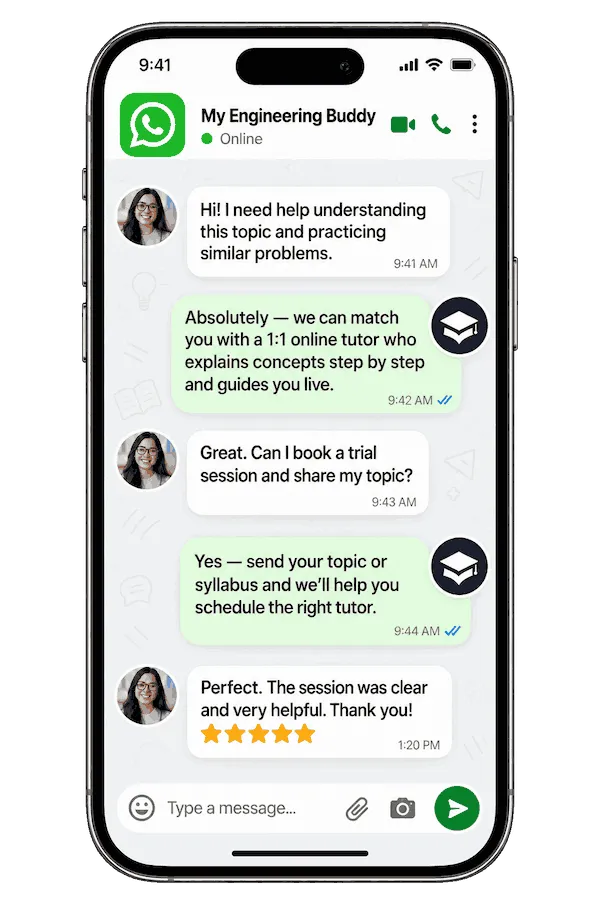
Unlike platforms where you fill out a form and wait, MEB responds in under a minute, 24/7. Tutor match takes under an hour. The $1 trial means you test before you commit. Everything runs over WhatsApp — no logins, no intake forms.
Study Plans (Pick One That Matches Your Goal)
The right plan depends on how much time you have and what you’re working toward. A student four weeks from an A Level exam needs a different sequence than one working through a university module week by week. Catch-up (1–3 weeks): high-frequency sessions targeting the biggest gaps before the exam. Exam prep (4–8 weeks): structured revision covering all set films, essay technique, and unseen film practice. Weekly support: one or two sessions per week aligned to your coursework deadlines and seminar schedule. The tutor builds the specific session sequence after the diagnostic — you don’t need to plan it yourself.
Pricing Guide
Film Studies tutoring starts at $20/hr for A Level and school-level support. Undergraduate sessions typically run $30–$55/hr. Postgraduate, dissertation, and specialist theory work goes up to $100/hr. Rate factors include level, topic complexity, timeline urgency, and tutor availability.
For students targeting film programmes at competitive universities — BFI-affiliated courses, NYU Tisch, USC School of Cinematic Arts, or graduate programmes in film theory — tutors with academic research or industry criticism backgrounds are available at higher rates. Share your specific goal and MEB will match the tier to your ambition.
Tutor availability tightens significantly in the 6 weeks before A Level and IB exam windows. Book early.
Start with the $1 trial — 30 minutes, no registration, no commitment. WhatsApp MEB for a quick quote.
MEB has been running since 2008. Across 52,000+ students and 2,800+ subjects, the pattern is consistent: students who come in struggling with Film Studies essay structure leave with a replicable method — one they can apply to any question, any film, any exam.
Source: My Engineering Buddy, 2008–2025.
FAQ
Is Film Studies hard?
Film Studies is harder than most students expect. Watching films is easy; writing about them at a level that earns marks requires precise vocabulary, a working knowledge of critical theory, and a structured argument. Most students underestimate the essay component until they get their first grade back.
How many sessions are needed?
Students with 4–8 weeks before an exam typically see clear improvement in essay quality after 6–10 sessions. Ongoing support through a semester usually means one or two sessions per week. The tutor gives a more specific estimate after the first diagnostic session.
Can you help with homework and assignments?
Yes. MEB tutoring is guided learning — you understand the work, then submit it yourself. Tutors help you plan essay arguments, apply critical frameworks correctly, and work through analysis that isn’t landing. See our Academic Integrity policy and Why MEB page for full details on what we help with and what we don’t.
Will the tutor match my exact syllabus or exam board?
Yes. Film Studies is examined differently across AQA, Eduqas, WJEC, OCR, and IB Film, and each has different set films and assessment components. MEB matches your tutor to your exact board, your set film list, and the component you’re working on.
What happens in the first session?
The tutor runs a diagnostic: they look at a recent essay or homework attempt, identify where the argument breaks down, and work through one corrected example with you. You leave the first session knowing exactly what to fix and with a written task to complete before the next one.
Is online tutoring as effective as in-person?
For Film Studies, yes — and in some ways better. The tutor can pull up film clips, annotate your essays on screen in real time, and share written frameworks you keep. Geography stops being a constraint. Students in the Gulf, Australia, and North America access the same tutors as students in the UK.
What’s the difference between AQA and Eduqas Film Studies at A Level?
AQA and Eduqas have different set film lists, different component structures, and different weightings for the written examination versus the non-examined assessment. MEB tutors are matched to your specific board — a tutor familiar with Eduqas Component 1 may not be right for an AQA student, and MEB accounts for this in the match.
Can you help with the non-examined assessment (NEA) or coursework component?
Yes. The NEA in A Level Film Studies — whether a short film production, a screenplay, or a critical study — requires a different kind of guidance than the written papers. MEB tutors help with planning, structuring your critical evaluation, and ensuring your analytical writing meets the assessment criteria before submission.
Can I get Film Studies help late at night or on weekends?
Yes. MEB operates 24/7 across all time zones. Students in the US, Gulf, and Australia regularly book late-evening or weekend sessions. WhatsApp MEB at any time — average response is under a minute, and tutor matching typically takes under an hour even outside standard working hours.
What if I don’t get on with my assigned tutor?
Tell MEB on WhatsApp. There’s no form, no escalation process, and no awkwardness. MEB will match you with a different tutor, usually within the same day. The $1 trial exists partly for this reason — you try before you commit to a longer block of sessions.
How do I get started?
Start with the $1 trial — 30 minutes of live tutoring or one essay question explained step by step. Three steps: WhatsApp MEB, get matched with a Film Studies tutor, start your trial session. No registration, no intake form, no waiting.
Trust & Quality at My Engineering Buddy
Every MEB tutor goes through subject-specific screening before they work with a student. For Film Studies, that means a live demo session, a review of their critical writing, and verification of their academic background — degree level, exam board knowledge, and familiarity with the set films in current circulation. Tutors are reviewed after every session, and those reviews are read. Rated 4.8/5 across 40,000+ verified reviews on Google.
MEB tutoring is guided learning — you understand the work, then submit it yourself. For full details on what we help with and what we don’t, read our Academic Integrity policy and Why MEB.
MEB has been serving students across the US, UK, Canada, Australia, Gulf, and Europe in 2,800+ subjects since 2008. In Communication & Media Studies, that includes Mass Communication tutoring, Cultural Studies help, and Filmmaking and Direction tutoring — alongside Film Studies at every level. The platform is built around one thing: a student who needs to improve, matched with a tutor who knows exactly how to help them do it.
Students consistently tell us that the first session reframes how they think about Film Studies essays. The shift from describing what happens in a film to analysing what it means — and why it matters — is something most students can make quickly once someone shows them how.
Explore Related Subjects
Students studying Film Studies often also need support in:
- Communication Studies
- Broadcast Journalism
- Video Production
- Video Editing
- Advertising
- Communication Theory
- Journalism
Next Steps
Ready to get started? Here’s what to do:
- Share your exam board (AQA, Eduqas, IB, or university course details), the hardest component you’re working on, and your exam or deadline date
- Share your availability and time zone
- MEB matches you with a verified Film Studies tutor — usually within 24 hours, often faster
Before your first session, have ready:
- Your exam board and syllabus, or your university course outline
- A recent essay attempt or homework question you struggled with
- Your exam or submission deadline date
The tutor handles the rest. First session starts with a diagnostic so every minute is used well.
Visit www.myengineeringbuddy.com for more on how MEB works.
Our experience across thousands of sessions shows that the students who improve fastest in Film Studies are the ones who bring a specific problem to the first session — a paragraph that didn’t land, a sequence they couldn’t analyse, an essay question they didn’t know how to approach. Specific beats general every time.
WhatsApp to get started or email [email protected].
Reviewed by Subject Expert
This page has been carefully reviewed and validated by our subject expert to ensure accuracy and relevance.




