




~1 min
Average Reply Time
~1 hour
To Be Matched With A Tutor
30 Min Trial
75% Find Their Tutor On The 1st Trial
$20-35+/hr
Premium Yet Affordable Learning
Stuck on cube queries, MDX syntax, or star schema design — and your OLAP assignment is due in 48 hours?
OLAP Tutor Online
OLAP (Online Analytical Processing) is a database computing method that enables multidimensional analysis of large datasets using cubes, dimensions, and measures — equipping students to design, query, and interpret data warehouses for business intelligence applications.
If you’re searching for an OLAP tutor near me, MEB connects you with verified experts in Computer Science and database systems for live 1:1 online sessions. Whether you’re wrestling with MDX queries, cube rollups, or the difference between ROLAP and MOLAP, a dedicated OLAP tutor online works through your exact course material — not a generic textbook. No guarantees, but students who show up consistently tend to move fast.
- 1:1 online sessions tailored to your course syllabus and database platform
- Expert verified tutors with subject-specific knowledge in OLAP, data warehousing, and BI
- Flexible time zones — US, UK, Canada, Australia, Gulf
- Structured learning plan built after a diagnostic session
- Ethical homework and assignment guidance — you understand before you submit
52,000+ students across the US, UK, Canada, Australia, and the Gulf have used MEB since 2008 — including students in Computer Science subjects like OLAP, data warehousing, and database management systems.
Source: My Engineering Buddy, 2008–2025.
How Much Does an OLAP Tutor Cost?
Most OLAP tutoring sessions run $20–$40/hr. Graduate-level or highly specialised work — think enterprise BI architecture or advanced MDX optimisation — can reach $100/hr. The $1 trial gets you 30 minutes of live tutoring or a full explanation of one homework question.
| Level / Need | Typical Rate | What’s Included |
|---|---|---|
| Undergraduate / Standard | $20–$35/hr | 1:1 sessions, homework guidance |
| Advanced / Graduate | $35–$70/hr | Expert tutor, niche OLAP depth |
| $1 Trial | $1 flat | 30 min live session or 1 homework question |
Tutor availability tightens around semester finals and database systems exam periods. Book early if your deadline is within three weeks.
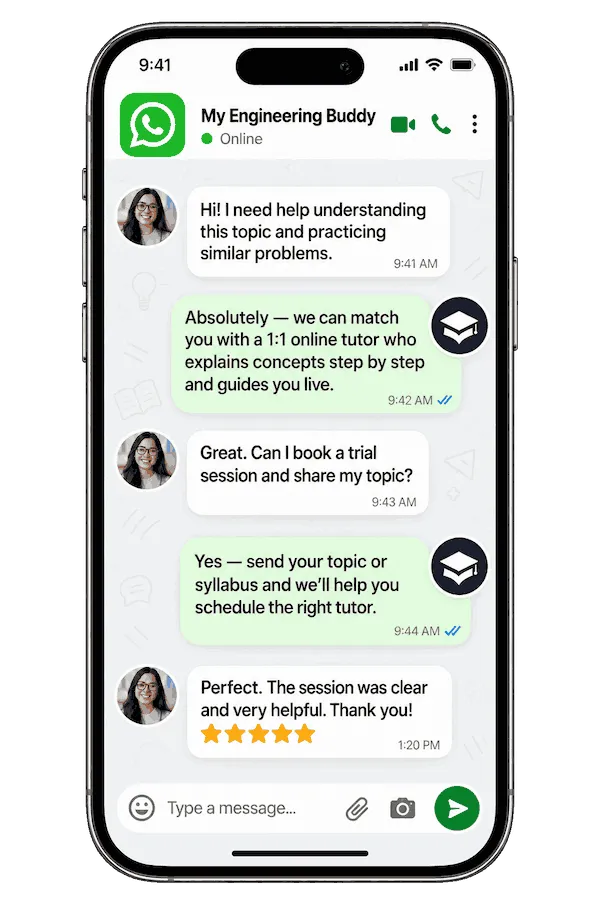
WhatsApp MEB for a quick quote — average response time under 1 minute.
Who This OLAP Tutoring Is For
Most students who reach out are either stuck on a specific concept — MDX, cube hierarchies, slowly changing dimensions — or they’re approaching a deadline with bigger gaps than they thought. Both situations are fixable with the right session structure.
- Undergraduate CS or Information Systems students taking a data warehousing or business intelligence module
- Graduate students building OLAP components into a database design project or thesis
- Students retaking after a failed first attempt in a database systems course
- Students with a conditional university offer that depends on passing their current database module
- Professionals upskilling in BI tools who need conceptual grounding alongside hands-on practice
- Parents supporting a student whose confidence has dropped alongside their grades in CS coursework
Students at universities including MIT, Carnegie Mellon, Georgia Tech, the University of Toronto, Imperial College London, and the University of Melbourne have used MEB for database and OLAP support — alongside students progressing into data engineering and BI analyst roles at companies that use tools like Microsoft SQL Server Analysis Services and Apache Kylin.
At MEB, we’ve found that students who come in thinking OLAP is purely a memorisation subject are usually the ones who get unstuck fastest. Once the cube model clicks — once you can see why a slice is different from a dice — the MDX syntax stops being arbitrary. That moment usually happens in the second or third session.
1:1 Tutoring vs Self-Study vs AI vs YouTube vs Online Courses
Self-study works if you’re disciplined, but OLAP has enough interconnected concepts — cubes, dimensions, aggregations, schema types — that gaps compound fast without feedback. AI tools answer individual questions but can’t watch you build a cube and tell you where your dimension hierarchy is wrong. YouTube covers star schema vs snowflake schema well enough, but stops when you’re debugging a specific MDX query. Online courses move at a fixed pace with no adaptation to your actual assignment. 1:1 OLAP tutoring with MEB is live, calibrated to your exact course database, and corrects reasoning errors before they become bad habits in your schema design.
Outcomes: What You’ll Be Able To Do in OLAP
After a structured set of OLAP tutoring sessions, you’ll be able to design a star or snowflake schema from a business requirements brief, write and debug MDX queries for slice, dice, roll-up, and drill-down operations, model fact and dimension tables with appropriate granularity, explain the architectural differences between ROLAP, MOLAP, and HOLAP to a technical interviewer or examiner, and apply aggregation functions correctly across multi-dimensional datasets in tools like SQL Server Analysis Services or similar platforms.
Based on feedback from 40,000+ sessions collected by MEB from 2022 to 2025, 58% of students improved by one full grade after approximately 20 hours of 1:1 tutoring in subjects like OLAP. A further 23% achieved at least a half-grade improvement.
Source: MEB session feedback data, 2022–2025.
Supporting a student through OLAP? MEB works directly with parents to set up sessions, track progress, and keep coursework on schedule. WhatsApp MEB — average response time is under a minute, 24/7.
What We Cover in OLAP (Syllabus / Topics)

Track 1: OLAP Fundamentals and Data Warehouse Architecture
- What OLAP is and how it differs from OLTP transaction processing
- Multidimensional data models: cubes, dimensions, measures, and hierarchies
- Star schema vs snowflake schema — design trade-offs and when to use each
- Fact tables: types (transaction, periodic snapshot, accumulating snapshot)
- Dimension tables: conformed dimensions, degenerate dimensions, junk dimensions
- Slowly changing dimensions (SCD Types 1, 2, 3) — modelling and implementation
- ETL pipeline basics: extract, transform, load into a data warehouse
Core texts: Kimball & Ross, The Data Warehouse Toolkit (3rd ed.); Inmon, Building the Data Warehouse (4th ed.).
Track 2: OLAP Operations and MDX Querying
- The five core OLAP operations: slice, dice, roll-up, drill-down, pivot
- MDX (Multidimensional Expressions) syntax: SELECT, FROM, WHERE structure
- Writing calculated members and named sets in MDX
- Filtering and sorting in MDX: NON EMPTY, ORDER, FILTER functions
- Tuple and set notation — common points of confusion resolved
- Debugging MDX queries: reading error messages, tracing measure resolution
- KPI design and implementation in SSAS tabular and multidimensional models
Core texts: Harinath et al., Professional Microsoft SQL Server Analysis Services; Whitehorn & Whitehorn, Business Intelligence: The IBM Solution.
Track 3: ROLAP, MOLAP, HOLAP and Modern BI Tools
- ROLAP vs MOLAP vs HOLAP — storage, performance, and use-case distinctions
- Microsoft SQL Server Analysis Services (SSAS): tabular vs multidimensional modes
- Apache Kylin: OLAP on Hadoop — architecture and cube build process
- Connecting OLAP cubes to front-end BI tools: Power BI, Tableau, Excel pivot tables
- Query performance optimisation: aggregations, partitioning, pre-computation
- Data lake vs data warehouse vs data mart — positioning in the analytics stack
Core texts: Ferrari & Russo, Tabular Modeling in Microsoft SQL Server Analysis Services; Microsoft documentation for SSAS.
What a Typical OLAP Session Looks Like
The tutor opens by checking what you covered last time — usually a specific schema design or an MDX query you attempted between sessions. If you struggled with slowly changing dimensions or the difference between roll-up and drill-through, that’s where the session starts. You and the tutor work through a live example on screen: building a star schema in SQL or writing an MDX query against a sample cube, with the tutor using a digital pen-pad to annotate dimension hierarchies and trace measure aggregation paths. You replicate the query or explain the design decision out loud, and the tutor catches the reasoning error before it becomes a pattern. The session closes with one concrete task — write an MDX query using NON EMPTY and ORDER, or redesign a given schema into third normal form — and the next topic is marked for the following session.
How MEB Tutors Help You with OLAP (The Learning Loop)
Diagnose: In the first session, the tutor asks you to walk through a schema you’ve attempted or explain how you’d approach a cube design brief. This exposes whether the gap is conceptual (you don’t see how dimensions relate to facts) or technical (you understand the model but break down at MDX syntax).
Explain: The tutor works through a live example using a digital pen-pad — drawing the cube structure, annotating the dimension hierarchy, writing the MDX query step by step. Nothing is copy-pasted from a slide. You watch reasoning happen in real time.
Practice: You attempt the next problem with the tutor present. Not after the session. Not for homework. Right now, while there’s someone who can catch the mistake at the moment it happens.
Feedback: The tutor goes back through your attempt and names exactly where the logic broke down — wrong granularity in the fact table, misplaced FILTER function in MDX, SCD type applied to the wrong dimension. You know not just that it was wrong, but why.
Plan: The session ends with a written note of what was covered, what the next topic is, and one practice task to attempt independently before the next session. Progress is tracked, not assumed.
Sessions run over Google Meet. Tutors use a digital pen-pad or iPad with Apple Pencil to annotate schemas and write queries live. Before your first session, share your course syllabus or assignment brief, a schema you’ve attempted or a query you’re stuck on, and your exam or submission deadline. The first session is your diagnostic — every minute is used to map where you are and where you need to be. Start with the $1 trial — 30 minutes of live tutoring that also serves as your first diagnostic.
Students consistently tell us that OLAP clicks differently when someone draws the cube in front of them. Reading about dimensions and measures in a textbook is one thing. Watching a tutor build a star schema live, naming each design decision as they go, is something else. That visual moment is where the abstraction collapses into something real.
Tutor Match Criteria (How We Pick Your Tutor)
Not every database tutor knows OLAP at the depth a data warehousing course demands. MEB matches on specifics.
Subject depth: Tutors are vetted on OLAP concepts specifically — schema design, MDX, SSAS, and the ROLAP/MOLAP/HOLAP distinction — not just general database knowledge. A tutor who only knows SQL doesn’t make the cut for an OLAP match.
Tools: All sessions run on Google Meet with a digital pen-pad or iPad and Apple Pencil for live annotation. No static slides.
Time zone: Matched to your region — US, UK, Gulf, Canada, or Australia — so session times are realistic, not inconvenient.
Goals: Whether you need exam preparation, assignment help with a specific schema design, or conceptual grounding before a BI project, the tutor is matched to that goal — not a generic database profile.
Unlike platforms where you fill out a form and wait, MEB responds in under a minute, 24/7. Tutor match takes under an hour. The $1 trial means you test before you commit. Everything runs over WhatsApp — no logins, no intake forms.
Study Plans (Pick One That Matches Your Goal)
A catch-up plan over 1–3 weeks targets a specific gap — MDX syntax, schema design, or SCD types — before an assignment deadline. An exam prep plan over 4–8 weeks covers the full OLAP syllabus in sequence, with past paper and problem set practice built in. Ongoing weekly support aligns to your semester schedule, keeping coursework on track without cramming. The tutor maps the specific session sequence after the first diagnostic — not before, because the gaps vary more than the syllabus does.
Pricing Guide
OLAP tutoring runs $20–$40/hr for most undergraduate and taught-master’s levels. Specialist work — enterprise SSAS architecture, advanced MDX optimisation, or OLAP integration with a Hadoop-based stack — reaches up to $100/hr. Rate factors include topic complexity, your timeline, and tutor availability in your time zone.
Availability tightens during semester finals and database systems coursework periods. If your deadline is within four weeks, book sooner rather than later.
For students targeting roles at firms that run large-scale BI infrastructure or pursuing graduate research in data systems, tutors with professional data engineering and BI architecture backgrounds are available at higher rates — share your specific goal and MEB will match the tier to your ambition.
Start with the $1 trial — 30 minutes, no registration, no commitment. WhatsApp MEB for a quick quote.
OLAP tutoring with MEB starts at $20/hr, with a $1 trial session — 30 minutes of live, 1:1 instruction matched to your course platform and assignment type, with no registration required to begin.
Source: My Engineering Buddy, 2025.
FAQ
Is OLAP hard?
The conceptual model — cubes, dimensions, measures — is learnable quickly. The difficulty is MDX syntax and schema design decisions, which feel arbitrary until you understand the underlying data model. Most students find it clicks within two to three focused sessions with a tutor who can draw it out live.
How many sessions are needed?
Students filling a single gap — one concept or one assignment — often need two to four sessions. Those working through a full data warehousing module from mid-semester typically use eight to twelve. The tutor sets a realistic plan after the first diagnostic session.
Can you help with homework and assignments?
MEB tutoring is guided learning — you understand the work, then submit it yourself. The tutor explains the concept, works through an example, and helps you reason through your own attempt. See our Academic Integrity policy and Why MEB page for full details on what we help with and what we don’t.
Will the tutor match my exact syllabus or exam board?
Yes. Before your first session, share your course outline or module guide. The tutor aligns to your exact topics — whether that’s SSAS-based coursework, Kimball methodology, or a university-specific database design project using a particular BI stack.
What happens in the first session?
The tutor runs a diagnostic — asking you to walk through a schema or explain a concept you’ve attempted. This identifies the actual gap, not just the reported one. The rest of the session either starts fixing it or maps the plan for subsequent sessions.
Is online tutoring as effective as in-person?
For OLAP, arguably more so. The tutor annotates schemas and writes MDX queries live on a shared screen, which is clearer than a whiteboard across a table. You can also share your own database files directly, which speeds up problem-specific help considerably.
What’s the difference between ROLAP and MOLAP, and does it matter for my course?
ROLAP stores data in relational tables and generates SQL at query time; MOLAP pre-computes and stores aggregated data in a proprietary cube format. Most university courses require you to explain both and make design trade-off arguments — your tutor will cover this with course-specific examples.
Can I get OLAP help at midnight?
Yes. MEB operates 24/7. WhatsApp MEB at any hour and a response typically comes back within a minute. Tutors are available across time zones, so late-night sessions for US, UK, Gulf, and Australian students are standard — not an exception.
What if I don’t understand MDX at all — is it too late to start?
No. MDX is learnable from scratch in a structured way. Tutors start with the SELECT-FROM-WHERE structure, build to tuples and sets, then move to FILTER and ORDER functions. Students with zero MDX exposure have reached assignment-ready competence in four to six sessions.
Do you cover OLAP in tools like Power BI or Tableau, or only SQL Server?
Both. MEB tutors cover OLAP concepts in SSAS, Power BI’s Analysis Services connection, Apache Kylin, and front-end reporting in Tableau. If your course uses a specific tool, mention it when you message — the tutor match accounts for it.
How do I get started?
WhatsApp MEB, share your course outline and your hardest current topic, and MEB matches you with a verified OLAP tutor — usually within the hour. The $1 trial is your first session: 30 minutes live or one homework question explained in full. Three steps: WhatsApp, get matched, start trial.
What’s the difference between OLAP and OLTP, and why does my course teach both?
OLTP handles real-time transaction processing — inserts, updates, deletes. OLAP handles analytical queries over historical data — aggregations, trends, reports. Most database courses cover both because BI systems typically feed from OLTP sources into an OLAP layer. Your tutor covers the architectural boundary and the design implications of each.
Trust & Quality at My Engineering Buddy
Every MEB tutor goes through screening that includes subject-specific vetting, a live demo evaluation, and ongoing review based on student session feedback. For OLAP, that means tutors are tested on schema design, MDX, and BI tool familiarity — not just general database knowledge. Tutors hold degrees in Computer Science, Information Systems, or related fields, and many have professional backgrounds in data engineering or BI development. Rated 4.8/5 across 40,000+ verified reviews on Google.
MEB tutoring is guided learning — you understand the work, then submit it yourself. For full details on what we help with and what we don’t, read our Academic Integrity policy and Why MEB.
MEB has been serving students across the US, UK, Canada, Australia, the Gulf, and Europe in 2,800+ subjects since 2008. In Computer Science and database subjects specifically — including data lakes, database design, and relational databases — MEB has supported students at every level from first-year undergraduates to doctoral researchers. Learn more about how sessions are structured at MEB’s tutoring methodology page.
Try your first session for $1 — 30 minutes of live 1:1 tutoring or one homework question explained in full. No registration. No commitment. WhatsApp MEB now and get matched within the hour.
Explore Related Subjects
Students studying OLAP often also need support in:
- OLTP
- Normalization
- Stored Procedures
- Transactions
- ER / Entity Relationship Diagrams
- Distributed Systems
- Information Systems
Next Steps
When you message MEB, share your exam board or course name, your hardest current OLAP topic, and how many weeks you have until your exam or assignment deadline. Include your time zone and typical availability — mornings, evenings, weekends.
MEB matches you with a verified tutor, usually within 24 hours. Most students are in their first session the same day.
Before your first session, have ready:
- Your course syllabus or module guide
- A schema you’ve attempted, an MDX query you’re stuck on, or a homework question you couldn’t answer
- Your exam date or assignment submission deadline
The tutor handles the rest — diagnostic first, plan second, sessions third.
Visit www.myengineeringbuddy.com for more on how MEB works.
WhatsApp to get started or email [email protected].
MEB has matched students with verified OLAP tutors across the US, UK, Canada, Australia, and the Gulf since 2008 — with sessions available 24/7, average response under one minute, and a $1 trial to start without any commitment.
Source: My Engineering Buddy, 2008–2025.
Reviewed by Subject Expert
This page has been carefully reviewed and validated by our subject expert to ensure accuracy and relevance.




