




~1 min
Average Reply Time
~1 hour
To Be Matched With A Tutor
30 Min Trial
75% Find Their Tutor On The 1st Trial
$20-35+/hr
Premium Yet Affordable Learning
Most students who struggle with Mineralogy hit the same wall: they can name a mineral but can’t explain why it cleaves the way it does, or what its optical properties tell a petrographer. A 1:1 online Mineralogy tutor fixes that faster than re-reading the textbook ever will.
Mineralogy Tutor Online
Mineralogy is the study of naturally occurring inorganic solids — their crystal structure, chemical composition, physical properties, and classification. It equips students to identify minerals, interpret crystallographic data, and apply mineral science to geology and materials research.
MEB offers 1:1 online tutoring and homework help in Mineralogy and across the full range of Earth Science subjects. Whether you’re searching for a Mineralogy tutor near me or need expert online sessions at 2 a.m. before a lab report deadline, MEB matches you with a verified specialist — usually within the hour. Sessions are built around your exact syllabus, not a generic curriculum. One diagnostic session identifies exactly where time is being lost.
- 1:1 online sessions tailored to your course or university module
- Expert verified tutors with hands-on mineralogical and crystallographic knowledge
- Flexible time zones — US, UK, Canada, Australia, Gulf
- Structured learning plan built after a diagnostic session
- Ethical homework and assignment guidance — you understand before you submit
52,000+ students across the US, UK, Canada, Australia, and the Gulf have used MEB since 2008 — including students in Earth Science subjects like Mineralogy, Petrology, and Geochemistry.
Source: My Engineering Buddy, 2008–2025.
How Much Does a Mineralogy Tutor Cost?
Most Mineralogy tutoring sessions run $20–$40/hr depending on level and topic complexity. Graduate-level optical mineralogy or advanced crystallography can reach $60–$100/hr. New students can start with the $1 trial — 30 minutes of live tutoring or one homework question explained in full, no registration required.
| Level / Need | Typical Rate | What’s Included |
|---|---|---|
| Undergraduate (intro level) | $20–$35/hr | 1:1 sessions, homework guidance |
| Advanced / Graduate | $40–$100/hr | Expert tutor, optical & crystallographic depth |
| $1 Trial | $1 flat | 30 min live session or 1 homework question |
Tutor availability tightens around semester exam periods and lab submission windows. Book early if you’re within four weeks of a deadline.
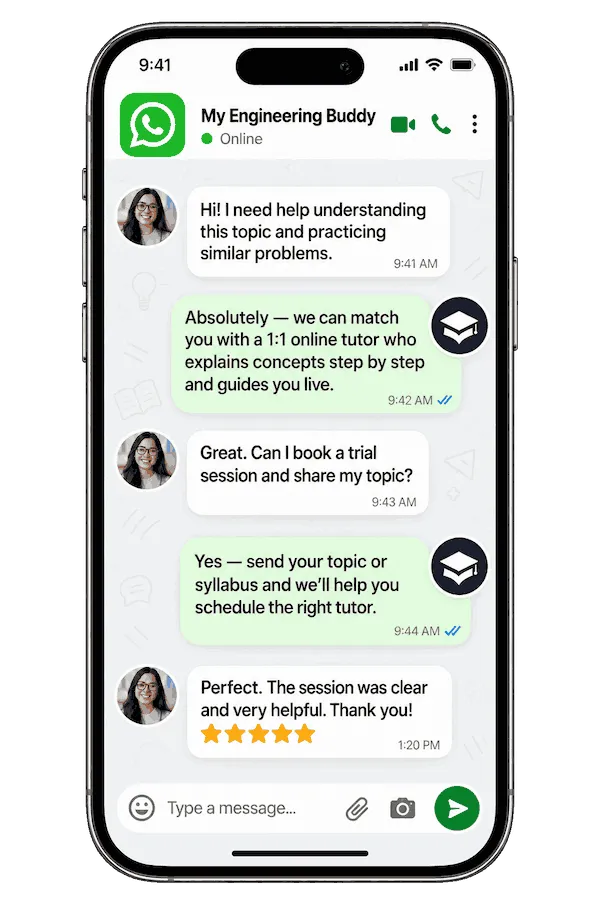
WhatsApp MEB for a quick quote — average response time under 1 minute.
Who This Mineralogy Tutoring Is For
Mineralogy sits at the intersection of chemistry, physics, and geology. Students find it harder than it looks on the syllabus — optical properties and crystallographic symmetry in particular catch people off guard. This tutoring is designed for students who need to close specific gaps, not just re-read notes.
- Undergraduate geology or earth science students struggling with crystal systems, mineral optics, or X-ray diffraction concepts
- Graduate students needing support with advanced mineralogical analysis for thesis work
- Students retaking after a failed first attempt at mineralogy lab practicals or written exams
- Students with a university conditional offer depending on their Earth Science grade
- Parents watching a student’s confidence drop as mineral identification labs pile up
- Students who need ethical homework and assignment guidance — understanding first, then submitting
MEB tutors have supported students at institutions including MIT, University of Michigan, University of Edinburgh, ETH Zurich, University of British Columbia, Imperial College London, and Australian National University.
1:1 Tutoring vs Self-Study vs AI vs YouTube vs Online Courses
Self-study works if you’re disciplined, but mineralogy requires live feedback when you misidentify a cleavage plane or misread a birefringence chart — a textbook can’t correct you in the moment. AI tools give fast explanations but can’t adapt to your specific thin section lab or diagnose whether you’re confusing uniaxial and biaxial interference figures. YouTube covers mineral identification overviews well but stops cold when you’re stuck on a specific gypsum vs calcite problem under crossed polars. Online courses are structured but move at a fixed pace, regardless of where your actual gap is. 1:1 tutoring with MEB is live, calibrated to your exact course, and corrects crystallographic errors the moment they appear — not after a grade comes back.
Outcomes: What You’ll Be Able To Do in Mineralogy
After working with an MEB Mineralogy tutor, students can solve mineral identification problems using physical properties like hardness, cleavage, and streak without hesitation. They can analyze optical properties under the petrographic microscope — including pleochroism, extinction angles, and interference figures for uniaxial and biaxial minerals. Students learn to apply crystal symmetry concepts to interpret X-ray diffraction patterns and explain the relationship between crystal structure and physical behaviour. They can write accurate mineral descriptions for lab reports and present crystallographic data in the format their examiner expects.
Based on feedback from 40,000+ sessions collected by MEB from 2022 to 2025, 58% of students improved by one full grade after approximately 20 hours of 1:1 tutoring in subjects like Mineralogy. A further 23% achieved at least a half-grade improvement.
Source: MEB session feedback data, 2022–2025.
Supporting a student through Mineralogy? MEB works directly with parents to set up sessions, track progress, and keep coursework on schedule. WhatsApp MEB — average response time is under a minute, 24/7.
Try your first session for $1 — 30 minutes of live 1:1 tutoring or one homework question explained in full. No registration. No commitment. WhatsApp MEB now and get matched within the hour.
What We Cover in Mineralogy (Syllabus / Topics)

Track 1: Crystal Chemistry and Crystallography
- Crystal systems, lattice types, and space groups
- Symmetry elements: rotation axes, mirror planes, inversion centres
- Ionic radii, coordination number, and crystal structure prediction
- Silicate mineral structures: nesosilicates through tectosilicates
- X-ray diffraction: Bragg’s law, powder and single-crystal methods
- Unit cell determination and Miller indices
- Solid solution series and isomorphism
Core texts: Klein & Dutrow Manual of Mineral Science; Nesse Introduction to Mineralogy; Putnis Introduction to Mineral Sciences.
Track 2: Physical and Optical Mineralogy
- Physical properties: hardness (Mohs scale), cleavage, fracture, lustre, streak, specific gravity
- Diagnostic mineral identification using hand specimen and binocular microscope
- Optical theory: refractive index, birefringence, pleochroism
- Uniaxial and biaxial minerals: optic sign, optic axial angle (2V), interference figures
- Plane-polarised and crossed-polars petrographic microscope techniques
- Mineral colour, dispersion, and absorption spectra
- Common ore minerals and their optical characteristics in reflected light
Core texts: Nesse Introduction to Optical Mineralogy; MacKenzie & Guilford Atlas of Rock-Forming Minerals in Thin Section; Deer, Howie & Zussman Rock-Forming Minerals.
Track 3: Mineral Groups, Geochemistry, and Applied Mineralogy
- Systematic mineralogy: oxides, carbonates, sulfides, phosphates, halides, native elements
- Feldspar, pyroxene, amphibole, mica, and olivine groups in depth
- Clay minerals and their identification challenges
- Mineral stability diagrams and phase equilibria
- Trace element partitioning and mineral geochemistry
- Applied mineralogy: ore deposit minerals, industrial minerals, environmental mineralogy
Core texts: Wenk & Bulakh Minerals: Their Constitution and Origin; Deer, Howie & Zussman An Introduction to the Rock-Forming Minerals; Cawthorn Layered Intrusions.
What a Typical Mineralogy Session Looks Like
The tutor opens by checking your work from the previous session — usually a thin section description or a crystal symmetry problem set. From there, you and the tutor work through the current sticking point on screen: for example, determining whether a mineral is uniaxial positive or negative from an interference figure, or calculating d-spacings from an XRD trace. The tutor uses a digital pen-pad to annotate diagrams, draw crystal structures, and walk through extinction angle measurements step by step. You replicate each step and explain your reasoning back — that’s where the actual learning locks in. The session closes with a specific practice task: describe three minerals from a provided thin section image before the next session, with the next topic (say, feldspar twinning or amphibole identification) already queued.
How MEB Tutors Help You with Mineralogy (The Learning Loop)
Diagnose: In the first session, the tutor identifies exactly which concepts are causing marks to drop — whether that’s confusing monoclinic and triclinic symmetry, struggling with biaxial interference figures, or losing points on systematic mineralogy descriptions. This shapes every session that follows.
Explain: The tutor works through live problems on screen using a digital pen-pad — drawing crystal lattices, annotating thin section images, and stepping through optical property calculations in real time. Nothing is assumed. Every step is shown.
Practice: You attempt problems with the tutor present, not after the session ends. This is where the gaps show up. The tutor catches errors in reasoning before they become habits.
At MEB, we’ve found that students in Mineralogy don’t usually fail because they haven’t studied hard enough. They fail because no one ever showed them how to read an interference figure properly — and they’ve been guessing since week three.
Feedback: The tutor explains precisely where marks were lost and why — whether you misidentified extinction angle type, applied the wrong optical sign rule, or described a mineral group incorrectly. Feedback is step-by-step, not a summary grade.
Plan: After each session, the tutor maps the next topic and sets the sequence — so you’re always building on what was fixed, not jumping around. Accountability is built in.
Sessions run over Google Meet. The tutor uses a digital pen-pad or iPad with Apple Pencil. Before your first session, share your course outline or module guide, a recent lab report or exam question you struggled with, and your deadline or exam date. The first session covers your diagnostic and starts working immediately. Whether you need a quick catch-up before a lab practical, structured revision over four to six weeks, or ongoing weekly support through the semester, the tutor maps the session plan after that first diagnostic. Start with the $1 trial — 30 minutes of live tutoring that also serves as your first diagnostic.
Students consistently tell us that the petrographic microscope section of Mineralogy — specifically interference figures and extinction angles — accounts for more lost marks than any other single topic. One session on this usually turns it around.
Source: My Engineering Buddy, tutor feedback summary, 2022–2025.
Tutor Match Criteria (How We Pick Your Tutor)
Not every geology tutor knows optical mineralogy well enough to teach it. MEB matches on specifics, not broad subject area.
Subject depth: Tutors are matched to your exact level — introductory mineral identification, advanced crystallography, or graduate-level mineralogical analysis for thesis work. A tutor who teaches Petrology tutoring alongside Mineralogy is flagged; one who only knows general geology is not assigned.
Tools: Every session uses Google Meet plus a digital pen-pad or iPad and Apple Pencil — essential for annotating thin section images and drawing crystal structures live.
Time zone: Matched to your region — US, UK, Gulf, Canada, or Australia. No 3 a.m. compromises.
Goals: Exam performance, lab report quality, conceptual understanding for a research project, or homework completion — the tutor is matched to what you actually need.
Unlike platforms where you fill out a form and wait, MEB responds in under a minute, 24/7. Tutor match takes under an hour. The $1 trial means you test before you commit. Everything runs over WhatsApp — no logins, no intake forms.
Study Plans (Pick One That Matches Your Goal)
The right plan depends on how much time you have and what specifically needs fixing. Catch-up (1–3 weeks): for students behind on crystal systems, optical properties, or mineral identification before a practical exam. Exam prep (4–8 weeks): structured revision covering all syllabus tracks, with past paper and lab report practice built in. Weekly support: ongoing sessions aligned to your semester schedule and coursework deadlines, so nothing piles up. The tutor builds the specific session sequence after the diagnostic — not before.
Pricing Guide
Mineralogy tutoring starts at $20/hr for introductory undergraduate level. Graduate-level optical mineralogy and advanced crystallographic analysis typically run $50–$100/hr depending on depth and tutor background. Rate factors include level, topic complexity, how tight your timeline is, and tutor availability.
Availability tightens during university exam periods and lab submission windows — particularly in November and April. Book ahead if you’re within a month of a deadline.
For students targeting top geoscience programmes at institutions like ETH Zurich, University of Edinburgh, or Caltech, tutors with active research or industry backgrounds in mineralogy and materials science are available at higher rates. Share your specific goal and MEB will match you to the right tier.
Start with the $1 trial — 30 minutes, no registration, no commitment. WhatsApp MEB for a quick quote.
A common pattern our tutors observe is this: students put off booking until two weeks before the exam, then need double the sessions to cover the same ground. The earlier you start, the less it costs — in time and money.
FAQ
Is Mineralogy hard?
It’s harder than most students expect. Crystal symmetry and optical mineralogy — especially interference figures — are the two points where grades consistently drop. With targeted 1:1 support on those specific topics, most students find they catch up quickly.
How many sessions are needed?
Most students see a clear improvement within four to six sessions of focused work. Students aiming to cover the full syllabus before a written exam or lab practical typically book eight to twelve sessions spread over four to six weeks.
Can you help with homework and assignments?
Yes. MEB tutoring is guided learning — you understand the work, then submit it yourself. This applies to mineral identification labs, thin section descriptions, crystallography problem sets, and written assignments. See our Academic Integrity policy and Why MEB page for full details on what we help with and what we don’t.
Will the tutor match my exact syllabus or exam board?
Yes. Before matching, MEB asks for your institution, module code or course name, and any specific topics you’re assessed on. The tutor is selected based on that information — not assigned from a generic geology pool.
What happens in the first session?
The first session is a diagnostic. The tutor identifies exactly where your understanding breaks down, which topics are affecting your marks most, and how many sessions you realistically need. Work begins in the same session — no separate intake process.
Is online tutoring as effective as in-person?
For Mineralogy, yes — with the right tools. Thin section images, crystal structure diagrams, and XRD traces are all shared and annotated on screen. The digital pen-pad replicates the whiteboard experience. Students in the Gulf, Canada, and Australia use MEB without any disadvantage compared to local options.
Can I get Mineralogy help at midnight or on weekends?
Yes. MEB operates across multiple time zones and tutors are available outside standard business hours, including late evenings and weekends. WhatsApp is the fastest way to check availability — responses typically come back within a minute.
What if I don’t get on with my assigned tutor?
Request a replacement via WhatsApp. MEB will rematch you with a different tutor, usually within the same day. The $1 trial exists precisely so you can test the fit before committing to a full session plan.
Do you offer help specifically with the petrographic microscope lab component?
Yes. Optical mineralogy under the petrographic microscope — including plane-polarised light properties, crossed-polars analysis, interference figures, and extinction angle measurement — is one of the most requested topics on the Mineralogy programme. Tutors work through real thin section images with you on screen.
What’s the difference between Mineralogy and Petrology, and do I need both?
Mineralogy focuses on individual minerals: their structure, properties, and identification. Geochemistry tutoring and Geology help often overlap with both. If your module covers rock-forming mineral assemblages in igneous, sedimentary, or metamorphic contexts, you likely need Petrology support alongside Mineralogy — MEB covers both.
How do I get started?
Start with the $1 trial: 30 minutes of live tutoring or one Mineralogy question explained in full. Three steps: WhatsApp MEB → get matched with a verified Mineralogy tutor → start your trial session. That’s the entire process.
Trust & Quality at My Engineering Buddy
Every MEB tutor is screened before being assigned to any student. Screening includes subject-specific vetting, a live demo session evaluated by senior staff, and ongoing review of session feedback. Tutors hold degrees in geology, earth sciences, or materials science — many have postgraduate qualifications or professional research experience in mineralogy specifically. Rated 4.8/5 across 40,000+ verified reviews on Google. That number reflects 18 years of consistent delivery, not a recent surge.
MEB tutoring is guided learning — you understand the work, then submit it yourself. For full details on what we help with and what we don’t, read our Academic Integrity policy and Why MEB.
MEB has served 52,000+ students across the US, UK, Canada, Australia, the Gulf, and Europe since 2008, covering 2,800+ subjects. Earth Science is one of the strongest subject families on the platform — with specialist tutors in Mineralogy, Petrology, and Geophysics. If your department covers any Earth Science module, MEB has a tutor who has taught it before. See how MEB structures sessions at our tutoring methodology page.
Students consistently tell us that finding a tutor who actually knows the difference between the Becke line test and the relief method — and can explain it live on screen — is what makes MEB different from a general science tutor service.
Explore Related Subjects
Students studying Mineralogy often also need support in:
Next Steps
Here’s what to do now:
- Share your exam board or module name, the topics causing the most trouble, and your exam or lab deadline
- Share your availability and time zone — MEB will match you with a verified Mineralogy tutor, usually within 24 hours
- Your first session starts with a diagnostic so every minute is used on what actually matters
Before your first session, have ready: your course outline or module guide, a recent past paper attempt or lab report you struggled with, and your exam or submission deadline date. The tutor handles the rest.
Visit www.myengineeringbuddy.com for more on how MEB works. Then take the first step: WhatsApp to get started or email [email protected].
Reviewed by Subject Expert
This page has been carefully reviewed and validated by our subject expert to ensure accuracy and relevance.




