~1 min
Average Reply Time
~1 hour
To Be Matched With A Tutor
30 Min Trial
75% Find Their Tutor On The 1st Trial
$20-35+/hr
Premium Yet Affordable Learning
Hire The Best Industrial Automation Tutor






PLCs won’t ladder-program themselves — and a course that moves on before you’ve grasped feedback control will cost you weeks.
Industrial Automation Tutor Online
Industrial Automation is the application of control systems — PLCs, SCADA, DCS, and sensor networks — to operate industrial processes with minimal human intervention, equipping engineers to design, commission, and troubleshoot automated manufacturing and process systems.
MEB offers 1:1 online tutoring and homework help in 2800+ advanced subjects, including Industrial Automation. Whether you’re searching for an Industrial Automation tutor near me or need live online help with ladder logic, PID tuning, or SCADA configuration, a verified MEB tutor works through your exact course material with you — no fixed syllabus, no waiting for the next lecture. Part of a wider set of Electrical Engineering tutoring programmes at MEB, Industrial Automation support is available across US, UK, Canada, Australia, and Gulf time zones.
- 1:1 online sessions tailored to your course syllabus — university module or industry certification
- Expert-verified tutors with hands-on PLC, SCADA, and control systems experience
- Flexible time zones — US, UK, Canada, Australia, Gulf covered
- Structured learning plan built after a diagnostic session
- Ethical homework and assignment guidance — you understand the work, then submit it yourself
52,000+ students across the US, UK, Canada, Australia, and the Gulf have used MEB since 2008 — including students in Electrical Engineering subjects like Industrial Automation, Control Systems, and Instrumentation and Control Engineering.
Source: My Engineering Buddy, 2008–2025.
How Much Does an Industrial Automation Tutor Cost?
Most Industrial Automation tutoring sessions run at $20–$40/hr. Graduate-level PLC programming, SCADA architecture, or advanced process control goes up to $100/hr depending on the tutor’s industry background. Not sure if it’s worth it? Start with the $1 trial and judge from the first session.
| Level / Need | Typical Rate | What’s Included |
|---|---|---|
| Standard (undergraduate modules) | $20–$35/hr | 1:1 sessions, homework guidance |
| Advanced / Specialist (DCS, SCADA, PID design) | $35–$70/hr | Expert tutor, industry-depth coverage |
| Graduate / Niche certification | Up to $100/hr | Research-level or certification-specific support |
| $1 Trial | $1 flat | 30 min live session or 1 homework question explained |
Availability tightens at the end of semester and during professional certification windows. Book early if you have a fixed deadline.
WhatsApp MEB for a quick quote — average response time under 1 minute.
Who This Industrial Automation Tutoring Is For
Industrial Automation sits at the overlap of electrical engineering, control theory, and software — which means confusion can come from any direction. Students hit walls at different points: ladder logic syntax, closed-loop PID tuning, SCADA tag databases, or sensor calibration.
- Undergraduate electrical or mechatronics engineering students covering PLCs, SCADA, or DCS modules
- Graduate students working on process control, automation design projects, or thesis research
- Students retaking after a failed first attempt who need gaps closed fast before resitting
- Students 4–6 weeks from an exam with significant gaps in control loop design or fieldbus protocols still to close
- Engineers pursuing ISA (International Society of Automation) or IEC 61511 functional safety certifications
- Students needing guided control systems homework help alongside their automation module
Students in this subject typically progress toward roles at automation integrators, process industries, or advanced study at universities such as MIT, Georgia Tech, ETH Zurich, Imperial College London, and Delft University of Technology.
1:1 Tutoring vs Self-Study vs AI vs YouTube vs Online Courses
Self-study works if you’re disciplined, but there’s no one to catch a wrong assumption about closed-loop stability before it runs through three more assignments. AI tools explain concepts quickly but can’t watch you build a ladder logic rung and tell you exactly where the scan cycle logic breaks. YouTube is useful for getting an overview of a Siemens S7 PLC, but it stops the moment your specific configuration throws an error. Online courses are structured — fixed pace, no personalisation, no room for your actual lab setup. 1:1 tutoring with MEB is live, adjusted to your exact module or certification, and corrects errors in real time before they compound. In Industrial Automation especially, where a misunderstood interlock can cascade, that correction speed matters.
Outcomes: What You’ll Be Able To Do in Industrial Automation
After targeted 1:1 sessions, you’ll be able to design and interpret ladder logic diagrams for sequential process control, analyze closed-loop PID response and apply tuning methods like Ziegler-Nichols to real plant scenarios, configure SCADA HMI screens with correct tag mapping and alarm management, explain DCS architecture and the role of function blocks in a distributed process environment, and apply IEC 61131-3 programming standards across structured text, function block diagram, and sequential function chart languages. These are not abstract concepts — they’re the skills that come up in project submissions, viva examinations, and on the job.
Based on feedback from 40,000+ sessions collected by MEB from 2022 to 2025, 58% of students improved by one full grade after approximately 20 hours of 1:1 tutoring in subjects like Industrial Automation. A further 23% achieved at least a half-grade improvement.
Source: MEB session feedback data, 2022–2025.
At MEB, we’ve found that Industrial Automation students who struggle with PID tuning almost always have the same root problem — they were taught the formula before they understood what error, integral windup, and derivative kick actually represent in a physical system. Fix that, and the math clicks fast.
What We Cover in Industrial Automation (Syllabus / Topics)

PLC Programming and Ladder Logic
- IEC 61131-3 programming languages: LD, FBD, ST, IL, SFC
- Ladder logic design for sequential and combinational control
- Timers, counters, and data handling in Siemens S7 and Allen-Bradley PLCs
- Scan cycle operation, input/output addressing, and memory organisation
- Interlocking logic and fail-safe design principles
- Structured Text programming for arithmetic and loop control
- Fault diagnosis and program debugging techniques
Core references: Bolton, Programmable Logic Controllers (5th ed.); Petruzella, Programmable Logic Controllers (5th ed.); Siemens S7-1200 System Manual.
SCADA, DCS, and Process Control Systems
- SCADA architecture: RTUs, MTUs, communication protocols (Modbus, DNP3, OPC)
- HMI design: tag databases, alarm management, and trending displays
- Distributed Control System (DCS) function block programming
- Process control loop design: P, PI, PID, cascade, and feedforward control
- Ziegler-Nichols and Cohen-Coon PID tuning methods
- Control valve sizing, actuator selection, and final control element characteristics
- Safety instrumented systems (SIS) and IEC 61511 functional safety basics
Core references: Shinskey, Process Control Systems; Coughanowr, Process Systems Analysis and Control; Smith & Corripio, Principles and Practice of Automatic Process Control.
Sensors, Instrumentation, and Industrial Networks
- Measurement principles: pressure, temperature, flow, and level sensors
- Sensor calibration, accuracy, repeatability, and error analysis
- 4–20 mA current loops, HART protocol, and digital fieldbus standards
- Industrial Ethernet, PROFIBUS, PROFINET, and EtherNet/IP architectures
- instrumentation and control engineering integration with automation systems
- Signal conditioning, noise rejection, and grounding practices
- Pneumatic and hydraulic actuator control basics
Core references: Lipták, Instrument Engineers’ Handbook; Bentley, Principles of Measurement Systems; Hughes, Electrical and Electronic Technology.
Students consistently tell us that the part of Industrial Automation that feels most abstract at first — fieldbus protocol selection and network topology — becomes concrete the moment they see a real PLC I/O configuration and trace which signal goes where. We replicate that in sessions using annotated diagrams on a digital pen-pad.
Platforms, Tools & Textbooks We Support
Industrial Automation is heavily software-driven. MEB tutors can work with you across the tools your course or employer actually uses:
- Siemens TIA Portal (S7-1200, S7-1500)
- Rockwell Studio 5000 / RSLogix (Allen-Bradley PLCs)
- MATLAB / Simulink for control loop modelling and PID simulation
- LabVIEW for data acquisition and real-time control
- Ignition SCADA (Inductive Automation) and Wonderware InTouch
- Arduino programming for low-cost prototyping and sensor interfacing
- AutoCAD Electrical for panel wiring diagrams
What a Typical Industrial Automation Session Looks Like
The tutor opens by reviewing what was covered last time — usually a specific topic like PID tuning or SCADA tag configuration — and asks you to explain it back briefly to check retention. Then you move to the current problem: say, a malfunctioning interlock in a ladder logic program or a control loop that overshoots badly on a Simulink simulation. The tutor uses a digital pen-pad to annotate the ladder rung or draw the process flow diagram while you work through the logic together. You’re expected to replicate the reasoning or rewrite the rung yourself. By the end of a session, you’ll have a concrete practice task — a specific ladder logic exercise or a PID simulation to tune — and the next topic is agreed before you close.
How MEB Tutors Help You with Industrial Automation (The Learning Loop)
Diagnose: In the first session, the tutor identifies exactly where your understanding breaks down — whether that’s scan cycle logic, the difference between a P-only and a PI controller, or why your SCADA alarm keeps triggering false positives. They don’t guess. They ask you to work through a problem live and watch where you slow down.
Explain: The tutor works through a solved example on a digital pen-pad — annotating a ladder diagram, drawing a Bode plot, or tracing a signal through a 4–20 mA loop — so you see the reasoning, not just the answer. For control engineering concepts like root locus or state-space representation, this visual approach makes a real difference.
Practice: You attempt the next problem while the tutor watches. This is the part most students skip when studying alone. Errors surface here — and catching them before submission is the whole point.
Feedback: The tutor goes through each mistake step by step — not just marking it wrong, but explaining which assumption broke and how to correct it. If you lost marks on a previous assignment, the tutor can work through that feedback with you too.
Plan: At the end of each session, the tutor notes your progress, sets a specific practice task, and maps the next topic. That accountability keeps the pace up between sessions.
Sessions run over Google Meet. The tutor uses a digital pen-pad or iPad with Apple Pencil. Before your first session, share your module outline or course syllabus, any past assignments where you lost marks, and your exam or submission deadline. The first session starts with a diagnostic — so every minute is used well. Start with the $1 trial — 30 minutes of live tutoring that also serves as your first diagnostic.
MEB tutors bring industrial background — not just academic knowledge. Students working on PLC commissioning assignments or SCADA design projects get guidance from tutors who have actually built these systems, not just taught from a textbook.
Source: My Engineering Buddy tutor selection criteria, 2024.
Tutor Match Criteria (How We Pick Your Tutor)
Not every engineer who knows Industrial Automation can teach it. MEB’s matching process filters on four things specifically.
Subject depth: The tutor must have hands-on experience with your specific syllabus level — undergraduate module, graduate research, or professional certification — and ideally with the exact PLC platform or DCS your course uses.
Tools: Every tutor works on Google Meet with a digital pen-pad or iPad and Apple Pencil. No blurry webcam pointing at a whiteboard.
Time zone: Matched to your region — US, UK, Gulf, Canada, or Australia — so sessions happen at a time that doesn’t ruin your sleep schedule.
Goals: Whether you need exam preparation, help with a specific distributed control systems (DCS) assignment, or ongoing weekly support through the semester, the match reflects that.
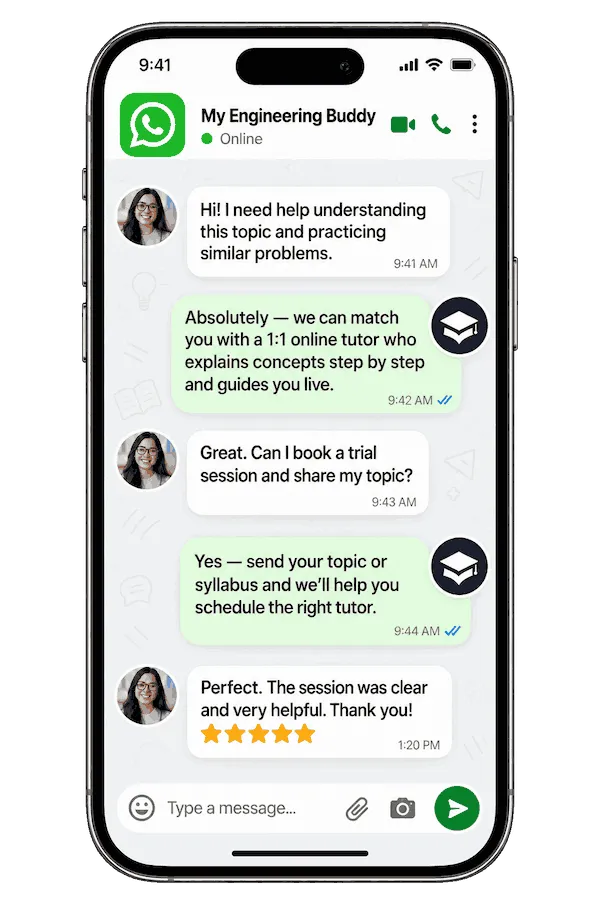
Unlike platforms where you fill out a form and wait, MEB responds in under a minute, 24/7. Tutor match takes under an hour. The $1 trial means you test before you commit. Everything runs over WhatsApp — no logins, no intake forms.
Study Plans (Pick One That Matches Your Goal)
After the diagnostic session, your tutor builds the plan. Three common structures: a catch-up plan (1–3 weeks) for students who are behind on ladder logic or control loop theory and need gaps closed before a submission; an exam prep plan (4–8 weeks) that works through past papers, weak topics, and timed practice systematically; and ongoing weekly support aligned to your lecture schedule, where the tutor covers each new topic before your next tutorial or lab session so you’re always ahead rather than catching up. The tutor sequences this specifically after seeing your module outline and current progress.
Pricing Guide
Industrial Automation tutoring starts at $20/hr for standard undergraduate-level work. Advanced topics — DCS architecture, functional safety (IEC 61511), or real-time control with Simulink — typically run $35–$70/hr. Graduate-level or highly niche certification support goes up to $100/hr.
Rate factors: your level, topic complexity, timeline urgency, and tutor availability. Availability tightens at semester end and before professional certification exam windows.
For students targeting competitive graduate programmes or industry roles at companies like Siemens, Honeywell, ABB, or Emerson, tutors with direct industry experience in process automation are available at higher rates — share your specific goal and MEB matches the tier to your ambition.
Start with the $1 trial — 30 minutes, no registration, no commitment. WhatsApp MEB for a quick quote.
FAQ
Is Industrial Automation hard?
It is genuinely multi-disciplinary — you need electrical theory, programming logic, and control mathematics all at once. Students who struggle usually hit one specific wall: PID tuning, IEC 61131-3 syntax, or fieldbus protocols. Identifying that wall early is what makes tutoring effective.
How many sessions do I need?
Most students with a specific gap — one topic, one assignment type — see clear progress in 3–5 sessions. Broader exam preparation or certification support works better over 8–12 sessions. The tutor gives a realistic estimate after the first diagnostic session.
Can you help with Industrial Automation homework and assignments?
Yes. MEB tutoring is guided learning — you understand the work, then submit it yourself. The tutor explains the concept, works through a similar example, and guides your reasoning. See our Academic Integrity policy and Why MEB page for full details on what we help with and what we don’t.
Will the tutor match my exact syllabus or exam board?
Yes. Before the first session, you share your module outline, course code, or certification body. The tutor aligns to that — whether it’s a university module at Georgia Tech, an ISA-based certification, or a specific IEC 61131-3 programming standard your course requires.
What happens in the first session?
The tutor runs a short diagnostic — asks you to explain a concept or work through a problem live — to locate exactly where your understanding breaks down. Then they begin structured teaching from that point. You leave with a clear plan and a specific practice task.
Is online tutoring as effective as in-person for Industrial Automation?
For theory, control loop analysis, and programming — yes. The digital pen-pad replicates the whiteboard. The one limitation is physical hardware: you can’t hold a PLC over a screen. Tutors use annotated screenshots and simulation environments like Siemens TIA Portal or MATLAB to bridge that gap effectively.
What is the difference between PLC and DCS, and which should I focus on?
PLCs handle discrete, fast-switching tasks — motor control, conveyor interlocks. DCS systems manage continuous processes — chemical plants, refineries, power generation. Your course or job target determines the focus. Most undergraduate modules cover both; your tutor will confirm which topics your syllabus weights most heavily.
Can MEB help me with Siemens TIA Portal or Allen-Bradley RSLogix specifically?
Yes. MEB has tutors with hands-on experience in both platforms. Share which PLC software your course uses when you first contact MEB — the tutor match accounts for that. Sessions can work through actual program files you’re developing, not just textbook examples.
Can I get Industrial Automation help at midnight or on weekends?
Yes. MEB operates across time zones 24/7. Students in the Gulf, Australia, and the US regularly book late-night or weekend sessions. WhatsApp MEB at any hour — average response time is under a minute regardless of when you message.
Do you offer group Industrial Automation sessions?
No. All MEB sessions are 1:1 — that is the model. A group session means the tutor adapts to the average, not to your specific gap. Industrial Automation involves enough individual variation in course content and software tools that a shared session rarely serves everyone in it well.
How do I get started?
WhatsApp MEB, share your syllabus or course outline, and MEB matches you with a tutor — usually within the hour. Start with the $1 trial: 30 minutes of live 1:1 tutoring or one homework question explained in full. No registration required.
Trust & Quality at My Engineering Buddy
Every MEB tutor goes through a subject-specific vetting process: they submit qualifications, complete a live demo session evaluated by MEB, and receive ongoing feedback ratings from students after every session. Tutors for Industrial Automation are selected for both academic depth and practical experience — the subject involves real industrial systems, and a tutor who has only read about SCADA is not the same as one who has configured it. Rated 4.8/5 across 40,000+ verified reviews on Google. MEB has been operating since 2008 and has served 52,000+ students across the US, UK, Canada, Australia, the Gulf, and Europe.
MEB tutoring is guided learning — you understand the work, then submit it yourself. For full details on what we help with and what we don’t, read our Academic Integrity policy and Why MEB.
MEB covers 2,800+ subjects across Electrical Engineering and adjacent disciplines. Students working on Industrial Automation often also need support in Sensors and Actuators, Embedded Systems, and Signals and Systems — all covered by the same platform with the same matching process. See our tutoring methodology for how sessions are structured across subjects. For further background on control systems education resources, MIT OpenCourseWare covers foundational material at MIT OpenCourseWare — Feedback Systems, and IEEE Spectrum publishes current developments in automation technology at IEEE Spectrum.
Explore Related Subjects
Students studying Industrial Automation often also need support in:
- Power Electronics
- Embedded C Programming
- Microcontrollers
- Internet of Things (IoT)
- FPGA Design
- Electrical Machines
- VHDL
Next Steps
Getting started takes about two minutes.
- Share your exam board or module code, the topics giving you the most trouble, and your exam or submission deadline
- Share your availability and time zone
- MEB matches you with a verified Industrial Automation tutor — usually within 24 hours
Before your first session, have ready: your course syllabus or module outline, a recent past paper attempt or homework question you struggled with, and your exam or deadline date. The tutor handles everything else.
Try your first session for $1 — 30 minutes of live 1:1 tutoring or one homework question explained in full. No registration. No commitment.
WhatsApp MEB now and get matched within the hour.
Visit www.myengineeringbuddy.com for more on how MEB works. Or email [email protected] if WhatsApp isn’t convenient. WhatsApp to get started or email [email protected].
18 years. 52,000+ students. A 4.8/5 rating built one session at a time. MEB has stayed the same size on purpose — because the model only works when the tutor match is right and the student gets real attention, not a call centre response.
Source: My Engineering Buddy, 2008–2025.
A common pattern our tutors observe is this: students who arrive with three weeks left before their Industrial Automation exam and say “I just need help with PID” actually need help with the underlying transfer function theory first. Fixing the root saves more time than patching the symptom.
Reviewed by Subject Expert
This page has been carefully reviewed and validated by our subject expert to ensure accuracy and relevance.